Books

You are currently browsing the archive for the Books category.

Grover Lewis' writing feels like sort of a mixed-bag to me, intermittently soaring but very uneven.

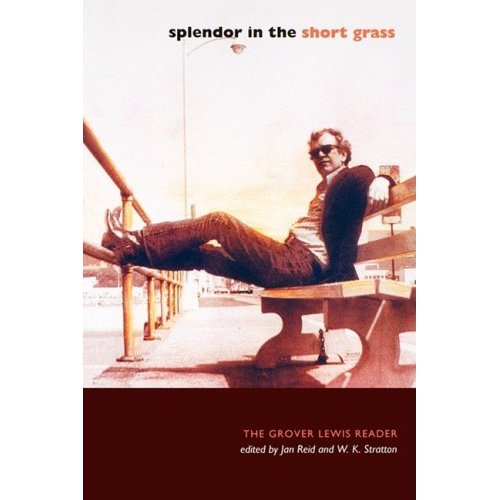
Grover Lewis was a prominent New Journalism writer of the 1960s and 1970s, probably best known for his Rolling Stone on-location pieces in which he ensconced himself on film sets and gave readers a behind-the-scenes look at how Sam Peckinpah and John Huston, among others, got their work done. He also had a taste for the film business’s fascinating fringe characters.

Lewis passed away in 1995 while in the midst of writing his memoirs. Unlike many of his contemporaries, Lewis is all but forgotten, despite the existence of a handsome collection of his work, Splendor in the Short Grass, which was published by the University of Texas Press in 2005. The book contains a piece taken from his uncompleted memoirs, in which Lewis recalls the tragic circumstances of how he lost both his parents while he was eight years old. An excerpt from “Goodbye If You Call That Gone”:

“History and legend bind us to the past, along with unquenchable memory.

In the spring of 1943, my parents–Grover Lewis, a truck driver, and Opal Bailey Lewis, a hotel waitress–shot each other to death with a pawnshop pistol. For most of a year, Big Grover had stalked my mother, my four-year-old sister, and me across backwater Texas, resisting Opal’s decision to divorce him. When she finally did and when he finally cornered her and pulled the trigger as he’d promised to do, she seized the gun and killed him, too.

A next-door neighbor of Opal’s–called ‘Dad’ North because of his advanced age–witnessed the mayhem shortly after dawn on a rainy Monday morning in May. Big Grover was twenty-seven years old, Opal twenty-six, and they’d been married for almost eleven years. My father survived for half a day without regaining consciousness, and died in the same charity hospital where I was born. Opal died where she fell, under a shadeless light bulb in the drafty old rooming house where she’d been living alone, and struggling to keep Titter and me in a nearby nursery school. No charges were filed, and a formal inquest was considered unnecessary since the police and the coroner’s office declared the case solved by mid-morning. My uncle Dubya Cee, Opal’s older brother, talked to one of the detectives involved and found out some additional information, which he shared only with the Bailey elders. Such, anyway, were the bare bones of the story as passed along in family history that soon blurred off into murky family legend. It was the sum of what I was allowed to know, although there remained to be answered, of course, questions I had not yet learned to ask.”
Tags:

"Miami" was originally spelled "Mayaimi."

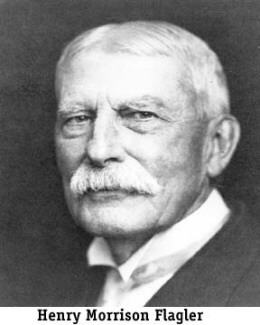
Henry Flagler dreamed the impossible dream and actually got to live it, if only for a while. A founding partner of Standard Oil, Flagler amassed amazing wealth by 1885 when he decided to transform Florida from swampland into an American Riviera. Soon, his grand hotels dotted places like St. Augustine and West Palm Beach, and he built the Florida East Coast Railroad, which extended all the way down to the city that would become Miami.

But in 1898 Flagler wanted more. To fulfill his plans, he would have to further extend the railroad from Biscayne Bay to Key West, which was roughly 125 miles off the coast. That would require a miracle of engineering. It didn’t happen overnight, but in 1912 Flagler’s Florida Overseas Railroad was completed. The visionary didn’t have much time to bask in his success, however. Flagler died the following year at 83 years old, after a fall in his home. In 1935, a hurricane destroyed the Key West railroad, which was never rebuilt.

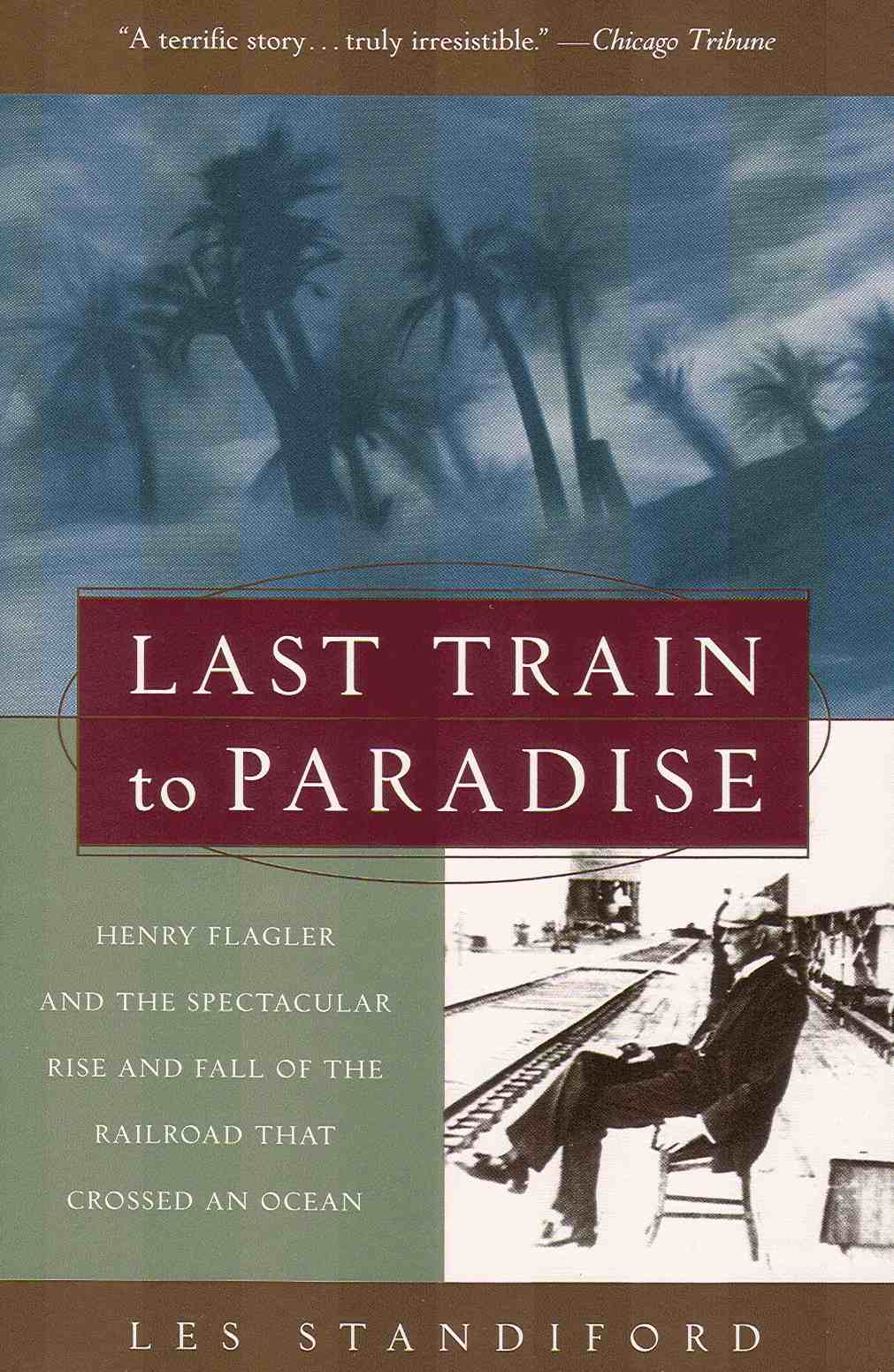
An excerpt from Lee Standiford’s Last Train to Paradise about the day the Florida Overseas Railroad opened:

“THE EIGHTH WONDER OF THE WORLD, headlines now bannered, such epithets as ‘Flagler’s Folly’ long forgotten. He had arrayed before him thousands of grateful citizens, along with a multitude of foreign dignitaries and government officials come to pay homage to what had been accomplished solely because of his vision and his unswerving devotion to that objective. Few people in history have accomplished so great a task or lived to experience such a moment as Flagler did.

The man he hired to bring his dream to fruition had died on the job and hundreds of other men had lost their lives as well, and despite all bromides otherwise, some weight of their passing had to have rested upon Flagler’s shoulders. Storms weathered, court fights fought, political enemies bested, impossible engineering problems solved, good men buried, rails joined at last. So many currents, so many thoughts and notions to meld and comprehend, after eighty-two years of life.

There’s no way to fathom how much of this had passed through his mind that day, but on his way off the platform Flagler placed a hand on Parrott‘s shoulder and whispered, ‘Now I can die happy. My dream is fulfilled.'”

Tags:

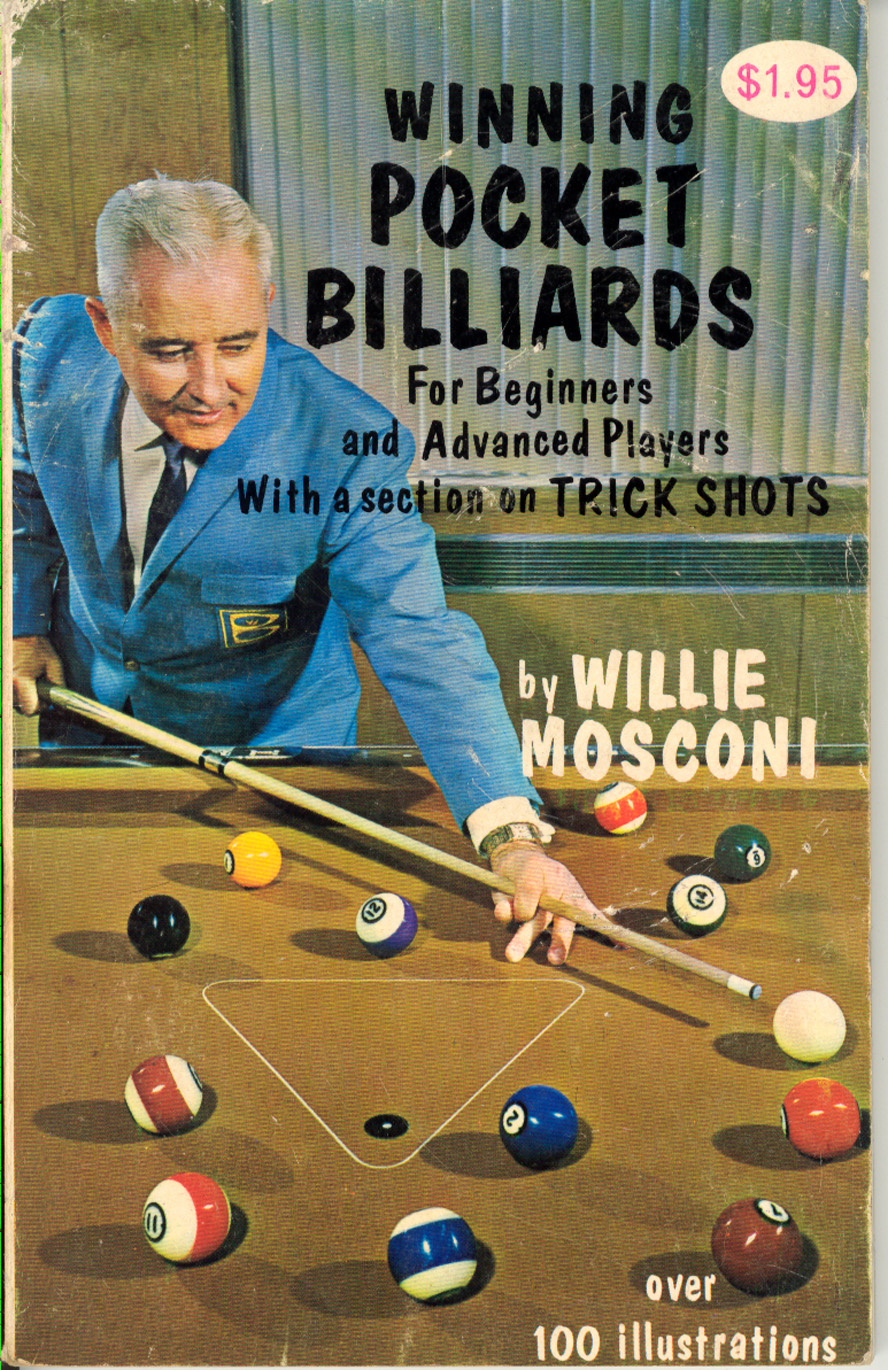
Before pro sports was a multi-billion-dollar business and athletes needed to be gigantic and juiced, a pool cue and incredible hand-eye coordination was sufficient to make someone a national star, even if they possessed a paunch and appeared unable to outrun a cigarette machine. Such was the case of Willie Mosconi, a working-class Philadelphia boy who displayed prodigious facility for the game from a tender age. Considered dapper by the modest standards of the pool hall, Mosconi was, along with fellow billiards wizard Minnesota Fats, one of the most famous “athletes” in America during the ’60s and ’70s.

Winning Pocket Billiards is a handsomely covered 1965 instructional book by Mosconi. There are a generous number of photos that show how to make the trick shots that Mosconi had mastered (as if) and a foreword that explains how he came to be so great at the game even though his father, who owned a pool hall, initially dreamed his son would become a great vaudeville performer. An excerpt:

“At the age of seven, Willie was launched on a round of exhibitions leading to a widely advertised match with another billiard prodigy, ten-year-old Ruth McGinnis. He won easily with a high run of 40. With the praise of an amazed audience still ringing in his ears, Willie ‘retired.’

As he tells it now, ‘I was disenchanted and confused. Earlier my dad had tried to prevent me from learning the game, and then he pushed me into it too fast.’

At the age of seventeen, the illness of both parents necessitated his leaving high school before graduation. In the Depression year of 1929, Willie became an upholsterer’s apprentice, starting at $8 a week and dexterously progressing to a piecework job for $40 per week before he was fired. He and his boss exchanged punches in disagreement over Willie’s request for a day off to watch the Athletics start winning the World Series.

Jobless and broke, Willie mustered courage, and revived a neglected touch at pool to enter and win a local tournament with a $75 first prize. He went on to finish third in the city championship that year. That might be the year that Willie cast the pattern of his life.”

___________________________

Mosconi showing off on I’ve Got a Secret, 1962:

Tags: ,

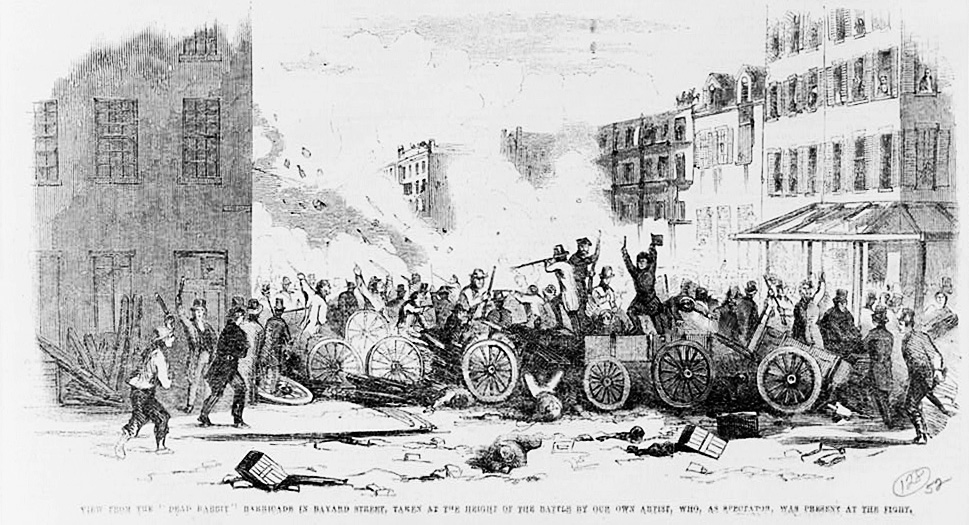
An 1857 illustration of the the Dead Rabbits battling the Bowery Boys.

In the raucous and often lawless Lower New York City of the nineteenth century, many a vicious gang was berthed in illicit groggeries stashed in the back rooms of corner groceries. But there wasn’t always honor among thieves and sometimes gangs splintered. In his great book, Low Life, Luc Sante relays how such a fragmenting led to the formation and naming of the Dead Rabbits. An excerpt:

“The Roach Guards, named after Ted Roach, the liquor dealer who backed them, suffered a factional dispute some time in the 1830s. During the argument a member of one feuding sector evidently threw a rabbit carcass into the assemblage of the other. These recognized a potent symbol when they saw one and hoisted the corpse as their banner. Henceforth they called themselves the Dead Rabbits, an epithet whose pungency was not diminished by the fact that in flash lingo ‘dead’ was an intensifier meaning ‘best’ and a ‘rabbit’ was a tough guy. Further distancing themselves from their former parent body, the Dead Rabbits sewed red stripes down the outer seams of their pants; the Roach Guards continued to sport blue ones.”

More Afflictor Luc Sante posts:

Tags: ,

"Some of the tenements managed to boast a saloon, brothel, or dance hall on every floor."

An excerpt about raffish pre-Civil War New York saloons from Luc Sante’s great book Low Life:

“The low-class Bowery dives just emerging featured a novelty: no glasses. Drinks, at three cents per, were served from barrels stacked behind the bar via thin rubber tubes, the stipulation being that the customer would drink all he wanted until he had to stop for a breath. Needless to say, there were many who developed deep lung capacity and tricks of circular respiration in order to outwit the system. In the decades before the Civil War the worst dives were located on the waterfront, and they traded with a highly elastic clientele of sailors. Sailors were free spenders, rootless, and halfway untraceable; they were marks of the first order. The street most overrun by sailors was Water Street, and there some of the tenements managed to boast a saloon, brothel, or dance hall on every floor. Notable were John Allen’s saloon-cum-whorehouse and Kit Burns’ Sportsmen Hall, which was an entire three-story building in which every variety of vice was pursued, but none so famous as its matches to the death between terriers and rats, held in a pit in its first-floor amphitheater, hence the resort’s more common name, the Rat Pit. Commerce was aided by the fact that, whether through fluke or graft, Kit Burns’s was the terminus for one of the early stage transit lines.”

Tags: , ,

Like a lot of people who move to New York to reinvent themselves, Jerzy Kosinksi was a tangle of fact and fiction that couldn’t easily be unknotted. He was lauded and reviled, labeled as brilliant and a plagiarist, called fascinating and a fraud. The truth, as usual, probably lies somewhere in between. Kosinski was a regular on talk shows, at book parties and at Plato’s Retreat. He acted in Reds and posed for magazine covers. But he was too haunted to be a bon vivant, and in 1991, the author committed suicide.

Kosinski did an interview with The Paris Review in 1972. He opined about what he felt was the ever-dwindling importance of written and verbal language. He was very concerned by how much people liked to watch. Since his death, the Internet has supplanted TV as the premium medium, allowing people to write and publish more words than ever before, though that hasn’t really halted our drift deeper into pictures.

An excerpt:

Question:

Since you often teach English, what is your feeling about the future of the written word?

Jerzy Kosinski

I think its place has always been at the edge of popular culture. Indeed, it is the proper place for it. Reading novels–serious novels, anyhow–is an experience limited to a very small percentage of the so-called enlightened public. Increasingly, it’s going to be a pursuit for those who seek unusual experiences, moral fetishists perhaps, people of heightened imagination, the troubled pursuers of the enlightened self.

Question:

Why such a limited audience?

Jerzy Kosinski:

Today, people are absorbed in the most common denominator, the visual. It requires no education to watch TV. It knows no age limit. Your infant child can watch the same program you do. Witness its role in the homes of the old and incurably sick. Television is everywhere. It has the immediacy which the evocative medium of language doesn’t. Language requires some inner triggering; television doesn’t. The image is ultimately accessible, i.e., extremely attractive. And, I think, ultimately deadly, because it tuns the viewer into a bystander. 

Of course, that’s a situation we have always dreamt of . . . the ultimate hope of religion was that it would release us from trauma. Television actually does so. It “proves” that you can always be an observer of the tragedies of others. The fact that one day you will die in front of the live show is irrelevant—you are reminded about it no more than you are reminded about real weather existing outside the TV weather program. You’re not told to open your window and take a look; television will never say that. It says, instead, “The weather today is . . .” and so forth. The weatherman never says, “If you don’t believe me, go find out.”

From way back, our major development as a race of frightened beings has been toward how to avoid facing the discomfort of our existence, primarily the possibility of an accident, immediate death, ugliness, and the ultimate departure. In terms of all this, television is a very pleasing medium: one is always the observer. The life of discomfort is always accorded to others, and even this is disqualified, since one program immediately disqualifies the preceding one. Literature does not have this ability to soothe. You have to evoke, and by evoking, you yourself have to provide your own inner setting. When you read about a man who dies, part of you dies with him because you have to recreate his dying inside your head.

Question:

That doesn’t happen with the visual?

Jerzy Kosinski:

No, because he dies on the screen in front of you, and at any time you can turn it off or select another program. The evocative power is torpedoed by the fact that this is another man; your eye somehow perceives him as a visual object. Thus, of course, television is my ultimate enemy and it will push reading matter—including The Paris Review—to the extreme margin of human experience.•

Tags: , ,

From dust jacket flap: "This book is a tribute to some of America's greatest characters, people holding on to unique ways of life at all costs."

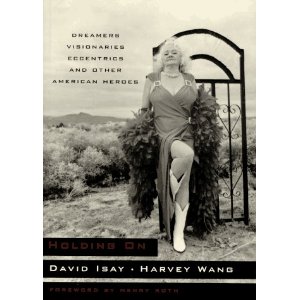
When I recently put up a post about Harvey Wang, it reminded me that in my whole life in New York City, I have only been the victim of theft one time and the stolen item was an excellent 1996 book called Holding On: Dreamers, Visionaries, Eccentrics and Other American Heroes, which Wang co-created with David Isay. I believe my house painter nicked it several years back when I left him alone in the apartment for a couple of hours.

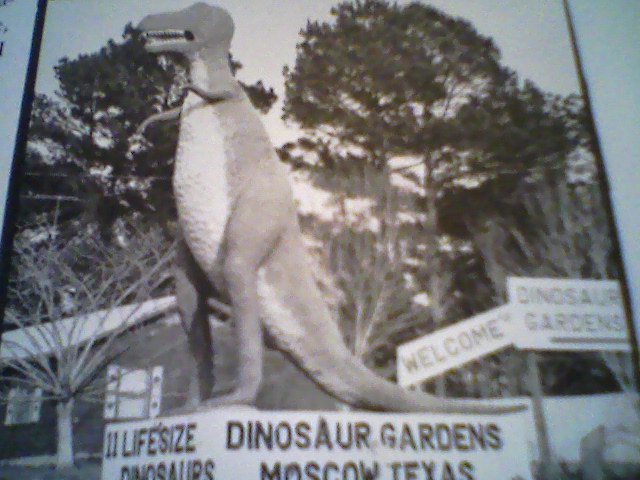
The book, about eccentric Americans (snake handlers, coon-dog graveyard caretakers, hat blockers, burlesque museum curators, etc.) who aren’t willing to be swallowed whole by a homogenized culture, is definitely worth stealing, though I paid a few bucks for a replacement copy. An excerpt from the chapter, “Donald Bean, Proprietor, Dinosaur Gardens, Moscow Texas”:

“‘I Thought I Saw a Dinosaur’ reads the welcome sign to Moscow, Texas, an unincorporated hamlet ninety miles north of Houston. There isn’t much more to the place. Indeed, the number of dinosaurs residing in Moscow rivals the town’s population, all thanks to the retired carpenter named Donald Bean.

‘I try to keep this as much as I can like it would have been back then, you know,’ Bean explains as we begin our tour through the roadside attraction. Canned dinosaur sound effects erupt from small speakers hidden in trees. We round the corner and come upon the theme park’s first dinosaur–Elasmosaurus, a twenty-foot-long flippered beast residing in a murky bog of water, surrounded by a ring of pond scum. ‘If you cleaned it out,’ Bean explained, ‘it wouldn’t be a swamp.’

All told, Donald Bean’s roadside attraction consists of exactly eleven worn fiberglass dinosaurs laid out along a winding trail cut into the woods behind his home. Bean opened up Dinosaur Gardens in 1981–the culmination of a lifelong fascination with these prehistoric creatures. ‘I always liked dinosaurs. They’re large…they’re big, and they ruled the world for years…Thousands of years…Well, millions of years!’ Donald Bean came up with the idea for the theme park in the late 1950s when he happened upon a similar roadside attraction in Oregon while vacationing with his wife, Yvonne. ‘Soon as I saw that I said, ‘That’s what I want to do!’ So I did it’

It took Bean twenty years of planning and saving before he was finally ready to build his own theme park. ‘My wife wasn’t too for the idea right off the jump go, because we spent our life savings on it.’ The park cost the Beans $100,000 to build, and when Dinosaur Gardens opened it was met with just about the level of enthusiasm one might anticipate for a dinosaur theme park in the heart of Moscow, Texas. The masses did not seem to share Bean’s fervor for creatures prehistoric. There were no lines at the ticket office. It kind of disappointed me,’ Bean says, wiping a spider web from Struthiomimus‘s mouth. ‘I don’t know how many people I thought would come, but I thought there’d be quite a few.'”

Tags: , ,

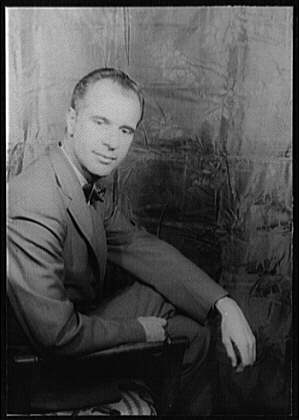
Hersey wrote an aftermath to "Hiroshima" 40 years later, tracing the fates of the six survivors he originally interviewed. (Photo by Carl Van Vechten.)

Truman Capote’s In Cold Blood and John Hersey’s Hiroshima are the two best pieces of long-form American nonfiction I have ever read. I wouldn’t change a word of either one. Hersey’s work, which he wrote for his longtime employer, The New Yorker, was so brilliantly shattering that the entire August 31, 1946 issue was dedicated solely to the article. It became an instant classic and so did the subsequent book version.

Although he was always best know for this piece during his life, Hersey turned out a formidable quantity of other quality fiction and nonfiction. A 1989 Vintage collection, Life Sketches: Incisive and Profoundly Insightful Portraits of Extraordinary Men and Women, 1944-1989, brought together some of Hersey’s finest biographical articles.

The 1945 piece, “The Brilliant Jughead,” tells the story of Private John Daniel Ramey, an illiterate U.S. soldier who was sent to a special training unit in Pennsylvania that conducted a highly successful three-month basic literacy course. This unit, and others like it, taught more than a quarter million illiterate servicemen–who were labeled with the pejorative “jughead” by some fellow soldiers–to read and write during WWII. An excerpt:

“Private Ramey, who was assigned to the Pennsylvania school toward the end of March, 1945, could hardly be called a typical jughead. There is, in fact, no typical illiterate, any more than there is a typical college graduate. Ramey is above whatever average there is. He finished the course, which usually takes twelve weeks, in ten. By jughead standards, Ramey is brilliant. He says that he was often embarrassed, when he was a civilian, by not being able to read and write, but the surprising thing about his life before the war is how much he, an illiterate, was able to do for himself: at one time he owned a house, ran a small coal mine employing twenty-eight men, and had two automobiles, the better of which was a Mercury with, as he says, ‘one of them cloth tops on it,’ bought brand-new. The fact that he is above average makes him especially grateful for the opportunities, the amazements, opened up for him by being educated, for the first time in his life, to the written word.”

Tags: , ,

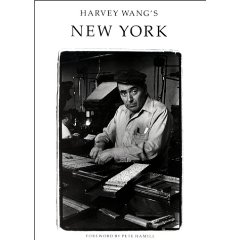
One of Wang's subjects, bowling alley mechanic Bill Newman, is someone I recall from my childhood in Queens.

Of all my favorite books about NYC, I think the one I love above all others is Harvey Wang’s New York. The 1990 book contains an introduction by Pete Hamill and just a few dozen black-and-white photos with a paragraph of text accompanying each one. And that’s all it needs.

Wang, a photographer and filmmaker, who maintains a website of his work, uses his trusty Leicas and Nikons to capture a phase of the city that had entered into obsolescence and is all but gone now: a New York that wasn’t drunk on self-awareness and star power, a place that was perhaps harder but less self-conscious.

In the book, Wang profiles New Yorkers at work in trades such as blacksmith, mannequin maker and scrap-metal collector, among others. He also interviews a seltzer bottler named George Williams. An excerpt:

“‘I go to sleep dreaming of seltzer bottles,’ says George Williams, who estimates he fills 3,000 empty glass canisters with a mixture of filtered water and carbon dioxide gas every day. He works at G & K Beer Distributors in Canarsie, Brooklyn. Kenny Gomberg, grandson of G & K founder Moe Gomberg says at the beginning seltzer was the biggest part of the business. Now it’s a novelty. George started in the business about thirty-five years ago at Cohen Seltzer Works in Boro Park, one of the dozens of bottlers in business back then. There are just a few left that fill the antique Czech-made bottles with a Barnett and Foster Syphon (sic) Filler machine that dates back to 1910. Says George, ‘The younger generation mostly goes for flavored sodas.'”

ALSO: Harvey Wang is having an exhibit of the many photographs he took of Adam Purple’s amazing Lower East Side earthwork, “The Garden of Eden,” fifteen thousand square feet of natural beauty that the artist somehow grew out of urban blight. It was sadly razed by developers in 1986. Wang’s photographs of the erstwhile oasis and its eccentric creator will be on display at the FusionArts Museum Gallery from February 2-20.

Tags: , , , , ,

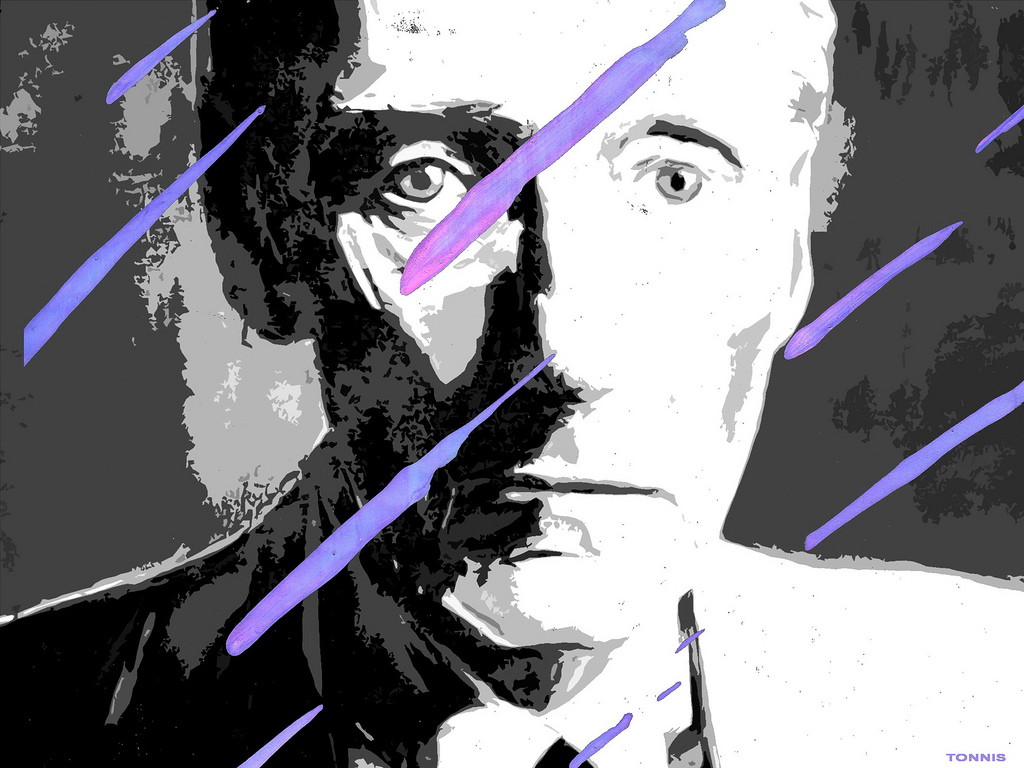
Burroughs published "Junky" under the pen name "William Lee" in 1953. (Image by Christiaan Tonnis.)

I have zero interest in drugs, but I think William S. Burroughs’ first novel, Junky, is pretty much perfect writing, even though he wasn’t particularly enamored with this work. In a 1965 Paris Review Q&A, a chain-smoking Burroughs recalled how the writing of Junky came about. An excerpt:

Interviewer: When and why did you start to write?

Burroughs: I started to write in about 1950; I was thirty-five at the time; there didn’t seem to be any strong motivation. I was simply endeavoring to put down in a straightforward, journalistic style something about my experiences with addiction and addicts.

Interviewer: Why did you feel compelled to record these experiences?

Burroughs: I didn’t feel compelled. I had nothing else to do. Writing gave me something to do every day. I don’t feel the results were at all spectacular. Junky is not much of a book, actually. I knew very little about writing at that time.

Interviewer: Where was this?

Burroughs: In Mexico City. I was living near Sears, Roebuck, right around the corner from the University of Mexico. I had been in the Army for four or five months and I was there on the GI Bill, studying native dialects. I went to Mexico partly because things were becoming so difficult with the drug situation in America. Getting drugs in Mexico was quite easy, so I didn’t have to rush around, and there wasn’t any pressure from the law.”

Tags:

In the article, Brian MacKinnon hinted that he would get plastic surgery and try to enter medical school under a new identity.

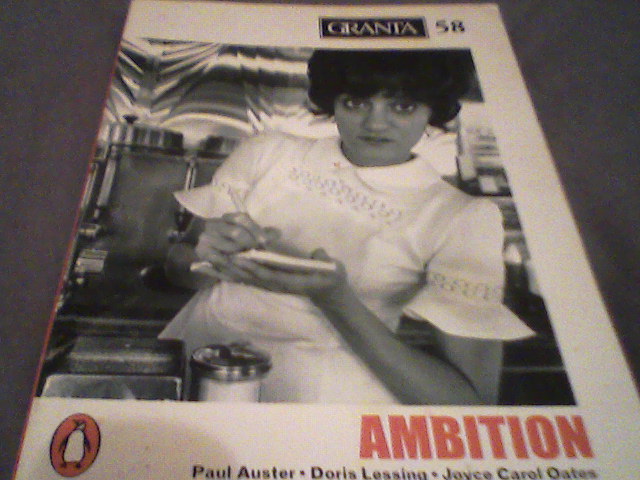
In 1997 Granta published its Ambition” issue. It contains a really great piece called “I Was Brandon Lee,” written by journalist Ian Parker, who is now a staff writer for the New Yorker. The story profiles a brazen impostor named Brian MacKinnon, a Scottish man who in 1995 went back and attended his old high school again when he was 32, pretending to be “Brandon Lee,” a Canadian teen who excelled academically, enjoyed extracurriculars and dreamed of being a doctor when he “grew up.”

One of the most interesting things about the case is that administrators, teachers and fellow students convinced themselves that the oldish-looking MacKinnon was 17, even though the truth stared them in the face. An excerpt:

“Gwyneth Lightbody was surprised, but hoped she did not show her surprise. ‘I said, ‘Well–in you come.” She told me that ‘He did not look like your typical teenager. I assumed he was an adult, but when you’re presented with facts…I mean, in teaching, you see all sorts of strange sights. It could be he had some illness that made him age rapidly–or something.’

On the first day she met some fellow teachers mid-morning. ‘We were all saying, ‘Have you got a pupil that looks old?’ We all thought he was an adult. But we assumed everything had been done, and he was just a bit of an oddity.’ Pupils were doing the same, trying to make Brandon fit his own story–by reminding themselves, for example, of the wide range in teenage body types. ‘I had a boyfriend who was over six feet then,’ one student said to me; another said: ‘I could think of boys with beards and hairy chests. If someone says they’re seventeen, you’re not going to turn round and say no, no you’re not.’ By lunch it seems MacKinnon had been accepted as an old-looking, odd-looking teenager–an alien from Canada–rather than an adult who looked his age.”

Tags: , ,

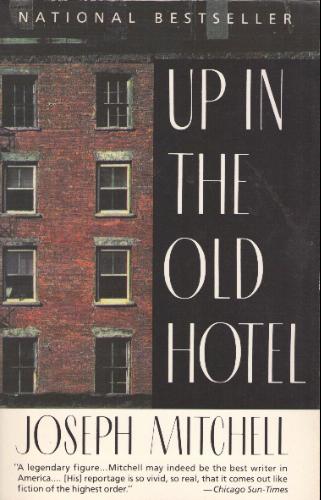
All three articles excerpted are contained Mitchell''s great collection, "Up in the Old Hotel."

Three wonderful opening sentences from articles written by the unimpeachable New Yorker legend Joseph Mitchell.

••••••••••

From “Mr. Hunter’s Grave” (1956):

“When things get too much for me, I put a wild-flower book and a couple of sandwiches in my pockets and go down to the South Shore of Staten Island and wander around awhile in one of the old cemeteries there.”

••••••••••

From “Hit on the Head with a Cow” (1938):

“When I have time to kill, I sometimes go to the basement of a brownstone tenement on Fifty-ninth Street, three-quarters of a block west of Columbus Circle, and sit on a rat-gnawed Egyptian mummy and cut up touches with Charles Eugene Cassell, an old Yankee for whose bitter and disorderly mind I have great respect.”

••••••••••

From “Goodbye, Shirley Temple” (1939):

“I’ve been going to Madame Visaggi’s Third Avenue spaghetti house off and on since speakeasy days, and I know all the old customers.”

Tags:

New York City has earthquakes, but they’re so minor we never feel them. In most instances, the earth prefers to swallow us up one by one. But it’s different in Los Angeles.

L.A.’s tempermental turf is the subject of The Myth of Solid Ground: Earthquakes, Prediction, and the Fault Line Between Reason and Faith, a volume on the topic by David L. Ulin. I remember Ulin’s writing from back in the day when he wrote book reviews for Newsday. He’s worked at the Los Angeles Times for a number of years now.

Among other earthquake-related topics, Ulin’s book looks at the thorny issue of earthquake prediction, by scientists and psychics, the concerned and the kooky. An excerpt about Linda Curtis, Seismological Secretary of the Southern California field office of the United States Geological Survey in Pasadena:

“Curtis is, in many ways, the USGS gatekeeper, the public affairs officer who serves as a frontline liaison with the community and the press. Her office sits directly across the hall from the conference room, and if you call the Survey, chances are it will be her low-key drawl you’ll hear on the line. In her late forties, dark-haired and good-humored, Curtis has been at the USGS since 1979, and in that time, she’s staked out her own odd territory as a collector of earthquake predictions, which come across the transom at sporadic but steady intervals, like small seismic jolts themselves.

‘I’ve been collecting almost since day one,’ she tells me on a warm July afternoon in her office, adding that it’s useful for USGS to keep records, if only to mollify the predictors, many of whom view the scientific establishment with frustration, paranoia even, at least as far as their theories are concerned.

‘Basically,’ she says, ‘we are just trying  to protect our reputation. We don’t want to throw these predictions in the wastebasket, and then a week later…’ She chuckles softly, a rolling R sound as thick and throaty as a purr. ‘Say somebody predicted a seven in downtown L.A., and we ignored it. Can you imagine the reaction if it actually happened? So this is sort of a little bit of insurance. If you send us a prediction, we put it in the file.'”

••••••••••

“Plus–the city of Los Angeles and its millions of people”:

Tags: ,

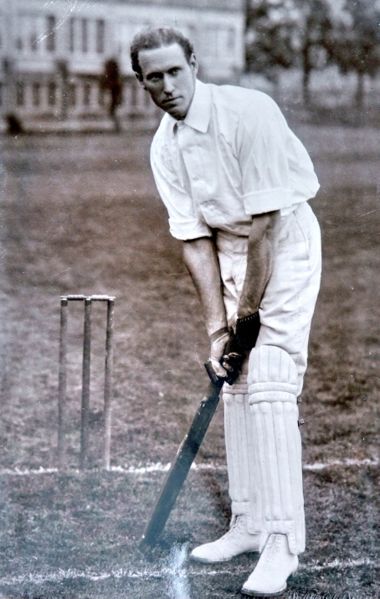
John Barton "Bart" King at bat in a Philadelphia match in 1900.

In 1900, cricket and baseball (or “base ball”) both enjoyed great popularity in America. People of that era probably couldn’t imagine a time when cricket wouldn’t be an important part of our sporting life. An excerpt from the 1901 Brooklyn Daily Eagle Almanac:

“Cricket continued to flourish in the United States during 1900. The annual contest with Canada again resulted in favor of the United States. Philadelphia is the stronghold of American Cricket, and in the Inter-City match with All New York maintained her superiority by winning the match in most hollow fashion. The Germantown Cricket Club won the Halifax Cup, the emblem of Quaker supremacy, for the sixth time in succession. In the metropolitan district, chief interest in the game is now centered in Brooklyn, where no less than six clubs have their headquarters. The championship of the Metropolitan District Cricket League was again captured by the Knickerbocker Athletic Club, while in the New York Cricket Association series the Paterson Cricket Club proved successful and retained the championship.”

Tags:

"Cow-dung toothpaste." (Image by Pikaluk.)

Some philosophers like working in airports, so why can’t photographers live in them? Native New Yorker Taryn Simon did just that for five days in 2009 (at JFK) to compile more than a thousand photos for her book, Contraband. The volume documents a wide variety of items confiscated from passengers by Customs officials. In a piece in the Guardian by Sean O’ Hagan, there’s a partial list of some of the verboten goods:

“The seized items include various drugs (Xanax, anabolic steroids, Ritalin, khat, ketamine, hashish), counterfeit jewellery, bags, hats, sportswear, shirts, DVDs and watches as well as several kinds of plants, seeds, grass, nuts and foodstuffs. Among the more exotic confiscated substances are deer antlers, deer blood, deer penis and deer tongue, as well as cow-dung toothpaste and cow urine.”

Tags: ,

The Objectivist novelist Ayn Rand sat down for an interview with Playboy in 1964, back when that magazine routinely did Q&As with incredible subjects. She gave opinions on everything from politics to philosophy to religion to literature. An excerpt from the interview, conducted by Alvin Toffler, in which she shares her ardently contrarian views of novelists of that era:

Playboy: Are there any novelists whom you admire?

Ayn Rand: Yes. Victor Hugo.

Playboy: What about modern novelists?

Ayn Rand: No, there is no one that I could say I admire among the so-called serious writers. I prefer the popular literature of today, which is today’s remnant of Romanticism. My favorite is Mickey Spillane.

Playboy: Why do you like him?

Ayn Rand: Because he is primarily a moralist. In a primitive form, the form of a detective novel, he presents the conflict of good and evil, in terms of black and white. He does not present a nasty gray mixture of indistinguishable scoundrels on both sides. He presents an uncompromising conflict. As a writer, he is brilliantly expert at the aspect of literature which I consider most important: plot structure.

Playboy: What do you think of Faulkner?

Ayn Rand: Not very much. He is a good stylist, but practically unreadable in content–so I’ve read very little of him.

Playboy: What about Nabokov?

Ayn Rand: I have read only one book of his and a half–the half was Lolita, which I couldn’t finish. He is a brilliant stylist, he writes beautifully, but his subjects, his sense of life, his view of man, are so evil that no amount of artistic skill can justify them.”

Tags: , , , , ,

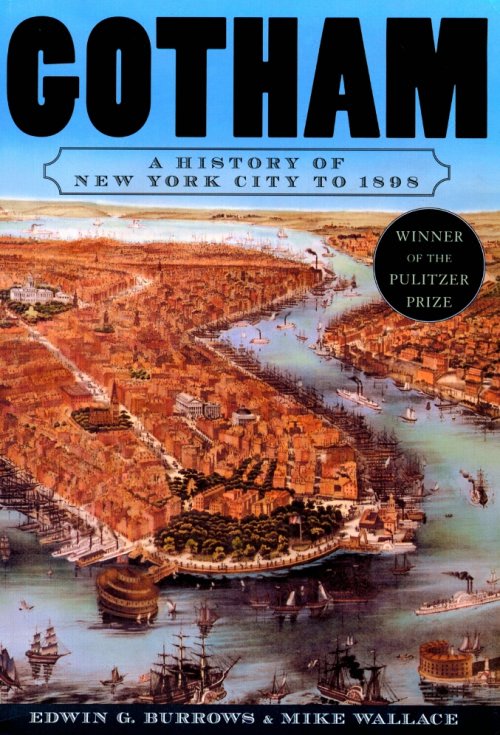
An out-of-control New Year’s Eve celebration in New York in 1827, as described in Gotham, by Edwin G. Burrows and Mike Wallace:

“On New Year’s Eve, as the city bade farewell to 1827, several thousand workingmen–laborers, apprentices, butcher boys, chimney sweeps–set out from the Bowery on a raucous march through the darkened downtown streets, drinking, beating drums and tin kettles, shaking rattles, blowing horns. The crowd headed down Pearl Street through the heart of the city’s commercial district, smashing crates and barrels and making what one account described as ‘the most hideous noises.’ From there the marchers wheeled across town to the Battery, where they knocked out the windows of genteel residences and attempted to tear down the iron railing around the park. At two in the morning they tromped up Broadway, just in time to harass revelers leaving a fancy dress-ball at the City Hotel. A contingent of watchmen appeared but, after a tense confrontation, gave way, and ‘the multitude passed noisily and triumphantly up Broadway.'”

Tags: ,

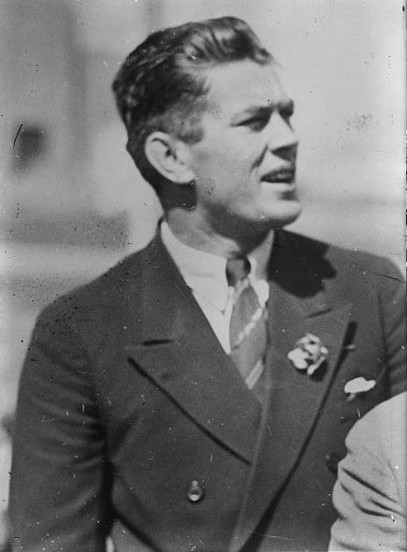
I own several different paperback editions of Janet Flanner’s Paris Was Yesterday: 1925-1939, some purchased, some gleaned. Flanner, the correspondent who wrote for the New Yorker under the pen name Genêt, chronicled European politics and culture from her vantage point in the City of Lights. In one diary-style entry, she records the night in 1928 when heavyweight boxing champ Gene Tunney drank beer with playwright Thornton Wilder. An excerpt:

Gene Tunney broke up the shop at Lipp’s when he recently entered there one night with Mr. Thornton Wilder. The heavyweight champion ordered and obtained a schooner of light beer; Mr. Wilder, because he was with Mr. Tunney, also received something to drink, doubtless not what he ordered, for service was paralyzed. The cashier, ordinarily a creature of discretion, ceased making her change; the waiters rallied round Tunney’s table shamelessly. All the French women stared, whispering, ‘Comme il est beau!’ ‘Quel homme magnifique!’ their escorts murmured without jealousy. It was a triumph which the champion accepted without too much grace. Nervously doffing and donning his hat as if the bay leaves irked him, he talked loudly, intelligently, for a half hour, and left.”

Tags: , ,

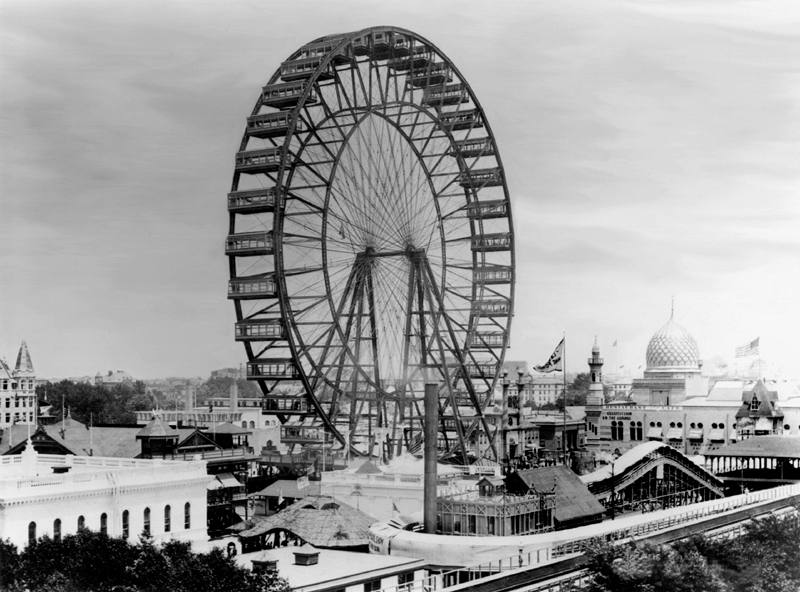
The first Ferris Wheel, at the Columbian Exposition in Chicago in 1893. It was 264 ft. high.

Guy de Maupassant is said to have lunched at the Eiffel Tower every day so that he could avoid looking at the edifice he so despised, and he wasn’t the only Parisian intellectual to hate on Gustave Eiffel’s “bridge to the sky.” French artists and thinkers railed against the tower even as it was in its planning stages as part of the Universal Exposition of 1889, claiming that it was a blight on the city.

But the Eiffel Tower was a huge hit during the fair, so much so that the planners of the 1893 World’s Columbian Exposition in Chicago felt that they needed to do something dramatic to compete with it. Daniel H. Burnham, Chief of Construction for the Columbian, searched futilely for an answer for a long time before George Ferris supplied him with one. An excerpt from Henry Petroski’s Remaking the World:

Burnham found himself at a banquet addressing architects and engineers, he praised the former but excoriated the latter for not having met the expectations of the people. Nothing had been proposed that displayed the originality or novelty to rival the Eiffel Tower. He wanted something new in engineering science, but felt the engineers were giving him only towers.

George Washington Gale Ferris, Jr.

Among the engineers at the banquet was the youngish George Washington Gale Ferris, Jr. He was born in Galesburg, Illinois, in 1859, and at the age of five moved with his family to western Nevada. There, while living on a ranch, he became fascinated with a large undershot water wheel, which raised buckets out of the Carson River to supply a trough for the horses. Ferris would later recall his fascination with the wheel’s action, but, according to some accounts, as a youngster he was not equally fascinated with formal education. … When Ferris would later be asked where the idea for his great wheel came from, he recalled that, a while after hearing Burnham’s challenge, he found himself at a Saturday afternoon dinner club made up mainly of world’s fair engineers.

According to Ferris, “I had been turning over every proposition I could think of. On four or five of these I had spent considerable time. What were they? Well, perhaps I’d better not say. Any way none of them were very satisfactory… It was at one of these dinners, down at a Chicago chop house, that I hit on the idea. I remember remarking that I would build a wheel, a monster. I got some paper and began sketching it out. I fixed the size, determined the construction, the number of cars we would run, the number of people it would hold, what we would charge, the plan of stopping six times in its first revolution and loading, and then making a complete turn–in short, before the dinner was over I had sketched out almost the entire detail, and my plan has never varied an item from that day. The wheel stands at the Plaissance at this moment as it stood before me then.”•

Tags: , , ,

Author Gary Shteyngart can't shut up to save his life! Just try to make him. (Image by Mark Coggins.)

Sarah Spitz from KCRW sends me info each week about the new author interviews that Michael Silverblatt does for his Bookworm program. If you’re unfamiliar with the show, all of the previous editions, which you can listen to completely free, are archived here. Recent ones include Stephen Sondheim, Mona Simpson, Nicole Krauss, Gary Shteyngart, Susan Straight, etc.

Tags: , , , , , ,

The Queens-born paleontologist, who died in 2002, lived in Soho for many years. (Image by Kathy Chapman)

The American Scientist list of  “100 or so Books that shaped a Century of Science” includes the following 20th-century volumes about evolutionary science:

Tags: , , , , , ,

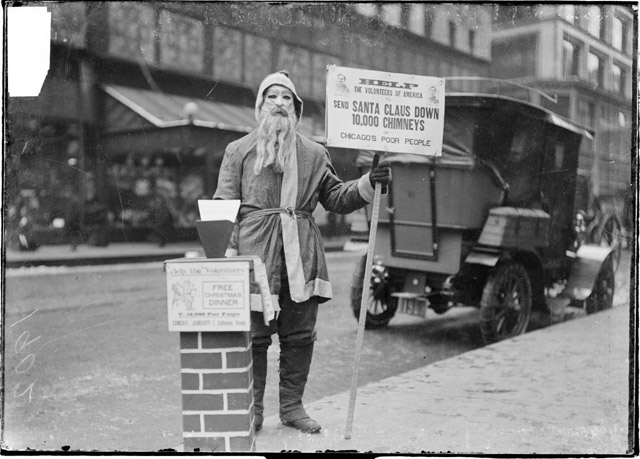
New York gave America Christmas, and Chicago gave us this creepy sidewalk Santa in 1902. He would murder you and your children while you slept. (Image by "Chicago Daily News.")

We know that New York City gave America the Thanksgiving holiday, but it was responsible for Christmas as well. An excerpt from the “1783-1843” section of Edwin G. Burrows and Mike Wallace’s amazing Gotham:

“Wealthy New Yorkers didn’t invent the new cult of domesticity, which was a characteristic of emerging bourgeois culture throughout the Atlantic world. They did, however, give it Christmas–a holiday that became synonymous with genteel family life and a quintessential expression of its central values.

For 150-odd years, probably since the English conquest, the favorite winter holiday of the city’s propertied classes was New Year’s Day (as distinct from the night before, which was the occasion for revelry and mischief among common folk). Families exchanged small gifts, and gentlemen went around the town to call on friends and relations, nibbling cookies and drinking raspberry brandy served by the women of the house. Sadly, according to John Pintard, the city’s physical expansion after 1800 rendered this ‘joyous older fashion’ so impractical that it was rapidly dying out.

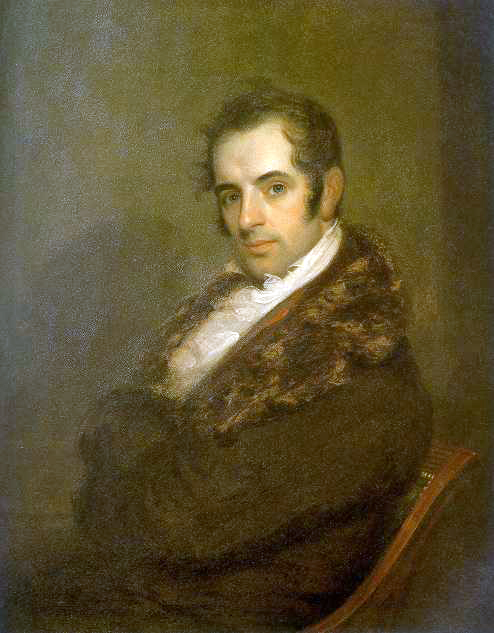
"Washington Irving had identified Nicholas as the patron saint of New Amsterdam, describing him as a jolly old Dutchman, nicknamed Sancte Claus." (Image by John Wesley Jarvis.)

As an alternative, Pintard proposed St. Nicholas Day, December 6, as a family-oriented winter holiday for polite society. In Knickerbocker’s History, Pintard’s good friend Washington Irving had identified Nicholas as the patron saint of New Amsterdam, describing him as a jolly old Dutchman, nicknamed Sancte Claus, who parked his wagon on rooftops and slid down chimneys with gifts for sleeping children on his feast day. It was Salmagundi-style fun, of course; although seventeenth-century Netherlanders had celebrated St. Nicholas Day, the earliest evidence of anyone doing so on Manhattan dates from 1773, when a group of ‘descendants of the ancient Dutch families’ celebrated the sixth of December ‘with great joy and festivity.’ Certainly nothing remotely like the Sancte Claus portrayed by Irving had ever been known on either side of the Atlantic.

Mere details were no obstacle to Pintard. On December 6, 1810–one year to the day after the publication of Irving’s History–he launched his revival of St. Nicholas Day with a grand banquet at City Hall for members of the New-York Historical Society. The first toast was to ‘Sancte Claus, good heylig man!’ and Pintard distributed a specially engraved picture that showed Nicholas with two children (one good, one bad) and two stockings hung by the hearth (one full, one empty)–the point being that December 6 was a kind of Judgement Day for the young, with the saint distributing rewards and punishments as required. St. Nicholas day never quite won the support Pintard wanted, and he eventually ran out of enthusiasm for the project. Sancte Claus, on the other hand, took off like a rocket.”


Tags: , , ,

Quentin Fiore, the graphic designer who created the book's amazing look, is now 90.

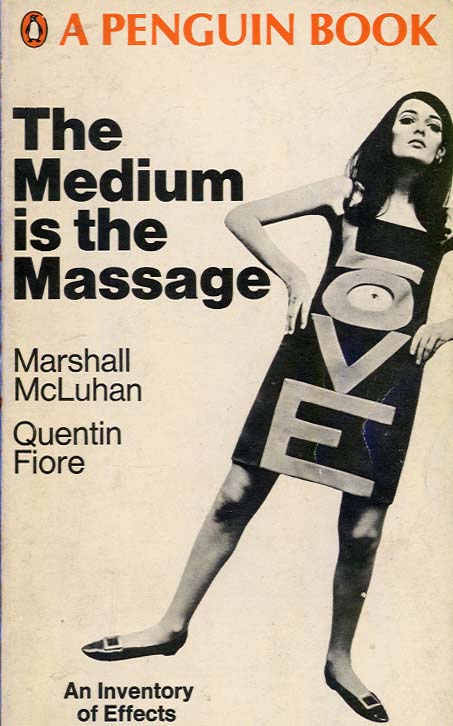
Facebook wunderkind Mark Zuckerberg being named Time magazine’s Person of the Year made me recall an ominous passage from early in The Medium Is The Massage: An Inventory of Effects, from 1967. Not that I think that things are quite this dire, but Marshall McLuhan was pretty prophetic here. An excerpt:

“How much do you make? Have you ever contemplated suicide? Are you now or have you ever been…? I have here before me…Electrical information devices for universal, tyrannical womb-to-tomb surveillance are causing a very serious dilemma between our claim to privacy and the community’s need to know. The older, traditional ideas of private, isolated thoughts and actions–the patterns of mechanistic technologies–are very seriously threatened by new methods of instantaneous electric information retrieval by the electrically computerized dossier bank–that one big gossip column that is unforgiving, unforgetful and from which there is no redemption, no erasure of early ‘mistakes.’ We have already reached a point where remedial control, born out of knowledge of media and their total effects on all of us, must be exerted. How shall the new environment be programmed now that we have become so involved with each other, now that all of us have become the unwitting work force for social change? What’s that buzzzzzzzzzzzzzzzzzzzzzzzzzzzzzzzzing?”

Tags: , ,

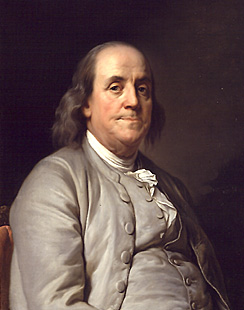
Even though he was reputed to really like orgies, Benjamin Franklin was careful about his body when it came to food and drink, experimenting with vegetarianism and preaching temperance. Franklin’s disregard for alcohol made him an oddball in an age when most folks were continually soused. An excerpt from Joyce Chaplin’s The First Scientific American:

“Fat though he grew, the adult Franklin’s much-noted coolness and detachment may have been the result, at least in part, of his measured consumption of alcohol. His sobriety was striking in an age when people drank steadily–to consume calories, to keep warm, and to avoid tainted water. Tipsiness was so common that it went unnoticed, even in small children, pious clerics, and pregnant women. We might call them drunk; but drunkenness at the time meant inability to stand.”

Tags: ,

“He owned ‘that which is the grand constituent of all truly great acting, intensity.'”

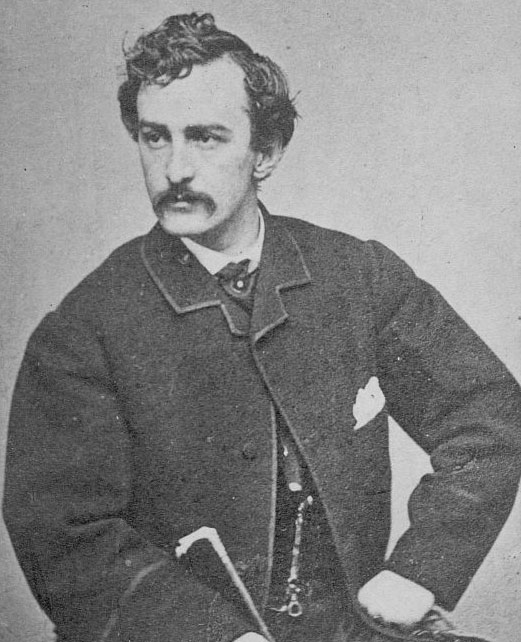
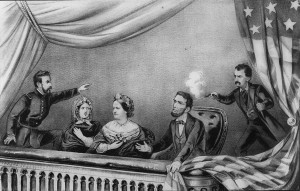
Accounts from Gene Smith’s 1992 history, American Gothic, about a pair of times when President Lincoln watched performances by the noted actor and his future assassin, John Wilkes Booth, on stage in Washington D.C. The first “meeting” took place in 1863.

___________________________

John was about to turn twenty-five, and of a theatrical stature to set himself up as a more or less permanent resident star in a leading city. He chose Washington. The wartime capital was bursting with people, and entertainments of any type drew capacity crowds. He opened as Richard III at Grover’s Theatre, on April 11, 1863, billed as “The Pride Of The American People–The Youngest Tragedian In The World–A Star Of The First Magnitude–Son Of The Great Junius Brutus Booth–Brother And Artistic Rival Of Edwin Booth.” President Lincoln attended. The National Republican said he scored a “complete triumph” and “took the hearts of the people by storm.” A day later the paper added that his playing created a sensation. “His youth, originality, and superior genius have not only made him popular but have established him in the hearts of the Washington people as a great favorite.” The National Intelligencer said he owned “that which is the grand constituent of all truly great acting, intensity. We have only to say that this young actor plays not from stage rule, but from his soul, and his soul is inspired with genius. Genius is its own schoolmaster: It can be cultivated but not created.•

___________________________

Accompanying President Lincoln and his wife to the theater one night were the two daughters of Cassius M. Clay, U.S. Minister to Russia. Their mother was an old friend of Mary Todd Lincoln and when they sent in their cards to her she responded with the invitation. As the party drove, a piece of iron suddenly sprung up and pierced the carriage seat between the President and his wife. For a moment an alarmed Mary Lincoln thought it was an attack. Mary Clay asked the President what measures he took to be guarded–no czar of Russian would go through a St. Petersburg street without cavalry escort and with police, detectives, and plainclothesmen along the route, and for good reason–and the President said, “I believe when my time comes there is nothing that can prevent my going.”

The star performer played a villain and twice “in uttering disagreeable threats came very near” and appeared to point to the President. “When he came a third time I was impressed by it, and said, ‘Mr. Lincoln, he looks as if he meant that for you.'”

“‘Well,'” he said of John Booth, “‘he does look pretty sharp at me, doesn’t he?'”•

Tags: , ,

« Older entries § Newer entries »