Books

You are currently browsing the archive for the Books category.

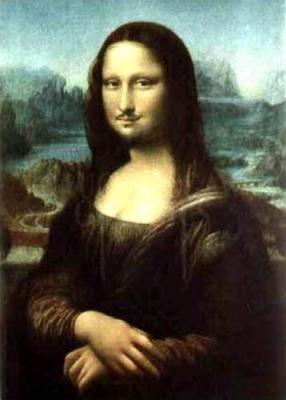
Duncan Watts, author of the new book, Everything Is Obvious, on Steven Cherry’s IEEE Spectrum podcast shooting down the most common explanations given for why the Mona Lisa is the most famous painting in the world:

“Steven Cherry: 

You take up some interesting questions in the book. For example, why is the Mona Lisa the most famous painting in the world?

Duncan Watts:

Well, it’s a great question. It’s one that I spend a fair bit of time talking about in the book. It’s—it clearly is the most famous painting in the world. If you’ve ever been to the Louvre, and I assume that many of your listeners have, you probably have stood in front of the Mona Lisa at some point and sort of wondered to yourself why is this the most famous painting in the world. Because when you get there, it sort of seems somewhat disappointing. Now if you—if you listen to the—the experts, the—the art critics, they will tell you that there are sort of all sorts of attributes that might not be immediately obvious to a naive viewer that explain why the Mona Lisa is so special. And they’ll talk about the—sort of innovative painting technique that da Vinci invented to achieve that sort of dreamy kind of finish, the—the fantastical background behind the subject, which was quite unusual back in those days, the mysterious nature of the subject herself. We now know it’s Lisa del Giocondo, but that was not known for many years. The—of course, the famous enigmatic smile, the identity of the artist himself, the fact that he was also famous.

But what is interesting is that when you wrap all these things together and you say the Mona Lisa is famous because it has all of these features, really all you’re doing is saying the Mona Lisa is the most famous painting in the world because it’s more like the Mona Lisa than anything else is.

And this sort of vacuous-sounding statement actually turns out to be rather typical of the kinds of explanations that we give, particularly when we’re trying to explain success. We often see that something is successful and we ask why is it successful. And then when we give what we think is an explanation, it turns out it’s really just a description of the thing itself.”

Tags: ,

I’ve just cracked open The Three Christs of Ypsilanti, a book I’ve always wanted to read and just never got around to. Another book that falls into that category of neglected reading matter: Neuropsychologist A.R. Luria’s The Mind of a Mnemonist. Luria was the forerunner to Oliver Sacks and other scientist’s sharing unusual case studies of the mind. The book, as you might gather from the title, is a portrait of a man with an incredibly elastic memory. In an excellent Five Books interview at the Browser, Joshua Foer discusses this work. An excerpt:

Question:

Finally, let’s turn to The Mind of a Mnemonist, a monograph by a renowned Russian neuropsychologist, Alexander Luria. He subtitles it ‘a little book about a vast memory.’ Tell us about Luria’s subject.

Joshua Foer:

This book created the entire genre of humanistic clinical histories. Without Luria, there could be no Oliver Sacks, the British neurologist who wrote Awakenings. For 30 years, Luria studied a journalist called Solomon Shereshevsky or simply ‘S’. Supposedly, S had a vacuum cleaner memory. He could remember anything.

Luria is a terrific writer, but he didn’t document S’s skills with the kind of detail that is required to compare S with people who live today. Luria is so concerned with telling a good story that he doesn’t rigorously describe S’s abilities. We don’t have any other records of S, this seemingly singular character in the history of psychology. As a result it’s hard to draw too many conclusions from this book.

Question:

What does Luria’s study of S teach us about the human condition?

Joshua Foer:

S seemed to remember too well. He was ineffectual as a journalist and ultimately couldn’t make a living as anything other than a stage performer — a memory freak. I think that points to something profound. Forgetting is an important part of learning, it teaches us to abstract. Because S remembered too much, he couldn’t process what he witnessed, and as a result he couldn’t make his way in the world.”

Tags: , ,

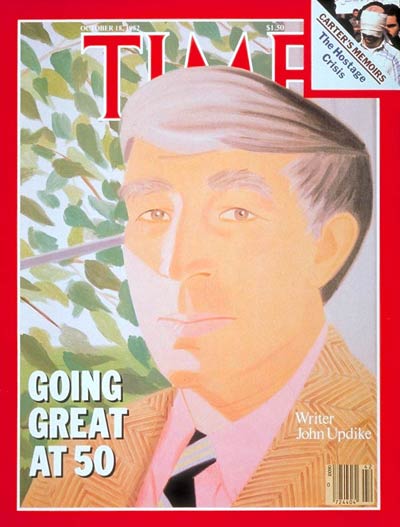
Bryant Gumbel interviewing 50-year-old John Updike on Today as Bech Is Back is released in 1982. 

Tags: ,

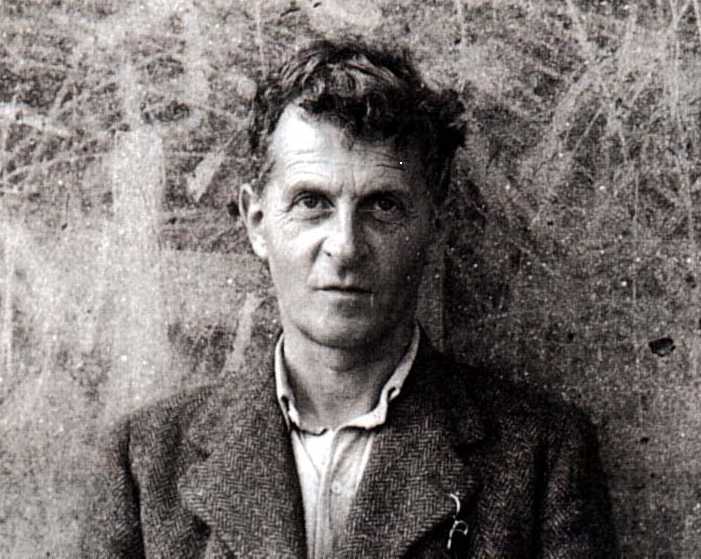
I’m perplexed by Freeman Dyson’s carefree (careless?) views about environmentalism. I know Earth must ultimately be disposable, but we needn’t hurry the process. But I love reading his essays in the New York Review of Books. From his latest piece, a consideration of Jim Holt’s new volume about modern philosophers, a history of his perplexing relationship with Ludwig Wittgenstein, first as reader, then as student:

Wittgenstein, unlike Heidegger, did not establish an ism. He wrote very little, and everything that he wrote was simple and clear. The only book that he published during his lifetime was Tractatus Logico-Philosophicus, written in Vienna in 1918 and published in England with a long introduction by Bertrand Russell in 1922. It fills less than two hundred small pages, even though the original German and the English translation are printed side by side. I was lucky to be given a copy of the Tractatus as a prize when I was in high school. I read it through in one night, in an ecstasy of adolescent enthusiasm. Most of it is about mathematical logic. Only the last five pages deal with human problems. The text is divided into numbered sections, each consisting of one or two sentences. For example, section 6.521 says: ‘The solution of the problem of life is seen in the vanishing of this problem. Is not this the reason why men, to whom after long doubting the sense of life became clear, could not then say wherein this sense consisted?’ The most famous sentence in the book is the final section 7: ‘Wherof one cannot speak, thereof one must be silent.’

I found the book enlightening and liberating. It said that philosophy is simple and has limited scope. Philosophy is concerned with logic and the correct use of language. All speculations outside this limited area are mysticism. Section 6.522 says: ‘There is indeed the inexpressible. This shows itself. It is the mystical.’ Since the mystical is inexpressible, there is nothing more to be said. Holt summarizes the difference between Heidegger and Wittgenstein in nine words: ‘Wittgenstein was brave and ascetic, Heidegger treacherous and vain.’ These words apply equally to their characters as human beings and to their intellectual output.

Wittgenstein’s intellectual asceticism had a great influence on the philosophers of the English-speaking world. It narrowed the scope of philosophy by excluding ethics and aesthetics. At the same time, his personal asceticism enhanced his credibility. During World War II, he wanted to serve his adopted country in a practical way. Being too old for military service, he took a leave of absence from his academic position in Cambridge and served in a menial job, as a hospital orderly taking care of patients. When I arrived at Cambridge University in 1946, Wittgenstein had just returned from his six years of duty at the hospital. I held him in the highest respect and was delighted to find him living in a room above mine on the same staircase. I frequently met him walking up or down the stairs, but I was too shy to start a conversation. Several times I heard him muttering to himself: ‘I get stupider and stupider every day.’

Finally, toward the end of my time in Cambridge, I ventured to speak to him. I told him I had enjoyed reading the Tractatus, and I asked him whether he still held the same views that he had expressed twenty-eight years earlier. He remained silent for a long time and then said, ‘Which newspaper do you represent?’ I told him I was a student and not a journalist, but he never answered my question.

Wittgenstein’s response to me was humiliating, and his response to female students who tried to attend his lectures was even worse. If a woman appeared in the audience, he would remain standing silent until she left the room. I decided that he was a charlatan using outrageous behavior to attract attention. I hated him for his rudeness. Fifty years later, walking through a churchyard on the outskirts of Cambridge on a sunny morning in winter, I came by chance upon his tombstone, a massive block of stone lightly covered with fresh snow. On the stone was written the single word, ‘WITTGENSTEIN.’ To my surprise, I found that the old hatred was gone, replaced by a deeper understanding. He was at peace, and I was at peace too, in the white silence. He was no longer an ill-tempered charlatan. He was a tortured soul, the last survivor of a family with a tragic history, living a lonely life among strangers, trying until the end to express the inexpressible.”

Tags: ,

Dendrochronology, not to be confused with Dendrophilia, is the science of tree rings. The opening of Ross Andersen’s new Aeon piece on the topic of ring-related research, which compares the past century of fervent deforestation with the burning of another set of valuable leaves, the Library of Alexandria:

“No event, however momentous, leaves an everlasting imprint on the world. Take the cosmic background radiation, the faint electromagnetic afterglow of the Big Bang. It hangs, reassuringly, in every corner of our skies, the firmest evidence we have for the giant explosion that created our universe. But it won’t be there forever. In a trillion years’ time it is going to slip beyond what astronomers call the cosmic light horizon, the outer edge of the observable universe. The universe’s expansion will have stretched its wavelength so wide that it will be undetectable to any observer, anywhere. Time will have erased its own beginning.

On Earth, the past is even quicker to vanish. To study geology is to be astonished at how hastily time reorders our planet’s surface, filling its craters, smoothing its mountains and covering its continents in seawater. Life is often the fastest to disintegrate in this constant churn of water and rock. The speed of biological decomposition ensures that only the most geologically fortunate of organisms freeze into stone and become fossils. The rest dissolve into sediment, leaving the thinnest of molecular traces behind.

Part of what separates humans from nature is our striving to preserve the past, but we too have proved adept at its erasure. It was humans, after all, who set fire to the ancient Library of Alexandria, whose hundreds of thousands of scrolls contained a sizable fraction of classical learning. The loss of knowledge at Alexandria was said to be so profound that it set Western civilisation back 1,000 years. Indeed, some have described the library’s burning as an event horizon, a boundary in time across which information cannot flow.

The burning of books and libraries has perhaps fallen out of fashion, but if you look closely, you will find its spirit survives in another distinctly human activity, one as old as civilisation itself: the destruction of forests. Trees and forests are repositories of time; to destroy them is to destroy an irreplaceable record of the Earth’s past. Over this past century of unprecendented deforestation, a tiny cadre of scientists has roamed the world’s remaining woodlands, searching for trees with long memories, trees that promise science a new window into antiquity. To find a tree’s memories, you have to look past its leaves and even its bark; you have to go deep into its trunk, where the chronicles of its long life lie, secreted away like a library’s lost scrolls. This spring, I journeyed to the high, dry mountains of California to visit an ancient forest, a place as dense with history as Alexandria. A place where the heat of a dangerous fire is starting to rise.”

Tags:

John-Cheever-001 (1)

From a 1979 People article about the late-life John Cheever, who was every bit as gifted at the short-story form as F. Scott Fitzgerald or Flannery O’Connor or Paul Bowles or any American writer:

Instead of whiskey, the traditional tonic of his profession, the tumbler in Cheever’s hand contains dark tea nowadays, and he distastefully yet methodically counts leftover cigarette butts in his ashtray, a requirement of Smokenders. Cheever joined because “there is something humiliating about getting off the plane in a place like Sofia and thinking, ‘Oh, my God, are they going to have my brand?'” Once tormented by phobias, Cheever required a slug of Scotch from the bottle in the glove compartment before he dared drive across a bridge. He was the despair of his publishers’ PR men, an author who disappeared for six weeks after the publication of a book and refused interviews upon returning. When his first novel was finished, he fled to Rome for a full year. Today such quirks have vanished. At 66, John Cheever is a resurrected man.

“Five years ago I was washing down Thorazine with Scotch,” he says candidly. “I felt suicidal; my life and my career were over. I wanted to end it.” Always a hard drinker, Cheever sank into alcoholism after a near-fatal heart attack in 1972. He swore off temporarily but relapsed while teaching at Boston University. Novelist John Updike, an old friend, saw him at his alcoholic nadir and sadly remarked, ‘I keep thinking the John Cheever I know is in there someplace.’ Finally, with the support of his family, Cheever faced the facts of his behavior (“such a loss of dignity”) and agreed to enter Smithers, an exclusive Manhattan clinic for alcoholism. “If you can have it cured,” he says, five years later, “I am cured.” When released after 32 days, he promptly sat down and, in less than a year, wrote his much-acclaimed fourth novel, Falconer, a gothic tale of life in a prison very much like Sing Sing. Cheever knew his subject well: He once taught a writing course to the convicts.

“I don’t know where the blackness in my life comes from,” Cheever says. “There is a great deal of sadness, of melancholy. I have no idea where it originates.” Part of it may stem from Cheever’s seafaring Yankee ancestry, and his grandfather, who, Cheever was told, committed suicide. John was born in Quincy, Mass., the son of a businessman bankrupted by the crash of ’29. His father was often away, and he and his older brother, Fred (also an alcoholic, who died in 1976), were raised by their English mother. She supported the family with a small gift shop, a source of embarrassment to Cheever. He was close to his maternal grandmother “partly because she called my mother a cretin, which is an easy way to endear yourself to a child” and remembers that she insisted French be spoken at meals. “I don’t recall her French was all that good.”•

_________________________________

Cheever’s cameo in the big-screen adaptation of “The Swimmer”:

Tags:

I read Richard Ford’s most famous novel, The Sportswriter, when I was a teen and liked it, but I was probably too young to fully appreciate it. (The same goes for Saul Bellow’s Herzog.) I always felt old for my age on the inside, but some cultural experiences require life experience. Ford presents a clutch of ideas about America in a new Financial Times diary. His take on the condition of the modern Republican party:

“Before President Obama scored his unhappy ‘own goal’ in the first debate, I was thinking about what might happen to the Republicans if they lost the election. More than in most political seasons, the rightwing has staked it all on being able to create an ‘entity’ out of comically ill-fitting parts – nutcase birthers, gay-marriage haters, anti-government and anti-tax fanatics, gun nuts, a smattering of reluctantly legitimate Romney supporters, plus a few grumpy GOP moderates who can’t think of what else to do with the vote they inherited from their old man. Quite a colourful circus tent. Nobody, including the Republicans, thinks this comprises a real political party – the kind where members sort of think the same about stuff. All they jointly hold dear is a race-tinged abhorrence of our not-inept, but not-entirely-ept-either, chief executive, whom they can’t believe was ever elected in the first place. But if Obama gets elected again, and their cocked-up contraption teeters over on to its side, then I was thinking they don’t really have much left for the future, except cross-eyed bitterness. But I now think that’s wrong. They’ll just throw a few of the noisier birthers and gay-bashers over the side, spasm smilingly back toward the middle and call that ‘new unity.’ This may bespeak an actual virtue of a vast, ungovernable country like ours, able to absorb most discords into an accommodating mediocrity. Though there’s the new question now: what happens if the bastards win? Do they actually govern? How?”

Tags:

In Lauren Weiner’s New Atlantis article about Ray Bradbury, she provides a tidy description of the Space Age sage’s youthful education:

“Bradbury spent his childhood goosing his imagination with the outlandish. Whenever mundane Waukegan was visited by the strange or the offbeat, young Ray was on hand. The vaudevillian magician Harry Blackstone came through the industrial port on Lake Michigan’s shore in the late 1920s. Seeing Blackstone’s show over and over again marked Bradbury deeply, as did going to carnivals and circuses, and watching Hollywood’s earliest horror offerings like Dracula and The Phantom of the Opera. He read heavily in Charles Dickens, George Bernard Shaw, Edgar Allan Poe, H. G. Wells, Arthur Conan Doyle, L. Frank Baum, and Edgar Rice Burroughs; the latter’s inspirational and romantic children’s adventure tales earned him Bradbury’s hyperbolic designation as ‘probably the most influential writer in the entire history of the world.’

Then there was the contagious enthusiasm of Bradbury’s bohemian, artistic aunt and his grandfather, Samuel, who ran a boardinghouse in Waukegan and instilled in Bradbury a kind of wonder at modern life. He recounted: ‘When I was two years old I sat on his knee and he had me tickle a crystal with a feathery needle and I heard music from thousands of miles away. I was right then and there introduced to the birth of radio.’

His family’s temporary stay in Arizona in the mid-1920s and permanent relocation to Los Angeles in the 1930s brought Bradbury to the desert places that he would later reimagine as Mars. As a high-schooler he buzzed around movie and radio stars asking for autographs, briefly considered becoming an actor, and wrote and edited science fiction ‘fanzines’ just as tales of robots and rocket ships were gaining in popularity in wartime America. He befriended the staffs of bicoastal pulp magazines like Weird Tales,Thrilling Wonder StoriesDime Mystery, and Captain Future by bombarding them with submissions, and, when those were rejected, with letters to the editor. This precocity was typical. Science fiction and ‘fantasy’ — a catchall term for tales of the supernatural that have few or no fancy machines in them — drew adolescent talent like no other sector of American publishing. Isaac Asimov was in his late teens when he began writing for genre publications; Ursula K. Le Guin claimed to have sent in stories from the age of eleven.”

••••••••••

Harry Blackstone, Sr. with his classic bit, “The Bunny Trick”:

Tags: , ,

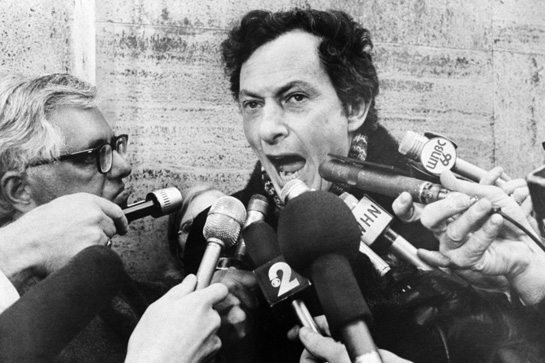
If you read this blog regularly, you know I’m a little obsessed with Clifford Irving, the writer who in 1970 accepted a million-dollar check for his authorized biography of the reclusive millionaire Howard Hughes. One problem: Hughes knew nothing about the book. The author was trying to pass off a fake and pocket a huge payday, and just as fascinating as the ruse was Irving doggedly sticking to his story even after the whole thing fell apart spectacularly. It was a literary scandal of Madoff-ian proportions, and a case study in extreme psychological behavior.

In 1972, as Irving was about to serve a stretch in prison for fraud, Ramparts magazine assigned Abbie Hoffman to do a Q&A with the trickster. An excerpt from the resulting article, “How Clifford Irving Stole That Book“:

Abbie Hoffman:

Did you ever get the idea, once the authenticity was questioned, of publishing it as a work of fiction? Would that have been really possible?

Clifford Irving:

You mean since recent events?

Abbie Hoffman:

Yeah.

Clifford Irving:

Oh, yeah, I still would like to have the book published. I think it’s the best novel I’ve ever written and it could easily be turned into a novel. It could also be published as is, provided libelous passages were taken out of it and provided that it stated very clearly that it’s a bogus autobiography of Howard Hughes. There is a court ruUng on it. As we understand it the court has given us permission to publish part or all of the book, provided that it’s made perfectly clear that it doesn’t purport to be genuine.

Abbie Hoffman:

I thought a funny incident occurred at Germaine Greer’s press party when you were introduced to Chief Red Fox. Could you talk about that a little?

Clifford Irving:

I went to this cocktail party. I was dragged along by Beverly Loo and Robert Stewart. I hate those damn cocktail parties but I had nothing to do and I wanted to meet Germaine Greer ’cause I heard she was six feet tall. But she was far more interested in talking to women’s liberation people and I stood around like a dope for awhile until I saw this beautiful old man in a corner. I asked about him and was told that’s Chief Red Fox, a 101-year-old Sioux Indian chief, and I said, ‘Beautiful, I’ve got to meet him.’ And I sat at his feet for an hour or two, talked to him, and he was a marvelous old man. But the way he came on to me with the broad American accent and told me how he danced at supermarket openings and was on the Johnny Carson Show where he did a war dance to liven things up, also the way he talked about Indian history, made me a little leery and I thought, well, he’s great but he’s not a 101-year-old Sioux Indian chief. Despite the fact that he was decked out like a technicolor western with a war bonnet and greasepaint make-up. And I went up to Beverly Loo and said,’He’s a great man, Beverly, but he’s no more a 101-year-old Sioux Indian than you’re the Empress Loo of the Ming Dynasty. She got very uptight about that and said, ‘What do you mean? How dare you!’ and I decided not to upset her any further so I backed off. Then of course it turned out later that there were great doubts thrown on the veracity of his books and his identity as well. I don’t know if I really smelled it out but something was funny there. I think maybe I was thinking in terms of a hoax since I was involved with one, and Chief Red Fox seemed to fit right into the category.

Abbie Hoffman:

When incidents like that happened did you start to feel you were watching a movie being made about your life or that you were acting out some kind of movie role?

Clifford Irving:

Well, going through that year I often felt that it was a happening because we sometimes had control over events but so many things happened that were absurd. And after awhile—not that I saw myself as a movie star—I saw this whole thing developing as a script, a movie script which no one would ever buy because it was ridiculous, it couldn’t possibly happen. The real and the unreal in a sense became totally confused—not that I really thought I was writing the autobiography of Howard Hughes, although of course in the act of creation you have to believe to a certain extent, but when you stop work you don’t believe any more. I mean you know what you’re doing but all the events had such a quality of ludicrousness and fantasy and coincidence that reality did at times blend with unreality. I think for the publishers as well.•

“I thought, well, he’s great but he’s not a 101-year-old Sioux Indian chief.”

See also:

Tags: , , , , ,

My earliest childhood memory is of lying on the living room floor of my family’s home and trying to pick up Crayolas with my toes. I doubt there was a day in my life until recent years when I didn’t spend several hours holding a pen or pencil or marker (with my fingers, not toes). That’s what writers did. And there were unintended benefits: There seems to be a strong connection between penmanship and memory. Write a fact on a piece of paper and it’s much more likely you’ll recall that fact.

I can’t tell you the last time I held any writing utensil in my hand. Whether it’s doing a crossword puzzle or paying a bill or jotting down a note, a screen and keypad do the job. But I don’t fret over the change. Yes, memories and individuality are diminished in some ways in a paperless world, but I’ll accept the trade-off any day. Having crayons as a child was wonderful, but you know what else would have been great? Having access to the mountain of information that is accessible 24/7 to us all now. It’s a net win.

Not everyone agrees, however. In a Guardian essayPhilip Hensher urges the reclamation of penmanship. An excerpt:

“We have surrendered our handwriting for something more mechanical, less distinctively human, less telling about ourselves and less present in our moments of the highest happiness and the deepest emotion. Ink runs in our veins, and shows the world what we are like. The shaping of thought and written language by a pen, moved by a hand to register marks of ink on paper, has for centuries, millennia, been regarded as key to our existence as human beings. In the past, handwriting has been regarded as almost the most powerful sign of our individuality. In 1847, in an American case, a witness testified without hesitation that a signature was genuine, though he had not seen an example of the handwriting for 63 years: the court accepted his testimony.

Handwriting is what registers our individuality, and the mark which our culture has made on us. It has been seen as the unknowing key to our souls and our innermost nature. It has been regarded as a sign of our health as a society, of our intelligence, and as an object of simplicity, grace, fantasy and beauty in its own right. Yet at some point, the ordinary pleasures and dignity of handwriting are going to be replaced permanently.” (Thanks Browser.)

Tags:

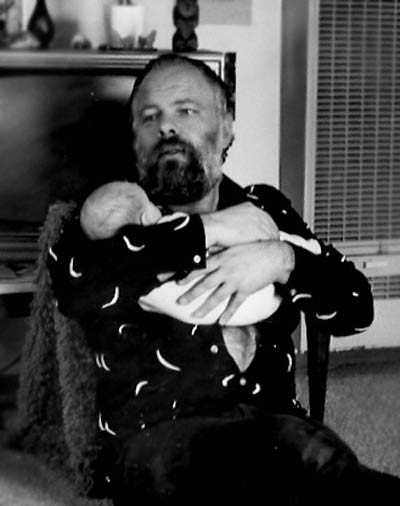
From a 1975 “Talk of the Town” piece in the New Yorker by Anthony Hiss about a trip to Los Angeles, a passage detailing his audience with Philip K. Dick, who wasn’t fully appreciated during his abbreviated lifetime (or in this brief article):

In the afternoon, we drove over to Fullerton to see Philip K. Dick, my favorite science-fiction writer, author of 33 novels and 170 short stories. Past the House of Egg Roll, past Moy’s Coffee Shop (Chop Suey, Hot Cakes), past Bowser Beautiful, through Bel Air. We drove to the end of Sunset Boulevard, where we saw seagulls, 18 surfers in wet suits, a blue suggestion of Catalina to the southwest, and an Indian girl in a green-and-gold sari on the beach. Then south, past a concrete wall painted ‘TOMMY SURKO SAYS FOR MY KIND OF GIRL THERE’S ONLY ONE! TOMMY SURKO!’ Behind the tall palms on Venice we could see snow on the mountains. Kids were skateboarding down a hill on Lincoln. Past Woody’s Smorgasburger, onto a freeway to Fullerton.

Philip K. Dick lives in an apartment full of books and records and photographs with his wife, Tessa; his small son, Christopher; and two cats, Harvey Wallbanger and Sasha. He is jolly and tubby and bearded. His books, which are hilarious, are popular in France, because the French think they are about how grim everything is. Dick showed us a French newspaper piece about him—the subtitles were “Le Chaos,” “L’Acide,” “Le Suicide,” “Les Machines” “La Société Totalitaire,” “La Paranoïa.” Dick has just finished a book about Tim Leary and the LSD crowd, and what happened to them.

We had stopped in to make a short call of homage, and wound up talking along for hours, drinking wine, and Tessa going out for some Chinese food, and then talking about cosmologies until it was almost time for our plane back to N.Y. The apartment also contains a two-foot-high metal rocket ship on a wooden base—this is his Hugo Award, the highest award in science fiction. The plaque is missing, though, because Dick once used the award to break up a fight. ‘It grabs good,’ he says. As for the cosmologies, this is what emerged from our discussions: cosmologies all seem to be based on repetition—you know, first the universe expands, then it contracts, then it expands again, etc.—but maybe that’s not so. Maybe this whole expansion business that the universe is currently embarked upon is going to happen only once. That would mean that every day really is a new day, right? Also, maybe it’s not true that Einstein was smarter than Newton. Maybe Newton’s laws accurately described the universe as it then existed. But since then it’s expanded and got more complicated, and can be accurately described only by Einstein physics. Which will eventually become outdated, maybe.”•

Tags: ,

It still bothers me greatly that David Foster Wallace fabricated huge sections of his so-called non-fiction pieces. I don’t think his great talent made that okay. But it’s difficult to discuss such things sensitively considering the unhappiness of his life and the sadness of his death.

I just came across a 1999 article Wallace wrote for Salon about the five most unappreciated American novels since 1960. I’ve read the titles on his list, so I thought I would give my take on them.

Omensetter’s Luck (William H. Gass, 1966): I’ve never really connected to Gass’ work, even his short fiction, but this one, his first novel, is his best. That said, I didn’t really enjoy this Faulkner-esque story, which concerns a preacher obsessed with the good fortune of a seemingly undeserving man, until the final third. What’s amusing is that my edition contains an essay by the author about how his OL manuscript was stolen by a colleague. It’s straightforward, filled with rich metaphor and emotion. After reading it, I though that perhaps Gass has been trying his whole career to write with someone else’s strengths instead of his own.

Steps (Jerzy Kosinski, 1968): Not so much a novel as a collection of nightmarish stories linked by theme and tone. Like Kafka, but with the lurid eroticism and violence above the surface. Kosinski’s sexual politics could be gross, but this is a very brisk read and some of the stories will remain lodged in your brain, unforgettable for their paranoia and horror.

Angels (Denis Johnson, 1983): Bruising, heartbreaking novel about a single mom toting her at-risk family through the underbelly of America. It does not have the lightness of tone that Jesus’ Son has. Not at all. But it’s the second-best fiction Johnson has written after JS.

•Blood Meridian: Or the Evening Redness in the West (Cormac McCarthy, 1985): This insane, brilliant and unsentimental novel set in the Old West is one of my absolute favorites. A story about innocence devoured in the belly of the beast, it’s the book that Herman Melville tried and failed to create in Moby Dick. 

•Wittgenstein’s Mistress (David Markson, 1988): The best of the author’s typically avant-garde anti-novels, it follows the (repetitive) thought process of a woman who may be the last person on Earth. Philosophical and challenging, you will love it or quickly put it down.•

Tags: , , , , ,

Imagine healthy, aging people experimenting with synthetic biology to prevent deterioration, replacing their own cells with inviolable, indefatigable ones. From a Technology Review Q&A conducted by David Ewing Duncan with geneticist George Church, whose new book is entitled Regenesis:

Technology Review:

When is regeneration likely to happen in humans?

George Church:

There is much to be worked out. But here’s the leap. If you want to accelerate this, you have to pick an intermediate target that doesn’t sound so scary. So you’ll start out with bone marrow patients. And you’re going to basically make a synthetic version of that patient’s bone marrow using IPS, which is going to work much better than the diseased bone marrow. And once this works that’s going to catch on like wildfire. And then you’ll do skin, and then you’ll do every other stem cell you can get.

Technology Review:

Who is going to do this?

George Church:

The only way people are going to get this is through some brave soul. It will start with a sick person, and they will end up getting well, possibly more well than before they got sick. So you didn’t just correct the sickness, you actually did more. And they’ll give testimonials, and someone from the New York Times will interview them, and tell this appealing anecdote.

Technology Review:

Will people who are, say, aging but not yet sick ever be able to use this technology?

George Church:

I don’t consider this medicine, it’s preventive. I expect somebody who is truly brave, who has nothing wrong with them other than maybe the usual aging, saying: ‘I want a bone marrow transplant’, or intestinal, or whatever. And it will gain momentum from there.” (Thanks Next Big Future.)

Tags: ,

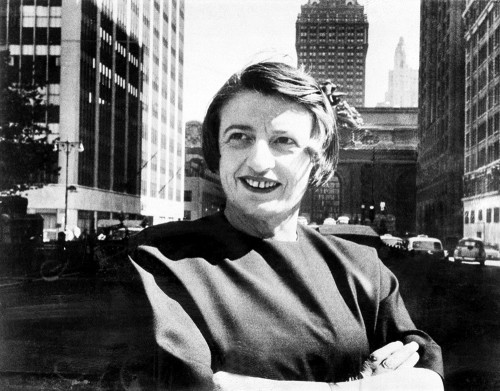
James Day interviewing Ayn Rand in 1974. In addition to explaining her Objectivist claptrap, Rand names Victor Hugo as her greatest literary influence.

Tags: , ,

“Bada-bing.”

From “Cyber-Neologoliferation,” James Gleick’s fun 2006 New York Times Magazine article about his visit to the offices of the Oxford English Dictionary, an explanation of how the word “bada-bing” came to be listed in the OED:

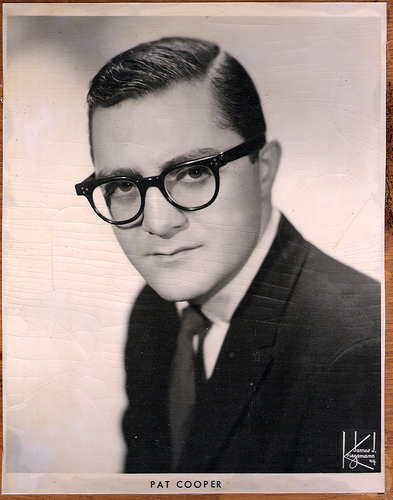
“Still, a new word as of September is bada-bing: American slang ‘suggesting something happening suddenly, emphatically, or easily and predictably.’ The Sopranos gets no credit. The historical citations begin with a 1965 audio recording of a comedy routine by Pat Cooper and continue with newspaper clippings, a television news transcript and a line of dialogue from the first Godfather movie: ‘You’ve gotta get up close like this and bada-bing! you blow their brains all over your nice Ivy League suit.’ The lexicographers also provide an etymology, a characteristically exquisite piece of guesswork: ‘Origin uncertain. Perh. imitative of the sound of a drum roll and cymbal clash…. Perh. cf. Italian bada bene mark well.’ But is bada-bing really an official part of the English language? What makes it a word? I can’t help wondering, when it comes down to it, isn’t bada-bing (also badda-bing, badda badda bing, badabing, badaboom) just a noise? ‘I dare say the thought occurs to editors from time to time,’ Simpson says. ‘But from a lexicographical point of view, we’re interested in the conventionalized representation of strings that carry meaning. Why, for example, do we say Wow! rather than some other string of letters? Or Zap! Researching these takes us into interesting areas of comic-magazine and radio-TV-film history and other related historical fields. And it often turns out that they became institutionalized far earlier than people nowadays may think.'”

Tags: ,

From Kevin Kelly’s 1994 book, Out of Control: The New Biology of Machines, Social Systems, and the Economic World, which examined, among other things, how hive behavior in insects might be replicated in humans connected by technology:

“Ants, too, have hive mind. A colony of ants on the move from one nest site to another exhibits the Kafkaesque underside of emergent control. As hordes of ants break camp and head west, hauling eggs, larva, pupae — the crown jewels — in their beaks, other ants of the same colony, patriotic workers, are hauling the trove east again just as fast, while still other workers, perhaps acknowledging conflicting messages, are running one direction and back again completely empty-handed. A typical day at the office. Yet, the ant colony moves. Without any visible decision making at a higher level, it chooses a new nest site, signals workers to begin building, and governs itself.

The marvel of ‘hive mind’ is that no one is in control, and yet an invisible hand governs, a hand that emerges from very dumb members. The marvel is that more is different. To generate a colony organism from a bug organism requires only that the bugs be multiplied so that there are many, many more of them, and that they communicate with each other. At some stage the level of complexity reaches a point where new categories like ‘colony’ can emerge from simple categories of ‘bug.’ Colony is inherent in bugness, implies this marvel. Thus, there is nothing to be found in a beehive that is not submerged in a bee. And yet you can search a bee forever with cyclotron and fluoroscope, and you will never find the hive.”

Tags:

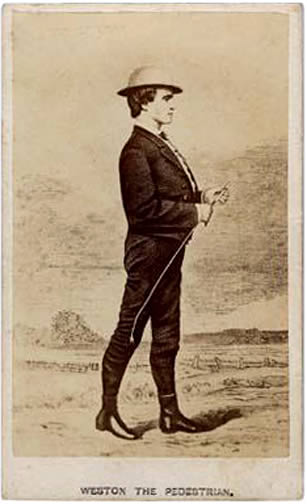
If you read this blog with any regularity you can understand that a story about the most famous pedestrian of the 1870s might have a special place in my heart. Still, this Grantland article by Brian Phillips about a walking wonder named Edward Payson Weston is wonderful on its own merits. The opening:

“In the summer of 1856, Edward Payson Weston was struck by lightning and fired from his job at the circus. He was 17 years old and had been traveling with the big top for no more than a few weeks — ‘under an assumed name,’ as he reassured the readers of his 1862 memoir, The Pedestrian. One day, as the troupe’s wagons passed near Tyngsborough, Massachusetts, he was ‘affected by a stroke of lightning’ and nearly killed. Nineteenth-century circus managers were about as tenderhearted as you would expect when it came to physical infirmity. When Weston was too sick to perform in Boston a few days later, he was unceremoniously sacked.

For most of us, being hit by lightning and kicked out of the circus would be an extraordinary turn of events. For Weston, it was a pretty typical week. Weston, whose story is recounted in the spectacularly entertaining book A Man in a Hurry, by the British trio of Nick Harris, Helen Harris, and Paul Marshall, lived one of those fevered American lives that seem to hurtle from one beautiful strangeness to the next. By his mid-teens, he had already: worked on a steamship; sold newspapers on the Boston, Providence, and Stonington Railroad; spent a year crisscrossing the country with the most famous traveling musicians in America, the Hutchinson Family Singers, selling candy and songbooks at their concerts; and gone into business for himself as a journalist and publisher. In his 20s and 30s, he somehow became one of the most celebrated athletes in the English-speaking world despite the fact that he was physically unprepossessing — 5-foot-7, 130 pounds, with a body resembling ‘a baked potato stuck with two toothpicks,’ as one journalist wrote — and that his one athletic talent was walking. Just straight-up walking made Weston, for a while, probably the biggest sports star on earth.”

Tags: ,

I was reading Chloe Schama’s New Republic piece about the return of the haunted house as a “character” in modern literature, though the spooky homes are in a different form. During the age of foreclosure, the houses aren’t even often completed–the ghosts are the homes themselves, nothing within them. And what’s scarier really: things abandoned when half-built or fully built? I’d say the former.

With completion comes possibility–for good as well as bad. Every new Frankenstein is frightening, whether it be electricity, the telephone or the Internet, because it will upend certain parts of our lives. But with these upsetting inventions come progress. Without their completion, no “monsters” are unloosed, but we are stunted and stifled. The half-built is stillborn. From Schama’s article:

“What makes the new literary haunted house different is that dreams dry up more quickly, sometimes before they even take root. Modernity means speed, even when it comes to malevolent spirits. These houses are the shells of prematurely stunted hopes, laced with traces of bitterness and regret. Perhaps at no other moment in America’s history have so many of our towns and cities been filled with these kinds of structures, and pulp has put them convincingly on the page.”

Tags:

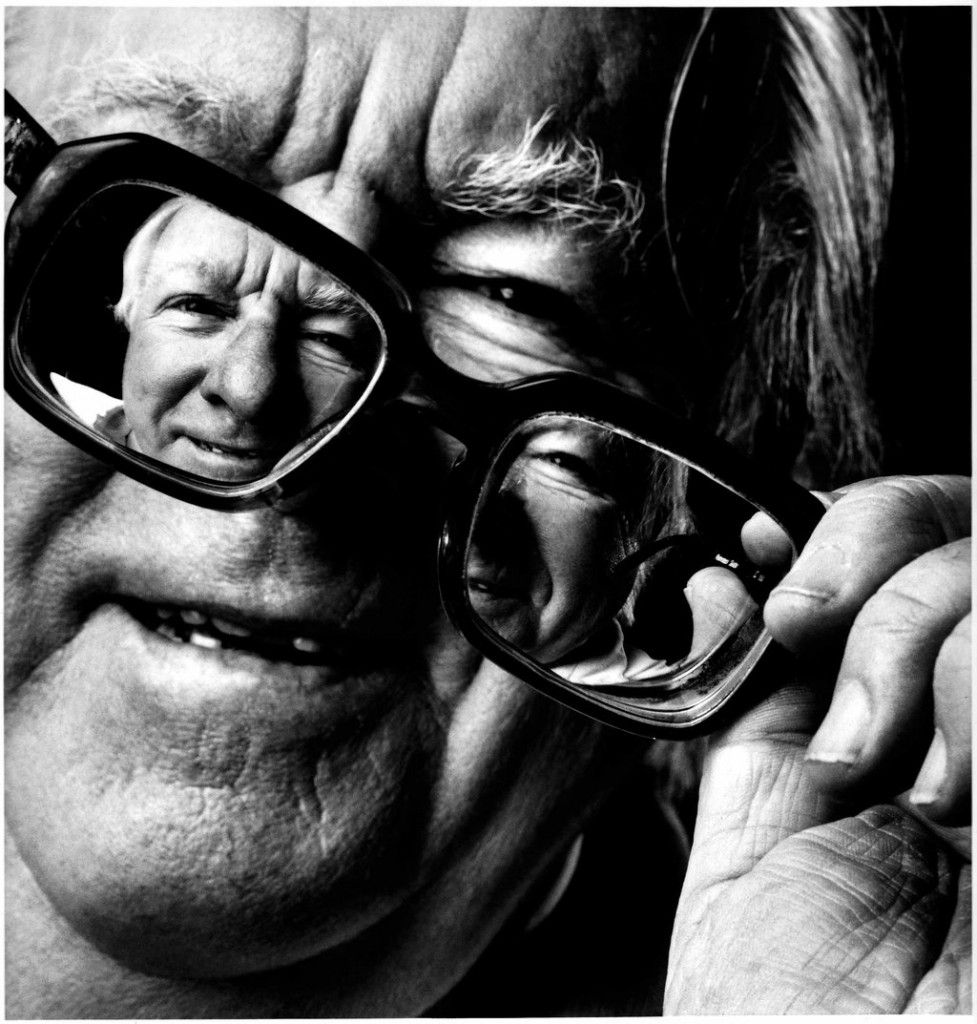
How cool: Ray Bradbury visits Merv Griffin in 1978 to discuss Close Encounters of the Third Kind and the future of humankind. He also reads one of his poems.

Tags: ,

“It turns out very few people saw the gorilla.” (Image by Kabir Bakie.)

From a Five Books interview at the Browser with behavioral economist Dan Ariely, a passage about The Invisible Gorilla, which demonstrates that we see more with our brains than our eyes and that our brains are often “blind”:

Let’s go through the books, and you can tell me what’s important about them and why you like them. The first one on your list is The Invisible Gorilla: How Our Intuitions Deceive Us, by Christopher Chabris and Daniel Simons.

These are the guys who did one of the most important pieces of research in social science, which is to show how little we actually see in the world around us. The basic demonstration of this is a movie in which there are two groups playing basketball. One group is wearing white t-shirts and the other group is wearing black t-shirts. They are passing the ball, and the viewer is asked to count how many times the people in white t-shirts pass the ball to each other. What then happens in the background is a gorilla passes through. He stops right in the middle and thumps his chest. When the clip is over, the viewer is asked, “How many times did you see the people in white t-shirts pass the ball?” Sometimes they get it right, sometimes they get it wrong. But when you ask, ‘How many of you saw the gorilla?’ it turns out very few people saw the gorilla.

I didn’t see the gorilla.

There’s also another demonstration in the book that I really like. This involves going up to someone on a campus with a map and saying, ‘Excuse me, can you help me figure out how to get to the student centre?’ They take the map from your hand and start explaining it to you. While they’re explaining, two people in workmen’s clothes come between you with a door. For a moment, they obscure your view. What the person you’ve asked for directions doesn’t know is that you’re going away. You’re walking off with the door and a new person is standing in front of them. The question is, do people notice this change? And the answer is, again, no.

These are findings that are incredibly powerful and important. We think we see with our eyes, but the reality is that we largely see with our brains. Our brain is a master at giving us what we expect to see. It’s all about expectation, and when things violate expectation we are just unaware of them. We go around the world with a sense that we pay attention to lots of things. The reality is that we notice much less than we think. And if we notice so much less than we think, what does that mean about our ability to figure out things around us, to learn and improve? It means we have a serious problem. I think this book has done a tremendous job in showing how even in vision, which is such a good system in general, we are poorly tooled to make good decisions.”

Tags:

I don’t think people should be exalted, any of us. No statues should be built. Even the best of us are disappointing–small and petty and vain and vengeful. We often take out our unhappiness on others. Even when being seemingly generous–celebrating our country, our community, our family, our friends–we’re often just celebrating ourselves. And we should never do that. We should remain humble.

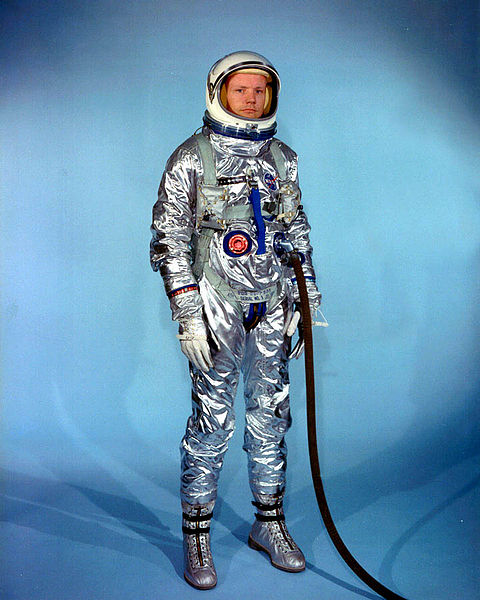
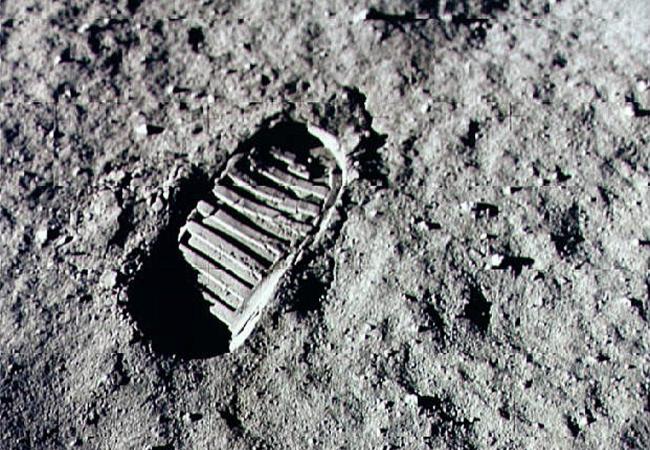
Neil Armstrong was just flesh and bones like the rest of us. He had his bad days and his flaws. But it’s amazing that he displayed such humility while accomplishing so much and braving every challenge. Not everyone can afford to be so modest. Some people have so many strikes against them that they have to convince everyone else–even themselves–that they belong. But it’s great that the one of us who went the furthest, and got there first, stayed so down-to-earth. Neil Armstrong was above and beyond, and I’m not only talking about atmosphere and stratosphere. 

From Oriana Fallaci’s 1966 book about the space program, If the Sun Dies:

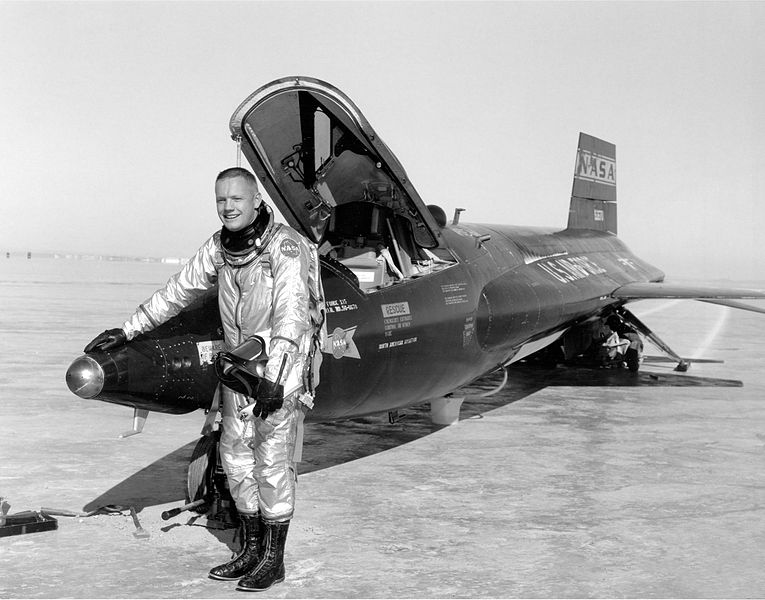
“The third old man was thirty-four and looked like John Glenn’s young brother: the same freckles, the same fair coloring, the same ease; he had even been born in Ohio. Nevertheless certain things distinguished him from John Glenn–his lack of vivacity, his diplomacy and his shoulders that were extraordinarily rounded for such a strong physique. His mouth was ironical, but an irony full of caution. His voice was quiet, his movement economical. His name was Neil Armstrong and they picked him with the second group. The most interesting piece of information about him, for me, was that he didn’t have a service background. The only astronaut civilian I was to meet. And perhaps because of this he entered like someone visiting the dentist. And I felt indeed like a dentist, I was tempted to ask: Is it a molar that hurts or a canine? I would not have been at all surprised if he had answered: ‘No, Doctor, it’s an incisor.’ Sound track:

‘What a fine thing, Mr. Armstrong! You’re not from the service!’

‘I came from NASA, where I was an electronics engineer and a jet test pilot. It isn’t different. I mean, I’ve got as much discipline as the others and discipline is the main thing you need if you’re going into space. Besides, the reason they pick servicemen isn’t because they’re more suitable than civilians; they pick them because they’ve got them all neatly packaged and pre-selected so it’s easier to dig up the right man. You know everything about a serviceman, including how far you can trust him. But they knew everything about me too: I’ve been with NASA for several years.’
‘However, becoming an astronaut must give you great joy.’

‘I wouldn’t know. Let me think….”

‘Haven’t you thought about it before?’

‘To me it was simply being transferred from one office to another. I was in one office and then they moved me into this one. Well, yes, I suppose I was pleased. It’s always nice to gain in status. But I don’t have any personal ambition. My one ambition is to contribute to the success of this program. I’m no romantic.’

‘Do you mean that you don’t have a taste for adventure?’

‘For heaven’s sake, I loathe danger, especially if it’s useless; danger is the most irritating aspect of our job. How can a perfectly normal technological fact be turned into adventure? And why should steering a spacecraft be risking your life? It would be as illogical as risking your life when you use an electric mixer when making a milkshake. There should be nothing dangerous about making a milkshake and there should be nothing dangerous about steering a spacecraft. Once you’ve granted this concept, you can no longer think in terms of adventure, the urge of going up just for the sake of going up…’

I observed his mouth. Perhaps not the molar, not the canine, nor the incisor. It was probably the wisdom tooth.

‘Mr. Armstrong, I know somebody who would go up even if he knew he wouldn’t come back. Just for the urge to go up.’

‘Among us astronauts?’

‘Among you astronauts.’

‘I rule him out. If you knew him, he’d be a boy, not an adult.’

‘He’s an adult, Mr. Armstrong.’

‘But who?’

‘It doesn’t matter. Let’s talk about you. Leaving aside the milkshake, I suppose you’d be sorry not to go up?’

‘Yes, but I wouldn’t get sick about it. I don’t understand the ones who are so anxious to be the first. It’s all nonsense, kid stuff, just romanticism unworthy of our rational age. I rule out the possibility of agreeing to go up if I thought I might not come back, unless it were technically indispensable. I mean, testing a jet is dangerous but technically indispensable. Dying in space or on the Moon, is not technically indispensable and consequently if I had to choose between death while testing a jet and death on the Moon, I’d choose death while testing a jet. Wouldn’t you?’

No, it wasn’t the wisdom tooth that hurt. That one was healthy. It was something else, Father, a lack of pain, I would say, a good cry such as children have when they want the Moon, no matter if they have to die to get the Moon, that exquisite infancy which stays in us, as a gift, even when we are adults with all our teeth, our prudence.

‘No, confronted with such a dilemma, I’d unhesitatingly choose to die on the Moon: at least I’ll get a look at the Moon.’

‘Kid stuff. Nonsense. Die on the Moon! To get a look at the Moon! If it were a matter of staying there for a year or two…maybe…I don’t know. No, no, it would still be too high a price to pay because it’s senseless.’

‘Did you spend all your young years at NASA, Mr. Armstrong?’

‘I spent them traveling: Europe, Asia, South America. So I saw what there was to see, I understood what there was to understand, and here I am.’

‘Were you in the war, Mr. Armstrong?’

‘Sure, I was in Korea. Seventy-eight combat missions. I’d be lying if I said they’d done me any good.’

‘Do you have any children, Mr. Armstrong?’

‘Sure. One seven and one two. How could I not have children at my age?’

‘Ten minutes,’ said the Bureaucrat. ‘Hurry!’

He stood up. ‘I’d better say goodbye. I have to go in the centrifuge.’

‘I don’t envy you, Mr. Armstrong.’

‘Yes, it’s very disagreeable: perhaps the thing I hate most. But indispensable.’

‘Time’s up! Stop!’

‘Goodbye.’

‘Goodbye.'”
Tags: ,

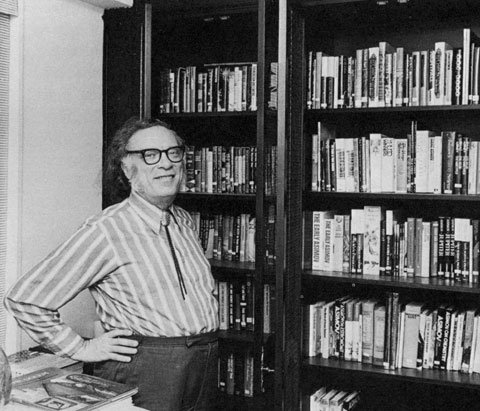
Asimov and his blazer (wow!) interviewed by Bill Boggs in 1982. Have I ever mentioned that I have read almost no science fiction? ‘Tis true.

In 1984, Boggs welcomed Heller, who will always be remembered for Catch-22, but should also be remembered for Something Happened.

Tags: , ,

A section from a great bundle of ideas about the future of books presented by China Miéville in a lecture at the Edinburgh International Book Festival:

“In fact what’s becoming obvious – an intriguing counterpoint to the growth in experiment – is the tenacity of relatively traditional narrative-arc-shaped fiction. But you don’t radically restructure how the novel’s distributed and not have an impact on its form. Not only do we approach an era when absolutely no one who really doesn’t want to pay for a book will have to, but one in which the digital availability of the text alters the relationship between reader, writer, and book. The text won’t be closed.

It never was, of course – think of the scrivener’s edit, the monk’s mashup – but it’s going to be even less so. Anyone who wants to shove their hands into a book and grub about in its innards, add to and subtract from it, and pass it on, will, in this age of distributed text, be able to do so without much difficulty, and some are already starting.

One response might be a rearguard clamping down, as in the punitive model of so-called antipiracy action. About which here I’ll only say – as someone very keen to continue to make a living from writing – that it’s disingenuous, hypocritical, ineffectual, misunderstands the polyvalent causes and effects of online sharing, is moribund, and complicit with toxicity.” (Thanks Browser.)

Tags:

“In the 1910s deodorants and antiperspirants were relatively new inventions.” (Image by Terêza Tenório.)

I’ve sat next to a lot of you on the subway this summer, and I don’t think it’s an exaggeration to say that you smell like the outhouse behind a diarrhea factory. But things used to be even worse. The opening of Sarah Everts’ Smithsonian article about the birth of the underarm deodorant industry in stanky-assed America:

“Lucky for Edna Murphey, people attending an exposition in Atlantic City during the summer of 1912 got hot and sweaty.

For two years, the high school student from Cincinnati had been trying unsuccessfully to promote an antiperspirant that her father, a surgeon, had invented to keep his hands sweat-free in the operating room.

Murphey had tried her dad’s liquid antiperspirant in her armpits, discovered that it thwarted wetness and smell, named the antiperspirant Odorono (Odor? Oh No!) and decided to start a company.

But business didn’t go well—initially—for this young entrepreneur. Borrowing $150 from her grandfather, she rented an office workshop but then had to move the operation to her parents’ basement because her team of door-to-door saleswomen didn’t pull in enough revenue. Murphey approached drugstore retailers who either refused to stock the product or who returned the bottles of Odorono back, unsold.

In the 1910s deodorants and antiperspirants were relatively new inventions. The first deodorant, which kills odor-producing bacteria, was called Mum and had been trademarked in 1888, while the first antiperspirant, which thwarts both sweat-production and bacterial growth, was called Everdry and launched in 1903.

But many people—if they had even heard of the anti-sweat toiletries—thought they were unnecessary, unhealthy or both.”

••••••••••

Odo-Ro-No TV ad from 1960:

Tags: ,

Having met some venture capitalists over the years, I can tell you their success rate isn’t that high. That’s not because they’re not talented or intelligent. On the contrary. It’s just that most things in life don’t pan out. When they occasionally do, venturers make their mark and live to invest another day. Some get fabulously wealthy–but even they have a pretty high fail rate.

Since being named Mitt Romney’s VP pick, Paul Ryan has attacked President Obama’s stimulus plan in particular and government investments in general. But from lithium-ion battery factories in Michigan to the auto industry to the many alternative energy initiatives througout the country, this administration has largely invested shockingly well, made bold attempts to transform our future and created well-paying jobs that are many grades above Staples cashier. 

David Plotz, who quietly does an excellent job at Slate, examines that other silent success, Obama’s stimulus, in an interview with Michael Grunwald, author of The New New Deal. The opening:

Slate:

What possessed you to write this book?

Michael Grunwald:

I fled Washington for the public policy paradise of South Beach while writing my last book, about the Everglades and Florida, so in 2010 I was only vaguely aware of the Beltway consensus that President Obama’s stimulus was an $800 billion joke. But because I write a lot about the environment, I was very aware that the stimulus included about $90 billion for clean energy, which was astonishing, because the feds were only spending a few billion dollars a year before. The stimulus was pouring unprecedented funding into wind, solar, and other renewables; energy efficiency in every form; advanced biofuels; electric vehicles; a smarter grid; cleaner coal; and factories to make all that green stuff in the U.S.

It was clearly a huge deal. And it got me curious about what else was in the stimulus. I remember doing some dogged investigative reporting—OK, a Google search—and learning that the stimulus also launched Race to the Top, which was a real a-ha moment. I knew Race to the Top was a huge deal in the education reform world, but I had no idea it was a stimulus program. It quickly became obvious that the American Recovery and Reinvestment Act (the formal name of the stimulus) was also a huge deal for health care, transportation, scientific research, and the safety net as well as the flailing economy. It was about Reinvestment as well as Recovery, and it was hidden in plain view.”

Tags: , , ,

« Older entries § Newer entries »