Books

You are currently browsing the archive for the Books category.

In 1992, AI legend Marvin Minsky believed that by the year 2023 people would be able to download the contents of their brains and achieve “immortality.” That was probably too optimistic. He also thought such technology would only be possible for people who had great wealth. That was probably too pessimistic. From an interview that Otto Laske conducted with Minsky about his sci-fi novel, The Turing Option:

Otto Laske:

I hear you are writing a science fiction novel. Is that your first such work?

Marvin Minsky:

Well, yes, it is, and it is something I would not have tried to do alone. It is a spy-adventure techno-thriller that I am writing together with my co-author Harry Harrison. Harry did most of the plotting and invention of characters, while I invented new brain science and AI technology for the next century.

Otto Laske:

At what point in time is the novel situated?

Marvin Minsky:

It’s set in the year 2023.

Otto Laske: 

I may just be alive to experience it, then …

Marvin Minsky: 

Certainly. And furthermore, if the ideas of the story come true, then anyone who manages to live until then may have the opportunity to live forevermore…

Otto Laske: 

How wonderful …

Marvin Minsky:

 … because the book is about ways to read out the contents of a person’s brain, and then download those contents into more reliable hardware, free from decay and disease. If you have enough money…

Otto Laske: 

 That’s a very American footnote …

Marvin Minsky:

Well, it’s also a very Darwinian concept.

Otto Laske: 

Yes, of course.

Marvin Minsky:

There isn’t room for every possible being in this finite universe, so, we have to be selective …

Otto Laske: 

 And who selects, or what is the selective mechanism?

Marvin Minsky: 

Well, normally one selects by fighting. Perhaps somebody will invent a better way. Otherwise, you have to have a committee …

Otto Laske:  

That’s worse than fighting, I think.”

Tags: ,

From Andrew Hacker’s New York Review of Books critique of a trio of new volumes about predictive powers, including The Signal and the Noise, written by political polling wunderkind Nate Silver:

The Signal and the Noise is in large part a homage to Thomas Bayes (1701–1761), a long-neglected statistical scholar, especially by the university departments concerned with statistical methods. The Bayesian approach to probability is essentially simple: start by approximating the odds of something happening, then alter that figure as more findings come in. So it’s wholly empirical, rather than building edifices of equations. Silver has a diverting example on whether your spouse may be cheating. You might start with an out-of-the-air 4 percent likelihood. But a strange undergarment could raise it to 50 percent, after which the game’s afoot. This has importance, Silver suggests, because officials charged with anticipating terrorist acts had not conjured a Bayesian ‘prior’ about the possible use of airplanes.

Silver is prepared to say, ‘We had some reason to think that an attack on the scale of September 11 was possible.’ His Bayseian ‘prior’ is that airplanes were targeted in the cases of an Air India flight in 1985 and Pan Am’s over Lockerbie three years later, albeit using secreted bombs, plus in later attempts that didn’t succeed. At the least, a chart with, say, a 4 percent likelihood of an attack should have been on someone’s wall. Granted, what comes in as intelligence is largely ‘noise.’ (Most intercepted conversations are about plans for dinner.) Still, in the summer of 2001, staff members at a Minnesota flight school told FBI agents of a Moroccan-born student who wanted to learn to pilot a Boeing 747 in midair, skipping lessons on taking off and landing. Some FBI agents took the threat of Zacarias Moussaoui seriously, but several requests for search and wiretap warrants were denied. In fact, an instructor added that a fuel-laden plane could make a horrific weapon. At the least, these ‘signals’ should have raised the probability of an attack using an airplane, say, to 15 percent, prompting visits to other flight schools.”

Tags: , ,

From an interview at Guernica about technology and art with critic Paul Stephens, a passage about Bob Brown’s proposal eight decades ago for an e-reader:

Guernica: 

Information overload is a hot topic; we all struggle with being bombarded. You look backwards to Gertrude Stein, Stéphane Mallarmé, Walter Benjamin, T. S. Eliot—at the way the modernists who were also on the cusp of a technology explosion dealt with information and how it was conveyed via new channels. Some, like Stein, embraced this bombardment; others, like Pound and Eliot, did not. How can we return to Stein and relate that to having an iPhone?

Paul Stephens: 

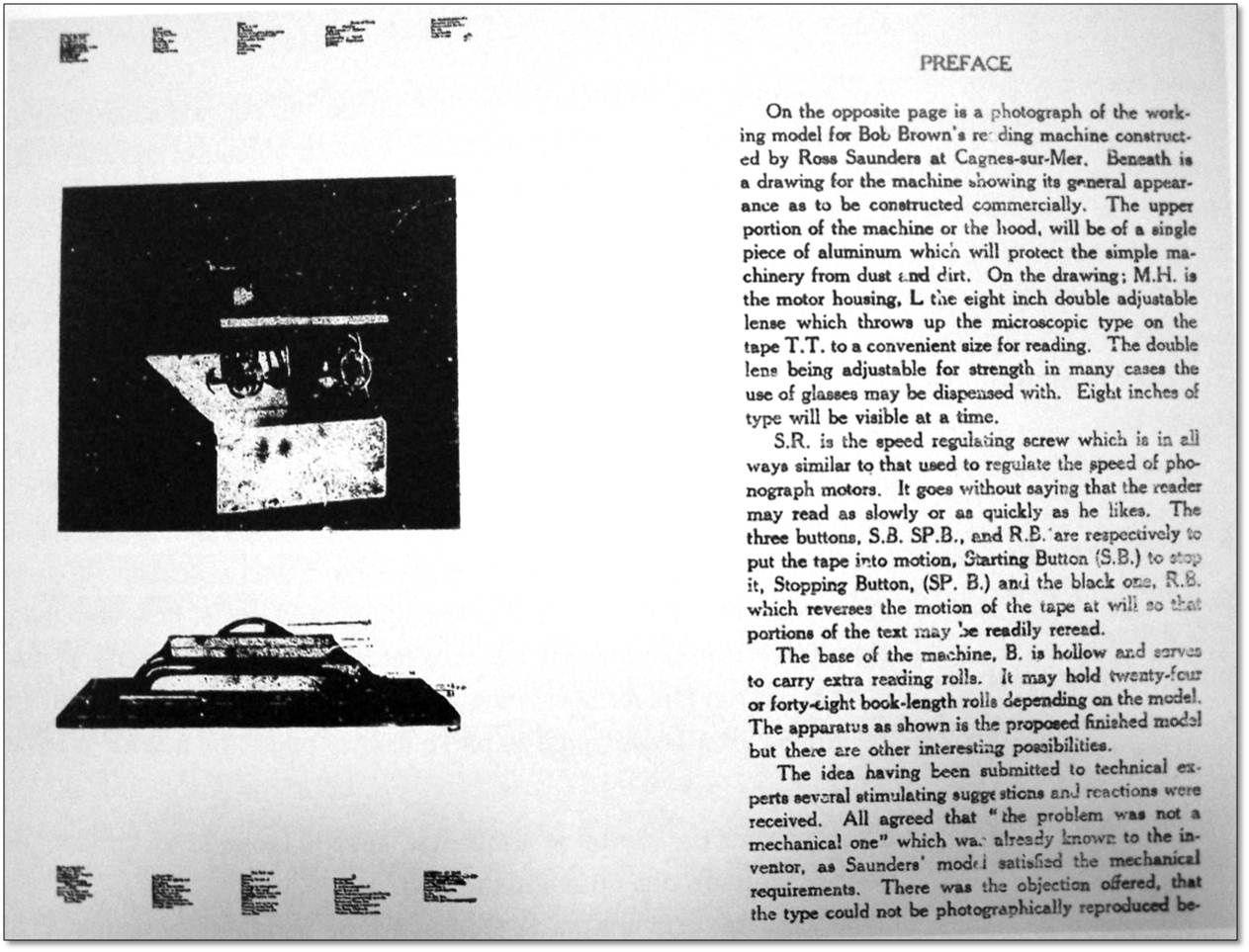
A major impetus for the book was my research on Bob Brown, who described a pocket reading machine in 1930. A friend and disciple of Stein, Brown was thinking about the new technologies of microfilm and sound film, and the possibility that it would soon be possible to transmit poem texts instantaneously by means of radio. He put together an anthology that asked poets to write what he called ‘readies,’ parallel to the ‘talkies,’ which had just revolutionized film. The anthology included writers like Stein, Pound, William Carlos Williams, and the Italian futurist F.T. Marinetti, and probed how poetry would change if it were sped up. He was never able to construct the device, but did publish the anthology.

Amazingly enough, it was prophetic of some of the developments we’ve seen with smartphones. For instance, they got rid of punctuation and compressed words—a lot of the poems looked like textese, a sub-language we’re now increasingly familiar with. Bob Brown claimed to get the idea from reading Stein’s Tender Buttons on Wall Street in 1914 and looking at a stock ticker at the same time, which is just mind-blowing to me. The stock ticker was an extraordinary invention—essentially a horizontal scroll that conveyed instantaneous price data over long distances in real time, not unlike Stein’s notion of a ‘continuous present.’ The fractured, cubist syntax of Stein seemed like language in motion to Brown. He thought her modernist experiments were a parallel development to reading facilitated by machines, and he predicted that our pace of reading would accelerate.”

Tags: ,

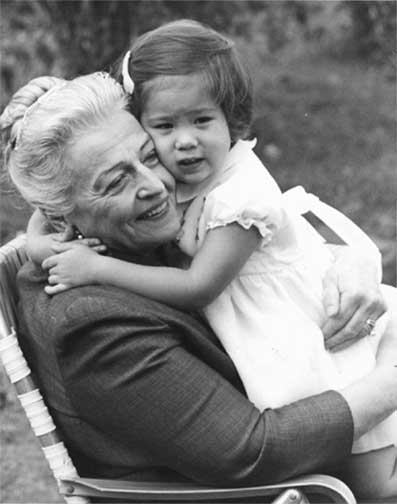
It’s amazing that Pearl S. Buck won a Nobel Prize for Literature and Tolstoy didn’t. But this 1966 appearance on Merv Griffin’s talk show by the writer is still a rare treat. She mostly discusses her work helping Korean children born to American fathers during the war and her feelings about the folly of Communism.

Tags: ,

The Browser has an excellent Five Books Interview with psychology professor Susan Gelman on the topic of essentialism, or the way we categorize people and things we encounter based on biases we believe to be facts. One of Gelman’s choices is William March’s novel, The Bad Seed, which allows her to address the idea of so-called inherited evil. An excerpt:

Question:

Let’s go on to The Bad Seed, a 1954 thriller about a little girl who turns out to be a serial killer.

Susan Gelman:

I love this book. I have to confess that in high school I had the lead in a play that we put on of The Bad Seed. I was the evil girl. So I’ve been thinking about this one for a long time. It’s really essentialism personified. What makes it essentialism is that this girl, who outwardly seems very sweet and innocent, in actuality is bad to the core. So there’s this appearance/reality distinction that is a big piece of essentialism. Also, the reason that she’s evil is that she was born that way – it was passed down from her grandmother. Her grandmother was a serial killer who got executed. The serial killer’s daughter was a very young child at the time. She was adopted and didn’t even remember any of this in more than the vaguest way. She was a perfectly fine person: The evil skipped a generation, and it was her own daughter who turned out to be this bad seed. The idea is that your moral character can be in-born. This little girl was raised in a wonderful environment, but that had no effect. That the evil is passed down from generation to generation is a very essentialist idea. It was actually controversial. If you read some reviews when the book came out, some of the reviewers really objected to that aspect.

Question:

What’s your view?

Susan Gelman:

As far as I understand it, there is no evidence that criminality is passed down through the genes. It’s a fiction, but it’s one that resonates with people. This is not supposed to be a work of science fiction. It works well for the plot of the book: The mother feels guilty for passing this along to her daughter. In some ways she feels her daughter is not at fault, because she doesn’t know any better. This is just the way she was born. What’s interesting to me is that that’s considered a plausible underlying theme that a reader can perfectly well accept. It’s a nice illustration of the common-sense aspect of essentialism.”

Tags: ,

Oliver Sacks recently sat for an interview with Tim Adams at the Guardian to discuss his new book, Hallucinations. One exchange concerning a shift toward rationalism in the last 200 years, although we continue to create mundane ways to distance ourselves from facts:

Guardian:

It seems that such visual disorders at certain points in history have been more ‘believable’ and also, therefore, more commonly noted?

Oliver Sacks:

Yes, in other places and at other times, hallucinations were far more acceptable. Up to about 1800, people were allowed to have visions or to hear voices. They were seen to have some external spiritual reality; they were ghosts or angels or demons. The word hallucination only really became a pejorative at the end of the 18th or early 19th century. We still associate it with madness. But how those who hallucinate understand what they see also changes. We are more likely to see UFOs and aliens when people in earlier times would see angels.”

Tags: ,

I mentioned Jon Gertner’s Bell Lab history, The Idea Factory, a couple of times recently. For me, the most interesting parts are the passages about Information Theory mastermind Claude Shannon. As the author points out, Shannon’s co-workers were often years ahead of the curve in their work, but Shannon himself was working decades in the future. In addition to knowing what the world would look like generations in advance, Shannon, a wisp of a man, was deeply eccentric and fond of games and parlor tricks. He designed the first computer chess program and the initial computerized mouse that “learned” more every time it went through a maze. (Like this, but 60 years ago.) His wife, Betty, was always challenged when choosing a Christmas present for him because what do you get for the man who has everything–in his head? An excerpt from Gertner’s book, which recalls how the scientist turned Bell Labs into a fucking clown car:

“One year, Betty gave him a unicycle as a gift. Shannon quickly began riding; then he began building his own unicycles, challenging himself to see how small he could make one that could still be ridden. One evening after dinner at home in Morristown, Claude began to spontaneously juggle three balls, and his efforts soon won him some encouragement from the kids in the apartment complex. There was no reason, as far as Shannon could see, why he shouldn’t pursue his two new interests, unicycling and juggling, at Bell Labs, too. Nor was there any reason not to pursue them simultaneously. When he was in the office, Shannon would take a break from work to ride his unicycle up and down the long hallways, usually at night when the building wasn’t so busy. He would nod to passerby, unless he was juggling as he rode. Then he would be lost in concentration. When he got a pogo stick, he would go up and down the hall on that, too.

Here, then, was a picture of Claude Shannon, circa 1955, a man–slender, agile, handsome, abstracted–who rarely showed up on time for work, who often played chess or fiddled with amusing machines all day; who frequently went down the halls juggling or pogoing, and who didn’t seem to care, really, what anyone thought of him or his pursuits. He did what was interesting. He was categorized, still, as a scientist. But it seemed obvious that he had the temperament and sensibility of an artist.”

Tags: , ,

Societies are prone to rampant, unreported abuse of their most vulnerable whenever they’re so repressed and authoritarian that you’re not allowed to say the truth aloud, when any person or group is considered sacred. Anyone in 1960 or so who had known about the Catholic Church’s child-sex ring would have been torn to shreds by media and institution alike if they had dared to blow the whistle. Protecting the accepted order of things was given preference over protecting children.

Families are no different. Their “rulers” can also be savage if there are no checks and balances. A gigantic movie star like Joan Crawford could do as she pleased in a buttoned-down America as long as she gave the public the face it wanted. And the result was terrible child abuse. Christina Crawford, who shocked the nation with her book Mommie Dearest in 1978, was attacked even then for presenting the facts. Some people still wanted the lie. Here she is interviewed by Phil Donahue that same year.

Tags: , ,

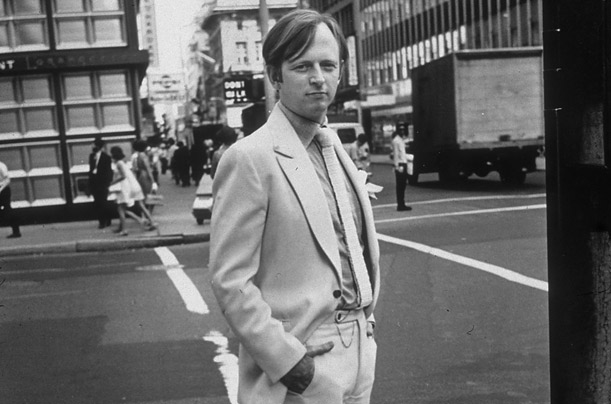
Quintessential New York writer Tom Wolfe actually has quite a history on the West Coast as well. From Michael Anton’s excellent City Journal consideration of Wolfe’s California experiences, the moment Wolfe recognized the richness of Left Coast subcultures:

“It started by accident. Wolfe was working for the New York Herald Tribune, which, along with eight other local papers, shut down for 114 days during the 1962–63 newspaper strike. He had recently written about a custom car show—phoned it in, by his own admission—but he knew there was more to the story. Temporarily without an income, he pitched a story about the custom car scene to Esquire. ‘Really, I needed to make some money,’ Wolfe tells me. ‘You could draw a per diem from the newspaper writers’ guild, but it was a pittance. I was in bad shape,’ he chuckles. Esquire bit and sent the 32-year-old on his first visit to the West—to Southern California, epicenter of the subculture.

Wolfe saw plenty on that trip, from Santa Monica to North Hollywood to Maywood, from the gardens and suburbs of mid-’60s Southern California to its dung heaps. He saw so much that he didn’t know what to make of it all. Returning to New York in despair, he told Esquire that he couldn’t write the piece. Well, they said, we already have the art laid in, so we have to do something; type up your notes and send them over. ‘Can you imagine anything more humiliating than being told, ‘Type up your notes, we’ll have a real writer do the piece’?’ Wolfe asks. He stayed up all night writing a 49-page memo—which Esquire printed nearly verbatim.

It’s a great tale, but, one fears, too cute to be strictly true. I ask him about it point-blank. ‘Oh, yes, that’s exactly what happened,’ he says. ‘I wrote it like a letter, to an audience of literally one person’—Esquire managing editor Byron Dobell—’with all these block phrases and asides. But at some point in the middle of the night, I started to think it might actually be pretty good.’

That piece—’The Kandy-Kolored Tangerine-Flake Streamline Baby’—represents the first time that Wolfe truly understood and was able to formulate the big idea that would transform him from an above-average feature writer into the premier cultural chronicler of our age. Those inhabiting the custom car scene were not rich, certainly not upper-class, and not prominent— indeed, they were almost invisible to society at large. Wolfe described his initial attempt to write the story as a cheap dismissal: ‘Don’t worry, these people are nothing.’ He realized in California that he had been wrong. These people were something, and very influential within their own circles, which were far larger than anyone on the outside had hitherto noticed.

‘Max Weber,’ Wolfe tells me, ‘was the first to argue that social classes were dying everywhere—except, in his time, in England—and being replaced by what he called ‘status groups.’ ‘ The term improves in Wolfean English: ‘Southern California, I found, was a veritable paradise of statuspheres,’ he wrote in 1968. Beyond the customizers and drag racers, there were surfers, cruisers, teenyboppers, beboppers, strippers, bikers, beats, heads, and, of course, hippies. Each sphere started off self-contained but increasingly encroached on, and influenced, the wider world.

‘Practically every style recorded in art history is the result of the same thing—a lot of attention to form plus the money to make monuments to it,’ Wolfe wrote in the introduction to his first book. ‘But throughout history, everywhere this kind of thing took place, China, Egypt, France under the Bourbons, every place, it has been something the aristocracy was responsible for. What has happened in the United States since World War II, however, has broken that pattern. The war created money. It made massive infusions of money into every level of society. Suddenly classes of people whose styles of life had been practically invisible had the money to build monuments to their own styles.’ If Wolfe’s oeuvre has an overarching theme, this is it.'”
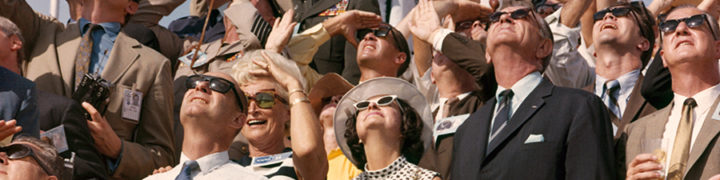

Tags: ,

The Financial Times published its “Best Books of 2012 list today. The contrarian libertarian Peter Thiel chose Sonia Arrison’s 100 Plus, a volume about the longevity boom that’s likely in our near future. The book asserts that “the first person to live to 150 years has probably already been born.” Thiel’s blurb:

“As our parents and grandparents live longer lives, they also contend with diseases and indignities. Many question whether we should want to live longer, to say nothing of for ever. In 100 Plus (Basic Books), Sonia Arrison answers definitively: longer lives and healthier lives are the same goal. The greatest threat to our quality of life in old age comes from complacent acceptance of the inevitability of decay; if you think something will break down anyway, why bother fixing it? Arrison demolishes every argument for fatalism.”

Tags: ,

The opening paragraphs of Thomas Nagel’s review of a pair of just-published volumes about morality in the New York Review of Books:

“Human beings want to understand themselves, and in our time such understanding is pursued on a wide front by the biological, psychological, and social sciences. One of the questions presented by these forms of self-understanding is how to connect them with the actual lives all of us continue to lead, using the faculties and engaging in the activities and relations that are described by scientific theories.

An important example is the universal human phenomenon of morality. Even if we come to accept descriptive theories of the different forms of morality based on evolutionary biology, neuroscience, or developmental and social psychology, each of us also holds specific moral views, makes moral judgments, and governs his conduct and political choices partly on the basis of those attitudes. How do we combine the external descriptive view of ourselves provided by empirical science with the active internal engagement of real life?”

Tags:

Penn Jillette: A juggler or something.


I’m always overjoyed whenever I see Penn Jillette, but I soon realize that Andre the Giant has not, in fact, been reincarnated, and I return to sitting shiva.

Penn has written a new book, Every Day Is An Atheist Holiday!, which is being published to coincide with the anniversary of the bombing of Pearl Harbor. This time he’s named names. Considering what a high-powered show-biz career Penn’s had, you know it’s going to be juicy. The following questions are sure, at last, to be answered: Which, if any, of the Flying Karamazov Brothers have had gonorrhea? Does Brother Theodore smell like cabbage or does cabbage smell like Brother Theodore? Is it true Al Goldstein broke his hip while falling off of Gloria Leonard at the Ben-Gurion Retirement Center? Wow, and that’s just the beginning! Randomly open this book to any page, begin reading and you’ll quickly suspect it was that quiet fuck Teller who had all the brilliant ideas.

Penn also spills about his faux TV boss, Donald Trump, a bigoted, orange-headed buffoon who hasn’t been told the truth about himself very often. Apparently, Trump is upset that some blogs repeatedly ridicule him. From the New York Daily News:

The magician calls Trump’s boardroom behavior “free-form rants in front of a captive audience,” where the billionaire would whine “about articles written about him and defend himself against charges made, as far as I could tell, by random bloggers with a few hundred hits. Attacks that could have no impact on his life at all. It sounded like this cat was Googling himself, being bugged by what was written, and then defending himself to people who were trying to improve their careers by playing a TV game with him.”•

Tags: , ,

In a Q&A with Time, Oxford psychologist Kevin Dutton points out, among other things, that not all psychopaths are violent. Dutton has authored the new book, The Wisdom of Psychopaths. An excerpt in which he shares his belief that his father was a non-violent psychopath:

“Question:

You write that you think your father was a psychopath…

Kevin Dutton:

It sounds like a crazy thing to say, but there’s no doubt at all about it. He was a nailed down psychopath.  He wasn’t violent. He was a market trader [in the U.K., a person who sells things at an open-air street market].  One of the central messages of the book is that you don’t need to be violent to be a psychopath.  My dad was ruthless, fearless and also extremely charming. He could have sold shaving cream to the Taliban.

Question:

So what would be an example of his psychopathic behavior?

Kevin Dutton:

When I was a kid, probably about 9 or 10 [years old], we went to an Indian restaurant for dinner. Just as my dad was about to pay, he suddenly tinked his spoon against his glass and stood up. The whole restaurant went silent. My dad said, ‘I’d just like to thank you all for coming; some from just round the corner, some from much further afield. You’re all most welcome to join us for a little drinks reception across the road.’

And so an entire restaurant of strangers who had never seen us before were  all applauding wildly because they didn’t want to be seen as gatecrashers. We just took off. He [told me] we’re not going to the pub really and [explained that his] old friend Malcolm had [just opened a new pub across the street].

If you think about the front you need to do that: it’s a whole different kind of personality. On a personal level, I guess I wrote the book to figure out my old man.” (Thanks Browser.)

Tags: ,

In my early Catholic grade-school years, I had to write a one-page book report, and I chose to do it on Dick Gregory’s autobiography, which had this title. That might not be seen as odd today–or perhaps it still is—but a tiny child in all-white school choosing that book was, shall we say, unusual. It was in no way a political statement on my behalf nor was I mischievously trying to use a bad word; I just thought it was an interesting book. (It was co-written by the excellent Robert Lipsyte, by the way.) My teacher, who didn’t need this shit, was uncomfortable. On the positive side: The priests never touched me. 

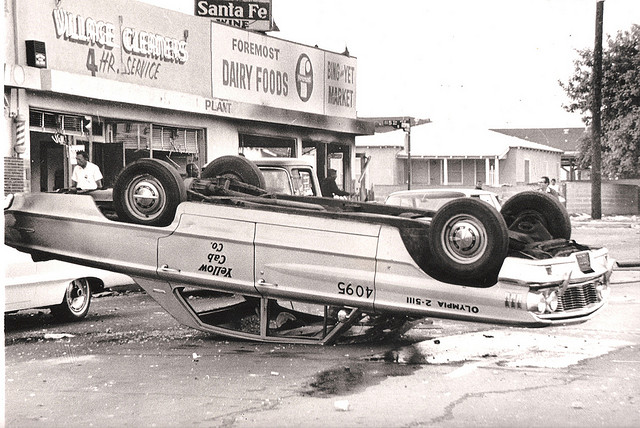
In this 1965 clip, Merv Griffin interviews the civil rights activist / stand-up comedian in the aftermath of the Watts riots.

Tags: , ,

Slavoj Žižek, briilliant and buffoonish, offers a tour of his humble abode. The kitchen, in particular, is special. (Thanks Biblioklept.)

Tags:

Gore Vidal regularly diminished other writers-often really talented ones–as a means of elevating himself. It’s an immature and cheap way of making yourself seem superior. (It’s the same thing that Chevy Chase, that miserable prick, does with fellow comedians). In a 2006 interview conducted by Jon Wiener that’s published at Los Angeles Review of Books, Vidal used this tactic on Truman Capote and Thomas Pynchon, two writers who were his betters and who turned out works that will outlast anything he did. Not even close. An excerpt:

“Jon Wiener: 

One of the things they do at community colleges is teach writing. I think there are programs everywhere now. At my school, U.C. Irvine, we have an undergraduate major called ‘Literary Journalism.’ It started only a couple of years ago, but it already has over 200 majors, and if there are 200 at Irvine, there is a similar number at a hundred other schools. This means hundreds of thousands of students are studying to be writers. What do you make of this?

Gore Vidal: 

We have Truman Capote to thank for that. As bad writers go, he took the cake. So bad was he, you know, he created a whole new art form: the nonfiction novel. He had never heard of a tautology, he had never heard of a contradiction. His social life was busy. To have classes in fiction — that really is hopeful, isn’t it. People can go to school and bring in physics. The genius of Thomas Pynchon’s Gravity’s Rainbow: he had to take all of his first year courses at, what was it, Cornell? One of his teachers was Nabokov. And everything he had in his first year’s physics went in to Gravity’s Rainbow. Whether it fit in or not, it just went in there. That’s one way of doing it.”

Tags: , , ,

Merv Griffin interviews John le Carré in 1965, during the frost of the Cold War.

Tags: ,

Miami has the greatest concentration of Art-Deco architecture of any city (though not the most, overall) because it was so unattractive a place to builders for for so long. It was left to debilitate, though it turned out to be surprisingly benign neglect. No one wanting to build there for decades allowed for the survival of those gorgeous old buildings that had passed into disrepair. They otherwise most certainly would have been razed and replaced with lesser structures. By the time Miami was ready to roar back, the citizens realized they possessed unburied treasures. Thus we have modern Miami, an architectural hotspot. Decay–to a point–can be a favor.

Information, like architecture, often requires benign neglect to survive, especially since it’s not always immediately clear what information is most vital. From Sebastian Stockman’s Atlantic article about the history of note-taking:

“Historically, notes were not always well preserved. Pliny the Elder, for instance, took ‘prodigious’ notes, according to the conference’s other co-organizer, Harvard history professor Ann Blair. Pliny would have first made notes on clay tablets before copying them to parchment. But no third copies were made, and we only know that Pliny the Elder was a serious note-taker because Pliny the Younger said so.

The notes that do survive, Blair said, have done so thanks to ‘long periods of benign neglect, combined with crucial moments of careful stewardship’ by various libraries and other institutions. This conference was held in part to highlight such stewardship at many of Harvard’s libraries, and the fact that anyone can now view digitized versions of these annotations here. You can examine high-resolution images of John Hancock’s commonplace book, say, or pages from William James’diary. You might also follow one or more of the guided itineraries through the collections, curated by conference participants and others. (Price’s tour is here; Blair’s is here.)

While there was plenty of fascinating history (Did you know that ‘off the cuff’originally referred not to the practice of extemporaneous speaking, but to a speaker’s surreptitious glance at penciled notes on his starched shirt cuff? Or that Elizabethan-era theater-goers used to crib from plays not the main plot points, but the funniest jokes or the best pick-up lines?), the conference considered the future of note-taking.

Because it does have a future.”

Tags:

The opening of Kwame Anthony Appiah’s New York Review of Books piece about Rorschach readings of politics in the age of Obama:

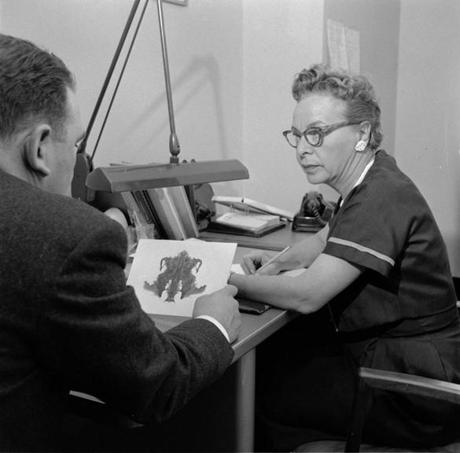
“You know the joke. A psychiatrist shows a patient a series of inkblots. Each time, the patient sees an erotic episode. ‘You seem to be preoccupied with sex,’ the psychiatrist concludes. The patient protests: ‘You’re the one with all those dirty pictures.’ Ask people to read the inkblots of American political life and that result, too, is likely to tell you more about them than it does about what is really going on.

Jamie Barden, a psychologist at Howard University, ran an experiment that demonstrated this very nicely. Take a bunch of students, Republicans and Democrats, and tell them a story like this: a political fund-raiser named Mike has a serious car accident after a drunken fund-raising event. A month later he makes an impassioned appeal against drunk driving on the radio. Now ask them this question: Hypocrite or changed man?

It turned out that people (Democrats and Republicans both) were two and a half times as likely to think Mike was a hypocrite if they were told he belonged to the other party. This experiment only confirms a wide body of work in social psychology demonstrating that we’re biased against people we take to be members of a group that isn’t our own, more biased if we think of them as the opposition. That’s not something most of us needed a psychologist to tell us, of course. The news is not that we are biased, it’s how deeply biased we are.”

Tags:

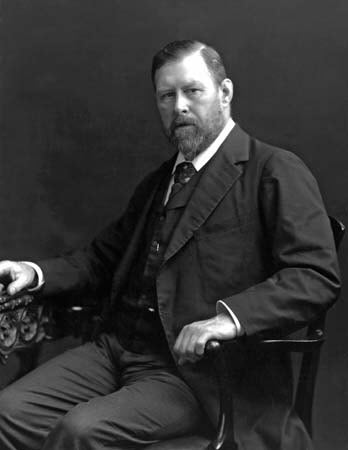
Dracula is of course one of the most famous literary characters ever created, delivered from Bram Stoker’s dark consciousness deeply into our own. Neither Industrial nor Technological Revolutions have been able to erase his vision. It’s not likely you’ve missed the Google Doodle commemorating Stoker’s 165th birthday today. Here’s an excerpt from the first notice of the Irish theater manager’s novel in the Brooklyn Daily Eagle, from the January 15, 1900 issue:

Dracula by Bram Stoker is the name of a book from the pen of the accomplished manager of the Lyceum Theater, London, and of the dramatic companies headed by Sir Henry Irving and Ellen Terry. The publishers are the Doubleday & McClure Company, New York, and the chaste and attractive work of the printer and binder is a worthy setting of the clear thought, the weird imagination and the reverential spirit of a volume of originality, interest and power. The story has been issued both in Great Britain and American for several weeks, but more than acknowledgment for its appearance has not yet been made in many quarters, for it requires, while it rewards, very careful reading, since its point of view is novel, profound and startling.

The Quick and the Dead’–long before, ages before it was the title of an essentially cheap and brief lived story in these states, the product of erotic fancies and anaemic thinking–became the comprehensive summary of the two divisions of humanity which, according to the creed, are to be arraigned at the final assize. The term was thought to be all embracing. Mr. Stoker adds to ‘The Quick and the Dead’ a third lot, whom he calls, for want of a better word, the ‘un-Dead.’ They comprise the vampire class. If not as a whole, at least as many of them are affected by a relation to the race of man. The ‘un-Dead’ are inanimate and powerless by day. They are viciously effective and malignly mobile by night. Of the number of them the book gives neither statement nor intimation. It deals with a housed or castled small colony of them in a mountain fastness of Transylvania, of whom the chief is the Count Dracula, who gives name to the book, a ‘tall man with a long brown beard, very bright eyes, which seemed red in the lamplight; a hard-looking mouth, with very red lips and sharp looking teeth, white as ivory; prodigious strength, his hand actually seemed like a steal vise.’ This he appeared when he whisked the main character up a mountain side to his rocky lair–the proper word is undoubtedly lair. But he is a lightning change artist, and the foregoing description was true of him only when he was acting as his own coachman. In his revealed person, the one in which he figures throughout the book, he is thus described:

‘His face was a strong– a very strong aquiline, with high bridge of the thin nose and peculiarly arched nostrils; with lofty domed forehead, and hair growing scantily round his temples but profusely elsewhere. His eyebrows were very massive, almost meeting over the nose, and with bushy hair that seemed to curl in its own profusion. The mouth, so far as I could see it under the heavy mustache, was fixed and rather cruel-looking, with peculiarly sharp white teeth; these protruded over the lips, whose remarkable ruddiness showed astonishing vitality in a man of his years. For the rest, his ears were pale, and at the tops extremely pointed; the chin was broad and strong, and the cheeks firm though thin. The general effect was one of extraordinary pallor.”

Tags:

Data is key, but perhaps not everything should be quantified. The opening of “Literature Is Not Data,” Stephen Marche’s essay at the L.A. Review of Books:

“BIG DATA IS COMING for your books. It’s already come for everything else. All human endeavor has by now generated its own monadic mass of data, and through these vast accumulations of ciphers the robots now endlessly scour for significance much the way cockroaches scour for nutrition in the enormous bat dung piles hiding in Bornean caves. The recent Automate This, a smart book with a stupid title, offers a fascinatingly general look at the new algorithmic culture: 60 percent of trades on the stock market today take place with virtually no human oversight. Artificial intelligence has already changed health care and pop music, baseball, electoral politics, and several aspects of the law. And now, as an afterthought to an afterthought, the algorithms have arrived at literature, like an army which, having conquered Italy, turns its attention to San Marino.

The story of how literature became data in the first place is a story of several, related intellectual failures.

In 2002, on a Friday, Larry Page began to end the book as we know it. Using the 20 percent of his time that Google then allotted to its engineers for personal projects, Page and Vice-President Marissa Mayer developed a machine for turning books into data. The original was a crude plywood affair with simple clamps, a metronome, a scanner, and a blade for cutting the books into sheets. The process took 40 minutes. The first refinement Page developed was a means of digitizing books without cutting off their spines — a gesture of tender-hearted sentimentality towards print. The great disbinding was to be metaphorical rather than literal. A team of Page-supervised engineers developed an infrared camera that took into account the curvature of pages around the spine. They resurrected a long dormant piece of Optical Character Recognition software from Hewlett-Packard and released it to the open-source community for improvements. They then crowd-sourced textual correction at a minimal cost through a brilliant program called reCAPTCHA, which employs an anti-bot service to get users to read and type in words the Optical Character Recognition software can’t recognize. (A miracle of cleverness: everyone who has entered a security identification has also, without knowing it, aided the perfection of the world’s texts.) Soon after, the world’s five largest libraries signed on as partners. And, more or less just like that, literature became data.”

Tags: ,

I only suffered one little loss in the storm. My 1000 or so books were stored in the basement of a relative’s house, which was in one of those ominous-sounding low-lying, coastal areas. Those volumes now swim with the fishes. That leaves me in possession of only 24 books which I just read, am reading or about to read.

Whenever I lose any possession, I always have a feeling of lightness. Without the weight, I just might float away. Should l use this opportunity to switch to an e-reader for all my in-print reading? Maybe.

I don’t fret at all about the loss. I think it’s amazing I’ve had the opportunity to read so many great books by so many brilliant people. How enriched my life has been because of it. What privilege.

It makes me think of all those in the world who don’t have that opportunity because of poverty or politics or bias. All that wasted potential.

••••••••••

“How many little Albert Eisteins / Cut down in their prime?”:

The new Rolling Stone interview with President Obama is now online and ungated. It was conducted by historian Douglas Brinkley, who is not a bullshitter. An excerpt about Ayn Rand:

Douglas Brinkley:

Have you ever read Ayn Rand?

President Obama:

Sure.

Douglas Brinkley:

What do you think Paul Ryan’s obsession with her work would mean if he were vice president?

President Obama:

Well, you’d have to ask Paul Ryan what that means to him. Ayn Rand is one of those things that a lot of us, when we were 17 or 18 and feeling misunderstood, we’d pick up. Then, as we get older, we realize that a world in which we’re only thinking about ourselves and not thinking about anybody else, in which we’re considering the entire project of developing ourselves as more important than our relationships to other people and making sure that everybody else has opportunity – that that’s a pretty narrow vision. It’s not one that, I think, describes what’s best in America. Unfortunately, it does seem as if sometimes that vision of a ‘you’re on your own’ society has consumed a big chunk of the Republican Party.

Of course, that’s not the Republican tradition. I made this point in the first debate. You look at Abraham Lincoln: He very much believed in self-sufficiency and self-reliance. He embodied it – that you work hard and you make it, that your efforts should take you as far as your dreams can take you. But he also understood that there’s some things we do better together. That we make investments in our infrastructure and railroads and canals and land-grant colleges and the National Academy of Sciences, because that provides us all with an opportunity to fulfill our potential, and we’ll all be better off as a consequence. He also had a sense of deep, profound empathy, a sense of the intrinsic worth of every individual, which led him to his opposition to slavery and ultimately to signing the Emancipation Proclamation. That view of life – as one in which we’re all connected, as opposed to all isolated and looking out only for ourselves – that’s a view that has made America great and allowed us to stitch together a sense of national identity out of all these different immigrant groups who have come here in waves throughout our history.”

Tags: , , , ,

From a 1948 New Yorker piece by Lillian Ross about young Norman Mailer, who was experiencing his first rush of fame with The Naked and the Dead:

“Mailer’s royalties will net him around thirty thousand this year, after taxes, and he plans to bank most of it. He finds apartments depressing and has a suspicion of possessions, so he and his wife live in a thirty-dollar-a-month furnished room in Brooklyn Heights. He figures that his thirty thousand will last at least five years, giving him plenty of time in which to write another book. He was born in Long Branch, New Jersey, but his family moved to Brooklyn when he was one, and that has since been his home. He attended P.S. 161 and Boys High, and entered Harvard at sixteen, intending to study aeronautical engineering. He took only one course in engineering, however, and spent most of his time reading or in bull sessions. In his sophomore year, he won first prize in Story’s college contest with a story entitled ‘The Greatest Thing in the World.’ ‘About a bum,’ he told us. ‘In the beginning, there’s a whole tzimes about how he’s very hungry and all he’s eating is ketchup. It will probably make a wonderful movie someday.’ In the Army, Mailer served as a surveyor in the field artillery, an Intelligence clerk in the cavalry, a wireman in a communications platoon, a cook, and a baker, and volunteered, successfully, for action with a reconnaissance platoon on Luzon. He started writing The Naked and the Dead in the summer of 1946, in a cottage outside Provincetown, and took sixteen months to finish it. ‘I’m slowing down,’ he said. ‘When I was eighteen, I wrote a novel in two or three months. At twenty-one, I wrote another novel, in seven months. Neither of them ever got published.’ After turning in the manuscript of The Naked and the Dead, he and his wife went off to Paris. ‘It was wonderful there,’ he said. ‘In Paris, you can just lay down your load and look out at the gray sky. Back here, the crowd is always yelling. It’s like a Roman arena. You have a headache, and you scurry around like a rat, like a character in a Kafka nightmare, eating scallops with last year’s grease on them.'”

Tags: ,

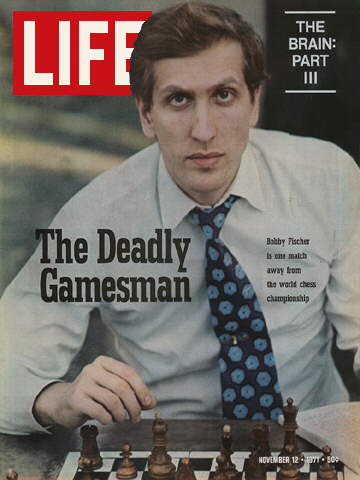
The opening of Jonathan Safran Foer’s Slate piece about Bobby Fischer, which is taken from Jewish Jocks: An Orthodox Hall of Fame

“A Jew wrote The Natural, but has there ever been a natural Jew? Free-spiritedness, joie de vivre, ease in the world—these are not what we do. We do scrappiness, resilience, hard work, self-questioning, self-consciousness, self-destruction, and unflappable will. This applies especially to our athletes, many of whom were not given the best of genetic toolboxes. Most great Jewish athletes have at least this in common: they overcome God’s gifts.

Not a jock, and not a Jew by any definition richer than heredity, Bobby Fischer was the quintessential Jewish Jock. He worked harder than any of his peers. He attempted to conceal his insecurity behind an ego built for 20, and his self-love behind self-hatred behind self-love. And perhaps more than any human who has ever lived, he kvetched: The board is too reflective, the presence of breathing humans too distracting, the high-frequency sounds—which only he and Pomeranians could detect—made game play utterly impossible. Some loved him for his loony obstinacy. Most didn’t.

Contrary to our notions of a chess prodigy and the accepted version of Bobby Fischer’s biography, he was not magnificent from the start. He had to learn, practice, and mature. As an adolescent in Brooklyn, he developed an unusually strong passion for a game that he was not unusually good at. (Children his age regularly beat him.) While he did clearly come into some innate prodigious talent—hard work might unleash genius, but it never creates it—what distinguished him, both in his formative years and through his career, was his single-minded, obsessive devotion to the game. He was known to practice 14 hours a day, and fall asleep with one of his several hundred chess books and journals on his chest. (‘I give 98 percent of my mental energy to chess,’ he once said. ‘Others give only 2 percent.’) Like a good Jewish boy, he outworked his peers and brought the A home to Mama. And like a good Jewish boy, he couldn’t stand Mama—her politics, priorities, relationship to money, or religion.

He got better. And better. “

  • To see all the other Bobby Fischer posts, go here.

Tags: ,

« Older entries § Newer entries »