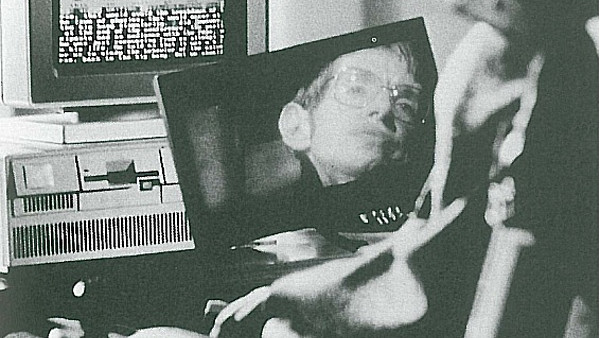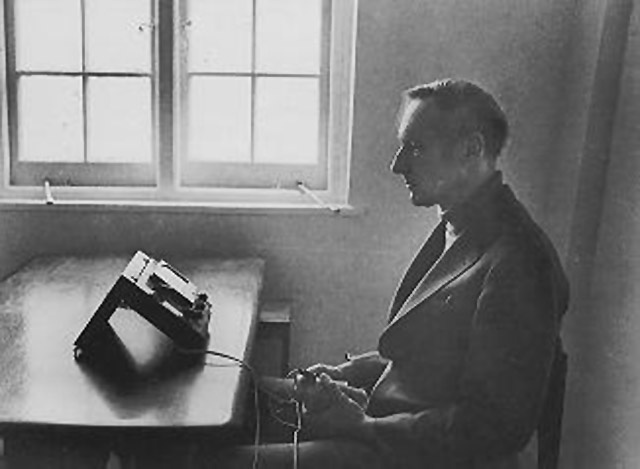
Andrei Linde, Stanford physicist by way of Russia, and his “chaotic expansion” theory of the universe, are featured in an early chapter of Jim Holt’s terrific 2012 book, Why Does the World Exist? In this clip, Linde relays how his central idea for explaining how it all came to be was rebuffed–somewhat–by Stephen Hawking in an unusual circumstance.
You are currently browsing the archive for the Books category.
Tags: Andrei Linde, Jim Holt, Stephen Hawking
I love reading, but libraries and bookstores (save one) depress me. They’re morgues and tombs that prematurely bury the living. The books aren’t dead–just the covers are. But the “new library” offers no books, just access. From Katie McDonough at Salon:
“Some are calling it a ‘bookless’ library, but paperless is a more accurate description of the all-digital public library branch set to open in Texas this fall.
The $1.5 million facility in Bexar County will not house a single printed book, but will offer 100 e-readers on loan, and 10,000 digital titles accessible to readers via their home computers and digital devices, with more being added regularly.
‘If you want to get an idea what it looks like, go into an Apple store,’ Bexar County Judge Nelson Wolff, the man behind the digital overhaul, told San Antonio Express News when plans were first announced earlier this year.
Saying goodbye to the printed page may be tough for some to swallow, but remote access to digital files is key to bringing books to the low-income and unincorporated areas of Bexar County currently without library access, says ‘BiblioTech’ project coordinator Laura Cole.”
Tags: Katie McDonough, Laura Cole, Nelson Wolf
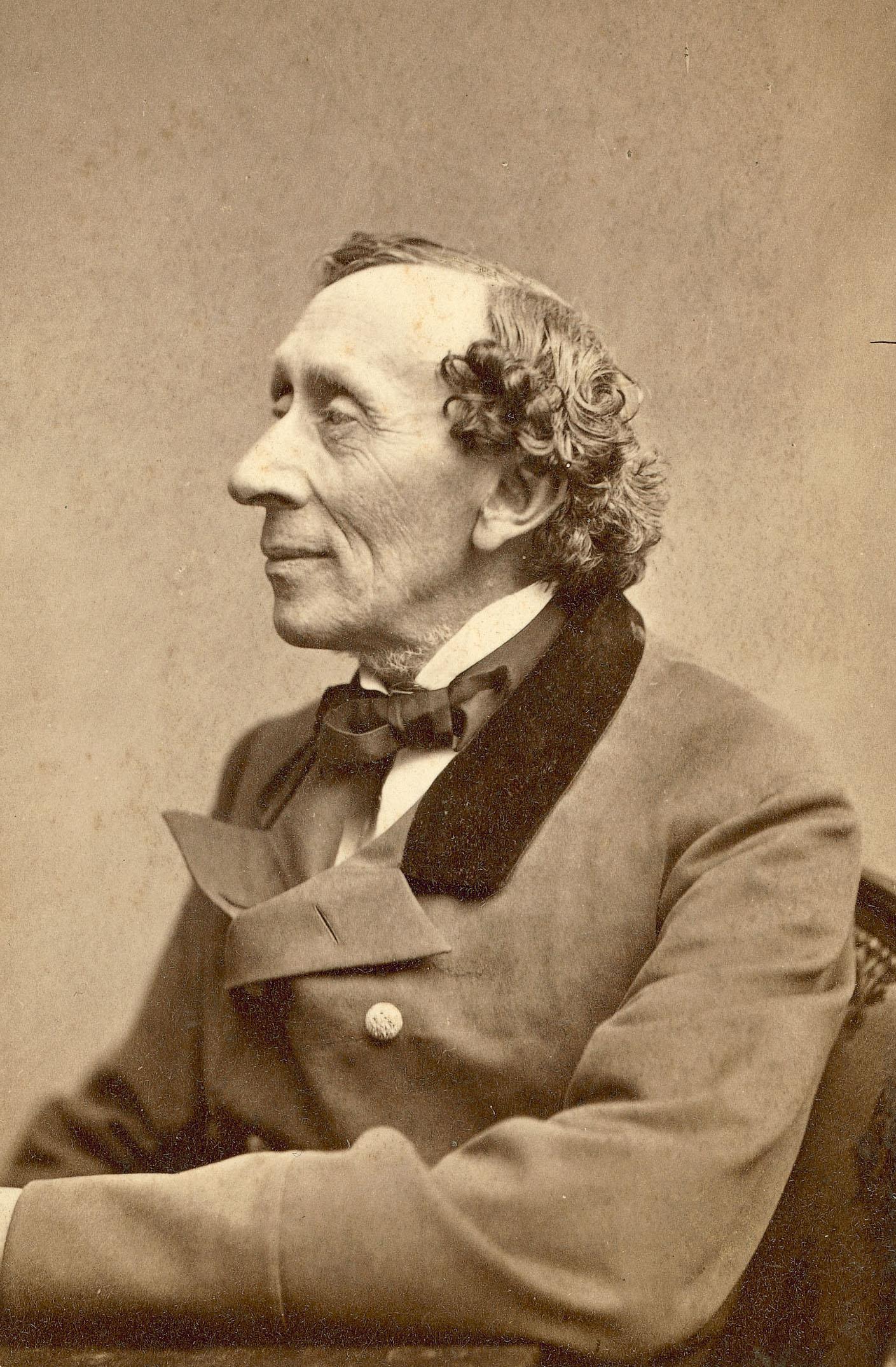
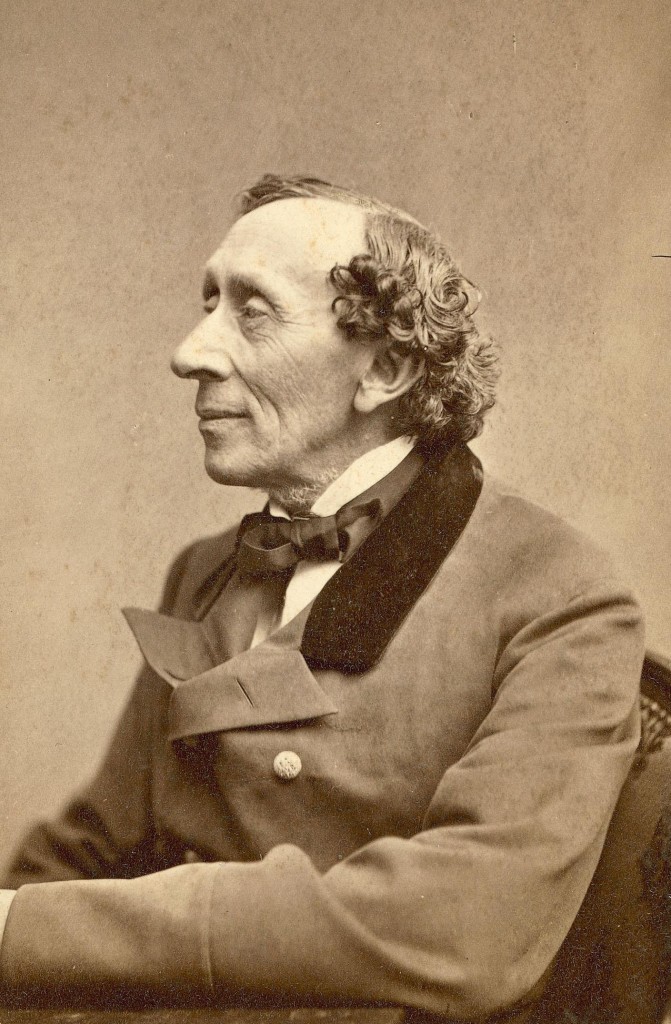
I recently re-read the simple yet deeply moving Hans Christian Andersen allegory, “The Fir Tree” when I picked up a copy of Randall Jarrell’s Book of Stories. Here’s the opening of Danish writer’s August 5, 1975 New York Times obituary, which covers his early life up until his first fame:
“The death of Hans Christian Andersen, the Danish poet and novelist, at Copenhagen, yesterday, is announced by a cable dispatch.
Hans Christian Andersen was born at Odense, in the Island of Fünen (part of the Kingdom of Denmark) on the 2d of April, 1805. Born in a land peculiarly rich in old song, mythology, and folk lore, and the only child of a man who, though only a poor shoemaker, was a man of literary taste and ability and of a highly poetic temperament–a temperament which his child inherited to the full–Andersen was a striking example of Cervantes’ maxim, that ‘Every one is the son of his own works.’ Finding in his child a spirit akin to his own, the elder Andersen fostered and encouraged the fanciful, and poetical elements of his nature at every opportunity. Andersen often spoke of his father’s eloquence ‘in telling me fairy tales.’ Again he said, ‘on Sundays he made me panoramas, theatres, and transformation pictures, and he would read me pieces out of Holberg’s plays and stories from the Thousand and One Nights.’ And Andersen discloses his father to us in the following comment on those Sunday readings: ‘And those were the only moments in which I remember him as looking really cheerful, for in his position as an artisan he did not feel happy.’ While still a very young child Andersen was taken by his father to the theatre, and in his connection he shows the truth of Milton’s lines in Paradise Regained:
‘The childhood shows the man
As morning shows the day.’
Unable, of course, to go often to the theatre, the youngster made friends with the play-bill distributors, who gave him a programme every day. He would retire into some corner with his treasure and imagine the whole play according to its play, and the names and characters in it. Then he collected all his dolls, and, with some pieces of calico for curtain and wings, he would make them enact the pieces in puppet fashion, he repeating what he could remember of his father’s reading. He had, too, a remarkably sweet and clear voice, and would introduce songs into his mimic performances. In this way he whiled away the long hours of his mother’s absence from home; for after his father’s death, which occurred when the boy was only nine years old, she used to go out washing for other people. The death of his father changed the current of his dramatic tendencies, and Hamlet’s Ghost and Lear found their way on to his miniature stage. In these days he wrote his first piece–a tragedy, which he called ‘Abor and Elvira.’ It was founded on an old song of Pyramus and Thisbe, and all the characters in it either died, committed suicide, or were killed. At fourteen years of age Andersen persuaded his mother, who had married again, to let him leave home, and he started for Copenhagen, with a small bundle of clothes, thirteen bank dollars, and a letter of introduction to Mme. Schall, a dancer at the theatre, prepared to begin the battle of life. Andersen arrived in Copenhagen on the 5th of September, 1819. His first visit was to the theatre, round which he walked several times, and which, before he left it, he felt that he looked upon as a home. Ten years later, in that very theatre, he witnessed the production of his first dramatic effort, entitled ‘The Courtship of St. Nicholas’ Steeple; or, What Does the Pit Say?’ The letter of introduction to Mme. Schall proved of no avail. She thought the boy crazy, and got him out of her house as quickly as possible. Remembering that he had read in a newspaper at Odense that an Italian named Siboui was Director of the Musical Conservatory of Copenhagen, he inquired the way and betook himself to Siboui’s house, whom he told his story. It happened that Weyse, the celebrated composer, and Baggesen, the poet, and a large company were dining with Siboui. The lad recited some scenes from Holberg, and some poems, and ended by bursting into tears. Weyse was deeply moved, and immediately raised a subscription for the friendless lad among those present. The collection amounted to $70. In time Andersen became a member of the ballet and chorus at the theatre, and spent his leisure hours in a sort of desultory study under the auspices of Weyse, Baggesen, the poet Guldberg, Oersted, the philosopher, and others who were interested in him; but so far he had talent without education. At the end of the theatrical season of 1823 he received his dismissal from the theatre, and for some months he experienced real want, but suffered in silence. Oersted, however, interested Collin, the Director of the Theatre Royal, in his favor. Collin was struck with the merits as well as the fruits of a historical tragedy called ‘Alfsol,’ which Andersen gave him to read, and, using his influence with King Frederick VI, and the Directors of the public schools, he procured a pension for him for a few years and free instruction in the Latin school at Slagelse, telling him that in time he would be able to produce works worthy to be acted on the Danish stage. He studied at Slagelse, and afterward in the Latin school at Helsingür, and then returned to Copenhagen, where he was welcomed by the family of Admiral Wulff in the Amalienborg Palace.
During these days he wrote but little poetry, the principal pieces being ‘The Soul,’ ‘To My Mother,’ and ‘The Dying Child,’ the last of which was among the most widely circulated of all his attempts in verse. At the time it was written it was printed with an apology for having been the composition of one still at school. From grave to gay, Andersen wrote several humorous pieces, which Heiberg readily printed in the Flying Post. In September, 1828, he became a student in the Royal College at Copenhagen, entering upon his studies with the greatest enthusiasm. The following year was the turning point of his life. He varied his studies by writing a humorous book, his first work, entitled ‘A Foot Journey to Amak.’ No one would publish the book, so he took the risk upon himself. To his great joy and astonishment it was out of print a few days after its appearance. Reitzel, the book-seller, purchased the second edition, and afterward published a third. The book was also reprinted in Sweden. Everybody in Copenhagen read it, and Andersen was famous.”
Tags: Hans Christian Andersen
I understand the value of marginalia, but I hate you very much if you write in books. It may be a moot point as paper morphs into pixels, and the printed books that remain will be too costly to deface. But the act of reader comments hasn’t ended in the e-book age, just morphed. Amazon keeps track of the most-highlighted Kindle phrases. The act of discovering an individual’s scratchings in used books has become a set of collective data.
The opening of Noreen Malone’s New Republic article which sifts through our favorite passages to find meaning:
“One of the great small pleasures of used books is the occasional marginalia of a previous owner. You learn a tiny bit about that anonymous soul by seeing the passages she underlined, or tidily double-underlined, or exclamation-pointed, or starred madly and messily. You begin to worry about the girl who found so much to mark in To The Lighthouse, or fall in love, a little bit, with the person who found all the funniest parts of Catch 22. (It is another type of intimacy entirely to borrow a book from someone you know, and to discover what he found worth picking up a pen for.)
This experience would seem to be lost as reading becomes ever more digital—ebook sales rose more than 44 percent last year—but that’s not entirely the case. Amazon keeps track of which passages Kindle readers highlight most, which means the company can offer a new version of the old serendipitous experience. Only this one is data-driven: The company also keeps a running list of the most highlighted Kindle passages of all time. Instead of a cozy tete-a-tete with the idiosyncratic mind of a stranger, you get the reading equivalent of a giant rave, a warehouse pulsing with usually private emotions turned into shared public expressions. It’s a glimpse into our collective, most interior, and most embarrassing preoccupations.
The most immediately noticeable thing about the list is how Hunger Games-heavy it is. Nineteen of the top 25 most-highlighted passages are written by Suzanne Collins, who is not exactly known for a glittering prose style. That breakdown would suggest that Americans are mostly obsessed with teenagers and dystopias, which, while not entirely untrue, is also useful reminder that this is a numbers game. Bestsellers will naturally have the greatest number of underlines, and there are certain kinds of bestsellers that are more likely to be read digitally. These include books aimed at teenagers that a massive number of adults have embraced (potentially embarrassing), books in the public domain (free), and self-help books (potentially embarrassing). Taken together, they suggest that your average Kindle reader is a creature caught in permanent adolescence, but yearning to improve. Oh, and he’s cheap.”
Tags: Noreen Malone
Fantasies tell us a lot about a person or a people, but there’s danger in taking them too literally. They’re fantasies not just because we can’t or aren’t allowed to live them, but often because we don’t actually want them realized. They do bear watching, however, since when the bad ones are put into action, horrors can occur.
The opening of a Foreign Policy article about a new wave of scary Chinese military fantasy novels:
“It is the year 2049. China’s economic development has so disturbed the world’s other major powers that the United States, Japan, and Russia form an alliance and invade China. Fierce battles break out on the plains of northeast China, where Japanese troops and U.S. fighter jets besiege Chinese infantry. Caught by surprise, China’s army nonetheless stages a glorious counterattack by deploying levitating tanks, and employing a strategy based on lessons learned from the Anti-Japanese War and the Resist America War (better known in the West as WWII and the Korean War, respectively).
Such is the plot of The Last Counterattack, a serial novel published on Blood and Iron Reading, a Chinese military literature website. In one of the latest installments, published on May 2, U.S. government-sponsored hackers have infiltrated the Chinese military’s network and accidently launched a Chinese nuclear missile directed at the United States. The anonymous author’s online profile says he is a former colonel in the People’s Liberation Army and currently a staff officer in charge of operations and reconnaissance in the 12th Armored Division at China’s 21st Army Group. Going by the online pseudonym ‘the Old Staff Officer,’ he told FP in an interview conducted over the Chinese messaging service QQ that he ‘enjoys the feeling of letting [his] imagination fly.’ But Li, as I’ll call him, believes that what he’s writing may actually come to pass. In an April blog post, he explained his thinking for the book: [The world besieges China and attacks it from all sides. Is this possible? Yes!’
There are thousands of Chinese war fantasy novels on the Internet — too sensitive to be published in book form, they circulate on blogs, and websites like Blood and Iron Reading. Most languish, but the more popular ones get read millions of times. As a rising China struggles to define its military aspirations, and as the country’s vast propaganda apparatus encourages citizens to define their version of President Xi Jinping’s vague slogan ‘Chinese Dream,’ these military fantasy novels provide insight into what Chinese people’s war dreams look like.”
Some scientific explanations are so beautiful that they just have to be true. Except maybe some of them are not. Confusing physics and poetry can be dangerous.
Time is an illusion we’ve always been told, but perhaps it isn’t so. From James Gleick’s New York Review of Books piece about Lee Smolin’s just-published book on the topic:
“In an empty universe, would time exist?
No, it would not. Time is the measure of change; if nothing changes, time has no meaning.
Would space exist, in the absence of any matter or energy? Newton would have said yes: space would be empty.
For Smolin, the key to salvaging time turns out to be eliminating space. Whereas time is a fundamental property of nature, space, he believes, is an emergent property. It is like temperature: apparent, measurable, but actually a consequence of something deeper and invisible—in the case of temperature, the microscopic motion of ensembles of molecules. Temperature is an average of their energy. It is always an approximation, and therefore, in a way, an illusion. So it is with space for Smolin: ‘Space, at the quantum-mechanical level, is not fundamental at all but emergent from a deeper order’—an order, as we will see, of connections, relationships. He also believes that quantum mechanics itself, with all its puzzles and paradoxes (“cats that are both alive and dead, an infinitude of simultaneously existing universes”), will turn out to be an approximation of a deeper theory.
For space, the deeper reality is a network of relationships. Things are related to other things; they are connected, and it is the relationships that define space rather than the other way around. This is a venerable notion: Smolin traces the idea of a relational world back to Newton’s great rival, Gottfried Wilhelm Leibniz: ‘Space is nothing else, but That Order or Relation; and is nothing at all without Bodies, but the Possibility of placing them.’ Nothing useful came of that, while Newton’s contrary view—that space exists independently of the objects it contains—made a revolution in the ability of science to predict and control the world. But the relational theory has some enduring appeal; some scientists and philosophers such as Smolin have been trying to revive it.
Nowadays, the Internet—like the telegraph a century before—is commonly said to ‘annihilate’ space. It does this by making neighbors of the most distant nodes in a network that transcends physical dimension. Instead of six degrees of separation, we have billions of degrees of connectedness. As Smolin puts it:
We live in a world in which technology has trumped the limitations inherent in living in a low-dimensional space…. From a cell-phone perspective, we live in 2.5-billion-dimensional space, in which very nearly all our fellow humans are our nearest neighbors.
The Internet, of course, has done the same thing. The space separating us has been dissolved by a network of connections.
So maybe it’s easier now for us to see how things really are. This is what Smolin believes: that time is fundamental but space an illusion; ‘that the real relationships that form the world are a dynamical network’; and that the network itself, along with everything on it, can and must evolve over time.”
Tags: James Gleick, Lee Smolin
The only brick-and-mortar bookstore I go to anymore is the Strand in Manhattan. The shop’s website is unreliable as hell when it comes to letting you know what volumes are in stock in the store, but it has an amazing amount of really good books, and you can save some bucks if you’re a smart shopper. The Strand asks different writers to a curate a shelf (a table, actually) of their favorite works. The following is a list of George Saunders’ 56 selections. What’s the most surprising choice? Bright Lights, Big City, maybe?
- The Beggar Maid: Stories of Flo and Rose by Alice Munro
- Selected Poems by Anna Akhmatova
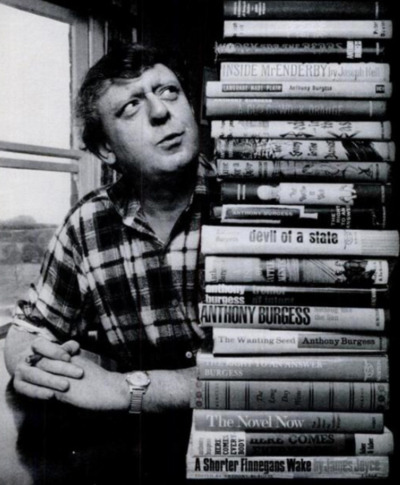
- A Clockwork Orange by Anthony Burgess
- Sakhalin Island (Alma Classics) by Anton Chekhov
- Airships by Barry Hannah
- Age of Wire and String by Ben Marcus
- I Served the King of England by Bohumil Hrabal
- Doctor Zhivago by Boris Pasternak
- Today I Wrote Nothing: The Selected Writing of Daniil Kharms by Daniil Kharms
- Twilight of the Superheroes: Stories by Deborah Eisenberg
- The Dead Father by Donald Barthelme
- Ragtime by E.L. Doctorow
- In Our Time by Ernest Hemingway
- Johnny Tremain by Esther Hoskins Forbes
- Everything That Rises Must Converge by Flannery O’Connor
- Stories in the Worst Way by Gary Lutz
- A Collection of Essays by George Orwell
- Edie: American Girl by Jean Stein
- The Groucho Letters: Letters from and to Groucho Marx by Groucho Marx
- The Bridegroom by Ha Jin
- Loving/Living/Party Going by Henry Green
- Senselessness by Horacio Castellanos Moya
- 1920 Diary by Isaac Babel
- The Collected Stories of Isaac Babel by Isaac Babel
- A Sportsman’s Notebook by Ivan Turgenev
- Visions of Gerard by Jack Kerouac
- Dubliners by James Joyce
- Bright Lights, Big City by Jay McInerney
- Joel Sternfeld: American Prospects by Kerry Brougher
- Dos Passos: U.S.A., 42nd Parallel, 1919, Big Money by John Dos Passos
- A Confederacy of Dunces by John Kennedy Toole
- Cannery Row by John Steinbeck
- Sometimes a Great Notion by Ken Kesey
- The Life and Opinions of Tristram Shandy, Gentleman by Laurence Sterne
- Hadji Murat (Vintage Classics) by Leo Tolstoy
- Resurrection by Leo Tolstoy
- Journey to the End of the Night by Louis-Ferdinand Céline
- One More Time: The Best of Mike Royko by Mike Royko
- A Hero of Our Time by Mikhail Lermontov
- Dead Souls (Wordsworth Classics) by Nikolai Gogol
- Collected Tales by Nikolai Gogol
- Europeana: A Brief History of the Twentieth Century by Patrik Ourednik
- Cathedral by Raymond Carver
- Collected Stories of Richard Yates by Richard Yates
- All the King’s Men (Restored Edition) by Robert Penn Warren
- Children of Light by Robert Stone
- Living End by Stanley Elkin
- The Coast of Chicago by Stuart Dybek
- The Bushwhacked Piano by Thomas McGuane
- The Barracks Thief by Tobias Wolff
- The Bluest Eye by Toni Morrison
- I Will Bear Witness, 1942-1945: A Diary of the Nazi Years by Victor Klemperer
- Omon Ra by Victor Pelevin
- Ironweed by William Kennedy
- The Designated Mourner by Wallace Shawn
Tags: George Saunders
William S. Burroughs was more deeply involved in Scientology than we know according to a new book by David S. Wills. The writer just did an Ask Me Anything at Reddit on the topic. A few passages follow.
____________________
Question:
David S. Wills:
____________________
Question:
____________________
Question:
____________________
Question:
An excerpt from a blog post at the New Yorker in which George Packer, who just published The Unwinding: An Inner History of the New America, writes of some of the things he likes about our contemporary nation:
“Recent additions to American life that I would fight to hang onto: marriage equality, Lipitor, a black President, Google searches, airbags, novelistic TV shows, the opportunity for women to be as singlemindedly driven as their male colleagues, good coffee, safer cities, cleaner air, photographs of the kids on my phone, anti-bullying, Daniel Day Lewis, cheap communications, smoke-free airplanes, wheelchair parking, and I could go on.
In general, the things in my list fall into two categories: technological advances that make life easier, tastier, more entertaining, healthier, longer; and socio-political changes that have made the country a more tolerant, inclusive place. Over the past generation, America has opened previously inaccessible avenues to previously excluded groups, although in some cases the obstacles remain formidable, and in others (immigrant farm laborers, for example) there has hardly been any change at all. More Americans than ever before are free to win elective office or gain admission to a good college or be hired by a good company or simply be themselves in public. And they have more freedom to choose among telephones, TV shows, toothpastes, reading matter, news outlets, and nearly every other consumer item you can think of.
The bottom line in all these improvements is freedom. In America, that’s half the game.
The other half is equality.”
Tags: George Packer
I think I’m out of step with the world. The things that many people value, that they pin their hopes on, just don’t interest me. (And vice versa.) I’m sure this was probably always true, but now there are physical manifestations to constantly alert me of this situation, like people tearing through their Facebook accounts on smartphones in every coffee shop and park. But I don’t think this narcissism and self-interest and illusion should pose problems for fiction writers, except if they’re trying to observe a world that doesn’t exist anymore in a way that likewise doesn’t exist anymore. But not everyone agrees. From Damien Walter at the Guardian:
“Walk in to any public space today, from a waiting room to a coffee shop, and note the disturbing absence of voices. We are there, and we are elsewhere. Our discussions are mediated via social networks, and conducted through touchscreen interfaces. Can we call them friends, this network of professional and social contacts we interact with through computers?
Journalist and chronicler of hacker culture Quinn Norton describes an aesthetic crisis in writing ‘(H)ow do we write emotionally of scenes involving computers? How do we make concrete, or at least reconstructable in the minds of our readers, the terrible, true passions that cross telephony lines?’ In a digital world do falling in love, going to war and filling out tax forms all look the same? Do they all look like typing?”
Tags: Damien Walter, Quinn Norton
Bret Easton Ellis, who fucked Blair who fucked Trent before they all fucked Clay, just did an Ask Me Anything on Reddit. He’s a godawful writer but if you want to look at his works as presaging the overt violence and sexuality of our virtual world, you can. Of course, that would be giving him far too much credit. A few exchanges from the AMA follow.
_____________________
Question:
I read in a German magazine you once were so drunk (or stoned) you confused texting and tweeting and asked for drugs on Twitter. Is that a true story?
Bret Easton Ellis:
Yeah. That’s a true story. I still left the drunken tweet on my Twitter feed, hoping one day it becomes a catch phrase.
_____________________
Question:
Bret Easton Ellis:
_____________________
Question:
Could you explain the ending to American Psycho to me like I’m a 5 year old?
Bret Easton Ellis:
_____________________
Question:
A lot of people were deeply shocked by the comments you made about David Foster Wallace, even after he had tragically committed suicide, particularly when you said he was “the most tedious, overrated, tortured, pretentious writer of my generation.”
What happened to create this feud? Were you surprised at the backlash your comments received?
Bret Easton Ellis:
There wasn’t a feud. David and I had never met. But I never responded to his work. Simple as that. I was reading the new bio and it was pissing me off–the kid gloves approach. And that I thought he had a literary fraudulence about him that manifested itself in his fiction. You could say the same about me. I was not surprised by the backlash to those tweets. There are a lot of little snowflakes who somehow really respond to this faux-earnestness of DFW that I just don’t think is realistic.
_____________________
Question:
Bret Easton Ellis:
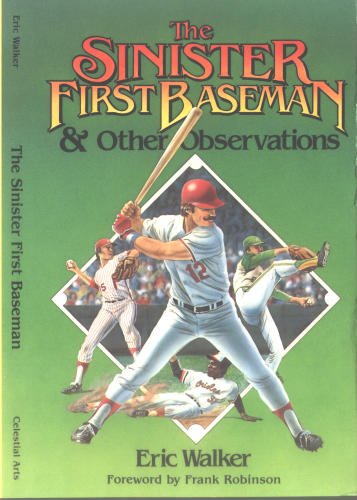
At present, there are 13 used copies of Eric Walker’s oddly titled, out-of-print 1982 baseball-themed paperback, The Sinister First Baseman & Other Observations, on sale from Amazon sellers, and the cheapest one, in merely “Acceptable” condition, goes for $104.96. Who, exactly, is Eric Walker and why does he have so much value for so few people?
There were always those who suspected that baseball’s conventional wisdom was not so wise, but in the 1970s, Walker, a Bay Area baseball fan birthed the idea of Moneyball before Sandy Alderson or Billy Beane had entered the game. Even he, however, had an important precursor. From “The Forgotten Man of Moneyball,” Walker’s 2009 Deadspin article, a passage about his inspiration:
But who am I, and why would I be considered some sort of expert on moneyball? Perhaps you recognized my name; more likely, though, you didn’t. Though it is hard to say this without an appearance of personal petulance, I find it sad that the popular history of what can only be called a revolution in the game leaves out quite a few of the people, the outsiders, who actually drove that revolution.
Anyway, the short-form answer to the question is that I am the fellow who first taught Billy Beane the principles that Lewis later dubbed ‘moneyball.’ For the long-form answer, we ripple-dissolve back in time to San Francisco in 1975, where the news media are reporting, often and at length, on the supposed near-certainty that the Giants will be sold and moved. There sit I, a man no longer young but not yet middle-aged, a man who has not been to a baseball game — or followed the sport — for probably over two decades, but a man who in childhood used to paste New York Giants box scores into a scrapbook, and who remembers, dimly but fondly, such folk as Whitey Lockman and Wes Westrum.
Carpe diem, I think.
With my lady, also a baseball fan of old, I go to a game. We have a great time; we go to more games, have more great times. I am becoming enthused. But I am considering and wondering — wondering about the mechanisms of run scoring, things like the relative value of average versus power. Originally an engineer by trade, I am right there with Lord Kelvin: ‘When you cannot measure it and express it in numbers, your knowledge is of a very meagre and unsatisfactory kind.’ I fiddle with some numbers; but I vaguely remember Branch Rickey’s work, the cover story in Life magazine for Aug. 2, 1950, [ed. note: it was actually 1954 and not a cover story] and think that I may not need to reinvent the wheel. I go to the San Francisco main library, looking for books that in some way actually analyze baseball. I find one. One. But what a one.
If this were instead Reader’s Digest, my opening of that book would be ‘The Moment That Changed My Life!’ The book was Percentage Baseball, by one Earnshaw Cook, a Johns Hopkins professor who had consulted on the development of the atomic bomb. Today, when numerical analysis of baseball performance is a commonplace, it is hard to grasp how revolutionary, even shocking, were the concepts Cook was developing (Rickey’s work, which had quickly dropped off everyone’s radar, notwithstanding). The book was, and remains, awe-inspiring.•
Tags: Billy Beane, Earnshaw Cook, Eric Walker, Sandy Alderson
The opening of Jaron Lanier’s piece in Wired about Moore’s Law, which is excerpted from his new book, Who Owns the Future?:
“Moore’s Law is Silicon Valley’s guiding principle, like all ten commandments wrapped into one.
The law states that chips get better at an accelerating rate. They don’t just accumulate improvements, in the way that a pile of rocks gets higher when you add more rocks. Instead of being added, the improvements multiply. The technology seems to always get twice as good every two years or so. That means after forty years of improvements, microprocessors have become millions of times better.
No one knows how long this can continue. We don’t agree on exactly why Moore’s Law or other similar patterns exist. Is it a human-driven, self-fulfilling prophecy or an intrinsic, inevitable quality of technology?
Whatever is going on, the exhilaration of accelerating change leads to a religious emotion in some of the most influential tech circles. It provides a meaning and context.
Moore’s Law means that more and more things can be done practically for free, if only it weren’t for those people who want to be paid. People are the flies in Moore’s Law’s ointment. When machines get incredibly cheap to run, people seem correspondingly expensive.
It used to be that printing presses were expensive, so paying newspaper reporters seemed like a natural expense to fill the pages. When the news became free, that anyone would want to be paid at all started to seem unreasonable.
Moore’s Law can make salaries — and social safety nets — seem like unjustifiable luxuries.”
Tags: Jaron Lanier
Two recent George Saunders TV appearances if you missed them, with Stephen Colbert and George Stephanopoulos. Ayn Rand, interestingly, is mentioned in both interviews, as a punchline for Colbert and in a serious vein with Stephanopoulos, as Saunders cops to being a right-winger as a youth.
Tags: George Saunders, George Stephanopoulos, Steven Colbert
The opening of a really good Jim Holt New York Review of Books piece about the posthumously published memoir by Benoit Mandelbrot, father of the fractal, who saw the mathematics of roughness not only in clouds and cauliflower but in financial markets as well:
“Benoit Mandelbrot, the brilliant Polish-French-American mathematician who died in 2010, had a poet’s taste for complexity and strangeness. His genius for noticing deep links among far-flung phenomena led him to create a new branch of geometry, one that has deepened our understanding of both natural forms and patterns of human behavior. The key to it is a simple yet elusive idea, that of self-similarity.
To see what self-similarity means, consider a homely example: the cauliflower. Take a head of this vegetable and observe its form—the way it is composed of florets. Pull off one of those florets. What does it look like? It looks like a little head of cauliflower, with its own subflorets. Now pull off one of those subflorets. What does that look like? A still tinier cauliflower. If you continue this process—and you may soon need a magnifying glass—you’ll find that the smaller and smaller pieces all resemble the head you started with. The cauliflower is thus said to be self-similar. Each of its parts echoes the whole.
Other self-similar phenomena, each with its distinctive form, include clouds, coastlines, bolts of lightning, clusters of galaxies, the network of blood vessels in our bodies, and, quite possibly, the pattern of ups and downs in financial markets. The closer you look at a coastline, the more you find it is jagged, not smooth, and each jagged segment contains smaller, similarly jagged segments that can be described by Mandelbrot’s methods. Because of the essential roughness of self-similar forms, classical mathematics is ill-equipped to deal with them. Its methods, from the Greeks on down to the last century, have been better suited to smooth forms, like circles. (Note that a circle is not self-similar: if you cut it up into smaller and smaller segments, those segments become nearly straight.)
Only in the last few decades has a mathematics of roughness emerged, one that can get a grip on self-similarity and kindred matters like turbulence, noise, clustering, and chaos. And Mandelbrot was the prime mover behind it. He had a peripatetic career, but he spent much of it as a researcher for IBM in upstate New York. In the late 1970s he became famous for popularizing the idea of self-similarity, and for coining the word ‘fractal’ (from the Latin fractus, meaning broken) to designate self-similar forms. In 1980 he discovered the ‘Mandelbrot set,’ whose shape—it looks a bit like a warty snowman or beetle—came to represent the newly fashionable science of chaos. What is perhaps less well known about Mandelbrot is the subversive work he did in economics. The financial models he created, based on his fractal ideas, implied that stock and currency markets were far riskier than the reigning consensus in business schools and investment banks supposed, and that wild gyrations—like the 777-point plunge in the Dow on September 29, 2008—were inevitable.”
Tags: Benoit Mandelbrot, Jim Holt
According to Jonathan Alter’s forthcoming book on the 2012 Presidential election, Steve Jobs, who loathed Fox News, personally ordered all Apple advertising from the truth-challenged cable station. From Paul McNamara at Network World:
“As relates to his previously documented loathing of Fox News, it’s now known that the late Steve Jobs backed up his harsh words by wisely withholding Apple’s advertising dollars, according to an upcoming book about the 2012 presidential campaign.
The book’s author, Jonathan Alter, a Bloomberg political columnist and contributor to MSNBC, tells of Jobs ‘personally ordering that Apple ads be removed from Fox News,’ according to a blog post in the New York Times over the weekend. Alter’s book, The Center Holds: Obama and His Enemies, is scheduled to hit stores June 4.
That the Apple co-founder held Fox News in low regard has been publicly known since the publication of Walter Isaacson’s authorized biography in October 2011. Here’s the key passage recounting a conversation Jobs had with Rupert Murdoch, chairman and CEO of News Corp., which owns Fox News:
‘You’re blowing it with Fox News,’ Jobs told him over dinner. ‘The axis today is not liberal and conservative, the axis is constructive-destructive, and you’ve cast your lot with the destructive people. Fox has become an incredibly destructive force in our society. You can be better, and this is going to be your legacy if you’re not careful.’ Jobs said he thought Murdoch did not really like how far Fox had gone too far.”
Tags: Jonathan Alter, Paul McNamara, Rupert Murdoch, Steve Jobs
Alec Ash of the Los Angeles Review of Books has an interview with science-fiction author Fei Dao of China, arguably the most sci-fi place on Earth right now, a nation careering wildly into its future, though oddly mostly utilizing pieces of the Western industrial past to get there. So far, at least. An excerpt:
“Question:
What is unique or particular about Chinese science fiction?
Fei Dao:
Chinese sci fi has about a hundred years of history. When it started, in the late Qing dynasty around 1902, it was chiefly concerned with the problem of bringing ancient China into modernity. At that time, Liang Qichao [translated sci fi] because he thought it would be beneficial for China’s future … as something that could popularize scientific knowledge. And Lu Xun thought that if you gave ordinary people scientific literature to read, they would fall asleep. But if you blended scientific knowledge into stories with a plot, it would be more interesting. [He thought that] in this way, the people could become more modern.
So at that time science fiction was a very serious thing to do in China that could allow ordinary people to get closer to modern scientific knowledge, and serve as a tool for transforming traditional culture into modern culture. It played a very important role, and had a serious mission to accomplish.
Today, there is a commercial publishing market for sci fi, and people don’t have such weighty expectations of literature, yet authors are still discussing serious topics. Three Body by Liu Cixin or Subway (地铁) by Han Song both have many reflections about the direction of this country and of humanity. So this kind of writing can convey concerns about the future, or discuss the current situation in China.
For example, Han Song’s Subway is about a subway station. In China, subway systems are an emblem of modernization. Many cities in China are building huge subway systems, because to have one or not is the standard of a city’s modernity and development. So in discussing this symbol, Han Song seized on a sensitive point. After publishing Subway, he wrote another book called Highspeed Rail (高铁), another emblem of technological innovation. So Han Song is consistently concerned with the potential catastrophes of the process of modernization.
Liu Cixin, on the other hand, is expressing a more grand feeling of the universe in the tradition of Western sci fi. In doing so, he wants Chinese people to look up at the sky, and not just be concerned with earthly matters. The mainstream of Chinese literature is about real-world subject matter, such as the countryside or urban life. Very few people are concerned with the fate of humankind, the future of the universe, or even aliens. These things are themselves alien to Chinese readers, but can be introduced through this kind of writing.
I think that the key theme of Chinese science fiction, no matter how it develops, is how this ancient country and its people are moving in the direction of the future.”
A miscast spokesperson of drugged-out hippies, the writer Richard Brautigan wasn’t enamored with narcotics nor the wide-eyed, bell-bottomed set. He wrote two things I love: The 1967 novel Trout Fishing in America and the 1968 poem “All Watched Over by Machines of Loving Grace.” The opening of “King of the Granola Heads” Michael LaPointe’s Times Literary Supplement review of a new book about the iconoclastic author:
“Richard Brautigan, the Love Generation’s prickly and whimsical poet-novelist, died what the sheriff’s report termed an ‘unattended death’ on September 16, 1984. Having committed suicide with one of his beloved Smith & Wesson revolvers, Brautigan was not discovered in his home in Bolinas, California until October 25, at which point he needed to be ‘scooped up with a shovel.’ Why did Brautigan, the author of bestselling, generation-defining novels such as Trout Fishing in America and In Watermelon Sugar, die so alone? In Jubilee Hitchhiker, William Hjortsberg maps the rocketing rise and disastrous decline of this most quixotic American author.
Born in 1935 to a single mother in Tacoma, Washington, Richard Gary Brautigan was destined for a life on the fringes. He was even, at first, estranged from his own name, his mother borrowing the surname Porterfield from one of his many stepfathers. Unmoored from ancestry, Brautigan would always be a self-mythologizer, complicating the biographer’s task, but in the early, ‘Dick Porterfield’ chapters of Jubilee Hitchhiker, Hjortsberg disentangles events from their embellishments. ‘Imagination feeds on the irrational,’ he writes, and Brautigan’s young mind was given a steady diet. The midcentury Pacific Northwest has the larger-than-life dimensions of legend, complete with a near-apocalyptic flood, which the Porterfield family was the last to escape, ‘watching the highway fold up behind them ‘like scrambled eggs.’
After the deluge, Brautigan acquired his major trope: ‘Fishing consumed [his] life.’ With his towering height, white-blond, soup bowl haircut and overalls, the young Brautigan resembled Tom Sawyer, ‘hitchhiking up the McKenzie in the rain with a fly rod under his arm and a peanut butter sandwich in his pocket.’ Brautigan would always retain an anachronistic quality. By the age of twelve, he was collecting cans, blackberries and nightcrawlers to help the family make ends meet. In 1956, he hitchhiked down to San Francisco and never saw or spoke to his family again.” (Thanks Browser.)
See also:
I love George Saunders and his deeply funny, deeply moving short stories, and he’s a wonderful journalist as well (like here and here). His fiction has a high-risk style, a seemingly unrestrained combo of Raymond Carver and Groucho Marx, and while I always fear he’ll go over the top completely, like, say, Kurt Vonnegut did with Slapstick, Saunders keeps maturing, deepening. His most recent collection, Tenth of December, is wonderful overall, and “The Semplica-Girls Diaries” is one of the best things he’s ever written, satire that is so sad and humane. Saunders was just interviewed about his computer desktop, of all things, by Ben Johncock for the Guardian. An excerpt:
“Twitter is a deliberate abstention. Somehow I hate the idea of there always being, in the back of my mind, this little voice saying: ‘Oh, I should tweet about this.’ Which knowing me, I know there would be. I’m sure some people can do it in a fun and healthy way, but I don’t think I could. Plus, it’s kind of funny – I’ve spent my whole life learning to write very slowly, for maximum expressiveness, and for money. So the idea of writing really quickly, for free, offends me. Also, one of the simplify-life things I’m doing is to try to just write fiction, period. There was a time there a few years back where, and screenplays, and travel journalism so on – just trying to keep the juices flowing and kick open some new doors. These, in turn, led to a period of sort of higher public exposure – TV appearances here in the US and some quasi-pundit-like moments. To be honest, this made me feel kind of queasy. I’m not that good on my feet and I found that I really craved the feeling of deep focus and integrity that comes with writing fiction day after day, in a sort of monastic way. So that’s what I’m trying to do now, as much as I can manage. And Twitter doesn’t figure into that.”
Tags: Ben Johncock, George Saunders
From Liz Gannes’ All Things D article about Eric Schmidt and Jared Cohen’s new book about our technological future:
“Written with Google Ideas director Jared Cohen, The New Digital Age was released today. It’s dense, though readable, and floats between visions of a hologram-and-robot-enhanced future for the developed world, and scarily specific predictions of how dictators will get hold of technology and use it for evil.
‘The Internet is the largest experiment involving anarchy in history,’ Schmidt and Cohen write, as they forecast all sorts of ‘painful liminal periods’ while things like privacy, citizenship and reporting get figured out as the next five billion people come online, joining the two billion that already are.
Schmidt and Cohen are not going to spark a social movement or even an op-ed war, a la that other recent tech exec book, Sheryl Sandberg’s Lean In. But they did manage to write a surprisingly non-corporate book that talks about Twitter at least 10 times as much as it does about Google’s driverless cars.”
Tags: Eric Schmidt, Jared Cohen, Liz Gannes
It’s difficult sometimes to think about futuristic living, all sleek and clean and perfect. Yesterday morning I sat down on a subway car next to a guy who smelled like a toilet had backed up onto a corpse in the bathroom of a diarrhea factory. Then he started snoring.
But some among us can see a future, or something resembling it, that is more orderly. From a Foreign Policy piece about the predictions in Eric Schmidt and Jared Cohen’s just-published book, The New Digital Age:
“Futuristic living:
Your apartment is an electronic orchestra, and you are the conductor. With simple flicks of the wrist and spoken instructions, you can control temperature, humidity, ambient music and lighting. You are able to skim through the day’s news on translucent screens while a freshly cleaned suit is retrieved from your automated closet because your calendar indicates an important meeting today. You head to the kitchen for breakfast and the translucent news display follows, as a projected hologram hovering just in front of you, using motion detection, as you walk down the hallway…. Your central computer system suggests a list of chores your housekeeping robots should tackle today, all of which you approve. It further suggests that, since your coffee supply is projected to run out next Wednesday, you consider purchasing a certain larger-size container that it noticed currently on sale online. Alternatively, it offers a few recent reviews of other coffee blends your friends enjoy.”
Tags: Eric Schmidt, Jared Cohen
From Robert Kuttner’s New York Review of Books piece about David Graeber’s Debt: The First 5,000 Years, a passage about the inequality of debt relief:
“The double standard in debt relief that favored large merchants, present at the creation of bankruptcy law in 1706, persists today in many different forms. It gets surprisingly little attention in the debt debates. Despite the tacit assumption that ‘surely one has to pay one’s debts,’ the evasion of repayment is both widespread and selective. Corporate executives routinely walk away from their debts via Chapter 11 of the national bankruptcy law when that seems expedient. Morality scarcely enters the conversation—this is strictly business.
Even more galling is the fact that the executives who drove the company into the ground often keep control by means of a doctrine known as debtor-in- possession. A judge simply permits the company to write off old debts, while creditors collect so many cents on the dollar out of available assets. Every major airline has now been through bankruptcy, and US Airways has gone in and out of Chapter 11 twice. In this process, all creditors are not created equal. Since banks typically have liens on the aircraft, bankers get paid ahead of others. Major losers are employees and retirees, since Chapter 11 allows a corporation to break a labor contact or reduce pension debts. Shareholders also lose, but by the time bankruptcy is declared, the company’s share value has usually dwindled to almost nothing. Much of the private equity industry uses the strategy of acquiring a company, taking it into bankruptcy, thus shedding its debts, and then cashing in on its subsequent profitability. Despite the misleading term private ‘equity,’ tax-deductible private debt is the essence of this industry, which relies heavily on borrowed money to finance its takeovers.
Homeowners, however, are explicitly prohibited from using the bankruptcy code to reduce their outstanding mortgage debt. White House legislation proposed in 2009 would have allowed a judge to reduce the principal on a home mortgage, as part of the effort to contain the economic crisis. Congress rejected the measure after extensive lobbying by the financial industry. Consumers may use bankruptcy to shed other debts, but a revision of the law signed by President Bush in 2005 subjects most bankrupt consumers to partial repayment requirements, while bankrupt corporations get a general discharge from their debts. Thanks to the influence of the same financial lobby, the rules of student debt provide that the obligations of a college loan follow a borrower to the grave.”
Tags: David Graeber, Robert Kuttner
The opening of Peter Lewis’ barnesandnoble.com review of Joel F. Harrington’s The Faithful Executioner, a new volume about the 16th-century man who did “god’s work” in the gallows:
“Frantz Schmidt was a master executioner. He had a notarized certificate to prove it. He apprenticed under a master; he paid his journeyman’s dues. He mostly worked in the imperial city of Nuremberg during his forty-five years of service, 1573-1618. He executed 394 people: men, women, and some boys and girls. Schmidt, always poised, delivered a good death, whether he beat you to kingdom come with a wagon wheel or applied the pitch and touched the flame, slipped the noose or cut off your head.
A ‘good death’ was meant to shock and awe the locals, to keep them ruly in the absence of any effective central authority during some seriously unruly times. Executions were carefully orchestrated, ritualized brutality that sated the drive for retribution, with clear rules and conduct. The fathers of Nuremberg, a city then at the zenith of its power and wealth, hired Frantz Schmidt: reliable, honest, pious, reflective, loyal, sober Frantz, a rare bird in the world of executioners.”
Douglas Rushkoff, author of Present Shock, discussing the anarchic nature of the flow of time in the Digital Age in a New York Times interview conducted by Quentin Hardy:
Question:
You say we have ‘a new relationship with time.’ What is it, and why is that a bad thing?
Douglas Rushkoff:
What we’ve done has made time even more dense. On Facebook, your past comes into your present when someone from your second grade class suddenly pops up to send you a message, and your future is being manipulated by what Facebook knows to put in front of you next. Present shock interrupts our normal social flow.
It didn’t have to be this way. When digital culture first came along, it was supposed to create more time, by allowing us to shift time around. Somehow instead we’ve strapped devices to ourselves that ping us all the time.
Question:
Hasn’t time been collapsing for centuries? We moved from the rhythm of seasons to living by the clock in the Industrial Age. We’ve paced in front of the microwave for decades.
Douglas Rushkoff:
Yes, but it has hit a point where we have lost any sense of analog time, the way a second hand sweeps around a clock. We’ve chosen the false ‘now’ of our devices. It has led to a collapse of linear narratives and a culture where you have political movements demanding that everything change, now. The horrible truth is we are linear beings; we can’t multitask, and we shouldn’t keep interrupting important connections to each other with the latest message coming in.
Question:
It’s a funny thing: the counterculture used to talk about ‘Be here now,’ and the need to chase after self-awareness by seeking the eternal present. What is the difference between that world of the “now” and this one?
Douglas Rushkoff:
People are seduced by signals from the world, but that is manipulation, not reality. Computers have learned more about us than we’ve learned about them.•
Tags: Douglas Rushkoff, Quentin Hardy