Joe Keohane has an interesting piece, “The Lost Art of Pickpocketing,” on Slate. An excerpt:

“Pickpocketing in America was once a proud criminal tradition, rich with drama, celebrated in the culture, singular enough that its practitioners developed a whole lexicon to describe its intricacies. Those days appear to be over. ‘Pickpocketing is more or less dead in this country,’ says Harvard economist Edward Glaeser, whose new book Triumph of the City, deals at length with urban crime trends. ‘I think these skills have been tragically lost. You’ve got to respect the skill of some pickpocket relative to some thug coming up to you with a knife. A knife takes no skill whatsoever. But to lift someone’s wallet without them knowing …'”

Tags: ,

I hate everything about Star Wars, except for this. (Thanks Reddit.)

“But seriously, you should’ve seen my mother. She was wonderful. Blonde, beautiful, intelligent, alcoholic. Once they picked her up for speeding. They clocked her doing 55. All right, but in our garage?”


“The rich have got their channels in the bedrooms of the poor,” groaned Leonard Cohen not so long ago, decrying the way the powerful could cajole and pacify the masses when communications was in the hands of the few. But that was before the democratization of the media, before everyone had a channel or two hundred, before Survivors and Idols and Bachelors. Back when the playing field was still uneven and a
lack of discernible talent was considered a detriment, there was a simple man named Rupert Pupkin who stormed the gates.

Pupkin (Robert De Niro), an obsessed, delusional fan of New York talk show host Jerry Langford (Jerry Lewis), lives in his mother’s basement and ekes out a tiny existence while dreaming big. He’s a peasant who sees himself as a king—the king of comedy, to be precise. Rupert hones stand-up material in his dank apartment during the night, chats with cardboard cut-outs of Liza and the like and works on one-liners. He spends the rest of the time with stalkerish autograph hound Marcia (Sandra Bernhard), who makes him seem relatively balanced by comparison.

An awkward meeting with Jerry leads Rupert to believe that he’ll soon be sharing couch space with the legendary host, but it only brings the aspiring comic rejection and humiliation. Desperate, Rupert schemes with Marcia to kidnap Jerry and keep him until he gets his ransom—the chance to do the monologue on Langford’s show. Will his moment in the spotlight transform Rupert’s life or only confirm his failure? After all, unfettered democracy guarantees neither greatness nor meritocracy, only opportunity.•

Tags: , ,


"Yummm"

Girl Scout Thin Mints~ (Brooklyn or Manhattan)

Nope, this isn’t a joke. I’m in a desperate, delicious search for girl scout thin mints. It’s finally that season again and I haven’t been able to find them in the past few years. I’ll buy a ton from you if you or your child is selling and pay you if you can somehow get some for me. Please email if you do have, can have, or know where I can get some. Thanks a bunch! yummm


A Trenta-sized touchscreen created by the Media Merchants is currently being tested at two Canadian Starbucks outlets. (Thanks Singularity Hub.)

"Employees are more productive when they're allowed to engage in 'Internet leisure browsing.'" (Image by Mateo Inurria.)

It’s obvious that creative thinking requires time to just space out, that your brain can’t connect the dots if it doesn’t have free moments to recognize they exist and understand the relation between them, but science backs up what’s intuitive in this case. An excerpt from Bother Me, I’m Thinking” in the Wall Street Journal, neuroscientist Jonah Lehrer’s article about the value of not focusing:

“Scientists have begun to outline the surprising benefits of not paying attention. Sometimes, too much focus can backfire; all that caffeine gets in the way. For instance, researchers have found a surprising link between daydreaming and creativity—people who daydream more are also better at generating new ideas. Other studies have found that employees are more productive when they’re allowed to engage in ‘Internet leisure browsing’ and that people unable to concentrate due to severe brain damage actually score above average on various problem-solving tasks.

A new study led by researchers at the University of Memphis and the University of Michigan extends this theme. The scientists measured the success of 60 undergraduates in various fields, from the visual arts to science. They asked the students if they’d ever won a prize at a juried art show or been honored at a science fair. In every domain, students who had been diagnosed with attention-deficit disorder achieved more: Their inability to focus turned out to be a creative advantage.”

Tags:

The story of a Beijing telephone collector.

Tags:

The classic Ronco product, the Pocket Fisherman.

From “The Pitchman,” Malcolm Gladwell’s great 2000 New Yorker profile of inventor and marketing maven Ron Popeil:

“In the last thirty years, Ron has invented a succession of kitchen gadgets, among them the Ronco Electric Food Dehydrator and the Popeil Automatic Pasta and Sausage Maker, which featured a thrust bearing made of the same material used in bulletproof glass. He works steadily, guided by flashes of inspiration. This past August, for instance, he suddenly realized what product should follow the Showtime Rotisserie. He and his right-hand man, Alan Backus, had been working on a bread-and-batter machine, which would take up to ten pounds of chicken wings or scallops or shrimp or fish fillets and do all the work–combining the eggs, the flour, the breadcrumbs–in a few minutes, without dirtying either the cook’s hands or the machine. ‘Alan goes to Korea, where we have some big orders coming through,’ Ron explained recently over lunch–a hamburger, medium-well, with fries–in the V.I.P. booth by the door in the Polo Lounge, at the Beverly Hills Hotel. ‘I call Alan on the phone. I wake him up. It was two in the morning there. And these are my exact words: ‘Stop. Do not pursue the bread-and-batter machine. I will pick it up later. This other project needs to come first.’ The other project, his inspiration, was a device capable of smoking meats indoors without creating odors that can suffuse the air and permeate furniture. Ron had a version of the indoor smoker on his porch–‘a Rube Goldberg kind of thing’ that he’d worked on a year earlier–and, on a whim, he cooked a chicken in it. ‘That chicken was so good that I said to myself’–and with his left hand Ron began to pound on the table–‘This is the best chicken sandwich I have ever had in my life.’ He turned to me: ‘How many times have you had a smoked-turkey sandwich? Maybe you have a smoked- turkey or a smoked-chicken sandwich once every six months. Once! How many times have you had smoked salmon? Aah. More. I’m going to say you come across smoked salmon as an hors d’oeuvre or an entrée once every three months. Baby-back ribs? Depends on which restaurant you order ribs at. Smoked sausage, same thing. You touch on smoked food’–he leaned in and poked my arm for emphasis–‘but I know one thing, Malcolm. You don’t have a smoker.'”

Tags: , ,

"The child was adopted nearly a year ago by parties who stipulated that no record of its new owners he made."

I’m not even sure I completely understand this insane 1900 story about the desperate search for a baby that was given up for adoption, but the article spells the word “clue” as “clew,” so that’s good enough for me. An excerpt:

“Williamsport, Pa,. July 19.–Six years ago the wife of Philip Castner of Indianapolis, under an assumed name, gave birth to a son in the Williamsport Hospital. She gave it to the Home for the Friendless and later was divorced from her husband. Recently Castner heard of the birth and came for his son.

At the Home for the Friendless he learned that the child was adopted nearly a year ago by parties who stipulated that no record of its new owners he made. It is reported that the presence of the baby is necessary for the recovery of a fortune, which, if the child is not found within a given time, will revert to other parties. Mr. Castner left the city without having obtained a single clew as to the child’s whereabouts.”


Tags:

A brief look at the wacky world of Kenneth Anger, one of cinema’s all-time unusual characters, who’s made acclaimed shorts and also penned the scandalous Hollywood Babylon. How Anger describes himself:

“Offering a description of himself for the program of a 1966 screening, Kenneth Anger stated his ‘lifework’ as being Magick and his ‘magical weapon’ the cinematograph. A follower of Aleister Crowley‘s teachings, Anger is a high level practitioner of occult magic who regards the projection of his films as ceremonies capable of invoking spiritual forces. Cinema, he claims, is an evil force. Its point is to exert control over people and events and his filmmaking is carried out with precisely that intention.” (Thanks to The Documentarian.)

Tags:

(Image by Christian Fischer.)

The folks at 100 people.org explain how the billions of people on Earth are living right now by reducing world population to 100 and breaking it down into categories. I guess I’m most skeptical of just 1% of the population owning a computer and 82% being literate. The site’s numbers:

“50 would be female
50 would be male

20 would be children
There would be 80 adults,
14 of whom would be 65 and older

There would be:
61 Asians
12 Europeans
13 Africans
14 people from the Western Hemisphere

There would be:
31 Christians
21 Muslims
14 Hindus
6 Buddhists
12 people who practice other religions
16 people who would not be aligned with a religion

17 would speak a Chinese dialect
8 would speak Hindustani
8 would speak English
7 would speak Spanish
4 would speak Arabic
4 would speak Russian
52 would speak other languages

82 would be able to read and write; 18 would not

1 would have a college education
1 would own a computer

75 people would have some supply of food and a place to
shelter them from the wind and the rain, but 25 would not

1 would be dying of starvation
17 would be undernourished
15 would be overweight

83 would have access to safe drinking water
17 people would have no clean, safe water to drink”

Bryant wasn’t the only one who needed an explanation. (Thanks Reddit.)

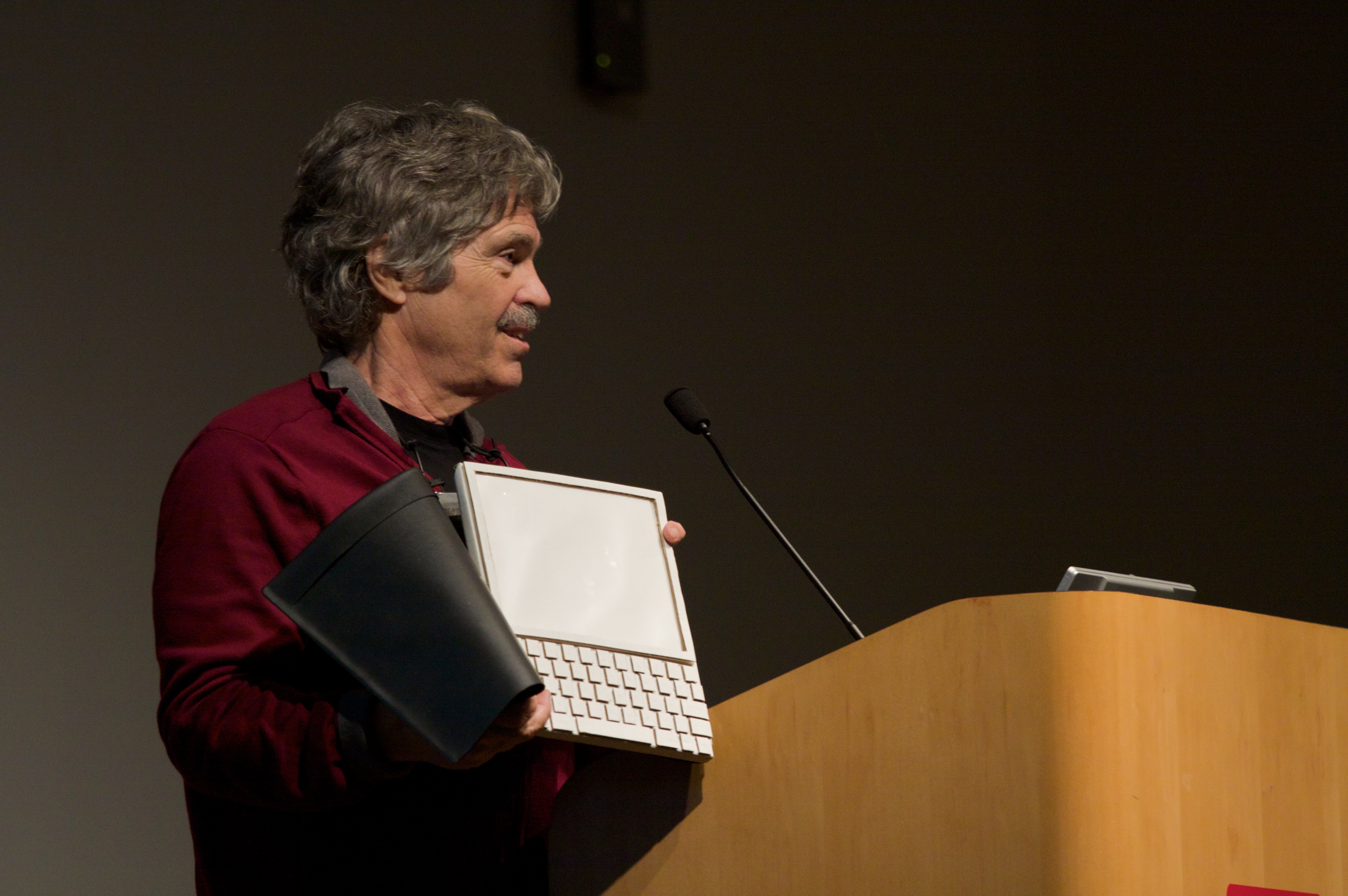
In 2008, Alan Kay presents the original 1960s Dynabook prototype, which was made of carboard.

Computer tablets became a big deal in 2010, but they weren’t anything new to Alan Kay. From “Space Wars: Fanatic Life and Symbolic Death Among the Computer Bums,” Stewart Brand’s 1972 Rolling Stone article about the emerging computer culture:

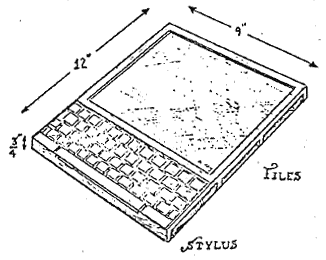
“Alan is designing a hand-held stand-alone interactive-graphic computer (about the size, shape and diversity of a Whole Earth Catalog, electric) called ‘Dynabook.’ It’s mostly high-resolution display screen, with a keyboard on the lower third and various cassette- loading slots, optional hook-up plugs, etc. His colleague Bill English describes the fantasy. thus:

‘It stores a couple of million characters of text and does all the text handling for you – editing, viewing, scanning, things of that nature. It’ll have a graphics capability which’ll let you make sketches, make drawings. Alan wants to incorporate music in it so you can use it for composing. It has the Smalltalk language capability which lets people program their own things very easily. We want to interface them with a tinker-toy kind of thing. And of course it plays Spacewar.’

"If Xerox Corporation decides to go with the concept, the Dynabooks could be available in two or three years."

The drawing capability is a program that Kay designed called ‘Paintbrush.’ Working with a stylus on the display screen, you reach up and select a shape of brush, then move the brush over and pick up a shade of half-tone-screen you like, then paint with it. If you make a mistake, paint it out with ‘white.’ The screen simultaneously displays the image you’re working on and a one-third reduction of it, where the dot pattern becomes a shaded half-tone.

A Dynabook could link up with other Dynabooks, with library facilities, with the telephone, and it could go and hide where a child hides. Alan is determined to keep the cost below $500 so that school systems could provide Dynabooks free out of their textbook budgets. If Xerox Corporation decides to go with the concept, the Dynabooks could be available in two or three years, but that’s up to Product Development, not Alan or the Research Center. Peter Deutsch comments: ‘Processors and memories are getting smaller and cheaper. Five years ago the idea of the Dynabook would have been a absolutely ridiculous. Now it merely seems difficult….'”

Tags: ,

French psychoanalyst Jacques Lacan has his lecture interrupted by a member of the Situationist International, the Marxist political group with a flair for surreal spectacle. Great academic theater from roughly four decades ago. (Thanks to The Documentarian.)

Tags:

"The applicant's bald spot is not less than three inches in diameter."


  • Bald-Head Club of America: Organized in Falls Village, Connecticut, in 1912. One of the conditions mentioned in the application for membership is the statement printed therein that the applicant’s bald spot is not less than three inches in diameter, and a further purpose is to promote social and fraternal relations between bald heads and cultivate a sentiment of sympathy for men who have hair. Membership fee, $1.
  • Anti-Horse Thief Association: To ensure the safety of our people and the security of their property against loss by thieves, robbers, murderers, vagrants, tramps, incendiaries, and all violators of the law, and to secure for us and our families the enjoyment of life and the pursuit of happiness in the possession of our honest reward of labor with equal and just rights to all. Founded in 1854, membership 45,000.
  • Telephone Pioneers of America: The objects of this society are social. They are to bring together those who were associated with the early days of the telephone business and perpetuate those friendships made at that time.
  • The Anti-Saloon League of America: Organized at Washington D.C., December 18, 1895 and installed in all States and Territories, including the Hawaiian Islands and Alaska. The league throughout the nation employs about 1,000 persons, who give their entire time to the work of this institution, and it has about 175 offices from which were distributed during the year more than 2,000,000 book pages of anti-saloon literature per day.
  • American Society for Thrift: The society was founded to promote thrift by inquiry, discussion, and education. It accepts no fees or contributions; it sends out regularly literature on the subject of thrift. In brief, its function is to lead to an American thrift propaganda. It has interested the National Education Association in its work, and that body has appointed a thrift board which is canvassing a plan of introducing thrift teachings in the public schools of America.

•Taken from the 1916 World Almanac and Encyclopedia.

Made herself vomit bolts right before the show, but, yes, she looks fabulous.

Sign: "Woman Voter Monthly Magazine 5 cts."

I posted once about a woman who opposed women’s suffrage, but how were men who supported female voting treated? The above classic photo shows the NYC headquarters of the Men’s League for Women’s Suffrage in 1915. Just two years earlier, an article in the New York Times provided coverage of the organization’s ill-fated attempt to spread its message of equality to London. An excerpt:

“Riotous scenes attended the attempt of the Men’s League for Women’s Suffrage to hold a meeting in Hyde Park this afternoon. The police gave the League permission to use a truck as a platform, and the overturning of this truck by the crowd ended the proceedings.

Laurence Housman, 1915. (Image by Bain News Service.)

The meeting, as usually, started in an orderly manner, but when Laurence Housman, the poet and playwright, attempted to address an audience of some 10,000 he was greeted with hisses and catcalls, and his speech was interrupted by a fire of heated comments from his hearers. Other speakers had even less success, the interruptions taking the form of clods of earth and other missiles. One youth had an ingenious idea for annoying the speakers. By means of a piece of a mirror he reflected the sun’s rays upon their faces, causing such discomfiture that they were obliged to turn around and address another section of the crowd.

Later one speaker made an allusion to ‘ignorant hooligans.’ The crowd took this as a direct application to themselves. Angry cries were raised, and an ugly rush was made for the truck. The police made valiant efforts to keep back the excited crowd but were practically powerless. The speakers made hasty exits from the vehicle, but one of them had not left it when the truck was captured. He took a flying leap just in time, for a half second later the wagon was completely overturned after a desperate heave by the protesting audience.”

Tags:

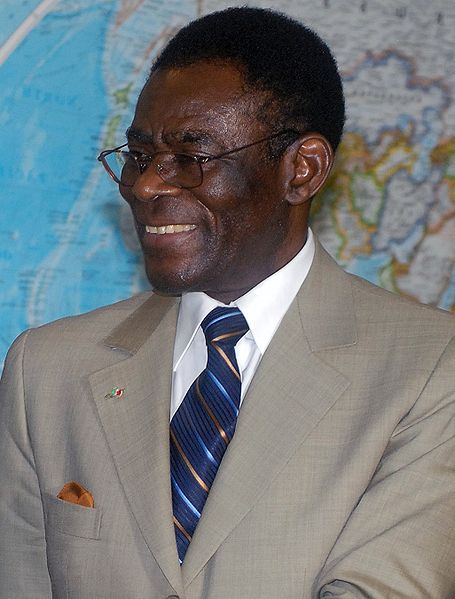
"His wardrobe was picked from the racks of Versace, Gucci, and Dolce & Gabbana, and he spared no expense on himself." (Image by Rodrigues Pozzebom.)

Someday Teodoro Nguema Obiang is likely to become dictator of oil-rich Equitorial Guinea, but for now he makes do in a $30 million Malibu compound stocked with Playboy bunnies. Considered the heir to his father, Teodoro Obiang Nguema Mbasogo, the nation’s current dictator who’s suffering from prostate cancer, Teodorin, as he is nicknamed, rules the sub-Saharan African nation’s media remotely, while spending lavishly and awaiting his iron throne. The opening of “Teodorin’s World,” Ken Silverstein’s fascinating article in the current Foreign Policy:

“The owner of the estate at 3620 Sweetwater Mesa Road, which sits high above Malibu, California, calls himself a prince, and he certainly lives like one. A long, tree-lined driveway runs from the estate’s main gate past a motor court with fountains and down to a 15,000-square-foot mansion with eight bathrooms and an equal number of fireplaces. The grounds overlook the Pacific Ocean, complete with swimming pool, tennis court, four-hole golf course, and Hollywood stars Mel Gibson, Britney Spears, and Kelsey Grammer for neighbors.

With his short, stocky build, slicked-back hair, and Coke-bottle glasses, the prince hardly presents an image of royal elegance. But his wardrobe was picked from the racks of Versace, Gucci, and Dolce & Gabbana, and he spared no expense on himself, from the $30 million in cash he paid for the estate to what Senate investigators later reported were vast sums for household furnishings: $59,850 for rugs, $58,000 for a home theater, even $1,734.17 for a pair of wine glasses. When he arrived back home — usually in the back seat of a chauffeur-driven Rolls-Royce or one of his other several dozen cars — his employees were instructed to stand in a receiving line to greet the prince. And then they lined up to do the same when he left.

The prince, though, was a phony, a descendant of rulers but not of royals. His full name is Teodoro Nguema Obiang Mangue — Teodorin to friends — and he is the son of the dictator of Equatorial Guinea, a country about the size of Maryland on the western coast of Africa. A postage stamp of a country with a population of a mere 650,000 souls, Equatorial Guinea would be of little international consequence if it didn’t have one thing: oil, and plenty of it. The country is sub-Saharan Africa’s third-largest producer of oil after Nigeria and Angola, pumping around 346,000 barrels per day, and is both a major supplier to and reliable supporter of the United States. Over the past 15 years, ExxonMobil, Hess Corp., and other American firms have collectively invested several billion dollars in Equatorial Guinea, which exports more of its crude to the U.S. market than any other country.” (Thanks Longform.)

Tags: , ,

But real hummingbirds still taste way better. I kid.

"Don't overpay anymore for your sheitel."

SHEITELS human european wigs (NEW YORK)

Ladies,,,,Don’t overpay anymore for your sheitel,,, I did the same thing… Im posting everywhere to warn aginst doing so…I didn’t know the markups on the sheitels your buying are 6X and more, i guess they charge alot for advertising costs etc… I found someone that can get them very low priced,,, and I wanted to tell everyone .. What I did is I went on eBay and found them , and I bought one… and now I’m buying more… I love mine, its perfect, its been about 4 months and I am trying to tell everyone I know about how happy I am,. its the best one iver ever seen. it has the kosher certificate also… and what a low price I paid. around 800$ and its long too… once i bought one for 3500$  and it fell apart in 6 months. I couldn’t get a refund. This wig is so much better.

Check your watch, smiley. Time's growing short. (Image by Marcello Casal Jr.)

Marginal Revolution pointed me to a blog post on the Monkey Cage by Graeme Robertson that wonders why protests can usurp the grip of authoritarian regimes. I think the points here are good, but I wonder if it applies to North Korea, or if that nation is just too much of an outlier? An excerpt:

“The key to answer this question, I think, is to understand the basic nature of authoritarian rule. While the news media focus on ‘the dictator’, almost all authoritarian regimes are really coalitions involving a range of players with different resources, including incumbent politicians but also other elites like businessmen, bureaucrats, leaders of mass organizations like labor unions and political parties, and, of course, specialists in coercion like the military or the security forces. These elites are pivotal in deciding the fate of the regime and as long as they continue to ally themselves with the incumbent leadership, the regime is likely to remain stable. By contrast, when these elites split and some defect and decide to throw in their lot with the opposition, then the incumbents are in danger.

So where do protests come in? The problem is that in authoritarian regimes there are few sources of reliable information that can help these pivotal elites decide whom to back. Restrictions on media freedom and civil and political rights limit the amount and quality of information that is available on both the incumbents and the opposition. Moreover, the powerful incentives to pay lip service to incumbent rulers make it hard to know what to make of what information there is. Rumor and innuendo thus play a huge role in all authoritarian regimes.

In this context, protests are excellent opportunities for communication. Broadly, there are two types of messages being sent. The one that gets the most scholarly attention is at the level of protesters trying to convince other citizens that “people like them” hate the incumbents and are willing to act.”

Tags:

Some of Gilbert Gottfried’s finest work since he played Dr. Peabody in Problem Child 3: Junior in Love. (Thanks Reddit.)

Tags:

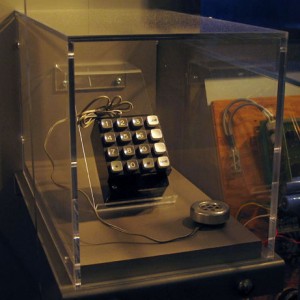
An original Blue Box at the Computer History Museum. Al Gilbertson invented the first such box, which gave callers the same control over the phone system as an operator. (Image by RaD man.)

Before the World Wide Web allowed most of the planet to be readily connected, people were already using whatever techological gadget they had at hand to try to reach out-of-the-way places and obscure information. Phone phreaks were pre-computer revolution hackers who figured out ways to place free phone calls and learn the finer points about the phone company’s computer system. For phreaks (including the pre-Apple Steves, Jobs and Wozniak), this hacking was a training ground for future endeavors in the computer industry.

The phone company was not amused, however, so these phreaks hid behind aliases like “Captain Crunch” and “Legion of Doom.” It was a subculture that few knew about until 1971, when Ron Rosenbaum’s Esquire article, “Secrets of the Little Blue Box,” profiled hacker Al Gilbertson. An excerpt:

“There is an underground telephone network in this country. Gilbertson discovered it the very day news of his activities hit the papers. That evening his phone began ringing. Phone phreaks from Seattle, from Florida, from New York, from San Jose, and from Los Angeles began calling him and telling him about the phone-phreak network. He’d get a call from a phone phreak who’d say nothing but, ‘Hang up and call this number.’

When he dialed the number he’d find himself tied into a conference of a dozen phone phreaks arranged through a quirky switching station in British Columbia. They identified themselves as phone phreaks, they demonstrated their homemade blue boxes which they called ‘M-F-ers’ (for ‘multi-frequency,’ among other things) for him, they talked shop about phone-phreak devices. They let him in on their secrets on the theory that if the phone company was after him he must be trustworthy. And, Gilbertson recalls, they stunned him with their technical sophistication.

I ask him how to get in touch with the phone-phreak network. He digs around through a file of old schematics and comes up with about a dozen numbers in three widely separated area codes.

‘Those are the centers,’ he tells me. Alongside some of the numbers he writes in first names or nicknames: names like Captain Crunch, Dr. No, Frank Carson (also a code word for a free call), Marty Freeman (code word for M-F device), Peter Perpendicular Pimple, Alefnull, and The Cheshire Cat. He makes checks alongside the names of those among these top twelve who are blind. There are five checks.
John T. Draper, the computer legend also known as "Captain Crunch." (Image by Aaron Getting.)

I ask him who this Captain Crunch person is.

‘Oh. The Captain. He’s probably the most legendary phone phreak. He calls himself Captain Crunch after the notorious Cap’n Crunch 2600 whistle.’ (Several years ago, Gilbertson explains, the makers of Cap’n Crunch breakfast cereal offered a toy-whistle prize in every box as a treat for the Cap’n Crunch set. Somehow a phone phreak discovered that the toy whistle just happened to produce a perfect 2600-cycle tone. When the man who calls himself Captain Crunch was transferred overseas to England with his Air Force unit, he would receive scores of calls from his friends and ‘mute’ them — make them free of charge to them — by blowing his Cap’n Crunch whistle into his end.)

‘Captain Crunch is one of the older phone phreaks,’ Gilbertson tells me. ‘He’s an engineer who once got in a little trouble for fooling around with the phone, but he can’t stop. Well, this guy drives across country in a Volkswagen van with an entire switchboard and a computerized super-sophisticated M-F-er in the back. He’ll pull up to a phone booth on a lonely highway somewhere, snake a cable out of his bus, hook it onto the phone and sit for hours, days sometimes, sending calls zipping back and forth across the country, all over the world….’

Back at my motel, I dialed the number he gave me for ‘Captain Crunch’ and asked for G—- T—–, his real name, or at least the name he uses when he’s not dashing into a phone booth beeping out M-F tones faster than a speeding bullet, and zipping phantomlike through the phone company’s long-distance lines.

When G—- T—– answered the phone and I told him I was preparing a story for Esquire about phone phreaks, he became very indignant.

‘I don’t do that. I don’t do that anymore at all. And if I do it, I do it for one reason and one reason only. I’m learning about a system. The phone company is a System. A computer is a System. Do you understand? If I do what I do, it is only to explore a System. Computers. Systems. That’s my bag. The phone company is nothing but a computer.'”

Tags: ,

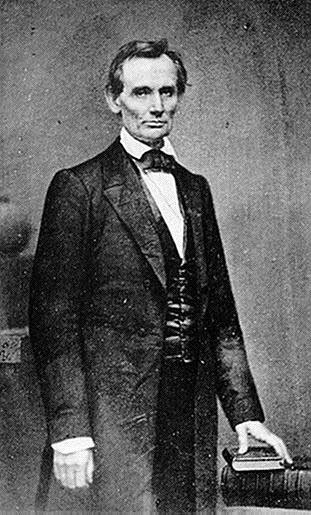
Thanks for ruining the ceiling, jackass. (Image by Mathew Brady.)

I recently posted about Abraham Lincoln’s less-than-graceful youth, using examples from Carl Sandburg’s great biography, The Prairie Years. Here’s another brief tale of Lincoln’s boorish behavior from that tome:

“He put barefoot boys to wading in a mud puddle near the home trough, pulled them up one by one, carried them to the house upside down, and walked their muddy feet across the ceiling. The stepmother came in, laughed at their foot tracks, told Abe he ought to be spanked–and he cleaned the ceiling so that it looked new.”

Tags:

Created by farmer Wu Yulu.

Tags:

« Older entries § Newer entries »