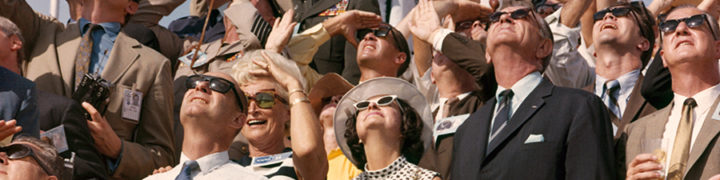
By Samsung. (Thanks Physorg.)
You are currently browsing the archive for the Videos category.

From “The Heron and the Astronaut,” Anne Morrow Lindbergh’s lyrical 1969 Life account of the Apollo 8 mission:
“At midnight, we decide to go out to the Cape to see the rocket lit up with searchlights for its final servicing. Already the roads approaching the Cape are full, the sides lined with cars, tents and trailers full of people spending the night on the beach to be in place for the early morning spectacle.
Even before we reach the Cape we see Apollo 8 miles away across the water, blazing like a star on the horizon. We journey toward it until we are only a mile or two distant. As we approach, it gets larger and brighter until it dominates the dark landscape, an incandescent tube, a giant torch with searchlights, focused on it and and beaming beyond over the heavens. The whole sky is arched with rainbows of light.
We climb out of the car and stand in the night wind, facing the source of light. Even at this distance we can see the rocket clearly, poised on its pad and gleaming white. The service structure, one half of its protective sheath, has been pulled away. Only the mobile launcher (the umbilical tower), that dark, bulky cranelike structure, stands beside it, dimmed by brilliance.
For the first time the rocket is alone, whole and free. It is no longer in sections, dwarfed by the mammoth assembly building or obscured by scaffolding. The thousands of details we witnessed this morning have been unified into a single shape. We cannot see, except as a dazzling whiteness, the glaze of frost that coats it due to the extreme cold of the liquid fuels it holds. There is just a wisp of vapor curling from one side like a white plume of breath in the darkness. All is simplified by distance and night into the sheer pure shape of flight, into beauty.”
••••••••••
The Apollo 8 mission:
Tags: Anne Morrow Lindbergh
Jean-Luc Godard on TV’s creeping influence on film. From Room 666, 1982.
See also:
- Dick Cavett interviews Godard. (1980)
Tags: Jean Luc-Godard
Kim Basinger uses beer-enriched shampoo. Shouldn’t you? From 1978.
Tags: Kim Basinger
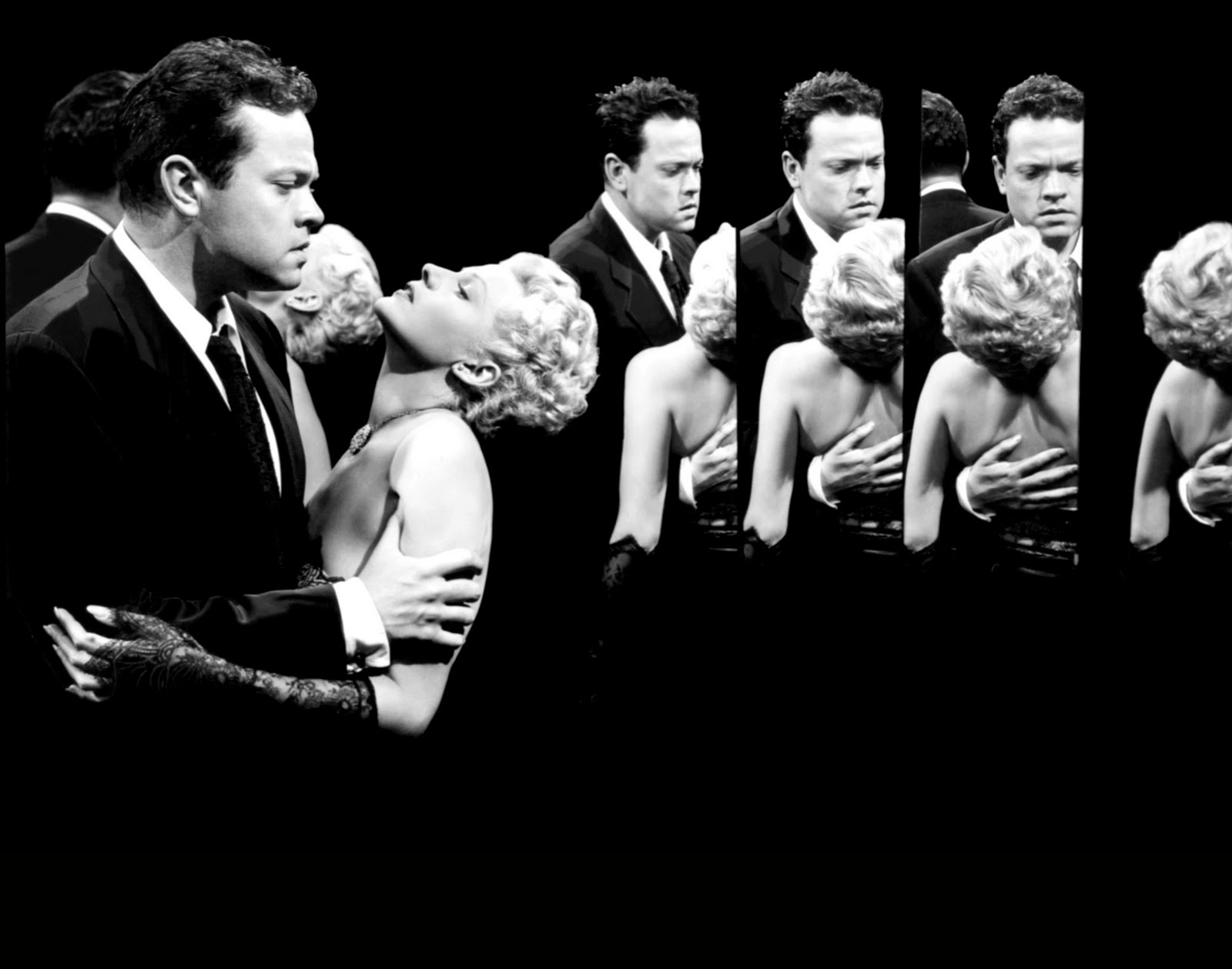
A genius computer scientist who long ago predicted cloud computing, social networks and the current connectivity, David Gelernter was famously sent an explosive by the Unabomber, though his life accomplishments should render that bold headline a footnote. The Economist has an excellent short profile of the technologist. An excerpt:
“More than two decades ago, Dr Gelernter foresaw how computers would be woven into the fabric of everyday life. In his book Mirror Worlds, published in 1991, he accurately described websites, blogging, virtual reality, streaming video, tablet computers, e-books, search engines and internet telephony. More importantly, he anticipated the consequences all this would have on the nature of social interaction, describing distributed online communities that work just as Facebook and Twitter do today.
‘Mirror Worlds aren’t mere information services. They are places you can ‘stroll around’, meeting and electronically conversing with friends or random passers-by. If you find something you don’t like, post a note; you’ll soon discover whether anyone agrees with you,’ he wrote. ‘I can’t be personal friends with all the people who run my local world any longer, but via Mirror Worlds we can be impersonal friends. There will be freer, easier, more improvisational communications, more like neighbourhood chatting and less like typical mail and phone calls. Where someone is or when he is available won’t matter. Mirror Worlds will rub your nose in the big picture and society may be subtly but deeply different as a result.'”
••••••••••
Gelernter’s Lifestreaming predated Facebook:
Tags: David Gelernter
Richard Stallman is right about social networks, but it’s not like we’re unaware of the intrusion–we just don’t care. In this scary world, we want a brother at any cost, even if it’s Big Brother. We want someone to watch over us.
Tags: Richard Stallman

Buying on credit will likely never cease, though the plastic cards that have long been part of the transactions may disappear. From a brief history of credit cards by Hilary Greenbaum and Dana Rubinstein in the New York Times Magazine:
“In Looking Backward, Edward Bellamy’s 1888 novel about a socialist utopia more than a century hence, citizens are issued ‘credit cards’ entitling them to shares of the national wealth. In today’s dystopian reality, people use a different sort of card to buy stuff on the Internet. Yet according to Robert Manning, a historian and author of Credit Card Nation, plastic remains ‘one of the top 10 innovations in the post-World War II period.’ Even if it owes its ubiquity, in part, to a New York businessman named Frank X. McNamara, who forgot to bring cash to a lunch meeting. In 1950, McNamara introduced a cardboard charge card. He called it the Diners Club.
During the 1920s, department stores started issuing charge plates or coins — round or rectangular and mostly made from metal — to encourage loyal customers to run a tab. The most popular, made by a company called Charga-Plate, was rectangular and big enough for an account number, a name and an address.”
••••••••••
“He wines and dines without ever spending cash,” 1963:
The first use of the Time-Slice special effect on TV, 1993.
In France.
Three short works by Michel Gondry:
“Let Forever Be,” the Chemical Brothers.
Air France commercial.
Directing the opening of Jimmy Kimmel Live.
Tags: Michel Gondry

From a 1979 Philip K. Dick interview in Science Fiction Review, in which the author inexplicably shows great love for Chairman Mao and makes an interesting point about the human capacity for blocking out the truth:
Question:
Right now, the first reports are coming back from our probes on Mars. What effect, if any, would news of life on Mars have on humanity?
Philip K. Dick:
You mean the average person?
Question:
Yes. What would it do to their thoughts of themselves, and their place in the universe?
Philip K. Dick:
All right. Yesterday, Chairman Mao died. To me, it was as if a piece of my body had been torn out and thrown away, and I’m not a Communist. There was one of the greatest teachers, poets, and leaders that ever lived. And I don’t see anybody walking around with any particularly unhappy expression. There have been some shots of people in China crying piteously, but I woke my girlfriend up at 7:00 in the morning. I was crying. I said, ‘Chairman Mao has died.’ She said, ‘Oh my God, I thought you said ‘Sharon was dead” — some girl she knows. I think I would be like that. I think there would be little, if any, real reaction. If they can stand to hear that Chairman–that that great poet and teacher, that great man, that–one guy on TV — one Sinologist — said ‘The American public would have to imagine as if, on a single day, both Kennedys, Dr. King, and Franklin D. Rossevelt were all killed simultaneously,’ and even then they wouldn’t get the full impact of it. So I don’t really think that to find life on Mars is going to affect people. One time I was watching TV, and a guy comes on, and he says, ‘I have discovered a 3,000,000-year-old humanoid skull with one eye and two noses.’ And he showed it — he had twenty-five of them, they were obviously fake. And it had one eye, like a cyclops, and had two noses. And the network and everybody took the guy seriously. He says, ‘Man originated in San Diego, and he had one eye and two noses.’ We were laughing, and I said, ‘I wonder if he has a moustache under each nose?
People just have no criterion left to evaluate the importance of things. I think the only thing that would really affect people would be the announcement that the world was going to be blown up by the hydrogen bomb. I think that would really effect people. I think they would react to that. But outside of that, I don’t think they would react to anything. ‘Peking has been wiped out by an earthquake, and the RTD — the bus strike is still on.’ And some guy says, ‘Damnit! I’ll have to walk to work!’ So? You know, 800,000 Chinese are lying dead under the rubble. Really. It cannot be burlesqued.
I think people would have been pleased if there was life on Mars, but I think they would have soon wearied of the novelty of it, and said, ‘But what is there on Jupiter? What can the life do?’ And, ‘My pet dog can do the same thing.’ It’s sad, and it’s also very frightening in a way, to think that you could come on the air, and you could say, ‘The ozone layer has been completely destroyed, and we’re all going to die of cancer in ten years.’ And you might get a reaction. And then, on the other hand, you might not get a reaction from people. So many incredible things have happened.
I talked to a black soldier from World War II who had entered the concentration camp — he had been part of an American battalion that had seized a German death camp — it wasn’t even a concentration camp, it was one of the death camps, and had liberated it. And he said he saw those inmates with his own eyes, and he said, ‘I don’t believe it. I saw it, but I have never believed what I saw. I think that there was something we don’t know. I don’t think they were being killed.’ They were obviously starving, but he says, ‘Even though I saw the camp, and I was one of the first people to get there, I don’t really believe that those people were being killed by millions. For some reason, even though I myself was one of the first human’ — notice the words ‘human beings’ — ‘human beings to see this terrible sight, I just don’t believe what I saw.’ And I guess that’s it, you know. I think that may have been the moment when this began, was the extermination of the gypsies, and Jews, and Bible students in the death camps, people making lampshades out of people’s skins. After that, there wasn’t much to believe or disbelieve, and it didn’t really matter what you believed or disbelieved.•
Tags: Chairman Mao, Mao Zedong, Philip K. Dick
In his New York Times opinion piece about the vacuum of governance in large swaths of Pakistan among other places, Steve Inskeep mentions in passing the late urban planner Constantinos Doxiadis, who was one of the key figures in 20th-century urban life. Funny that someone who held so much sway over so many lives is all but forgotten to those outside of city planning. A 1960s NBC interview with Doxiadis:
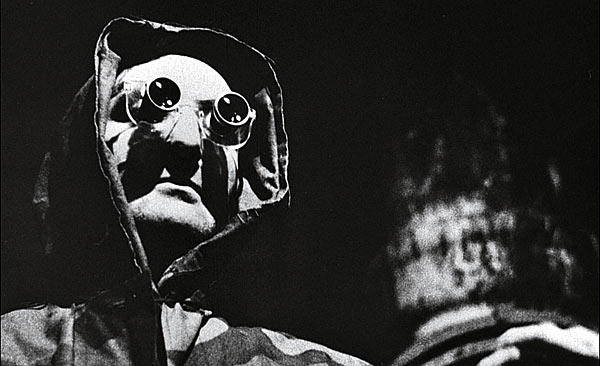
From “The Omega Glory,” Michael Chabon’s essay about that amorphous thing known as The Future, at The Long Now:
“The Sex Pistols, strictly speaking, were right: there is no future, for you or for me. The future, by definition, does not exist. ‘The Future,’ whether you capitalize it or not, is always just an idea, a proposal, a scenario, a sketch for a mad contraption that may or may not work. ‘The Future’ is a story we tell, a narrative of hope, dread or wonder. And it’s a story that, for a while now, we’ve been pretty much living without.
Ten thousand years from now: can you imagine that day? Okay, but do you? Do you believe ‘the Future’ is going to happen? If the Clock works the way that it’s supposed to do—if it lasts—do you believe there will be a human being around to witness, let alone mourn its passing, to appreciate its accomplishment, its faithfulness, its immense antiquity? What about five thousand years from now, or even five hundred? Can you extend the horizon of your expectations for our world, for our complex of civilizations and cultures, beyond the lifetime of your own children, of the next two or three generations? Can you even imagine the survival of the world beyond the present presidential administration?” (Thanks TETW.)
•••••••••
Punks and rotters, the lot of them, 1976:
Tags: Bill Grundy, Michael Chabon, Sex Pistols
Vin Scully for Continental and its electronic video games and “specially condensed” double-feature movies, 1970s.
Tags: Vin Scully
Experimenting with mobile phones in 1922. (Thanks Open Culture.)
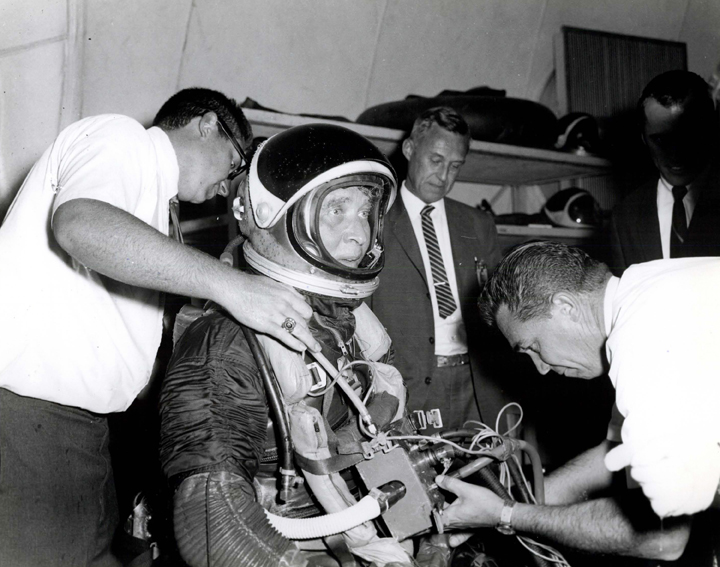
Compromise as much as courage was key to the U.S.A. touching down on the moon first. Operation Paperclip rounded up scores of Nazi scientists at the conclusion of WWII, and brought them to America to make us preeminent in rockets, satellites, and ultimately, spaceships, without ever holding these men accountable for their atrocities. Chief among these unlikely American heroes was brilliant Wernher von Braun, who was portrayed to the American public as a scientist who was dispassionate about politics, just another pawn in the horrible Nazi game. Of course, that was far from the truth. From “The Rocket Man’s Dark Side,” Leon Jaroff’s 2002 Time report about the genius whose awful past was lost in space:
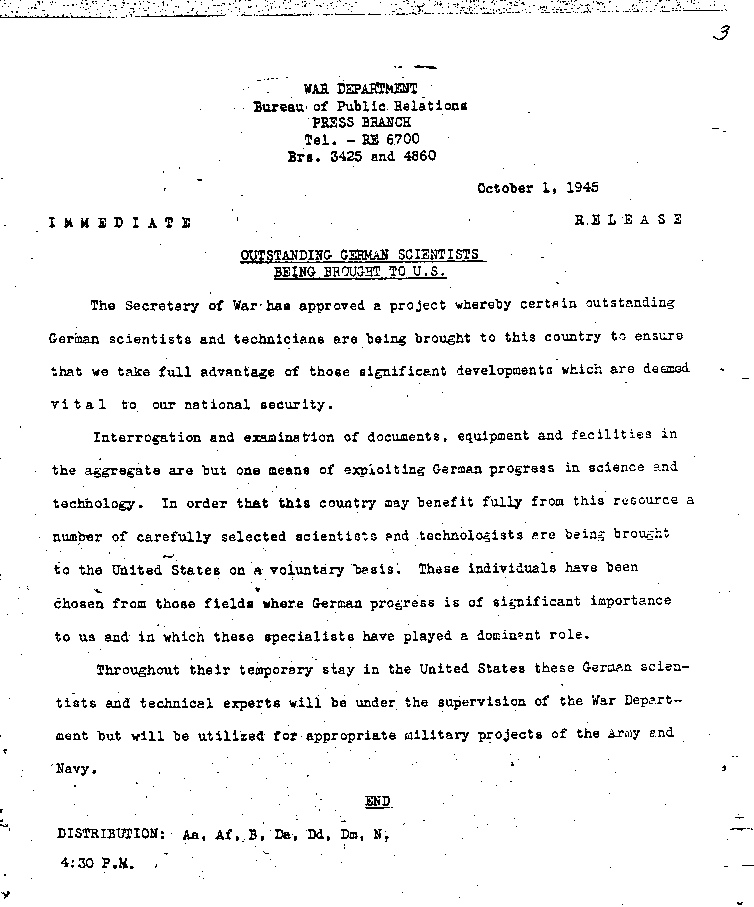
Still, he was apolitical, wasn’t he, and during the war had really only been pursuing his lifelong interest in rocketry. And hadn’t he fully redeemed himself with his great contributions to our space race with the Soviets?
That’s the gist of the official von Braun biography posted on the web site of NASA’s Marshall Space Flight Center, where under the directorship of von Braun, the mighty Saturn 5 rocket was developed. And it’s this sanitized biography that has roused the indignation of Tom Gehrels, a noted University of Arizona astronomer and pioneer in the program to discover and track Earth-threatening asteroids. A member of the Dutch resistance during World War II, Gehrels readily acknowledges von Braun’s contributions to the world of science, but is all too aware of the little-known dark side of both him and his brother Magnus. “They were Jekyll and Hyde characters,” Gehrels insists, “and the full truth ought to be known.”
It is Gehrels who has pieced together that truth, largely from interviews with surviving political prisoners who had been forced to build V-1s and V-2s under the supervision of the von Brauns in an underground complex near Nordhausen, Germany. These prisoners were housed in an adjacent concentration camp called Dora, and new arrivals were given the standard welcoming speech: ‘You came in through that gate, and you’ll leave through that chimney [of the crematorium].’
Indeed, some 20,000 died at Dora, from illness, beatings, hangings and intolerable working conditions. Workers, scantily clad, were forced to stand at attention in the biting cold during roll calls that went on for hours. Average survival time in the unventilated paint shop was one month. One prisoner told of being bitten on his legs by guard dogs. Presumably to test the effectiveness of a new medication, one of his legs was treated, the other allowed to fester and deteriorate.
For reasons best known to von Braun, who held the rank of colonel in the dreaded Nazi SS, the prisoners were ordered to turn their backs whenever he came into view. Those caught stealing glances at him were hung. One survivor recalled that von Braun, after inspecting a rocket component, charged, “That is clear sabotage.” His unquestioned judgment resulted in eleven men being hanged on the spot. Says Gehrels, ‘von Braun was directly involved in hangings.”•
Dr. Strangelove’s backstory—and salutes—were inspired by von Braun.
See also:
Tags: Leon Jaroff, Tom Gehrels, Wernher von Braun
Senseg creates interfaces that you can feel.

"The footage would capture the candidate seeming engaged in the kind of heart-to-heart dialogues with working-class Americans that the campaign had otherwise left off his schedule that day." (Image by Gage Skidmore .)
The source of the considerable reservoir of rage beneath Mitt Romney’s well-polished exterior is as mysterious as President Obama’s ever-present sense of calm–though it’s obviously more concerning. Robert Draper’s new New York Times Magazine article about the likely GOP Presidential nominee suggests that Romney is unflappable–I’m not buying it–but makes good points about the guy you’d least like to have a beer with competing for the country’s highest office. An excerpt;
“It’s very unlikely that we’ll ever hear Mitt Romney and Barack Obama openly discuss the things they have in common. Nonetheless, we may well see in the general election a contest between two dispassionate and accommodating pragmatists and skilled debaters who relish intellectual give-and-take, and whose willingness to compromise has infuriated the party faithful. Both have promised change. Each will frame the other as being not up to the task.
How ably Romney the nominee will defend himself, given the kid-gloves treatment by his current competition and the campaign’s avoidance of large segments of his own life story, is difficult to say just yet. In early November I watched Romney return to Iowa for only the fourth time. He stopped in Dubuque and Davenport and, before decent-size crowds, essentially regurgitated his address on the economy from the week before. In both cases he spoke for less than 20 minutes and did not take questions from the audience. Far more of his ground time was devoted to filming promotional material in a Dubuque sheet-metal factory, where the footage would capture the candidate seeming engaged in the kind of heart-to-heart dialogues with working-class Americans that the campaign had otherwise left off his schedule that day.
Near the end of his talk in Davenport, he said to the 275 east Iowans in attendance, ‘I want you to get to know me a little better.’ After wrapping up his speech, he moved briskly through the crowd, pausing now and then to take photos and sign autographs, before flying out of Iowa with Stuart Stevens and a couple of other staff members.”
••••••••
“Did you hear what I said?”
Tags: Mitt Romney, Robert Draper
Katharine Hepburn talks about aging in America, 1979.
Tags: Katherine Hepburn

America got rid of the draft but continued waging wars, which meant that a military class needed to emerge and companies had to form to manage outsourced dirty work. Most of us never get any blood on our hands, but America is more than ever in the business of war. In Vanity Fair, Todd S, Purdum investigates how the U.S. transformed during the Cold War and War on Terror from sleeping giant into a militarized security state. An excerpt:
“Just over 50 years ago, in his farewell address from the Oval Office, Dwight D. Eisenhower warned the nation of the dangers inherent in a powerful ‘military-industrial complex,’ and just three days later—as if in proof of Eisenhower’s words—John Fitzgerald Kennedy famously vowed to ‘pay any price, bear any burden, meet any hardship, support any friend, oppose any foe in order to assure the survival and the success of liberty.’ Yes, the United States faced extraordinary challenges in the postwar era—and was forced to shoulder extraordinary responsibilities. But some steps, once taken, prove impossible to walk back. By 1961 the problem that Eisenhower had identified was well advanced. Already, the United States was spending more on military security than the net income of all American corporations combined.
In the years since, the trend has warped virtually every aspect of national life, with consequences that are quite radical in their cumulative effect on the economy, on the vast machinery of official secrecy, on the country’s sense of itself, and on the very nature of national government in Washington. And yet the degree to which America has changed is noticed by almost no one—not in any visceral way. The transformation has taken hold too gradually and over too long a period. Almost no one alive today has a mature, firsthand memory of a country that used to be very different—that was not a superpower; that did not shroud the workings of its government in secrecy; that did not use ends-justify-the-means logic to erode rights and liberties; that did not undertake protracted wars on the president’s say-so; that had not forgotten how to invest in urgent needs at home; that did not trumpet its greatness even as its shortcomings became more obvious. An American today who is 25 or 50 or even 75—such a person has lived entirely in the America we have become.”
Tags: Todd S. Purdum
A 1970 NASA film about the benefits of satellites.
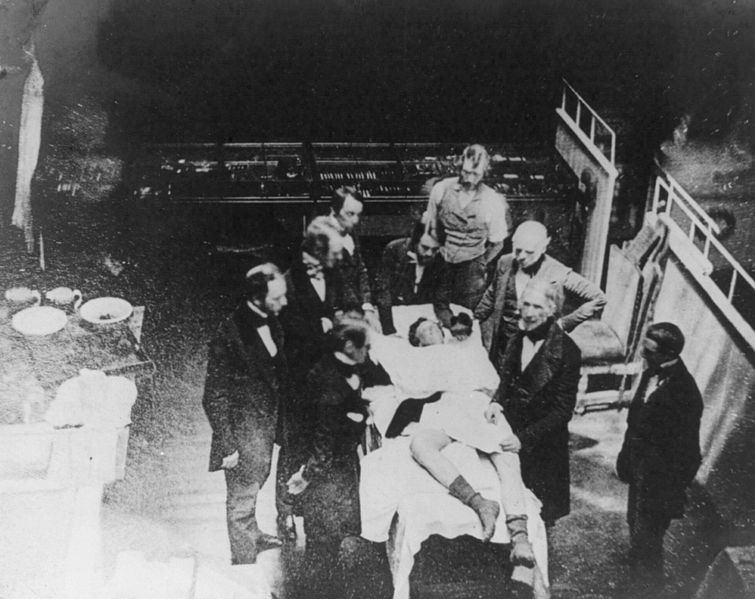
We’ve never really understood why anaesthesia works, only that it does, and that surgery was horrifying before its advent. But perhaps brain imaging will soon reveal the mystery of anesthesia’s potency. An excerpt from New Scientist about the history of surgery with gas:
“It was a Japanese surgeon who performed the first known surgery under anaesthetic, in 1804, using a mixture of potent herbs. In the west, the first operation under general anaesthetic took place at Massachusetts General Hospital in 1846. A flask of sulphuric ether was held close to the patient’s face until he fell unconscious.
Since then a slew of chemicals have been co-opted to serve as anaesthetics, some inhaled, like ether, and some injected. The people who gained expertise in administering these agents developed into their own medical specialty. Although long overshadowed by the surgeons who patch you up, the humble ‘gas man’ does just as important a job, holding you in the twilight between life and death.” (Thanks Browser.)
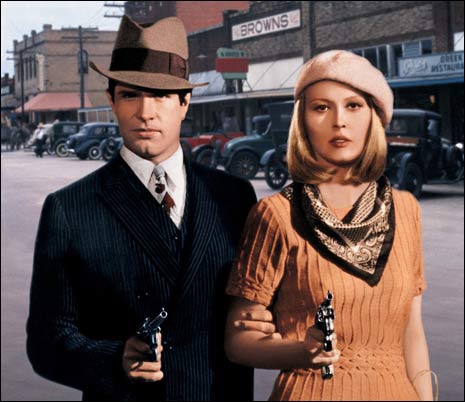
Laurie Winer writing in the Los Angeles Review of Books about Brian Kellow’s new Pauline Kael bio:
“Kael assumed national prominence in 1967, exactly when movies were taking quantum leaps in depictions of sex and violence, causing, as such leaps always do, anguish among cultural gatekeepers. Her review of Bonnie and Clyde marked Kael’s real debut in the New Yorker — she had previously published one article there about movies on TV. With his review of the same film, Bosley Crowther saw his 27-year reign as movie critic at the New York Times come to an end; Kael knew how to read the new graphic nihilism, and Crowther, her avowed nemesis, was left in the dark. Crowther had long been a powerful critic, and he had had his day, opposing Eugene McCarthy and censorship, and helping Americans to accept foreign films such as Open City and The Bicycle Thief. Now he was exposed as perilously out of touch. He was such an advocate of film as a force for betterment that he could hardly tell one violent movie from another. He called Bonnie and Clyde ‘a cheap piece of bald-faced slapstick comedy that treats the hideous depredation of that sleazy, moronic pair as though they were as full of fun and frolic as the jazz-age cut-up in Thoroughly Modern Millie.’ The resistance to this position was so strong that he wrote a second screed, precipitating his forced retirement as a film critic at the end of 1967.
Kael’s response to Arthur Penn’s film was so visceral because she sensed it marked a change in her own life as well as a change in movies. She was 48 years old, the single mother of a daughter, a person who had come from a West Coast farming family and who had struggled long and hard and with precious little recognition. With Bonnie and Clyde she finally came into her own as a critic of stature, someone who could influence the course of events, and she was eager to insert herself into the cultural moment: ‘The audience is alive to it,’ she wrote of the film, as if anyone with sense felt her excitement:
Our experience as we watch it has some connection with the way we reacted to movies in childhood: with how we came to love them and to feel they were ours — not an art that we learned over the years to appreciate but simply and immediately ours.”
••••••••••
PK + WA, 1975:
See also:
Tags: Brian Kellow, Laurie Winer, Pauline Kael
Not yet perfected but oh so promising.
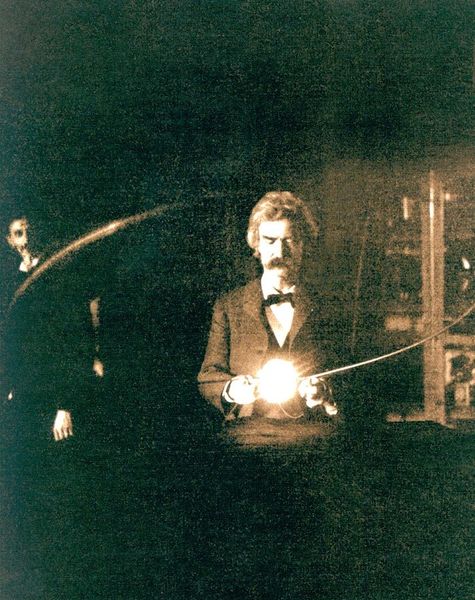
To celebrate the 176th birthday of Samuel Clemens, who was the Mark Twain of his day, here is a classic 1894 photo of the humorist messing around in the New York City laboratory of his good pal, Nikola Tesla. Twain’s wit and wisdom gained him worldwide adoration, made him a fortune (which he lost and regained), brought him into close contact with every notable figure of his era (not just Serbian electricians) and earned him a permanent place in the American literary canon. His speaking engagements were attended by rapturous audiences full of swooning women. Reports of his death may have been exaggerated, but his fame was not.
But like funny people before and after him, Twain had a melancholy side. A brief note from the Brooklyn Daily Eagle, 1898: “Mark Twain, at one time was in the habit of lunching at a restaurant in New York, pretty far uptown and away from the madding crowd. A lady who lived in one of the flats above the restaurant, meeting him just as he was coming away from lunch, spoke to him for a few minutes. Later on, when she herself was having her lunch, the waiter asked her to tell him the name of the gentleman with whom she had been speaking. He said he wanted to know because he was the saddest looking gentleman he had ever seen. ‘It’s quite depressing to wait on him,’ he said, ‘for I’ve never once seen him smile.'”
••••••••••
The Connecticut Yankee, in white suit, of course, 1909:
Tags: Mark Twain