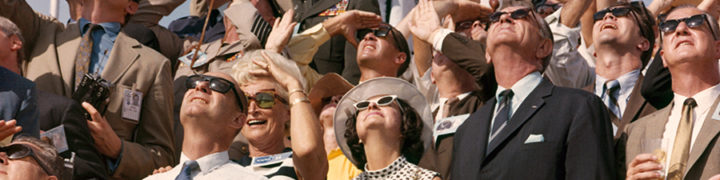
Up to 18 mph. From the good folks at Boston Dynamics.
You are currently browsing the archive for the Videos category.
Harpo Marx, who was plugging his new book, appeared on I’ve Got a Secret, 1961. Johnny Carson on the panel.
From the 1983 New York Times obituary of Mildred Dilling, who taught Harpo how to play his musical instrument and was profiled in the New Yorker in 1940 (subscription required):
“Mildred Dilling, a concert harpist who performed for five Presidents, taught Harpo Marx and owned the world’s largest private collection of harps, died in her Manhattan home last Thursday. She was 88 years old.
Miss Dilling performed throughout North and South America, the Orient and Europe. At the peak of her career, she gave 85 concerts and traveled 30,000 miles a year. In her early 80’s, Miss Dilling was still performing 10 concerts a year. She also conducted harp workshops at colleges and universities, giving master classes at the University of California, Los Angeles.”
Tags: Harpo Marx, Johnny Carson, Mildred Dilling
Two Texas doctors, Billy Cohn and Bud Frazier, create life without a pulse.
Tags: Billy Cohn, Bud Frazier
Marshall McLuhan and artist and ace typographer Harley Parker enjoy a bull session in 1967’s “Picnic in Space,” which is informed by the work of Warhol, Lichtenstein and Godard.
Tags: Harkey Parker, Marshall McLuhan
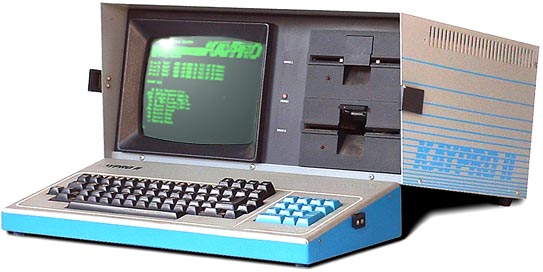
Just listened to a fun interview that Bill Simmons did with stats guru Bill James at the MIT Sloan Sports Analytics Conference. I paid close attention to James’ ability to remember names and dates, and like pretty much every informavore I’ve ever encountered, his recall isn’t very good. The memory is just so elastic even for someone who’s brilliant, except for a few anomalies. Interesting that James points out that he was actually aided in his early career in the 1970s by working with numbers in a time before everyone had a computer or two in their pocket. Because collecting and crunching info was so difficult in an unwired world, others interested in sports stats pretty much gave up while James soldiered on. An excerpt from James talking about his first use of computers:
“Bill Simmons: There’s no way you’re using a computer at this time?
Bill James: We didn’t have personal computers, no. Everything was handwritten and in notebooks.
Bill Simmons: When did you move over to the personal computer?
Bill James: I enjoyed personal compyers as soon as they came out–
Bill Simmons: I would have guessed.
Bill James: I never could program or anything like that. We had a Kaypro…I had a spreadsheet on it that was 32 cells long and 16 wide.”
•••••••••
A great 1983 Kaypro commercial by ad legend Joe Sedelmaier:
Tags: Bill James, Bill Simmons, Joe Sedelmaier
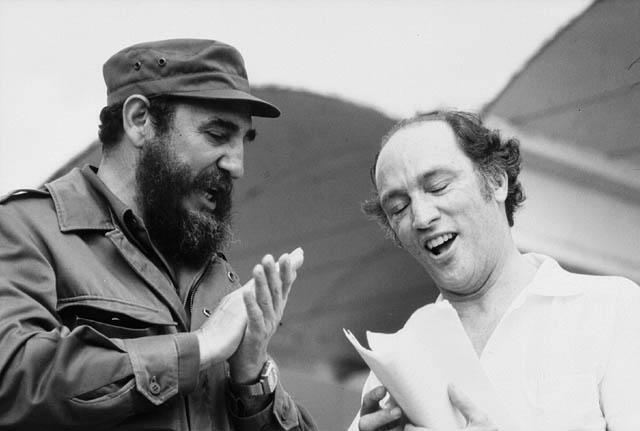
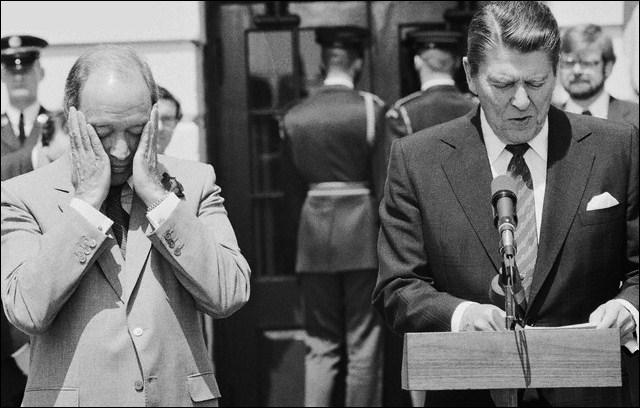
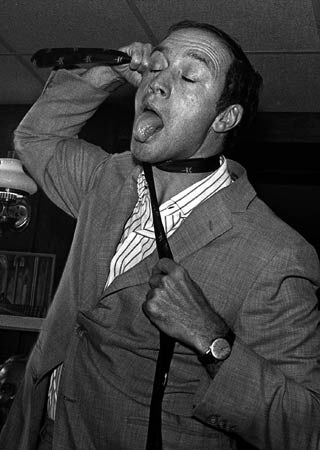
Pierre Trudeau dominated Canadian politics for more than 15 years beginning in 1968. A politican as rock star, he’s still the country’s Prime Minister best remembered outside of Canada and likely the most divisive one within the nation.
Trudeau responding to personal attacks, 1972:
Trudeau meets with John and Yoko, 1969 (no sound until :30):
Tags: John Lennon, Pierre Trudeau, Yoko Ono

In the wake of a devastating earthquake last year, Japanese researchers are experimenting with home levitation. From Popsci: “Instead of building super-strong yet flexible structures to withstand earthquakes, what if you built your house to levitate on a cushion of air? This is already being employed in Japan, a little less than a year after the massive earthquake and tsunami that devastated the country.
The levitation system is the brainchild of a company called Air Danshin Systems Inc., which the Japanese-culture-and-art site Spoon & Tamago says roughly translates to ‘anti-seismic.’ It was founded in 2005 but has caught on after the March 11, 2011 Tohoku earthquake.”

I’ve recently linked to a couple of excellent pieces of Charles Duhigg’s reportage for the New York Times (here and here). He has another impressive article, this one for Slate about the hidden corners of consumerism, called “The Power of Habit.” The opening:
“One day in the early 1900s, a prominent American businessman named Claude C. Hopkins was approached by an old friend with an amazing new creation: a minty, frothy toothpaste named ‘Pepsodent’ that, he promised, was going to be huge.
Hopkins, at the time, was one of the nation’s most famous advertising executives. He was the ad man who had convinced Americans to buy Schlitz beer by boasting that the company cleaned their bottles ‘with live steam’ (while neglecting to mention that every other company used the same method). He had seduced millions of women into purchasing Palmolive soap by proclaiming that Cleopatra had washed with it, despite the sputtering protests of outraged historians.
But Hopkins’ greatest contribution would be helping to create a national toothbrushing habit. Before Pepsodent, almost no Americans brushed their teeth. A decade after Hopkins’ advertising campaigns, pollsters found that toothbrushing had become a daily ritual for more than half the population. Everyone from Shirley Temple to Clark Gable eventually bragged about a ‘Pepsodent smile.”
••••••••
Steve and Eydie don’t have filthy, scummy teeth, 1978:
Tags: Charles Duhigg, Claude C. Hopkins
From Wired: “The robot on display in the video above is being developed by DARPA, the Pentagon’s blue-sky research agency, as part of their Autonomous Robotic Manipulation (ARM) program. Launched in 2010, the initiative aims to come up with robots that can perform highly complex tasks (bomb dismantling, for one) with very little human input.”
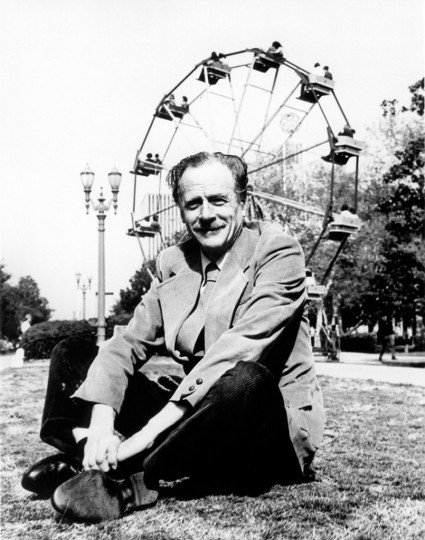
Marshall McLuhan watching the tube, urging us to drown out the white noise, to observe more closely.
Tags: Marshall McLuhan
William F. Buckley, Jr. welcomes Phyllis Schlafly and Ann Scott to debate the Equal Rights Amendment, 1973.
In 1967, Professor David F. James visited I’ve Got a Secret for a demonstration.
Tags: David F. James
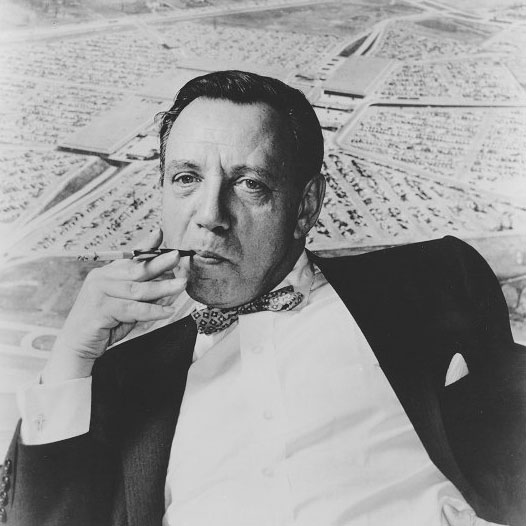
"Victor Gruen was short, stout, and unstoppable."
From “The Terrazzo Jungle,” Malcolm Gladwell’s great 2004 New Yorker article about the birth of the mall, long before anyone could imagine many of them becoming ghosts or virtual:
“Victor Gruen was short, stout, and unstoppable, with a wild head of hair and eyebrows like unpruned hedgerows. According to a profile in Fortune (and people loved to profile Victor Gruen), he was a ‘torrential talker with eyes as bright as mica and a mind as fast as mercury.’ In the office, he was famous for keeping two or three secretaries working full time, as he moved from one to the next, dictating non-stop in his thick Viennese accent. He grew up in the well-to-do world of prewar Jewish Vienna, studying architecture at the Vienna Academy of Fine Arts—the same school that, a few years previously, had turned down a fledgling artist named Adolf Hitler. At night, he performed satirical cabaret theatre in smoke-filled cafés. He emigrated in 1938, the same week as Freud, when one of his theatre friends dressed up as a Nazi Storm Trooper and drove him and his wife to the airport. They took the first plane they could catch to Zurich, made their way to England, and then boarded the S.S. Statendam for New York, landing, as Gruen later remembered, ‘with an architect’s degree, eight dollars, and no English.’ On the voyage over, he was told by an American to set his sights high—’don’t try to wash dishes or be a waiter, we have millions of them’—but Gruen scarcely needed the advice. He got together with some other German émigrés and formed the Refugee Artists Group. George S. Kaufman’s wife was their biggest fan. Richard Rodgers and Al Jolson gave them money. Irving Berlin helped them with their music. Gruen got on the train to Princeton and came back with a letter of recommendation from Albert Einstein. By the summer of 1939, the group was on Broadway, playing eleven weeks at the Music Box. Then, as M. Jeffrey Hartwick recounts in Mall Maker, his new biography of Gruen, one day he went for a walk in midtown and ran into an old friend from Vienna, Ludwig Lederer, who wanted to open a leather-goods boutique on Fifth Avenue. Victor agreed to design it, and the result was a revolutionary storefront, with a kind of mini-arcade in the entranceway, roughly seventeen by fifteen feet: six exquisite glass cases, spotlights, and faux marble, with green corrugated glass on the ceiling. It was a ‘customer trap.’ This was a brand-new idea in American retail design, particularly on Fifth Avenue, where all the carriage-trade storefronts were flush with the street. The critics raved. Gruen designed Ciro’s on Fifth Avenue, Steckler’s on Broadway, Paris Decorators on the Bronx Concourse, and eleven branches of the California clothing chain Grayson’s. In the early fifties, he designed an outdoor shopping center called Northland outside Detroit for J. L. Hudson’s. It covered a hundred and sixty-three acres and had nearly ten thousand parking spaces. This was little more than a decade and a half since he stepped off the boat, and when Gruen watched the bulldozers break ground he turned to his partner and said, ‘My God but we’ve got a lot of nerve.'” (Thanks TETW.)
••••••••••
Gruen commissioned this 1968 film about the revitalization of Fresno and the building of the Fulton Mall:
Tags: Malcolm Gladwell, Victor Gruen

"The elevator would zip along at 125 mph." (Image by Robert Lawton.)
I’m assuming better options for civilian space travel will come along before 2050 when Japan is planning on opening its Elevator Into Space, but here’s a bit about it from CNET:
“Japanese construction company Obayashi wants to build an elevator to space and transport passengers to a station about a tenth the distance to the moon.
The elevator would use super-strong carbon nanotubes in its cables and could be ready as early as 2050, according to Tokyo-based Obayashi.
The cables would stretch some 60,000 miles, about a quarter the distance to the moon, and would be attached to Earth at a spaceport anchored to the ocean floor. The other end would dangle a counterweight in space.
The elevator would zip along at 125 mph, possibly powered by magnetic linear motors, but would take about a week to get to the station. It would carry up to 30 people.”
•••••••••••
Philo T. Farnsworth, the Utah-born whiz kid who was hugely responsible for the creation of television, appearing on the medium he helped birth, on I’ve Got a Secret, in 1957. It may seem odd that someone who did something so monumental could appear to be anonymous on the show, but Farnsworth wasn’t widely known for his invention during his life. Even though the architecture of the medium has morphed wildly in the last two decades, we still watch his magic picture box in one form or another.
Tags: Philo T. Farnsworth
A TED Talk “from the future,” courtesy of Ridley Scott.
Tags: Ridley Scott.
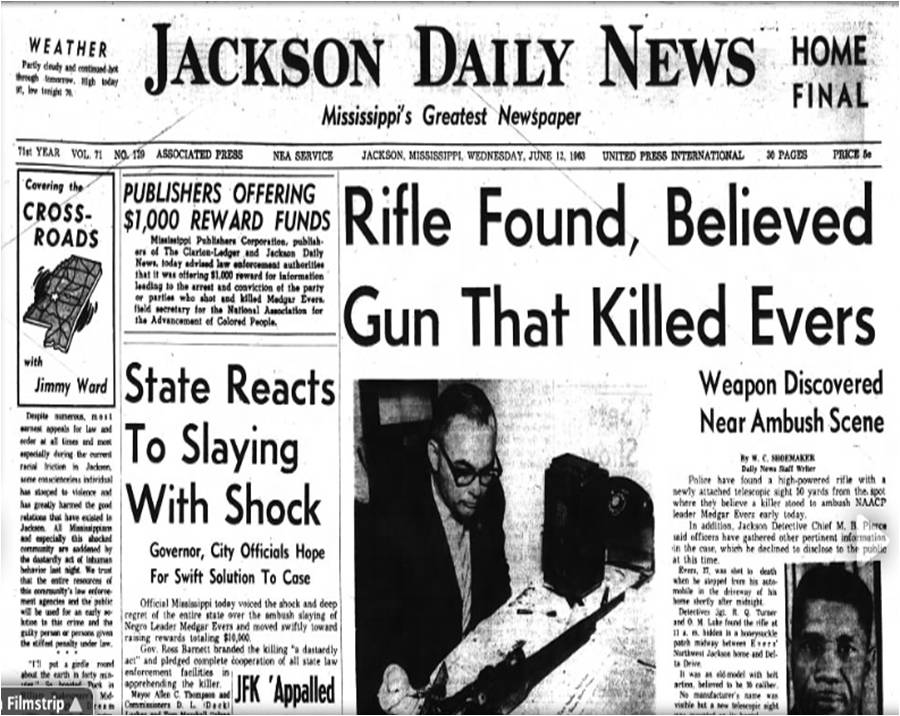
The opening of “He Said He Wouldn’t Mind Dying–If,” Myrlie Evers’ eloquent 1963 essay in Life, about the assassination of her husband, civil rights leader Medgar Evers:
“We all knew the danger was increasing. Threats came daily, cruel and cold and constant, against us and the children. But we had lived with this hatred for years and we did not let it corrode us.
Medgar was a happy man with a rich smile and a warmth that touched many people. He was never too busy to listen or too tired to to help. But beneath that gentle sympathy lay strength that could not be intimidated. Lord knows, enough people tried. But it never worked and that, I suppose, is why they killed him.
I don’t know what makes one man feel so passionately the needs of his people. It began for Medgar when he was a little boy in Decatur, Miss., where he was born. A family friend was lynched, and years later Medgar could still recall the shock with which he turned to his father.
‘Why did they kill him, Daddy?’ he asked.
‘Well, just because he was a colored man,’ his father said.
‘Could they kill you too?’
‘If I did anything they didn’t like, they sure could.’
Medgar never forgot that blunt statement of the facts of Negro life in Mississippi.”
•••••••••••
“A bullet from the back of a bush took Medgar Evers’ blood / A finger fired the trigger to his name”:
Tags: Medgar Evers, Myrlie Evers
IBM believes it’s on the brink of producing Quantum Computers, with qubits allowing basic devices to conduct millions of computations at once, realizing the 30-year-old dream of the late, great physicist Richard Feynman.
Tags: Richard Feynman
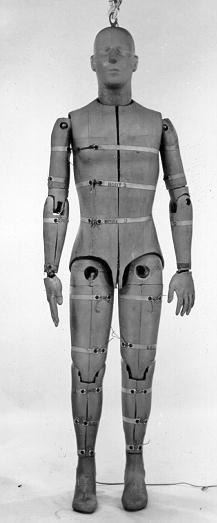
Soon our vital signs will be tracked continuosly and automatically, with predictive data allowing for preemptory strikes against oncoming health problems. The opening of “The Patient of the Future,” John Cohen’s excellent new MIT Technology Review article about Larry Smarr, a computer genius at the forefront of the “self-quant” movement;
“Back in 2000, when Larry Smarr left his job as head of a celebrated supercomputer center in Illinois to start a new institute at the University of California, San Diego, and the University of California, Irvine, he rarely paid attention to his bathroom scale. He regularly drank Coke, added sugar to his coffee, and enjoyed Big Mac Combo Meals with his kids at McDonald’s. Exercise consisted of an occasional hike or a ride on a stationary bike. ‘In Illinois they said, ‘We know what’s going to happen when you go out to California. You’re going to start eating organic food and get a blonde trainer and get a hot tub,’ ’ recalls Smarr, who laughed off the predictions. ‘Of course, I did all three.’
Smarr, who directs the California Institute for Telecommunications and Information Technology in La Jolla, dropped from 205 to 184 pounds and is now a fit 63-year-old. But his transformation transcends his regular exercise program and carefully managed diet: he has become a poster man for the medical strategy of the future. Over the past decade, he has gathered as much data as he can about his body and then used that information to improve his health. And he has accomplished something that few people at the forefront of the ‘quantified self’ movement have had the opportunity to do: he helped diagnose the emergence of a chronic disease in his body.
Like many ‘self-quanters,’ Smarr wears a Fitbit to count his every step, a Zeo to track his sleep patterns, and a Polar WearLink that lets him regulate his maximum heart rate during exercise. He paid 23andMe to analyze his DNA for disease susceptibility. He regularly uses a service provided by Your Future Health to have blood and stool samples analyzed for biochemicals that most interest him. But a critical skill separates Smarr from the growing pack of digitized patients who show up at the doctor’s office with megabytes of their own biofluctuations: he has an extraordinary ability to fish signal from noise in complex data sets.” (Thanks Browser.)
••••••••••
Gary Wolf with more about the Quantified Self at TED, 2010:
Tags: Gary Wolf, John Cohen, Larry Smarr
The tremendously talented–and tremendously disturbed–chess champion Bobby Fischer, who would go on to become both a king and pawn in life, appearing on I’ve Got A Secret, 1958. Dick Clark is the inquisitor.
Tags: Bobby Fischer, Dick Clark
Andy Warhol and Bianca Jagger interviewing young Steven Spielberg, 1979.
Tags: Andy Warhol, Bianca Jagger, Steven Spielberg

Seeing the women from Bridesmaids on the Oscars broadcast last night made me think of something. Right now there are a lot of great female comedians and there are a lot of great male comedians. But if you go beyond people doing comedy professionally, women are just much funnier. Most of the women I know are hilarious. They could be doing comedy professionally if they had followed that career path. I don’t think the same is true of male friends and acquaintances. Whoever has to put up with more shit in society will naturally be funnier. If you’re not standing in the mainstream, you’re looking at the world from an angle, and that’s just a more amusing way to see things.
You don’t see a lot of female faces at the head of Fortune 500 companies or on currency, and that’s why you see so many of them on comedy and improv stages. It’s sort of like how pro basketball is dominated in America by whatever ethnic group in living in the ghetto. Before African-Americans ruled the sport, the players were mostly Jewish men. As economic power shifts, so do talents.
Of course, women were putting up with a lot of crap long before they had the opportunity to shine in comedy. And they were probably funnier then, too.
•••••••••
“You feel that steam. It’s coming from my undercarriage”:
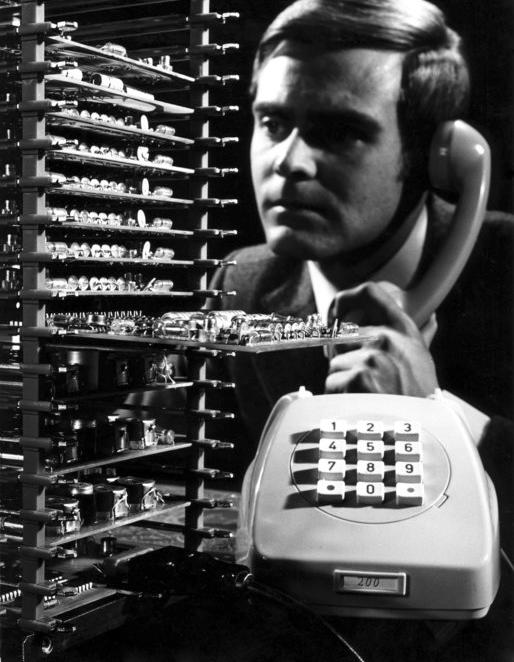
I’ve always believed that smaller offices in which there is a great deal of incidental interaction is a way more productive environment than spacious, comfy quarters. In a segment of “True Innovation,” Jon Gertner’s New York Times Opinion piece about creativity in America, the author explains the guiding principles of Mervin Kelly, one of the leading lights of Bell Labs during its glorious future-building run in the 20th century, who designed architecture that forced employee contact. An excerpt:
“At Bell Labs, the man most responsible for the culture of creativity was Mervin Kelly. Probably Mr. Kelly’s name does not ring a bell. Born in rural Missouri to a working-class family and then educated as a physicist at the University of Chicago, he went on to join the research corps at AT&T. Between 1925 and 1959, Mr. Kelly was employed at Bell Labs, rising from researcher to chairman of the board. In 1950, he traveled around Europe, delivering a presentation that explained to audiences how his laboratory worked.
His fundamental belief was that an ‘institute of creative technology’ like his own needed a ‘critical mass’ of talented people to foster a busy exchange of ideas. But innovation required much more than that. Mr. Kelly was convinced that physical proximity was everything; phone calls alone wouldn’t do. Quite intentionally, Bell Labs housed thinkers and doers under one roof. Purposefully mixed together on the transistor project were physicists, metallurgists and electrical engineers; side by side were specialists in theory, experimentation and manufacturing. Like an able concert hall conductor, he sought a harmony, and sometimes a tension, between scientific disciplines; between researchers and developers; and between soloists and groups.
ONE element of his approach was architectural. He personally helped design a building in Murray Hill, N.J., opened in 1941, where everyone would interact with one another. Some of the hallways in the building were designed to be so long that to look down their length was to see the end disappear at a vanishing point. Traveling the hall’s length without encountering a number of acquaintances, problems, diversions and ideas was almost impossible. A physicist on his way to lunch in the cafeteria was like a magnet rolling past iron filings.”
••••••••••
1960s computer animation by Bell Labs visual neuroscientist Béla Julesz:
Tags: Béla Julesz, Jon Gertner, Mervin Kelly