Videos

You are currently browsing the archive for the Videos category.

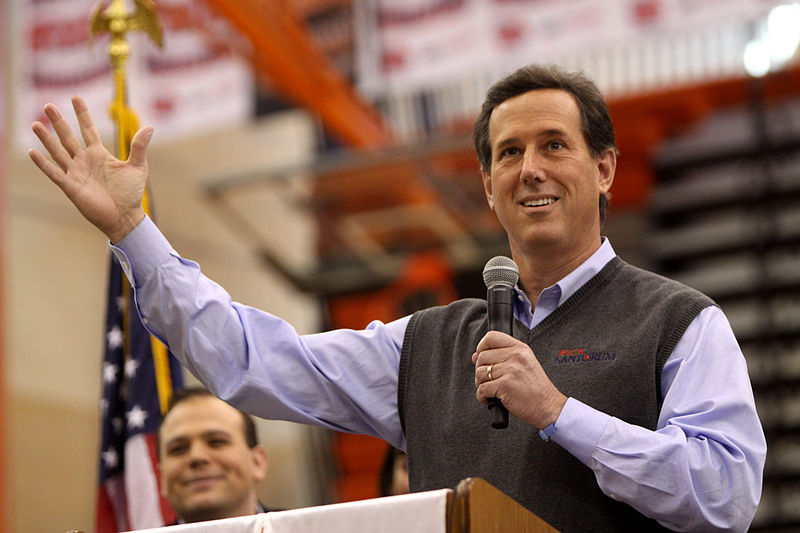
"America’s problem isn’t a breakdown in private morality." (Image by Gage Skidmore.)

From Robert Reich’s sober assessment of election year moralizing of condom-condemning Republicans:

“But America’s problem isn’t a breakdown in private morality. It’s a breakdown in public morality. What Americans do in their bedrooms is their own business. What corporate executives and Wall Street financiers do in boardrooms and executive suites affects all of us.

There is moral rot in America but it’s not found in the private behavior of ordinary people. It’s located in the public behavior of people who control our economy and are turning our democracy into a financial slush pump. It’s found in Wall Street fraud, exorbitant pay of top executives, financial conflicts of interest, insider trading, and the outright bribery of public officials through unlimited campaign ‘donations.’

Political scientist James Q. Wilson, who died last week, noted that a broken window left unattended signals that no one cares if windows are broken. It becomes an ongoing invitation to throw more stones at more windows, ultimately undermining moral standards of the entire community

The windows Wall Street broke in the years leading up to the crash of 2008 remain broken. Despite financial fraud on a scale not seen in this country for more than eighty years, not a single executive of a major Wall Street bank has been charged with a crime.” (Thanks Browser.)

•••••••••••

Robert Reich, buddy cop:

Tags:

The Carpenters perform for President Nixon at the White House, May of 1973, fifteen months before he resigned.

Tags: , ,

Predictions about 2003 tech from an AT&T film made a dozen years earlier.

Our ability to project our emotions onto computer code makes video games possible. From “Creating the Illusion of Emotion, or Why You Care About Ones and Zeroes,” by Brian Crecente in the Vancouver Sun:

“David Mark, president of AI design consultant Intrinsic Algorithm, spent about half an hour last week walking game developers through what he called the psychology of artificial intelligence. He used to time to give the game-makers tips on how to make gamers feel like they’re in a world populated by real people instead of digital automatons.

The key, he said, is to find a way to get gamers to project their own emotions and psychology onto the game’s characters.

‘In the absence of defining information people project what they believe should be there,’ he said.

To prove his point, Mark showed the Heider-Simmel demonstration, an animated video created by psychologists Fritz Heider and Mary-Ann Simmel in the 1940s to explore the ‘attribution of causality.’

The short video shows two animated triangles, an animated circle and a box. There was no audio, just the crude line drawings moving around. After showing the video he said that most viewers saw the video as a couple and a bully; or a mother, a child and a bad guy; or a father and a couple. Each viewer created their own, sometimes elaborate back story for the simple drawings.

‘It’s really just two triangles, a circle and some lines,’ Mark pointed out.

In the absence of information, viewers created their own fiction, their own emotional attachments. But movement and positioning, he added, does help shape context.”

••••••••••

Heider-Simmel Demonstration, an experimental study of apparent behavior:

Tags: , , ,

If driverless cars can communicate with one another at all times, brake pedals have diminshed utility. From IEEE Spectrum: “It’s not just the sensor-driven skills that will soon be common to individual cars that will shape the future of automotive transportation, but also the ability for cars to communicate with each other, sharing constant updates about exactly where they are and where they’re going. And with enough detailed information being shared at a fast enough pace between all vehicles on the road, things like traffic lights become completely redundant.”

An early expression of globalization, from a speech in Network, 1976.

“You have meddled with the primal forces of nature, Mr. Beale, and I won’t have it! Is that clear? You think you’ve merely stopped a business deal. That is not the case! The Arabs have taken billions of dollars out of this country, and now they must put it back! It is ebb and flow, tidal gravity! It is ecological balance! You are an old man who thinks in terms of nations and peoples. There are no nations. There are no peoples. There are no Russians. There are no Arabs. There are no third worlds. There is no West. There is only one holistic system of systems, one vast and immane, interwoven, interacting, multivariate, multinational dominion of dollars. Petro-dollars, electro-dollars, multi-dollars, reichmarks, rins, rubles, pounds, and shekels. It is the international system of currency which determines the totality of life on this planet. That is the natural order of things today. That is the atomic and subatomic and galactic structure of things today! And YOU have meddled with the primal forces of nature, and YOU… WILL… ATONE! Am I getting through to you, Mr. Beale? You get up on your little twenty-one inch screen and howl about America and democracy. There is no America. There is no democracy. There is only IBM, and ITT, and AT&T, and DuPont, Dow, Union Carbide, and Exxon. Those are the nations of the world today. What do you think the Russians talk about in their councils of state, Karl Marx? They get out their linear programming charts, statistical decision theories, minimax solutions, and compute the price-cost probabilities of their transactions and investments, just like we do. We no longer live in a world of nations and ideologies, Mr. Beale. The world is a college of corporations, inexorably determined by the immutable bylaws of business. The world is a business, Mr. Beale. It has been since man crawled out of the slime. And our children will live, Mr. Beale, to see that… perfect world… in which there’s no war or famine, oppression or brutality. One vast and ecumenical holding company, for whom all men will work to serve a common profit, in which all men will hold a share of stock. All necessities provided, all anxieties tranquilized, all boredom amused.”

••••••••••

Siskel (with mustache!) and Ebert praise their “favorite Christmas picture”:

William F. Buckley, Jr. and Tom Wolfe (prior to lifetime confinement to white suits) discuss modern architecture in 1981.

Tags: ,

If I had to bet on one aspect of our lives about to change drastically, I would go with batteries. Whether or not Apple is really working on hydrogen batteries as whispers sometimes suggest, I think the term “long-life” is about to change significantly for the better. And products and processors will be made to require less and less juice, adding to the efficiency. No longer will we be tethered to a wall. From Leo Kelion of BBC News:

Arm Holdings has unveiled what it describes as the ‘world’s most energy-efficient microprocessor’ design.

The firm says that microcontrollers based on the ‘Flycatcher’ architecture will pave the way for the ‘internet of things’- the spread of the net to a wider range of devices.

It suggests that fridges and other white goods, medical equipment, energy meters, and home and office lighting will all benefit from the innovation.

Two firms have licensed the technology.

They are NXP Semiconductors and Freescale.

‘It opens up all devices to the potential of being connected all the time,’ Freescale’s Geoff Lees told the BBC.

‘It’s allowing us to provide connectivity everywhere. So anything from consumer appliances, MP3-music audio docks, kitchen equipment with displays right through to remote sensors in rain monitoring equipment or personal medical devices – an area where ultra-long battery life allied to high performance and safety is becoming more and more important.'”

••••••••••

“Oy!”:

Tags:

Marshall McLuhan deconstructs a go-go bar, fucking ruining it for everyone.

Tags:

B.F. Skinner, the famed Behaviorist who plays a central role in one of my favorite New Yorker articles, Calvin Trillin’s “The Chicken Vanishes” (subscription required), is responsible for this 1954 video about his pre-personal computer Teaching Machine, which provided automated instruction.

Tags: ,

William F. Buckley, Jr. joined by hit-making producer David Merrick for a discussion about the future of American theater, 1966.

Tags: ,

If moderate conservatives like Jeb Bush are unable to rescue the Republican Party from its own extremism, if Presidential nomination victories become consistently Pyrrhic and disqualifying, will we see the emergence of a more centrist conservative party? Or is the madness of the GOP just a cycling out that will ultimately run its course? Nobody can sum up the Republicans’ recent rocky road and the fork that led it to its precarious current position more eloquently than Louis Menand does this week in the opening of his New Yorker piece, “Money Pol.” An excerpt:

“Once, when winters were cold and the world seemed large, creatures roamed the earth who were permissive on social issues and at ease with big government, yet remained ever faithful to the gods of business and finance. Their principles were abstract but broad-minded: tolerance, free trade, and a belief in something called the American Way. Their personal tastes were conventional. They were surprisingly allergic to indecorum, and disinclined to question the status quo. But they were not small-town or provincial; they were Wall Streeters, not Main Streeters. Their vista was international. They were private-sector types who answered the call to public service. They were liberal Republicans. Nelson Rockefeller was such a creature. So were Prescott Bush, William Scranton, Charles Percy, John Lindsay, Mark Hatfield, Elliot Richardson, and George Romney.

Then, one year, a powerful meteor struck the planet, and, virtually overnight, the entire species was wiped out. The meteor’s name was Ronald Reagan. Political paleontologists, looking back at the fossil record, can detect signs pointing to the organism’s imminent extinction that predate the Reagan era. Richard Nixon, for example, showed that a pro-business, big-government Republican, by appealing to suburban anti-Communism and white working-class resentment, could take a populist road to the White House. Men like Rockefeller and Romney despised Nixon; but they could never beat him. Liberal Republicans did not like to get into the political mud.”

••••••••••

Nelson Rockefeller, 1964: “The Republican Party must repudiate these people.”

Tags: , ,

So, texting while driving is pretty much fine now. I kid.

As their boy was newly named an astronaut in 1962, Neil Armstong’s parents appeared on I’ve Got a Secret.

Tags: , ,

In 1967, William F. Buckley welcomed beaded LSD guru Timothy Leary, who later became mortal enemies with Art Linkletter.

Tags: ,

Helen Keller meets Martha Graham, 1954.

Tags: ,

"He raised snapdragons and sweet peas."

While the United States acted with incredible bravery during World War II, one grievous mistake we made was the internment of Japanese-Americans, who were considered suspect merely because we were at war with the land of their ancestry. One such family forced to relocate from their home and community into a camp was the Mochidas of Hayward, California, seen in the above classic photograph, which was taken by the great Dorothea Lange. The original caption:

“Members of the Mochida family awaiting evacuation bus. Identification tags are used to aid in keeping the family unit intact during all phases of evacuation. Mochida operated a nursery and five greenhouses on a two-acre site in Eden Township. He raised snapdragons and sweet peas. Evacuees of Japanese ancestry will be housed in War Relocation Authority centers for the duration.”

••••••••••

Tags: ,

Very cool clip. William F. Buckley, Jr. welcomes filmmaker Otto Preminger in 1967, for a discussion about censorship.

Tags: ,

Sleazy, yes, but I need the traffic.

Neil deGrasse Tyson testifying in D.C. about the foolishness of an absence of a comprehensive U.S. space program.

Tags:

From a list of urban innovations at the Next Web, a section about using pedestrian energy to illuminate streetlights:

“Think about all the energy expended by pedestrians walking down the street. What if it could be harnessed to power street lighting? The Viha concept involves an electro-active slab with a lower portion that is embedded in the floor, and a mobile upper part that can produce energy.

While it won’t be able to replace power stations, this solution is designed to produce enough energy for use in the immediate vicinity, thus taking strain off the power grid and reducing the power bill of the local authority. In particularly crowded areas, this would work well.”

••••••••••

The Viha concept in practice:

On International Women’s Day, here’s a 1973 John Chancellor report about the “Battle of the Sexes” tennis match between Billie Jean King and Bobby Riggs, which was hokey as a sporting event but used pitch-perfect hoopla on an Ali scale to become a huge national attraction. King triumphed in the Astrodome in straight sets: 6-4, 6-3, 6-3.

Tags: , ,

The Handroid has potential for creating better prosthetics and for the remote handling of dangerous materials. By the good people at ITK. (Thanks Singularity Hub.)

The Rev. Dr. Billy Graham appears on What’s My Line?, 1960.

LBJ attends Graham crusade at the Astrodome, 1965:

Tags:

The designer as visionary in 1970, at the conclusion of the Space Race.

Tags:

« Older entries § Newer entries »