Smart Sand shares information, joins together to form objects. From CNET: “Researchers at MIT have developed a robotic system for duplicating shapes, a potential alternative approach to three-dimensional printing. The Distributed Robotics Lab at MIT today detailed research aimed at replicating objects by essentially carving them from an unformed pile of ‘smart sand’ or ‘robot pebbles.’ The vision is to have these miniature robots automatically create replicas of different sizes with only an original shape to work with.”
I’ve probably posted something about swarmbots being programmed to create their own language, but Marcus du Sautoy sums up the experimentation really well in a new article about the Turing Test in the Guardian. An excerpt:
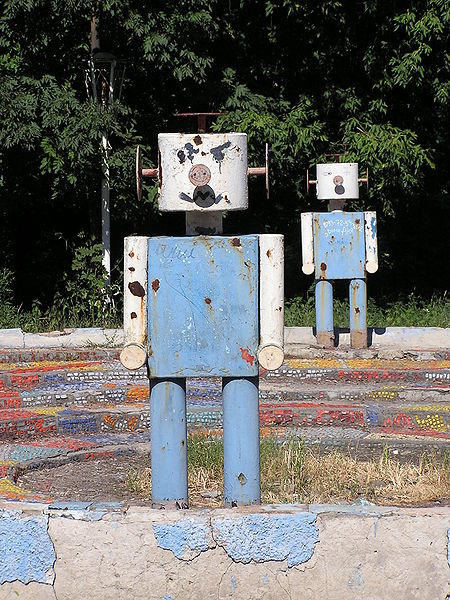
“For me one of the most striking experiments in AI is the brainchild of the director of the Sony lab in Paris, Luc Steels. He has created machines that can evolve their own language. A population of 20 robots are first placed one by one in front of a mirror and they begin to explore the shapes they can make using their bodies in the mirror. Each time they make a shape they create a new word to denote the shape. For example the robot might choose to name the action of putting the left arm in a horizontal position. Each robot creates its own unique language for its own actions.
The really exciting part is when these robots begin to interact with each other. One robot chooses a word from its lexicon and asks another robot to perform the action corresponding to that word. Of course the likelihood is that the second robot hasn’t a clue. So it chooses one of its positions as a guess. If they’ve guessed correctly the first robot confirms this and if not shows the second robot the intended position.
The second robot might have given the action its own name, so it won’t yet abandon its choice, but it will update its dictionary to include the first robot’s word. As the interactions progress the robots weight their words according to how successful their communication has been, downgrading those words where the interaction failed. The extraordinary thing is that after a week of the robot group interacting with each other a common language tends to emerge. By continually updating and learning, the robots have evolved their own language. It is a language that turns out to be sophisticated enough to include words that represent the concept of ‘left’ and ‘right.’ These words evolve on top of the direct correspondence between word and body position. The fact that there is any convergence at all is exciting but the really striking fact for me is that these robots have a new language that they understand yet the researchers at the end of the week do not comprehend until they too have interacted and decoded the meaning of these new words.”
The cameras follow us now, but we don’t mind. We even invite them. Nothing seems real, but everything is a reality show. It’s attention we think we need. But when everyone is a star, no one is. What happens when this new arrangement is not enough?
We don’t even know what it means yet, but we guess it’s cool. But what if it isn’t? What if those pictures of us on screens of all sizes aren’t flattering?
Not you, Ashlee. You’re good people. But what of the rest of us?•
From Felix Gillette’s smart new Businessweek article about the Internet buzz saw that is Buzzfeed, a passage on company co-founder Jonah Peretti, who sees the site as a psycho-sociological experiment, and one of his influences, Stanley Milgram:
“Peretti, 38, has a knack for coining clever Web neologisms. Among the keys to achieving success on the Internet, he says, is deploying ‘Big Seed Marketing,’ optimizing ‘Viral Lift,’ using a ‘Mullet Strategy,’ and catering to the ‘Bored at Work Network.’ ” He sees himself not only as a businessman but as something of an applied scientist, testing the theories of 20th century academic sociologists vs. the contemporary data of the social Web.
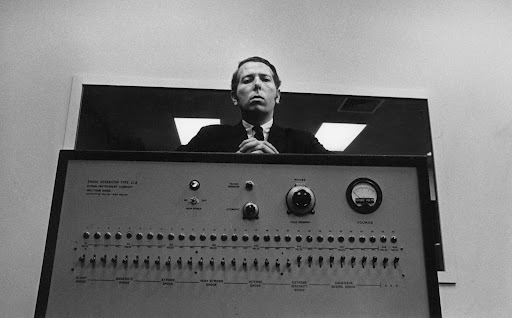
To understand some of the principles underlying BuzzFeed’s strategy, he recommends reading The Individual in a Social World, a 1977 book by Stanley Milgram, who is known, among other things, for his experiments leading to the six degrees of separation theory. ‘When some cute kitten video goes viral,’ says Peretti, ‘you know a Stanley Milgram experiment is happening thousands of times a day.’
Peretti grew up in Oakland, Calif., graduated Phi Beta Kappa from the University of California at Santa Cruz in 1996 with a degree in environmental studies, and spent a couple of years teaching computers and Web publishing to high school students in New Orleans. After co-writing a number of papers for academic conferences (‘Historical Role-Playing in Virtual Worlds: VRML in the History Curriculum and Beyond’), he matriculated at the Massachusetts Institute of Technology, where he earned a master’s degree from the Media Lab.
In 2001, inspired by reports of substandard working conditions at Nike (NKE) factories, Peretti ordered a pair of custom Nike sneakers decorated with the word ‘Sweatshop.’ The company refused to fill the order, and Peretti got into a theatrical back-and-forth with a customer rep on e-mail. Afterward, Peretti e-mailed the document to 10 acquaintances, who passed it along to their friends. The whole thing snowballed. Overnight, Peretti became an Internet sensation. NBC flew him to New York to appear on Today.
Peretti walked away from the Nike affair a presumed expert on the explosive Internet phenomena now known as viral media. Writing about his experience for the Nation in April 2001, he theorized, ‘In the long run this episode will have a larger impact on how people think about media than how they think about Nike and sweatshop labor.’ He speculated that by understanding the dynamics of ‘decentralized distribution systems and peer-to-peer networks,’ new forms of social protest would emerge and challenge the ‘constellations of power traditionally supported by the mass media.'”
Russell Harty visits Quentin Crisp’s filth-covered East Village dump in 1985.
At one point, Crisp comments that what makes New York City different is that it’s the only place where everyone talks to everyone. That may still be true for certain strips of Brooklyn, but it’s mostly a thing of the past otherwise. And it’s not just New Yorkers who have become so alienated from others–people who visit here from the rest of the country (and the rest of the world) seem even worse. We’ve always been tribal, but the tribe used to be more bound to geography and genuineness. No more. Now the virtual network of “friends” we accrue online is our tribe. The other self we create on social networks, which has only a glancing connection to the truth, is who we think we are. But it’s not real and we’re disconnected from ourselves and disenchanted with reality when it has the gall to encroach on our bubble. Things have gotten murky.
Saul Alinsky, the community organizer who’s been burned in effigy repeatedly by the GOP,predicted the rise of Reagan’s faux nostalgiayears before it became reality. Here he meets with William F. Buckley, Jr. in 1967.
"The funds will be used to 'design, program, harden, and field-test the apps with bonobo testers and to connect them to robots.'" (Image by Ltshears.)
Giving a bonobo its own robot to control remotely isn’t, on the face if it, as dangerous as letting a kangaroo have an A-bomb, but I still have my concerns. Nonetheless, unless this is an early April fools joke, a new Kickstarter campaign wants to match primates and bots. From IEEE Spectrum:
“What Dr. Ken Schweller (a professor of computer science and psychology and chair of the Great Ape Trust) wants to do is develop a set of Internet-connected keyboards that the bonobos can carry around with them and use to communicate directly with humans. Humans, for their part, will be able to use an app that translates their speech directly to the symbols used by the bonobos, potentially opening up real-time two-way intelligent communication between you and another species.
RoboBonobo and Bonobo Chat are trying to raise $20,000 on Kickstarter; the funds will be used to ‘design, program, harden, and field-test the apps with bonobo testers and to connect them to robots and other external devices.’ That’s a little bit unspecific for such a large sum of money (although we do know that the robot in the picture above will be getting a total redesign), but at least the $500 level reward is pretty awesome: you get to have a live Skype chat session with a bonobo, completely safe from rampaging RoboBonobos with water cannons.”
Before the Waldheim Affair became an international fiasco during the 1980s and he was banned from the United States, Kurt Waldheim, the future Austrian president with the Nazi past, spoke with PBS talk show host James Day in New York in 1973.
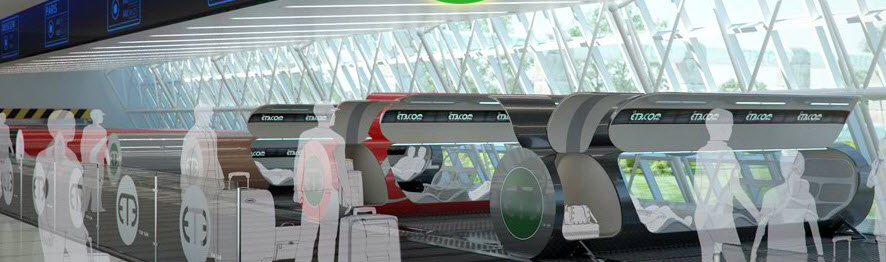
I love Ray Kurzweil, but let’s say that he is a glass-half-full kind of futurist. Naturally, he’s drawn to the promise of Evacuated Tube Transport Technolgy (ET3), car-sized passenger capsules that travel via tubes. Space travel here on Earth! Someday, perhaps. From Kurzweil:
“The Evacuated Tube Transport (ETT) system (U.S. Patent 5950543, assigned to ET3.com, Inc.) would take passengers from New York to Beijing in just two hours. Advocates of Evacuated Tube Transport (ETT) claim it is silent, cheaper than planes, trains, or cars and faster than jets.
How it would work: put a superconducting maglev train in evacuated tubes, then accelerate using linear electric motors until the design velocity is attained. Passive superconductors allow the capsules to float in the tube, while eddy currents induced in conducting materials drive the capsules. Efficiency of such a system would be high, as the electric energy required to accelerate a capsule could largely be recaptured as it slows.”
In the technologically simpler era of a hoaxer like Clifford Irving (here and here), perhaps there was some slim chance a public fraud could get away his scheme, or at least he could live well for a good, long time before his deceit undid him. But in our age of extreme connectivity and data trails, there’s no way someone can misrepresent themselves for too long. So why do people continue to perpetrate doomed hoaxes? Pathological behavior, I would assume. But more troublingly: Why do some others continue to cling to a faker’s veracity after the truth has become apparent, as if surrendering on one issue will topple their entire belief system?
From Gene Maddeus’ LA Weekly story about a drug dealer who feigned being a billionaire intent on purchasing the Los Angeles Dodgers:
“At this point, Dodger fans are desperate to be told two things: That the McCourt era is over, and that the team will win again. Unfortunately, nobody can say those things.
McCourt seems to have every intention of hanging on to the Dodger Stadium parking lots. That would force the new owner into an awkward partnership with the most hated man in Los Angeles.
As for winning, no one can make any promises about that, either — at least not while the bankruptcy sale is pending. The auction is a secret process, and the bidders making a play for the team have signed nondisclosure agreements. Though there have been plenty of leaks, no one is permitted to speak directly to the fans.
No one, except Josh Macciello.
Because, as it turns out, Macciello was never a real contender for the team. He is, instead, a fraud. Despite what he’s told reporter after reporter, and despite what those journalists have dutifully repeated, he does not have billions of dollars. He does not have rights to any gold mines. He is, instead, a convicted drug dealer and a huckster who has used his talents to persuade many people — not just journalists — to place their confidence in him. In his wake he has left a string of abandoned projects and broken promises.
The Dodger play is his boldest stunt so far. And, judged strictly as a bid for attention, it was a fantastic success. Reporters and fans ate up the tale of the regular guy who wanted to buy the team. Never mind the gaping holes in that narrative: At the end of the day, it was a great story.
Macciello is such a charismatic force that people continue to believe in him, even when confronted with evidence of his deceit. Provided with some of that information, his publicist, Cindy Rakowitz, continues to stand up for him. ‘I really do believe he has the money somewhere, somehow, some way,’ she says. ‘I want to believe.'”
A book that was seemingly written specifically for me (and anyone else who spends way too much time thinking about airports), Aerotropolis: The Way We’ll Live Next, by John Kasarda and Greg Lindsay, predicts that airport-centric insta-cities will be the next wave. Probably not going to happen outside of a few autocratic states, but it’s still a fun thought project. From the introduction of an interview with Lindsay at BLDG:
“If Atlanta’s Hartsfield-Jackson International Airport were to become its own country, its annual workforce and user base would make it ‘the twelfth most populous nation on Earth,’ as John Kasarda and Greg Lindsay explain in Aerotropolis; even today, it is the largest employer in the state of Georgia.
As J.G. Ballard once wrote, and as is quoted on the frontispiece of Aerotropolis:
I suspect that the airport will be the true city of the 21st century. The great airports are already the suburbs of an invisible world capital, a virtual metropolis whose fauborgs are named Heathrow, Kennedy, Charles de Gaulle, Nagoya, a centripetal city whose population forever circles its notional center, and will never need to gain access to its dark heart.
The remarkable claims of John Kasarda’s and Greg Lindsay’s new book are made evident by its subtitle: the aerotropolis, or airport-city, is nothing less than ‘the way we’ll live next.’ It is a new kind of human settlement, they suggest, one that ‘represents the logic of globalization made flesh in the form of cities.’ Through a kind of spatial transubstantiation, the aerotropolis turns abstract economic flows—disembodied currents of raw capital—into the shining city form of tomorrow.
The world of the aerotropolis is a world of instant cities—urbanization-on-demand—where nations like China and Saudi Arabia can simply ‘roll out cities’ one after the other. ‘Each will be built faster, better, and more cheaply than the ones that came before,’ Aerotropolis suggests: whole cities created by the warehousing demands of international shipping firms. In fact, they are “cities that shipping and handling built,’ Lindsay and Kasarda quip—urbanism in the age of Amazon Prime.”
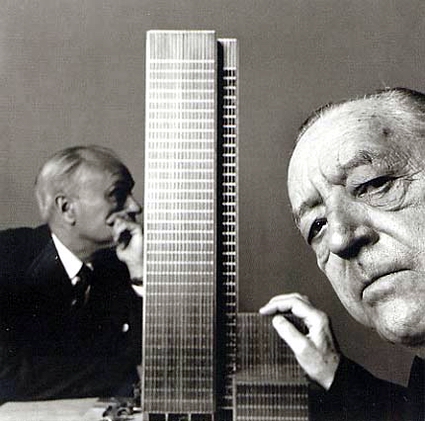
Mies van der Rohe, who was born 125 years ago today, put God in the details of his spare, glassy, flat-roofed buildings and striking furniture. From his 1969New York Times obituary:
“Ludwig Mies van der Rohe, a man without any academic architectural training, was one of the great artist-architect-philosophers of his age, acclaimed as a genius for his uncompromisingly spare design, his fastidiousness and his innovations.
Along with Frank Lloyd Wright and Le Corbusier, the German-born master builder who was universally know as Mies (pronounced mees) fashioned scores of imposing structures expressing the spirit of the industrial 20th century.
‘Architecture is the will of an epoch translated into space,’ he remarked in a talkative moment. Pressed to explain his own role as a model for others–a matter on which he was shy, as he was on most others–he said:
‘I have tried to make an architecture for a technological society. I have wanted to keep everything reasonable and clear–to have an architecture that anybody can do.'”
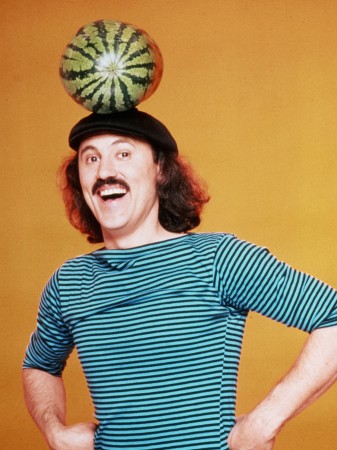
Much like Dick Cheney, the comedian Gallagher is an asshole with a bad heart. (Correction: Cheney was an asshole with a bad heart. He just had a heart transplant. Congratulations, you asshole!) No one should waste a moment of life writing a great article about a bigoted prop comic with a vicious streak, but that’s what Alex Pappademas did for Grantland. An excerpt fromGallagher Retires, Sort Of:
“He got bitterer as time went on. As with [George] Carlin, there was always some trigger-hippie rage boiling in Gallagher’s eyes; unlike Carlin, Gallagher never got a Mark Twain Prize, wrote bestsellers, or saved the universe using a time-traveling phone booth. Former standup comedians who went on to become huge stars despite not being good at standup comedy, according to a 2005 interviewwith Gallagher: David Letterman, Robin Williams, Tom Hanks, Chevy Chase, Michael Keaton (‘a terrible comedian’), Jim Carrey (’embarrassing.’)
‘It amazes me,’ he fumed, ‘that these comedians have serious acting careers.’
In his later years, when he wasn’t smashing fruit onstage, he was spraying bile—railing against gays, transsexuals, Mexicans, opponents of torture, people with tattoos, and the French, and spewing Arab jokes your most right-wing relative might have thought twice about mass-emailing even on the morning of 9/12/01. Most written accounts suggest that your average 21st-century Gallagher show played not unlike the way Wikipedia describes his 1992 laserdisc-based live-action shooting game, Gallagher’s Gallery: ‘Generally, the items that Gallagher deems broken or unnecessary, or those he simply dislikes, must be targeted.’ Reviewing a 2010 Gallagher performance in Bremerton, Washington for the Stranger, Lindy West described him spitting out the word Obama ‘like a mouthful of burning hair’ before impugning both Obama’s blackness and his loyalty to this country.”
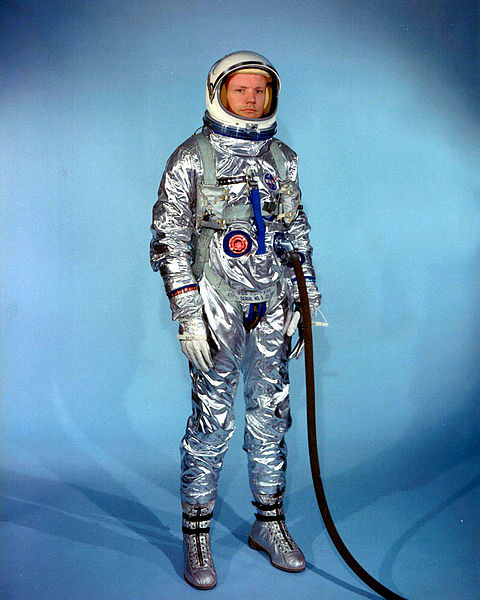
“De Monchaux: One of the things I find most fascinating about the idea of the spacesuit is that space is actually a very complex and subtle idea. On the one hand, there is space as an environment outside of the earthly realm, which is inherently hostile to human occupation—and it was actually John Milton who first coined the term space in that context.
On the other hand, you have the space of the architect—and the space of outer space is actually the opposite of the space of the architect, because it is a space that humans cannot actually encounter without dying, and so must enter exclusively through a dependence on technological mediation.
Whether it’s the early French balloonists bringing capsules of breathable air with them or it’s the Mongolfier brothers trying to burn sheep dung to keep their vital airs alive in the early days of ballooning, up to the present day, space is actually defined as an environment to which we cannot be suited—that is to say, fit. Just like a business suit suits you to have a business meeting with a banker, a spacesuit suits you to enter this environment that is otherwise inhospitable to human occupation.
From that—the idea of suiting—you also get to the idea of fashion. Of course, this notion of the suited astronaut is an iconic and heroic figure, but there is actually some irony in that.
For instance, the word cyborg originated in the Apollo program, in a proposal by a psycho-pharmacologist and a cybernetic mathematician who conceived of this notion that the body itself could be, in their words, reengineered for space. They regarded the prospect of taking an earthly atmosphere with you into space, inside a capsule or a spacesuit, as very cumbersome and not befitting what they called the evolutionary progress of our triumphal entry into the inhospitable realm of outer space. The idea of the cyborg, then, is the apotheosis of certain utopian and dystopian ideas about the body and its transformation by technology, and it has its origins very much in the Apollo program.
But then the actual spacesuit—this 21-layered messy assemblage made by a bra company, using hand-stitched couture techniques—is kind of an anti-hero. It’s much more embarrassing, of course—it’s made by people who make women’s underwear—but, then, it’s also much more urbane. It’s a complex, multilayered assemblage that actually recapitulates the messy logic of our own bodies, rather than present us with the singular ideal of a cyborg or the hard, one-piece, military-industrial suits against which the Playtex suit was always competing.
The spacesuit, in the end, is an object that crystallizes a lot of ideas about who we are and what the nature of the human body may be—but, then, crucially, it’s also an object in which many centuries of ideas about the relationship of our bodies to technology are reflected.”
“We’re still here at the big bang of this thing, and we’re not studying it enough. Who’s the cosmologist really looking at this in terms of what it might become in 10,000 years? What’s it going to be in 100 years? Here we are at the very beginning and we just may simply not be asking the right questions about what’s going on. Try looking at it from the other side, not from our side as human beings. Scientists are the people who can do that kind of thing. You can look at viruses from the point of view of a virus, not from the point of view of someone getting sick.
Very few people are looking at this digital universe in an objective way. Danny Hillis is one of the few people who is. His comment, made exactly 30 years ago in 1982, was that “memory locations are just wires turned sideways in time”. That’s just so profound. That should be engraved on the wall. Because we don’t realize that there is this very different universe that does not have the same physics as our universe. It’s completely different physics. Yet, from the perspective of that universe, there is physics, and we have almost no physicists looking at it, as to what it’s like. And if we want to understand the sort of organisms that would evolve in that totally different universe, you have to understand the physics of the world in which they are in. It’s like looking for life on another planet. Danny has that perspective. Most people say just, ‘well, a wire is a wire. It’s not a memory location turned sideways in time.’ You have to have that sort of relativistic view of things.
We are still so close to the beginning of this explosion that we are still immersed in the initial fireball. Yet, in that short period of time, for instance, it was not long ago that to transfer money electronically you had to fill out paper forms on both ends and then wait a day for your money to be transferred. And, in a very few years, it’s a dozen years or so, most of the money in the world is moving electronically all the time.”
• • • • • • • • • •
George’s dad, Freeman, planning interplanetary travel via A-bomb, 1958: