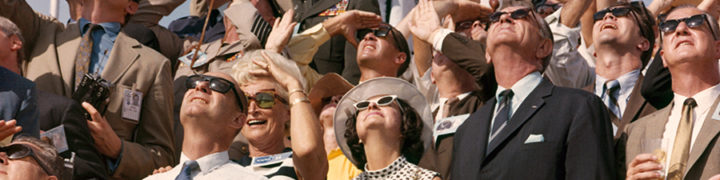
A bunch of rich guys, including James Cameron, Ross Perot, Larry Page, Eric Schmidt and Peter H. Diamandis, may be announcing tomorrow that they are getting into the business of asteroid mining, extracting precious resources from zooming space rocks. From Forbes:
“Diamandis has been interested in asteroid mining for a long time, and it sounds like this might be his time to put a plan into action. There are staggering amounts of gold in them thar asteroids, even if they are sort of far away.
‘The earth is a crumb in a supermarket of resources,” Diamandis told Forbes earlier this year. “Now we finally have the technology to extract resources outside earth for the benefit of humanity without having to rape and pillage our planet.'”
••••••••••
Hyperspace, not free of risk, is nonetheless a handy option:
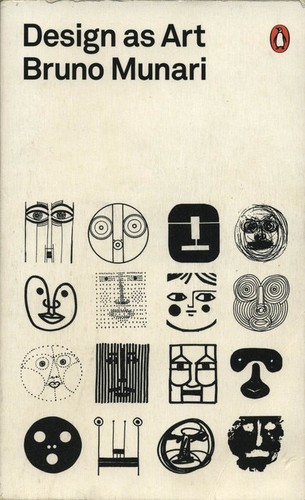
Picture 3 in the third row from the top looks like a precursor to Shepard Fairey's Obey the Giant.
On the gorgeous, newly redesigned Los Angeles Review of Books site, Hua Hsu writes about thehistory of office chair designs. In his piece, he mentions the legendary Italian designer Bruno Munari’s 1966 book,Design as Art. An excerpt from the book about the house of the future:
“The private house of the future (some are already lived in) will be as compact and comfortable as possible, easy to run and easy to keep clean without the trouble and expense of servants. A lot of single pieces of furniture will be replaced by built-in cupboards, and maybe we shall even achieve the simplicity, the truly human dimensions, of the traditional Japanese house, a tradition that is still alive.
In the house of the future, reduced as it will be to minimum size but equipped with the most practical gadgets, we will be able to keep a thousand ‘pictures’ in a box as big as a dictionary and project them on our white wall with an ordinary projector just as often as we please. And I do not mean colour photographs, but original works of art. With these techniques visual art will survive even if the old techniques disappear. Art is not technique, as everyone knows, and an artist can create with anything that comes to hand.”
••••••••••
Munari sharing design lessons with schoolchildren on Italian TV, 1976:
The Earth will be fine without us; we’re only capable of killing ourselves. So, the phrase “Save the Earth,” while driven by great intentions, has always been something of a misnomer. We need to save ourselves from our own destruction. And if we do that, we’ll eventually need to rescue ourselves from a dying sun and other ominous sounds ringing out from the reaches of the universe. But let’s not pretend we’re doing it for someone or something else.
Notes on the topic by the funniest American ever, George Carlin:
Connectivity doesn’t guarantee closeness. In fact, we may seem closer together and actually be further apart than ever. From “The Flight From Conversation,” Sherry Turkle’s New York Times essay:
“Over the past 15 years, I’ve studied technologies of mobile connection and talked to hundreds of people of all ages and circumstances about their plugged-in lives. I’ve learned that the little devices most of us carry around are so powerful that they change not only what we do, but also who we are.
We’ve become accustomed to a new way of being ‘alone together.’ Technology-enabled, we are able to be with one another, and also elsewhere, connected to wherever we want to be. We want to customize our lives. We want to move in and out of where we are because the thing we value most is control over where we focus our attention. We have gotten used to the idea of being in a tribe of one, loyal to our own party.
Our colleagues want to go to that board meeting but pay attention only to what interests them. To some this seems like a good idea, but we can end up hiding from one another, even as we are constantly connected to one another.”
••••••••••
Turkle, talking to people about how we don’t talk to people:
Long before American Idol, K-Tel provided an outlet for those who dreamed of pop stardom. The music industry, which somehow manages to be even worse than Hollywood, is the center of this 1973 board game. Oddly missing from the strategic options: consenting to sex with repellent record execs and banning the drummer from sharing your huge bowl of cocaine.
During the gas crisis of 1979, American car owners alternated days they could fill their tanks based on whether they had an odd or even number at the end of their license plates. What it looked like in Los Angeles.
There’s a full version online of Jean-Luc Godard’s 1968/72 collaboration with D.A. Pennebaker and Richard Leacock. Filmed originally as 1 A.M. (as in “One American Movie”), it was planned as Godard’s understanding of U.S. culture during the Vietnam age. (Though perhaps “misunderstanding” would be the more accurate term.) The project went uncompleted, was shelved and later reedited by Pennebaker into 1 P.M. (as in “One Parallel Movie”). A fascinating failure, the film features Rip Torn, Jefferson Airplane, Eldridge Cleaver and Tom Hayden, among others. (ThanksDangerous Minds.)
"Going viral like this requires massive connections of friends." (Image by Gilberto Santa Rosa.)
Can we, in this wired and connected age, have privacy as well as intimacy? Are we to break free from the shackles of Zuckerberg and allow the rise of networks that afford us more control of our lives? Or will we obediently create the content for channels that others program? From Ben Kunz’s new Businessweek article about the rise of “unsocial” networks:
“For nearly a decade, marketers have been agog over the promise of social networks to provide free advertising, a cascade of word-of-mouth in which consumers act as advocates for a brand or product. The dream is based in part on Robert Metcalfe’s law—the concept by the inventor of the Ethernet that in any networked system, value grows exponentially as more users join. Like the old 1970s shampoo commercial, you tell a customer about your product, and she tells two friends, and so on, and so on, until the world is knocking on your hair-products door. Going viral like this requires massive connections of friends.
Trouble is, Metcalfe was wrong, at least with human networks. In a landmark 2006 column in IEEE Spectrum, researchers Bob Briscoe, Andrew Odlyzko, and Benjamin Tilly showed mathematically that networks have a fundamental flaw if all nodes are not created equal. The authors pointed primarily to Zipf’s law, a concept by 1930s linguist George Zipf that in any system of resources, there exists declining value for each subsequent item. In the English language, we use the word ‘the’ in 7 percent of all utterances, followed by ‘of’ for 3.5 percent of words, with trailing usage of terms ending somewhere around the noun ‘floccinaucinihilipilification.’ On Facebook, your connections work the same way from your spouse to best friend to boss to that old girlfriend who now lives in Iceland.
Human networks, like words in English, have long tails of diminishing usage.”
The newest breed of information companies (Google excluded) create wealth, not jobs. That’s not an accusation, just a fact. Economist Brian Arthur refers to this dynamic as the “Second Economy,”–new technology shrinking the American workforce in an inversion of how railroad technology increased it during the 19th century. From Bill Davidow’ssmart, recent article about the Second Economyat the Atlantic:
“When the disappointing jobs numbers were reported last week (employers added 120,000 jobs in March, about half the number reported in the two previous months), analysts tripped over themselves looking for an explanation. Of course, jobs numbers are bound to vary, but in my view the long-term trend calls for more jobs to disappear, and the reason is clear as day: the exploding Second Economy.
The Second Economy — a term the economistBrian Arthuruses to describe the computer-intensive portion of the economy — is, quite simply, the virtual economy. One of its main byproducts is the replacement of low-productivity workers with computers. It’s growing by leaps and bounds, brimming with optimistic entrepreneurs, and spawning a new generation of billionaires. In fact, the booming Second Economy will probably drive much of the economic growth in the coming decades.
Unfortunately, the Second Economy will not create many jobs.”
Some people move noses of aircrafts into their garages so that they can enjoy a flight simulator hobby. James Price is one of those people. From Zoe Francis at the Mercury News:
“In his spacious three-car garage Price has a well-traveled jetliner cockpit tucked in next to the family car.
Aviation experts say Price, 52, is one of only a handful of people in the world who have built their own flight simulator cockpit in an actual jet nose.
His dream of building a full-sized jet simulator began nearly 20 years ago when Price joined an online group of flight simulator hobbyists — folks who typically use computer flight simulator programs or build fake cockpits at home.
Price, an air traffic controller and a private pilot who’s never flown a jet but dreams of doing so one day, began buying genuine 737 parts and building mock cockpits.
‘My first couple of versions of the cockpit … were just basically made up of wood in my spare room in my house.'”
It’s difficult to believe that the average person in China will ever know the same quality of life that Americans enjoy today, even if their economy blows past ours (which doesn’t seem to be a fait accompli). Because of China’s population size, even a super economy probably wouldn’t be able to put three SUVs in every garage. But that’s not to say that a large population foretells poverty, nor do technologies that displace workers. In the long run, a critical mass of people and technology seem to effect a greater prosperity. From “The Population Boon,” Philip E. Auerswald’s anti-Malthusian think piece in the American Interest:
“Almost exactly four years after V-J Day, on August 13, 1949, an MIT professor named Norbert Wiener wrote a letter to Walter Reuther, president of the United Auto Workers (UAW), containing a darkly prophetic message. Within a decade or two, Wiener warned, the advent of automatic automobile assembly lines would result in ‘disastrous’ unemployment. The power of computers to control machines made such an outcome all but inevitable. As a creator of this new technology, Wiener wanted to give Reuther advance notice so that the UAW could help its members prepare for and adapt to the massive displacement of labor looming on the horizon.
Now, if anyone in 1949 grasped the disruptive potential of computing machines, it was Norbert Wiener. A prodigy who earned his Ph.D. from Harvard in mathematical philosophy at age 18, he had contributed to the development of the first modern computer, created the first automated machine and laid the groundwork for a new interdisciplinary science of information and communication that he termed ‘cybernetics.’ His work anticipated and inspired Marshall McLuhan’s heralded studies of mass media, provided the initial impetus for the explorations by James Watson and Francis Crick that led to the discovery of the double helix, and spurred science-fiction writer William Gibson to coin the term ‘cyberspace’ to describe a type of virtual world that Wiener himself had envisioned two decades before the creation of the first web page.
Reuther took Wiener’s letter seriously, responding promptly by telegram: ‘Deeply interested in your letter. Would like to discuss it with you at earliest opportunity following conclusion of our current negotiations with Ford Motor Company. Will you be able to come to Detroit?’ When the two met in March 1950, they pledged to work together to create a labor-science council to anticipate and prepare for major technological changes affecting workers.
At about the same time Reuther and Weiner were meeting, a brain trust was gathering in the orbit of John D. Rockefeller III to address another problem: global overpopulation. The basic concern of this group was both old and simple: Human populations keep growing, but the planet isn’t getting bigger, so sooner or later disaster will be upon us. Funding from the Rockefeller Brothers Fund permitted the creation of the Population Council in 1952. John D. Rockefeller III appointed Frederick Osborn to be the Council’s first president.” (ThanksBrowser.)
••••••••••
Frightening you and your children about overpopulation, 1970s:
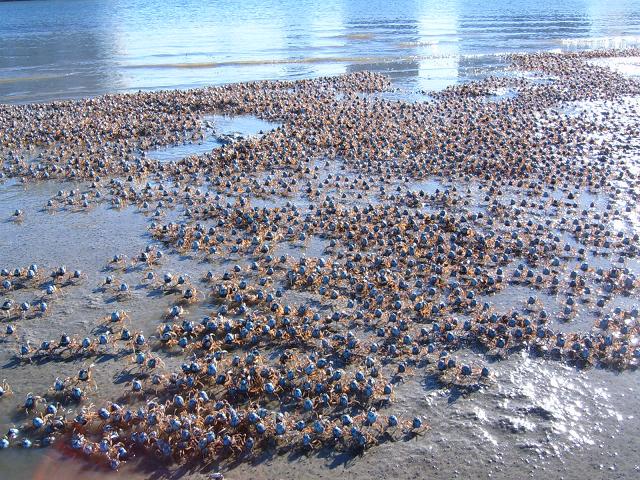
"The scientists have exploited the natural behavior of soldier crabs to design and build logic gates." (Image by Peter Ellis.)
Using the predictable swarming patterns of soldier crabs, Yukio–PegioGunji of Kobe University has designed a very unorthodox analog computer. From David Szondy at Gizmag:
“Thanks to Yukio–PegioGunji and his team at Japan’s Kobe University, the era of crab computing is upon us … well, sort of. The scientists have exploited the natural behavior of soldier crabs to design and build logic gates – the most basic components of an analogue computer. They may not be as compact as more conventional computers, but crab computers are certainly much more fun to watch
Electricity and microcircuits aren’t the only way to build a computer. In fact, electronic computers are a relatively recent invention. The first true computers of the 19th and early 20th centuries were built out of gears and cams and over the years many other computers have forsaken electronics for marbles, air, water, DNA molecules and even slime mold to crunch numbers. Compared to the slime mold, though, making a computer out of live crabs seems downright conservative.”
This 1978 product, endorsed by Rod Carew, couldn’t turn your kids into big leaguers, but it could distract them with an idiotic, repetitive task so that you could have a minute. Another cheap piece of plastic from the geniuses at K-Tel.
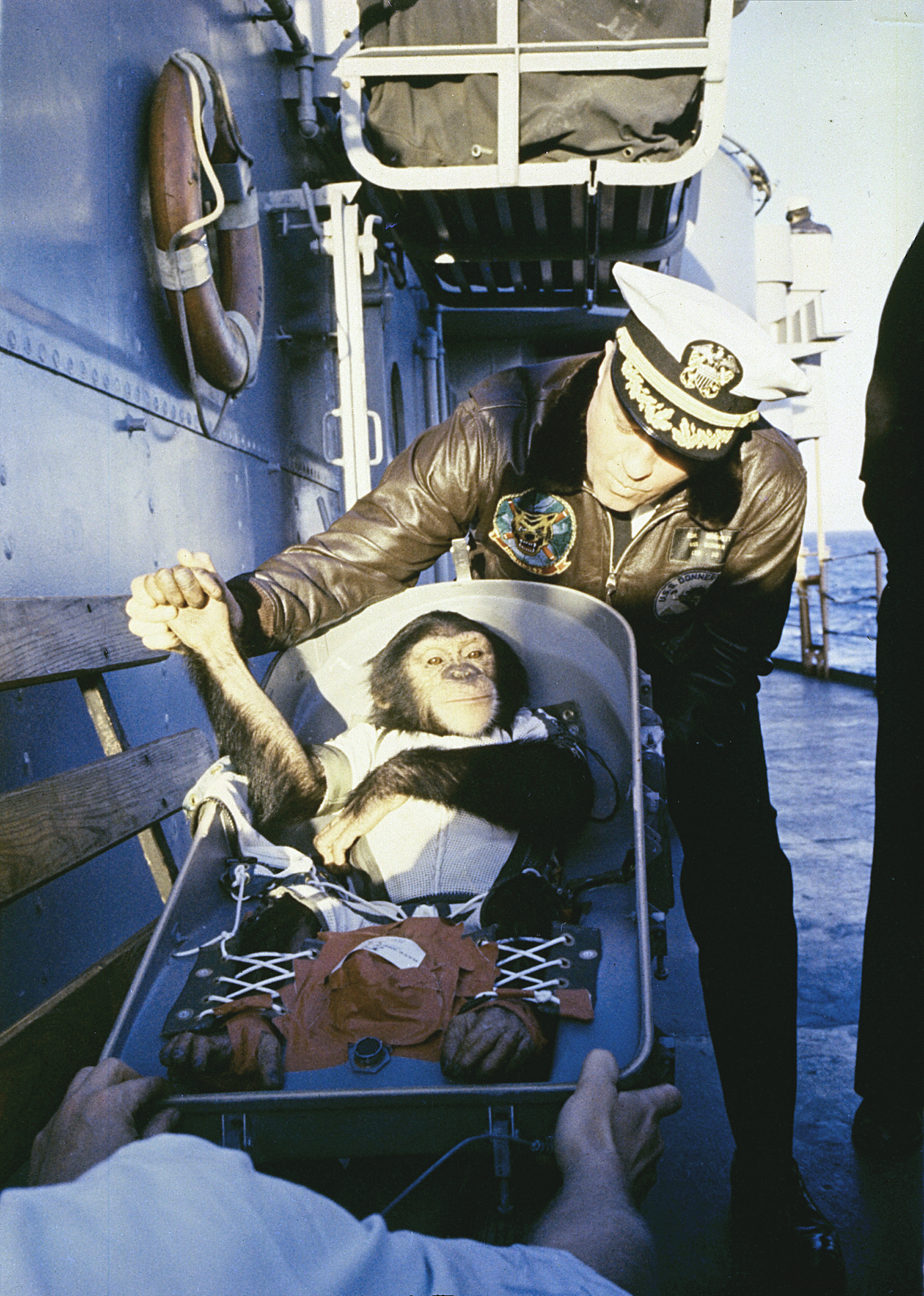
Months before America sent its first astronaut into space in 1961 and kicked the race to the moon into another gear, a chimpanzee named Ham departed Earth on a Mercury mission. Trained beginning in 1959 with behaviorist methods, Ham was not only a passenger but also performed small tasks during his suborbital flight. In the classic NASA photo above, Ham shakes hands with his rescuer aboard the U.S.S. Donner, after his 16-minute mission was successfully completed and he plunged back to his home. The famous chimp lived until 1983 and is buried at the International Space Hall of Fame in New Mexico. From a wonderfully terse account of Ham at Find A Grave:
“The first chimpanzee in space. Born in present-day Cameroon, captured by animal trappers and sent to Miami, FL. Ham’s name is an acronym for the lab that prepared him for his historic mission — the Holloman Aerospace Medical Center, located at Holloman Air Force Base in New Mexico. Purchased by the United States Air Force and brought to Holloman Air Force Base in 1959, he was selected from among a group of six chimpanzees (four female and two male). They trained to perform a series of simple tasks while in space to ascertain whether a human might be able to do the same tasks under space flight conditions. On January 31, 1961, Ham blasted off from Cape Canavaral becoming the world’s first AstroChimp. He proved that it was possible for a human to venture into space by taking a 16½ minute, 2000 mph ride atop an 83-foot Mercury Redstone rocket known as the MR2. Three months later the first American human, Alan Shepard, followed him into space.”
••••••••••
“The chimp has been carefully selected, thoroughly examined and patiently tutored”:
On a 1967 special, Woody Allen (and audience members) interviewed William F. Buckley. The conservative pundit asserted that tensions between Israelis and Arabs “will get tranquilized in time, I suspect.” Not quite.