
Videos

You are currently browsing the archive for the Videos category.

From “The Call of the Future,” Tom Vanderbilt’s Wilson Quarterly piece about the potential and pitfalls of the Internet as a tool:

“As we start to understand how people actually use the Internet, the cyberutopian hopes of a borderless, postnational planet can look as naive as most past predictions that new technologies would transform societies. In 1912, radio pioneer Guglielmo Marconi declared, ‘The coming of the wireless era will make war impossible, because it will make war ridiculous.’ Two years later a ridiculous war began, ultimately killing nine million Europeans.

While it’s easy to be dismissive of today’s Marconis—the pundits, experts, and enthusiasts who saw a rise in Internet connection leading to a rise in international understanding—that’s too simple and too cynical a response. Increased digital connection does not automatically lead to increased understanding. At the same time, there’s never been a tool as powerful as the Internet for building new ties (and maintaining existing ones) across distant borders.

The challenge for anyone who wants to decipher the mysteries of a connected age is to understand how the Internet does, and does not, connect us. Only then can we find ways to make online connection more common and more powerful.”

••••••••••

Marconi demonstrates the wireless telegraph:
Tags: ,

From Katie Drummond at Wired: “According to Dmitry Itskov, a 31-year-old Russian media mogul, the U.S. military’s Avatar initiative doesn’t go nearly far enough. He’s got a massive, sci-fi-esque venture of his own that he hopes will put the Pentagon’s project to shame. Itskov’s plan: Construct robots that’ll (within 10 years, he hopes) actually store a human’s mind and keep that consciousness working. Forever.

‘This project is leading down the road to immortality,’ Itskov, who founded New Media Stars, a Russian company that runs several online news outlets, tells Danger Room. ‘A person with a perfect Avatar will be able to remain part of society. People don’t want to die.'”

Tags: ,

Given enough time–and it doesn’t take long–the desert always wins. From The Passenger, 1975.

Tags:

Swims with the fishes.

•In regards Obama questioning whether Mitt Romney would have made the call to enter Pakistan and kill Osama bin Laden, it’s based on factual statements that Romney made which were not taken out of context.

•We need to stop acting like the murder of bin Laden was a sacred event. It was a political and military decision to eliminate a mass murderer. Save the sacred feelings for the victims of 9/11.

•If the decision had gone badly, it would have been politicized to the hilt by the GOP, including Romney. The Democrats would have been branded weak on defense as they have been for more than 40 years.

•It’s not like the GOP didn’t do its own–and very undeserved–victory lap over bin Laden’s killing. Members of the Bush Administration (Cheney, Rumsfeld, Rice) came out of the woodwork to try to claim credit.

•You could argue that Obama is hanging his “Mission Accomplished” banner with the ad, except that the mission actually was accomplished. Maybe it seems boastful, but it is accurate.

•It’s hilarious that draft-dodging members of a party that Swiftboated an Army veteran like John Kerry are now crying foul over being called out on being less forceful on military matters.

•If Arianna Huffington wants to better understand the definition of “despicable,” she should recall how she allowed Jenny McCarthy to use the Huffington Post as a platform to repeatedly frighten parents about immunizing their children. And even after it was proven that those charges were linked to junk science, there was still no retraction or apology. Now that’s despicable.•

Tags: , , , , , , ,

Norman Mailer decrying the preponderance of plastic, not mainly from an environmental perspective but from aesthetic and sensory points of view. Certainly the environmental threat is concerning, but, wow, there’ve been a lot of beautiful things made of plastic.

Tags:

A 15-year-old kid is exposed to the mistreatment of a robot as part of an ethical experiment. The robot will be fine. The child will never trust anyone again. Maybe that’s for the best. (Thanks IEEE Spectrum.)

“We’re drifting toward becoming a plutocracy.” (Image by Richard Whitney.)

A sequence from former Labor Secretary Robert Reich’s excellent Ask Me Anything on Reddit:

Question (seeker135):

In your opinion, are we in the Endgame of the Republic?

Answer (robertbreich):

No.


Question (hierocles):

In the sense that the United States political system will no longer look like it used to, yes. Obviously the country is not going to fall into anarchy. But without institutional changes, all branches of government will have to be controlled by the same party if they’re going to be at all effective. We will have to enter into a pseudo one-party state.

Answer (robertbreich):

I’m not quite as pessimistic, but I do think there have to be major institutional changes. The most important, in my view, is limiting campaign contributions. That will be hard to do in the wake of the Supreme Court’s grotesque ‘Citizen’s United’ decision, but I still think public financing of general elections can work, if the extent of the potential financing is raised. Remember, both presidential candidates used public financing in 1976, and didn’t rely on any outside financing. Seems hard to believe from where we are now.


Question (kblz):

Mr. Reich, is the United States is a functioning republic? also – what would you do, now, if you were secretary of labor? would you encourage and protect small businesses? what about healthcare?

Answer (robertbreich):

We’re drifting toward becoming a plutocracy, run by a relatively small number of extremely wealthy individuals, CEOs, and Wall Street moguls. That’s why we need to get serious about campaign finance reform, why tax reform is vital, and why the entire economy needs to be reorganized to widen the circle of prosperity — so that far more of us benefit from the gains of productivity growth. If I were back in the administration, I’d strengthen labor unions, try to create a single-payer system for healthcare, use antitrust laws to break up big concentrations of power (such as the biggest banks on Wall Street), resurrect the Glass-Steagall Act (that used to separate investment from commercial banking), and enlarge the Earned Income Tax Credit (a wage subsidy for lower-income workers).”

 • • • • • • • • • •

Oh my god, look at these two tiny communists go! They are so adorable.

Tags:

EST salesman Werner Erhard, who converted loads of people in the ’70s and ’80s to a higher level of self-awareness–or some shit–by gathering them in hotel ballrooms and hectoring them, just gave his first interview in a couple of decades. He is still a piece of work. From Lucy Kellaway’s Financial Times article:

“It turns out Werner Erhard sees himself as something far greater than nice. He solemnly tells me that he is, without question, a hero.

‘Here’s my definition of a hero. A hero is an ordinary person given being and action by something bigger than themselves. One thing I’m sure about is I’m real ordinary. Yet I’ve had the chance to touch the lives of a lotta people.’

It is true that Erhard has touched many lives – I’ve come across plenty of his converts – but I’ve never really grasped what it was that they learnt in those long days in hotel ballrooms.

‘People understood that nothing is significant. Life is empty and meaningless, and it’s empty and meaningless, that it’s empty and meaningless.’

I nod, a little confused.

‘Until what is significant is created by you, you aren’t living your life, you are living some inherited life.'” (Thanks Browser.)

••••••••••

John Denver interviews Erhard on the Tonight Show, 1973:

Bucky Fuller + Erhard:

Tags: ,

Smartmouth Stanley Siegel interviews pornographer Al Goldstein and comedian Jerry Lewis in 1976. When not busy composing the world’s finest beaver shots, Goldstein apparently had a newsletter about tech tools. He shows off a $3900 calculator watch and a $2200 portable phone. Lewis, easily the biggest tool on the stage, flaunts his wealth the way only a truly insecure man can.

Tags: , ,

Karlheinz Stockhausen,a great composer and a gigantic bag of shit, discussing human evolution in 1972.

Bionic eye research in Australia. (Thanks Verge.)

Did Sun Ra really film this in 1974? Maybe it was all a dream.

Tags:

Casinos bring people but not prosperity. I like them because I enjoy bustle, but no city should be banking its future on them or offering huge tax breaks to ensure their construction. (The same goes for sports stadiums.) A 1977 AT&T film about Atlantic City’s future as that town was about to roll the dice.

Perhaps not in our lifetimes, but eventually. By the tipsy futurists at Absolut.

From Donald Melanson’s Endgadget interview with Bill Buxton, Microsoft’s Principal Researcher, a discussion of NUI (Natural User Interfaces), such as Surface-like devices:

Are there areas that you think could benefit from natural user interfaces that haven’t yet?

I would say that we have just scratched the surface in this regard. We live in the physical world, and for a long time there was no digital world. Today we have some connections between the two worlds, but when we can truly blend them together, we get something completely new, something we are only now beginning to understand. This is why this is the most exciting time in my career since the first time I used a computer 41 years ago. Compared to what we have done in the past, what we can do today is fantastic. Compared to where we have the potential to be in 10-20 years, we still have a lot of work to do. We still work with computers. But reflecting what I said above, that is just a stepping stone to getting to the point where we are unaware that we are dealing with computers. As the saying goes, people don’t want a hammer or nail, nor even a hole in the wall. They want their picture hanging on the wall at the spot where they want it. That is the high order task. Every time you encounter an issue dealing with some intermediate step or tool in doing some higher order activity, that may well be an opportunity for a more natural, or appropriate means of accomplishing it.

In the future, neither the physical world nor the digital world will be sufficient by itself. The ability to translate your real-world experience metaphorically into the things that you want to do in the virtual world is key.”

••••••••••

Microsoft Office Labs vision, 2019, featuring natural user interfaces:

Tags: ,

An interview with Laurie Anderson from the Whistle Test, 1986.

Tags:

As DVDs become an increasingly marginal product in this age of streaming, will Netflix too be shunted aside by the lower entry costs of businesses that deal purely in digital data? From Nicholas Thompson’s post, “Is Netflix Doomed?” on the New Yorker’s Culture blog:

“It’s a bad time, too, for Netflix to have declining subscriber loyalty. The company believes that the mail-order-DVD business is finished, and that our DVD players are following our VCRs to the junkyard. So it is killing off that part of its business. Unfortunately, though, that’s the part with the high barriers to entry. It’s not easy for a startup to build massive warehouses and systems for mailing discs. It is easy, however, to get into the streaming business. Yesterday, for example, we learned of a startup called NimbleTV, which plans to let you watch all the channels you subscribe to through your cable provider on your phone or your tablet. If you had that, would you want Netflix, too?”

••••••••••

“The incredible new world of DVD,” 1997:

Tags:

David Cronenberg discussing casting porn star Marilyn Chambers in Rabid, 1979.

Tags: ,

From an article by David L. Chandler on Physorg, a capsule of the early education of Rodney Brooks, the robotics experts from Errol Morris’ great film, Fast, Cheap, and Out of Control:

“The former director of MIT’s Computer Science and Artificial Intelligence Laboratory (CSAIL) described growing up in in Adelaide, Australia. While he had never heard of MIT, he was an inveterate tinkerer who became intrigued early on by robotics.

In the early 1960s, Brooks recalled, he built a very primitive computer, using vacuum tubes, that had a total random access memory capacity of 64 bits (or 8 bytes) and took a year and a half to build. He then went on to build a very simple robot that remained in his mother’s garden shed for the next 30 years, he said.

After seeing the 1968 movie 2001: A Space Odyssey, he became intrigued by HAL, the movie’s intelligent, responsive computer. ‘He was a murdering psychopath,’ Brooks quipped — but nonetheless an impressive portrayal of machine intelligence.

Brooks’ first exposure to the Institute came when he read that an MIT professor named Marvin Minsky had been a consultant to filmmaker Stanley Kubrick; he immediately decided he wanted to attend MIT.

That dream took a while to realize: Brooks was turned down for graduate school at MIT, and turned down again — twice — for faculty positions after earning his doctorate at Stanford University. ‘Rejection is not the end,’ he advised the students, saying that it’s important to persevere in pursuit of one’s dreams: ‘Persistence pays off.'”

••••••••••

Rodney Brooks, roboticist:

Tags: ,

From Ron Rosenbaum’s reliably idiosyncratic work, his 1993 New York Times Magazine article about the violent underbelly of Long Island’s bedroom communities, where the only rest for the weary is often the big sleep:

A UNIFIED FIELD theory of longing would go a long way toward explaining what sometimes seems like an epidemic of desperate — and often desperately incompetent — spouse-murder plots on the Guyland. Recently I immersed myself in some 10 years of tabloid clippings on sensational Long Island homicides and came away with two powerful impressions. First, that the most sensational ones were almost always intrafamily homicides or spouse slayings. Now it’s true that, cross-culturally, homicides among intimates occur more frequently than ‘stranger’ homicides. But in another sense of the word, there’s no doubt Long Island has some of the stranger family homicides, stranger and more desperate. That was the second impression I had from study of the tabloid clips: the desperate longing to get the deed done — however bizarrely, incompetently or self-revealingly — often proved to be the undoing of the doer.

Consider this 1988 New York Post story, not one of the most sensational but representative of the broad midrange of Long Island spouse slayings. It appeared under the headline: ACCUSED HUBBY-KILLER’S HUNT FOR HIT MAN

The trial testimony therein described a woman who might be called the Ancient Mariner of Spouse Slayers — she soliciteth one of three:

‘A Long Island housewife on trial for arranging her husband’s murder openly sought a hit man several times, witnesses testified.’

The key word here is ‘openly.’ She ‘tried to hire a fellow church member, a county official and an undercover cop to kill [ her husband ] prior to his November 1986 bludgeoning death.’

‘Are you connected to the mob?’ she asked a county official with an Italian surname shortly after meeting him. ‘I’m looking for someone to kill my husband.’

Yes, surely this goes on in the rest of America, but not, I feel, with the urgency Long Islanders bring to it.” (Thanks TETW.)

••••••••••

In 1979, an earnest Merv Griffin interviews Kathleen and George Lutz, the Long Island couple at the center of the Amityville Horror hokum.

Read also:

Tags:

A future of plastic lawns for all was once the dream of some. From BBC, 1968:

Mike Wallace interviewing Thurgood Marshall during the Eisenhower Administration. Choppy video, but certainly worth it.

Tags: ,

“IBM at the World’s Fair,” 1964:

“Tops,” 1969:

Tags: ,

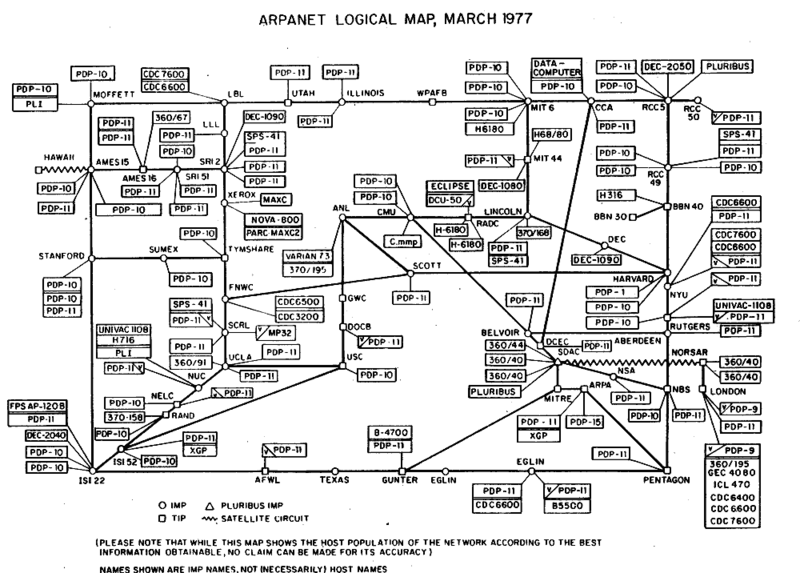
Vint Cerf, one of the fathers of our interconnected digital world, answering a Wired query about how he shepherded the Internet from proprietary to public:

Wired: So how did the internet get beyond the technical and academic community?

Cerf: Xerox invented the Alto machine which was a $50,000 personal computer given to every employee of Xerox PARC — so they’re living twenty years in the future for all practical purposes. They were even inventing their own internet. They had a whole suite of protocols. Some of the students that worked with me in Stanford went to work with Xerox PARC, so there was a lot of cross-fertilization.

It’s just that they decided to treat their protocol as proprietary, and Bob and I were desperate to have a non-proprietary protocol for the military to use. We said we’re not going to patent it, we’re not going to control it. We’re going to release it to the world as soon as it’s available, which we did.

So by 1988, I’m seeing this commercial phenomenon beginning to show up. Hardware makers are selling routers to universities so they can build up their campus networks. So I remember thinking, ‘Well, how are we going to get this in the hands of the general public?’ There were no public internet services at that point.

And there was a rule that the government had instituted that said you could not put commercial traffic on government-sponsored backbones, and, in this case, it was the ARPANET run by ARPA or for ARPA; the NSFNet run for the National Science Foundation, and there were others. The Department of Energy has ESnet and NASA had what was called the NASA Science Internet. The rule was no commercial traffic on any of them. So I thought, ‘Well, you know, we’re never going to get commercial networking until we have the business community seeing that commercial networking is actually a business possibility.’

So I went to the US government, specifically to a committee called the Federal Networking Council since they had the program managers from various agencies and they had been funding internet research. I said, ‘Would you give me permission to connect MCI Mail, a commercial e-mail service, to the internet as a test?’

Of course, my purpose was to break the rule that said you couldn’t have commercial traffic on the backbone.

And so they kind of grumbled for a while and they said, ‘Well, OK. Do it for a year.’”

••••••••••

A 1974 demo of the Xerox Alto:

Tags:

Americans loved gadgets before WWII, but the money wasn’t there to invest in machines during the Great Depression. A good part of the American postwar dividends was spent on machinery to ease life’s toil and just amaze, from kitchen appliances to bowling alley pinsetters. They had utility, but they were also fun to watch. Was our desire to see machines do their magic rooted in P.T. Barnum’s chicanery? Probably not. It’s probably an innate thing. But it’s an interesting theory. From Edward Tenner’s Atlantic essay, “The Pleasures of Seeing Machines Work“:

“The cultural historian Neil Harris has coined a phrase for this fascination with seeing things work, the Operational Aesthetic. One of the pleasures of bowling for postwar generations was the introduction of the automated pinspotter, the Roomba of the 1950s, which helped the sport’s explosive growth in the decade.

Who started it all? Harris has suggested it was none other than P.T. Barnum, whose American Museum in New York was widely (and rightly) suspected of fakery. But that helped build business. Visitors wanted to see for themselves, scrutinize the exhibits closely, and detect just how each illusion was accomplished. Barnum’s success was based not on cynicism about ‘suckers,’ but to the contrary, in appealing to critical intelligence to detect how it all was done.”

••••••••••

The history of Brunswick pinsetters:

Tags: , ,

« Older entries § Newer entries »