Videos

You are currently browsing the archive for the Videos category.

"We can now send a not too complicated photograph over very long distances in six to twelve minutes."

“We can now send a not too complicated photograph over very long distances.”

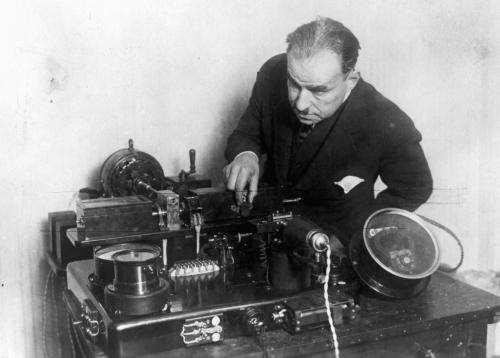
In the early years of the twentieth century, Professor Arthur Korn was conducting pioneering research into the development of the fax, which is still popular in certain places. A German of Jewish descent, the professor fled his home country in 1939 and emigrated to America, where he lived out his life. The opening of a November 24, 1907 New York Times article about Korn’s early telecommunications work, done in a time before world wars were even a thing, which seems to have resulted in the first facsimile ever sent:

“With the recent successful demonstration of Prof. Korn’s invention, by which photographs may be telegraphed from one part of the world to another, it seems not improbable that some day we may be able to see distant views through the aid of a telephone wire in the same way that we can now hear distant sounds.

That, at the first glance, may seem an impossibility; but no more impossible than the idea of telegraphing photographs would have appeared before its actual accomplishment.

The remarkable series of tests which demonstrated the practicability of the new invention took place in the office of The London Mirror on Nov. 7. The machine used in the test had been constructed for The Mirror by M. Carpenter of Paris. The receiving instrument was installed in the Paris office by L’Illustration, one of the leading pictorial journals of France.

Photographs–including one of the King–were both sent and received between London and Paris, a distance of 280 miles, and the eminently satisfactory results which were obtained came as a revelation to the distinguished company. Among the guests were several hundred who are prominent in science, art, politics, and journalism. This was the first time that photographs had been telegraphed from one capital to another, and Prof. Korn, the inventor, was the recipient of many congratulations, 

The first test was the sending of a photograph of King Edward to Paris, the whole operation taking only six minutes, at the end of which time the signal was given that the picture had been admirably reproduced in the Paris offices of L’Illustration.

Then a photograph was transmitted from Paris. A sensitive film was placed on a receiving cylinder, which is inclosed in a box, and as soon as the current was switched on the film began to slowly rotate and receive an exact copy of the film in Paris–an operation which again occupied six minutes.

The receiving film was then taken off the cylinder and an excellent photograph was printed from it amid the applause of the audience.

In a lecture given after the tests had been completed, Prof. Korn explained the working of his new system of photography. ‘We can now,’ he said, ‘send a not too complicated photograph over very long distances in six to twelve minutes. The problem of television, by which distant views are reproduced in a way similar to that by which we now hear distant sounds, has not yet been solved. Many bright minds are working upon it, but the great difficulty is the speed required. This must be a thousand times greater than the highest speed that has yet been obtained with telephotography.”

_______________________

“The picture you wish to have transmitted is taken to a sending station”:

Tags:

Sometimes you don’t want to be first in the world. This is one of those times. Fundawear from Durex. Do NOT masturbate during an electrical storm.

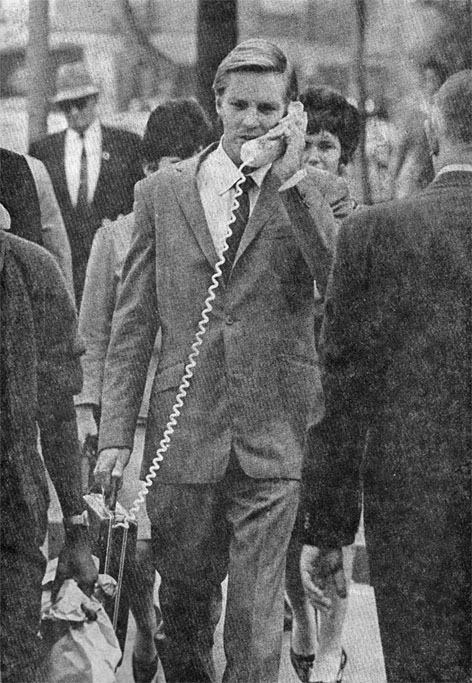
To celebrate 40 years since the first cell phone call, here’s a Motorola promotional video from the tool’s second decade.

Mantis, a two-ton robot with room for a passenger.

Steve Allen, in 1964, visited by Bob Dylan 1.0, before the singer-songwriter’s fame and the decade itself became a gathering storm.

Tags: ,

Margaret Thatcher, the former British Prime Minister, who just passed away, in a brief on-air spat with David Front in 1985 during the Falklands War. Thatcher, an iron-fisted conservative and the European parallel to Ronald Reagan, was often derided for being cruel to have-nots. She is not warmly remembered in her country while Reagan largely is in his. What does that say? Anything?

Tags: , ,

From the thoughtful people at Boston Dynamics, a new, camouflaged and more lifelike version of Petman. From the company’s copy: “PETMAN has sensors embedded in its skin that detect any chemicals leaking through the suit. The skin also maintains a micro-climate inside the clothing by sweating and regulating temperature.”

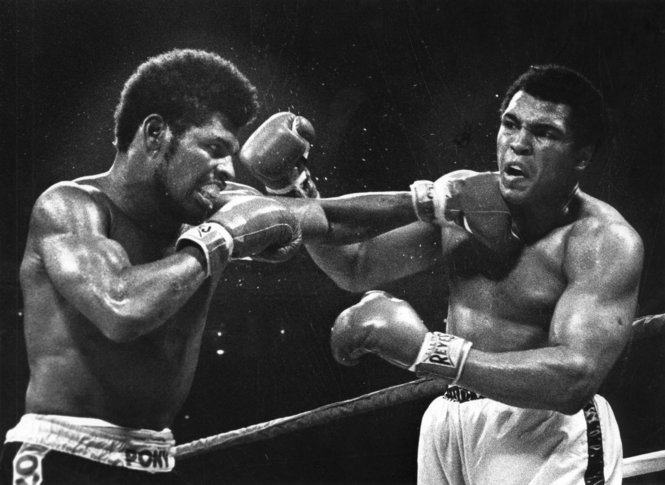
Muhammad Ali visits with Dick Cavett in 1978 in the wake of his loss to Leon Spinks. Ali, now slowed and beloved, would win a rematch in his final great moment as a boxer, but he really, really should have been retired for several years at this point. 

Tags: ,

Because all the poor people finally have sufficient food and shelter, we felt it was now appropriate to invent a hovercraft golf cart. I wish this were an April Fool’s Day joke, but it appears to be real. After a relaxing nine holes, let’s go to potter’s field and dig up dead beggars and use their bones to batter the current beggars.

Tags:

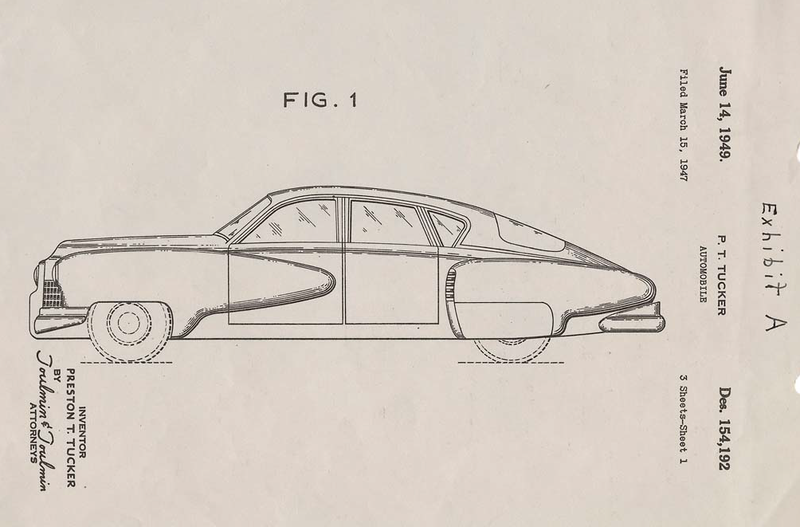
Fun 1948 PR film from Preston Tucker about his machine, a new sedan nicknamed the “Tucker Torpedo,” which revolutionized the American automobile, before the SEC and rumors of wrongdoing forced it off the road.

Tags:

When all the bees have disappeared, we will still have robotic dragonflies to fill the air. The BionicOpter, created by Festo: “Just like its model in nature, this ultralight flying object can fly in all directions.”

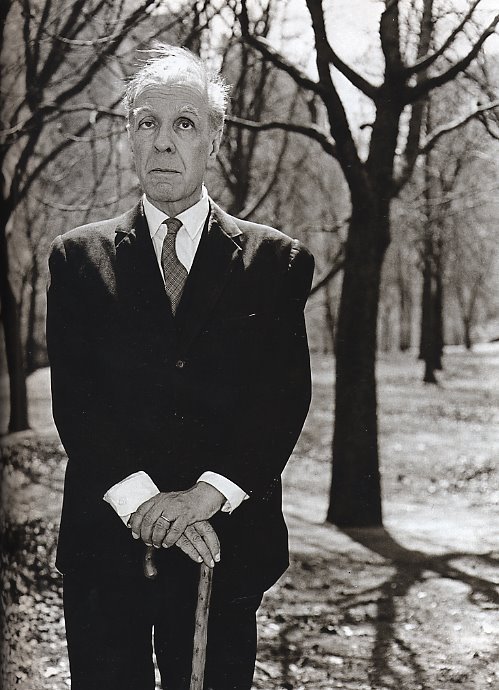
Why don’t I like Jorge Luis Borges’ writing more than I do? He would seem aesthetically to be right up my alley, but I just don’t connect to it. Here’s an appearance by the Argentine legend with William F. Buckley on Firing Line in 1977. 

Tags:

Via a Choire Sicha post at the excellent Awl blog, I just learned of Brendan Koerner’s The Skies Belong To Us, an exploration of the “golden age” of plane hijackings in the late ’60s / early ’70s. The forthcoming book looks at a turbulent time in America, when you could fly a 747 through the credibility gap. Into this void of political and moral authority arrived one skyjacking after another, pretty much on a weekly basis. Koerner focuses on the case of Roger Holder and Cathy Kerkow, a Vietnam vet and a party girl, who wrested control of a Western Airlines flight as part of an inchoate political protest, beginning the first leg of their insane journey.

The trailer for the book from the official website.

Tags: , , ,

From a famous Andy Kaufman show at Carnegie Hall in 1979, the Intergender Wrestling Champion “challenges the audience.” The old woman seated on the couch on the stage, who was supposedly the comedian’s grandmother, was actually Robin Williams in drag. He took off the costume only at the end of the show.

Tags: ,

I often wonder this: What better prepares us for life, a loving and encouraging childhood or one that is more challenging? Do an inordinate number of slings and arrows in youth give us survival strategies we would otherwise lack? Does a warm and protective childhood shield us permanently no matter what we face later in life? It varies, I’m sure.

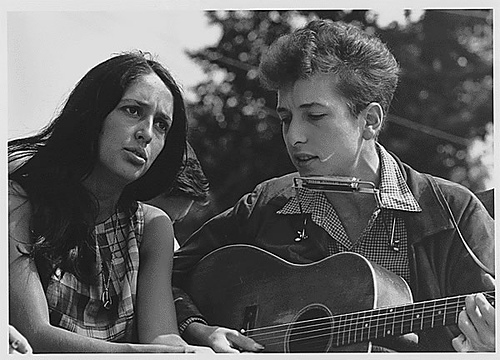
Joan Baez grew up in a Quaker family with a physicist father, being introduced to college campuses and interesting cities all around the world, being nurtured and developed. But did that prepare her for the Bob Dylans of the world, who lacked her kindness? Did that make her feel like she could put the world on her shoulders, a weight that no one can bear?

In this 1979 video, she discusses human rights in Vietnam with William F. Buckley.

Tags: ,

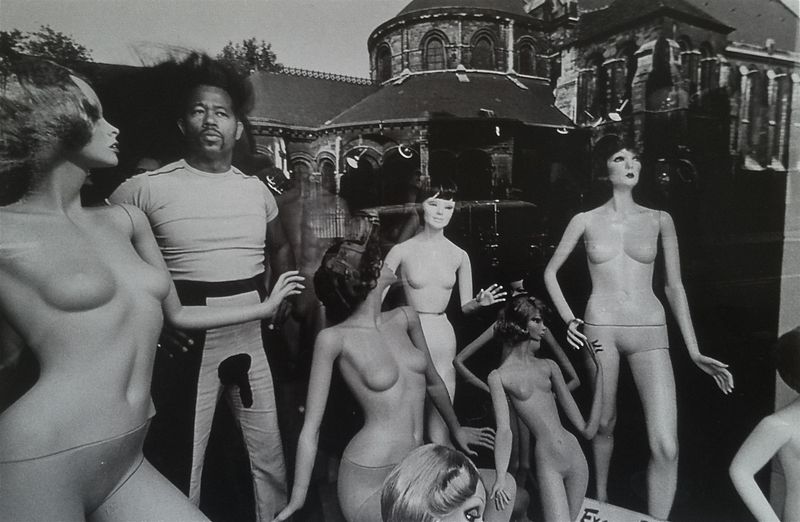
Black Panther Eldridge Cleaver was sadly not wearing his Penis Pants when he sat down in 1969 with William F. Buckley to discuss the Man and the Pigs and other handy generalizations. At the 3:28 mark.

Tags: ,

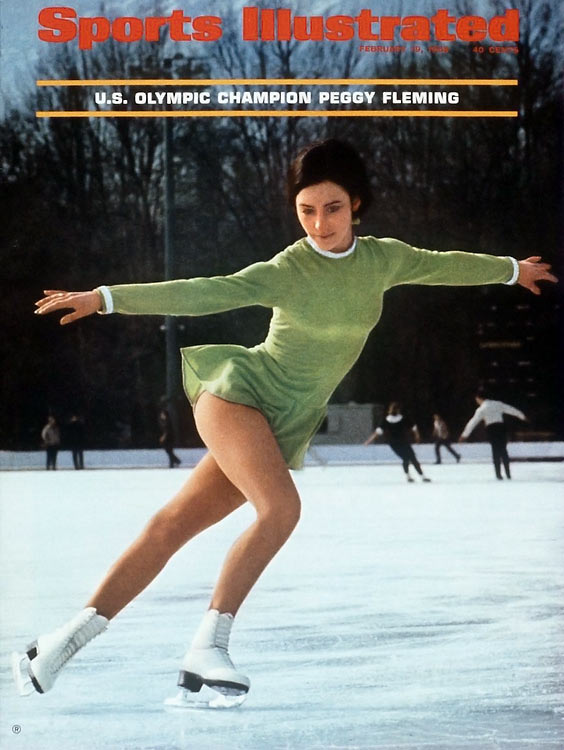
Figure skater Peggy Fleming was rewarded for her gold medal at the 1968 Olympics by getting to visit Joe Namath’s short-lived talk show the following year, enduring the host’s fu manchu and bell-bottoms and Paul Anka’s attempts at singing. Namath was actually a capable interviewer and conducted more natural and engaging conversations than the large majority of today’s late-night hosts. Dick Schapp plays the affable sidekick.

Tags: , , ,

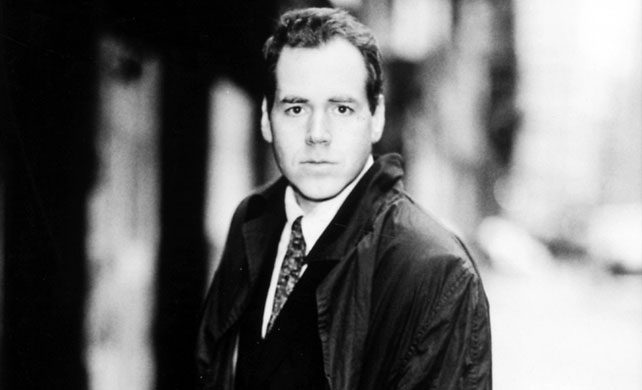
Bret Easton Ellis, popular and reviled for having penned Less Than Zero, a dreadful novel not for its scenes of unimpeded immorality but for its sheer incompetence, visited William F. Buckley in 1985, while he was still a junior at Bennington. Here’s the first five minutes of the show, which features Buckley’s customary long introduction of his guest and a couple of questions of fellow young writer Fernanda Eberstadt, though sadly no Ellis commentary.

Tags: , ,

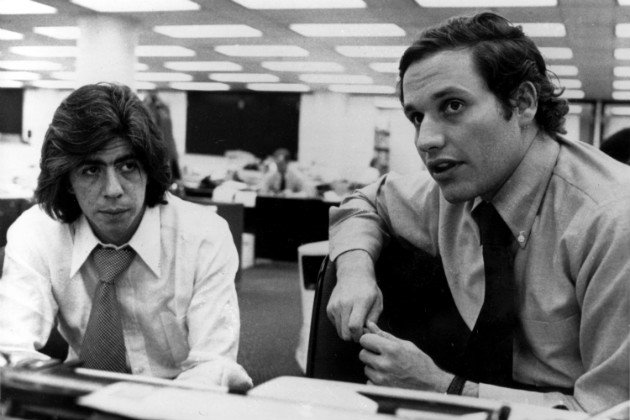
In a rare moment when he wasn’t watching porno, William F. Buckley spoke with Watergate heroes Bob Woodward (a so-so writer with his own credibility gap) and Carl Bernstein (a brilliant reporter and suspect human being). From 1974.

Tags: , ,

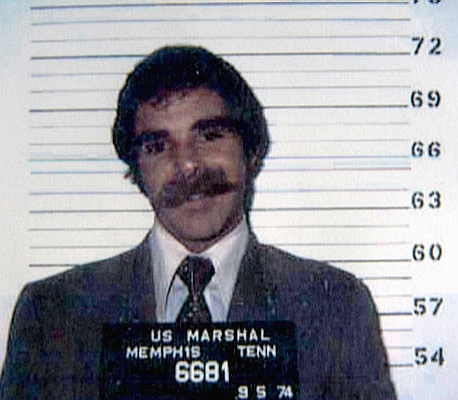
The Olivier of oral and progenitor of the pornstache, Harry Reems, the adult actor born Herbert Streicher to two very proud and well-hung parents, just passed away. In all seriousness, his work on the landmark 1972 skin-flick Deep Throat led to years of prosecution on obscenity charges. Reems ultimately was victorious, and converted to Christianity in later life. Margalit Fox, who writes lively copy about dead people, penned his obituary in the New York Times. An excerpt:

Mr. Reems, who began his career in the 1960s as a struggling stage actor, had already made dozens of pornographic films when he starred opposite Ms. Lovelace in Deep Throat.

But where his previous movies were mostly the obscure, short, grainy, plotless stag films known as loops, Deep Throat, which had set design, occasional costumes, dialogue punctuated by borscht-belt humor and an actual plot of sorts, was Cinema.

Mr. Reems played Dr. Young, a physician whose diagnostic brilliance — he locates the rare anatomical quirk that makes Ms. Lovelace’s character vastly prefer oral sex to intercourse — is matched by his capacity for tireless ministration.

“I was always the doctor,” he told New York magazine in 2005, “because I was the one that had an acting background. I would say: ‘You’re having trouble with oral sex? Well, here’s how to do it.’ Cut to a 20-minute oral-sex scene.'”•


William F. Buckley “welcomes” Reems and a wild-haired, pre-Epstein Alan Dershowitz:

Tags: , , ,

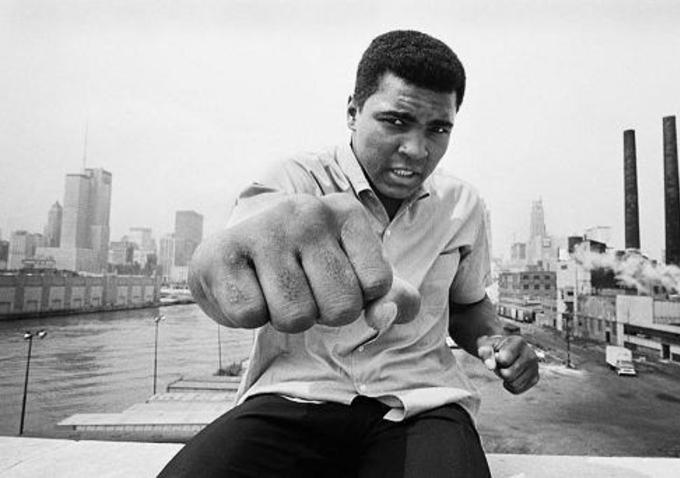
Muhammad Ali came close to boxing the ears of Joe Namath during a 1969 installment of the talk show hosted by the Jets quarterback. This was during the period when the boxer when the boxer had been stripped of the heavyweight championship for refusing to serve in the U.S. military, and he was in no mood. Oh, and George Segal and his facial hair dropped by.

Tags: , , ,

The recently deceased cinema savant Ric Menello existed on the fringes of the film world–of society, actually–yet some chance meetings gave him an unlikely Hollywood career. From Richard Brody’s appropriately all-over-the-place New Yorker blog post, a segment about the director James Gray remembering his first interaction with the man who would become his most eccentric collaborator:

I got a phone call—this is about 1996, I think, late ’96, somewhere around there—from Rick Rubin, who, along with Russell Simmons, started Def Jam Records. And Rick said [deepening his voice in impersonation], ‘I have somebody on the phone I want you to talk to.’ You know, he had made a three-way call.

I said, ‘Hello?’

[Adopts a nasal voice] ‘Hello?’ ‘Who’s this?’

[Shrill voice] ‘Who’s this?’

‘This is James Gray.’

‘Did you direct Little Odessa?

‘Yes.’

‘Ah, that wasn’t too good.’

‘Who is this?’

‘This is Ric Menello.’

[In the deep voice of Rick Rubin] ‘This is my friend Ric Menello. He knows much more about movies than you do.’

And all of a sudden I started talking to the guy. And, of course, I immediately liked him because he disparaged my work. And I realized that Rick Rubin was absolutely correct: he knew everything. He was working at the desk of the dorm—Weinstein dorm at N.Y.U.—when Rubin met him. And he would hold court talking about movies, and they quickly recognized him as kind of a savant, and they befriended him.”

____________________

Menello directed the “Going Back to Cali” video in 1989:

Tags: , , ,

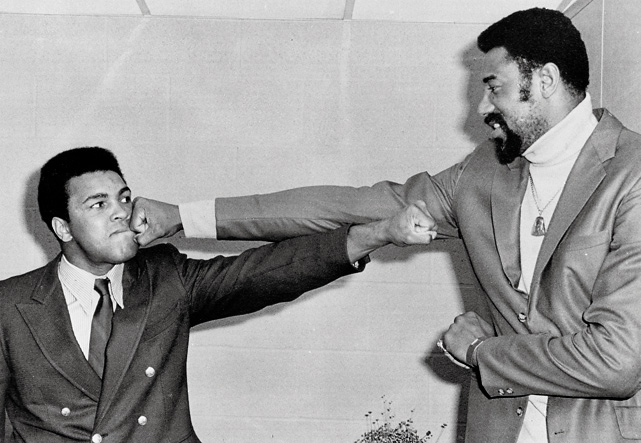
Wilt Chamberlain was a remarkable athlete (basketball, volleyball, track and field), but it’s probably a good thing he never realized his dream to fight Muhammad Ali. Howard Cosell presides over the ridiculousness, as he often did.

From East Side Boxing: “Springtime, 1971. Inside an office within the Houston Astrodome, a most unusual negotiation is about to take place. Seated at one end of the table is Muhammad Ali, former Heavyweight Champion of the World and self-proclaimed greatest fighter of all time. Next to him: Bob Arum, the former Justice Department attorney turned boxing promoter who had worked with Ali since his 1966 fight with George Chuvalo. 

A few minutes later, they are joined by one of the most imposing figures in all of sport, the towering titan of professional basketball Wilt Chamberlain. Ali and Chamberlain knew each other well and had appeared together on numerous occasions in the past, from television talk shows to press conferences addressing civil rights issues. The purpose of this meeting, however, was far different from their previous encounters.

Today no media cameras are present, no reporters scramble for sound bites. The two most famous athletes in the world isolated themselves within the cavernous empty stadium to quietly discuss an event without precedent in the annals of sport. For on this day, Muhammad Ali and Wilt Chamberlain will agree to face each other in a 15-round boxing match, to be held in the Astrodome on July 26, 1971. 

For Chamberlain, fighting Ali represented the pinnacle in his quest to conquer not only his own sport, but the entire sporting world.”

Tags: , ,

One of this week’s guests on Marc Maron’s WTF podcast is 87-year-old Dick Van Dyke. The guest discusses his career, especially his amazing run during the 1960s (Bye Bye Birdie, Chitty Chitty Bang Bang, the Dick Van Dyke Show, Mary Poppins), but he also mentions something I had never heard: Before his great success, in the mid-1950s, he was the host of CBS national morning show (as Charlie Rose is today), and his news reader was Walter Cronkite and one of his writers was Barbara Walters. It’s a fun listen if you get the chance, though Maron’s show always is.

Here Van Dyke is joined by Lucille Ball on his 1976 variety show for a skit about human augmentation, which is still only in its infancy. Not quite as dark a take as John Frankenheimer’s Seconds, as you might imagine.

Tags: ,

Last week I put up a post about Steven Pinker’s assertion that violent video games have become popular in an era when we’ve seen a marked decrease in violence perpetrated by young males, the group most devoted to them. But is it possible that such fare encourages a particular type of shocking violence (mass shootings) that gets lost in the larger statistics? Perhaps blood-soaked video games have little effect on the average youth–maybe it even helps him work through impulses virtually that would manifest themselves actually without the games. But it’s possible the most damaged among us are inspired by such bloody visions. Even if it’s so, do we want to live in a society in which our culture is governed by a very small minority of crazies? There was long the thought that pornography would encourage viewers to become sex criminals, but the preponderance of online pornography has coincided with a steep decrease in sex crimes. Just correlation? Perhaps, but I would guess causation. Violent culture may serve the same function (for most of us).

Orson Welles briefly talking about the supposed link between violent entertainment and actual violence.

Tags:

« Older entries § Newer entries »