Here’s the full version of Dennis Potter’s final interview in 1994, with Melvyn Bragg, when the auteur was dying and would interrupt the conversation periodically for a hit of morphine. Because the Singing Detective became such a sensation in the 1980s, he was often linked to the leading American TV producer of the day, Steven Bochco, which galled Potter. He HATED Bochco’s work, and when the two were joined by seminars, he would tell his counterpart exactly that to his face.
A wart that grew a man, Morton Downey Jr. was his generation’s Joe Pyne, a fun-house mirror of a media personality, held up to the absolute worst in American culture. His show was a sick and violent sideshow but mostly a con, save the host’s outrage, which was real and came from some unknown personal wounds.
Every generation gets the Joe Pyne they deserve, and in our time it’s Alex Jones, who doesn’t offer carnival-ish physical violence from inside a confined studio but something worse: scary conspiracy theories, threats of violence and utter hatred sent out to the like-minded. It’s not a purging but a rallying cry.
It makes sense that as most of the culture improves and progresses, that a stubborn strain of it gets worse, becomes a raging illness.
Part of an 1969 interview David Frost conducted with Truman Capote, who was already four years into a long decline, having published his masterpiece, In Cold Blood, in 1965, after a long struggle, with cycles of celebrity, scandal, addiction and rehab awaiting him. When I was a small child, I was taking a bus trip with my parents from the Port Authority, and we saw Capote seated on the benches, wearing a big straw hat, wasted out of his mind. He was trying to get a homeless woman to talk to him. She had no interest.
From the New York Times, a look back at 1991’s Biosphere 2, that boondoggle, which was supposed to be an air-tight test run for space colonization. It ended up being something less.
Americans have apparently realized in just the last few days that the Patriot Act combined with tons of our information online means that spying is easier than ever–and probably legal. Hopefully, we’re a little more aware that 3D printers, with all the great things they can do, will also lead to some problems. Staples begins selling one this month. From Singularity Hub: “The latest sign of the 3D printer home invasion? Retail office supply chain, Staples, says they’ll sell the 3D Systems Cube 3D Printer online and in retail storesby the end of June.
The $1,300 Cube connects to your home PC over Wi-Fi, allowing it to access and print 3D digital templates in plastic. The printer can print shapes that fit inside a cube 5.5″ to a side. Printing cartridges come in 16 colors which, along with other accessories, may also be purchased at Staples.”
The Swiss-headquartered ABB Group has created the first electric-bus system that doesn’t require overhead power lines, being able to “flash charge” in 15 seconds when it pulls into stops. From the company’s release:
“The new boost charging technology will be deployed for the first time on a large capacity electric bus, carrying as many as 135 passengers. The bus will be charged directly at selected stops with a 15-second energy boost while the passengers enter and leave the bus, based on a new type of automatic flash-charging mechanism. The pilot project runs between Geneva airport and the city’s international exhibition center, Palexpo.
‘Through flash charging, we are able to pilot a new generation of electric buses for urban mass transport that no longer relies on overhead lines,’ said Claes Rytoft, ABB’s acting Chief Technology Officer. ‘This project will pave the way for switching to more flexible, cost-effective, public transport infrastructure while reducing pollution and noise.'”
“The rich have got their channels in the bedrooms of the poor,” observed Leonard Cohen once upon a time, but there was no video streaming back then nor such a complex understanding of the workings of compulsive behavior. Today’s serialized TV, regardless of what size screen you’re watching it on, isn’t interested in diverting you but on hooking you, on making you, not just the video, go viral. You are the receiver of the content, but you’re also the messenger. And while that’s always been true, it’s never been more true. It’s a science–it’s a narcotic. We’re not talking about CBS trying to get viewers to tune into the Mary Tyler Moore Show once a week at an appointed time. We’re talking about narratives that have to defeat time shifting, the long tail of zillions of other options and the game-changing effect of a decentralized media.
Of course, these creations are an inexact science and the idea of a “scheme” being used to push our buttons and make us consume in bulk can be overstated, but the seemingly endless access we have to content is something new and worth analyzing. I guess this is the most interesting question for me: If the programs are really good, does it mitigate somewhat attempts to program us? From an Andrew Romano article in Newsweek about the age of binge viewing:
“So far, no scientist has studied binge watching per se, or the Hyperserial generation of television programming that has inspired so much of it. But the groundbreaking work of a Princeton University psychologist named Uri Hasson may hint at why the current trend toward narrative precision may also be triggering an increase in viewer engagement.
Hasson, a bald, bespectacled professor with a thick Israeli accent, doesn’t binge watch any television shows himself. ‘That is for people without work the next morning—or children,’ he quips. But Hasson may understand better than anyone else why the rest of us can’t help ourselves. In 2008 he coined the term ‘neurocinematics’—the neurobiological study of how films interact with the brain—to describe his work. A study published that year in Projections (subtitle:The Journal for Movies and Mind) was particularly revelatory. Employing fMRI technology, Hasson and his neuroscience colleagues screened four film clips—from Sergio Leone’s The Good, the Bad and the Ugly, Alfred Hitchcock’s ‘Bang! You’re Dead,’ Larry David’s Curb Your Enthusiasm, and an unedited, single-camera shot of New York’s Washington Square Park—and then watched as viewers’ brains reacted. Their goal? To measure the degree to which different people would respond the same way to what they were seeing.
The results varied widely, depending on which film was shown. The unstructured, ‘realistic’ video from Washington Square Park, for instance, elicited the same neurological reaction in only about 5 percent of viewers. Responses to Curb Your Enthusiasm were slightly more correlated, at roughly 18 percent; and The Good, the Bad and the Ugly ranked even higher, 45 percent. But ultimately, Hitchcock was the runaway ‘favorite’: a full 65 percent of the study’s cerebral cortices lit up the same way in response to the clip from ‘Bang! You’re Dead.’
Hasson’s conclusion was fascinating: the more ‘controlling’ the director—the more structured the film—the more attentive the audience. ‘In real life, you’re watching in the park, a concert on Sunday morning,’ Hasson tells me. ‘But in a movie, a director is controlling where you are looking. Hitchcock is the master of this. He will control everything: what you think, what you expect, where you are looking, what you are feeling. And you can see this in the brain. For the director who is controlling nothing, the level of variability is very clear because each person is looking at something different. For Hitchcock, the opposite is true: viewers tend to be all tuned in together.’
Is it possible, then, that the recent trend toward more structured, page-turning narratives on television might be generating ever-higher levels of cerebral correlation—and viewer engagement—in living rooms across the country?
‘Absolutely,’ Hasson says.”
_______________________
“It’s like daylight already. How did that happen?”
Dictaphones and typewriters were becoming office heirlooms in 1976, as demonstrated in this Canadian Broadcasting Corporation video about the office of tomorrow.
If you think Fruitarians are ridiculous, you should meet Breatharians, who believe that food and water are superfluous. Tom Snyder met a prominent one, Wiley Brooks, in 1981.
Graphic User Interface and sleek product design turned cold computers into must-have accessories, and MIT roboticist and artist Alexander Reben realizes that aesthetics can do the same for ‘bots. And that’s true for better or worse: That thing that is taking my job and trying to murder me is as cute as a kitten–and it talks!
The creator of Boxie the Cute Robot describes his work thusly: “These robots use their cuteness to get people to answer questions that are then made into a documentary filmed by the robot’s internal camera.” Reben just started doing an Ask Me Anything on Reddit. A few exchanges and a video follow.
_____________________
Question:
Alexander Reben:
_____________________
Question:
What is the most interesting thing that came out of this project for you and the other people you worked on this with? Did you find any challenges with the Boxie/BlabDroid project that you didn’t expect when you started? What was the biggest challenge in making it a success?
Alexander Reben:
The most interesting thing is that everyone had a great experience with the robots. If you watch the videos you see some people get really deep with them, some even crying. However, nobody asked for the video to not be used (everyone knows the robots are filming them). It was almost the inverse, the more people told the robots, the better the interaction. Many described it as a “cathartic” experience.
_____________________
Question:
Alexander Reben:
Right now, we plan to bring the robots around the world to meet new people and “learn more about the humans that inhabit earth.” They will be at the Doc/Fest festival in Sheffield England next week. We would love to get them other places like for a talk show segment or TV show.
Indeed, we are planning to bring the cost of the robots down to the price range of a premium Bluetooth accessory. Our plan is to allow the user to use their cellphone camera as the robot’s camera, thereby making them cheaper yet still getting high quality video. We also want to open source the protocols used to control the robot so people can hack them. We are still very optimistic because everyone who sees a BlabDroid in person wants one!
••••••••••
“If there was no money and no law, what would be the first thing you would do?”
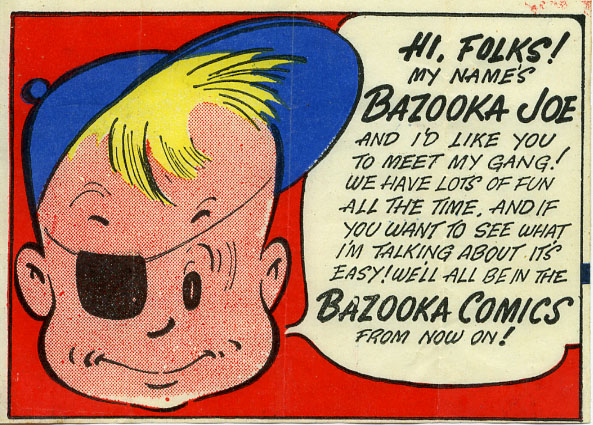
In 1975, Joe Garagiola hosted a remarkably stupid and wonderful bubble-gum blowing competition among baseball players, which was sponsored by Bazooka, a brand of gum favored by hoboes during World War II. One entrant was Philadelphia catcher Tim McCarver, whose head was the size of a medicine ball. The moment the contest ended, the players went in search of the nastiest groupies they could find.
I recently posted a brief documentary about Morganna the Kissing Bandit. Here’s her 1976 appearance on To Tell the Truth. Fittingly, the host was a male sports figure, Joe Garagiola. On the panel was film critic Gene Shalit, who was mediocre but possessed a mustache.
When I used to see Shalit at movie screenings, he would sometimes be listening to a Walkman during the film and talking aloud to himself. One time when I was sitting a row ahead of him, he screamed at me when I got up to leave after the movie was over. “Get out of the way,” he hollered. “I’m trying to watch the credits.” The dipshit was sort of right.
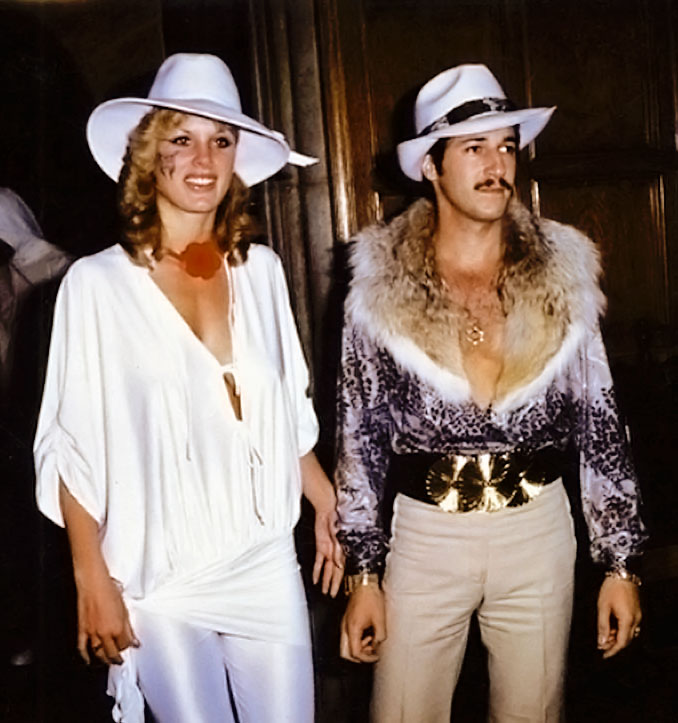
Posting an interview earlier with Peter Bogdanovich reminded me of “Death of a Playmate,” Teresa Carpenter’s searing, Pulitzer Prize-winning Village Voice article, which not only excoriated the estranged husband of Dorothy Stratten, who brutally murdered the Playboy centerfold and actress in 1980, but also pilloried Bogdanovich and Hugh Hefner for the objectification and commodification of the young woman. Of course, Carpenter, who later sold the rights to her article to Bob Fosse to serve as the basis of Star 80, could be accused of the latter herself. The piece’s opening:
It is shortly past four in the afternoon and Hugh Hefner glides wordlessly into the library of his Playboy Mansion West. He is wearing pajamas and looking somber in green silk. The incongruous spectacle of a sybarite in mourning. To date, his public profession of grief has been contained in a press release: “The death of Dorothy Stratten comes as a shock to us all. . . . As Playboy’s Playmate of the Year with a film and television career of increasing importance, her professional future was a bright one. But equally sad to us is the fact that her loss takes from us all a very special member of the Playboy family.”
That’s all. A dispassionate eulogy from which one might conclude that Miss Stratten died in her sleep of pneumonia. One, certainly, which masked the turmoil her death created within the Organization. During the morning hours after Stratten was found nude in a West Los Angeles apartment, her face blasted away by 12-gauge buckshot, editors scrambled to pull her photos from the upcoming October issue. It could not be done. The issues were already run. So they pulled her ethereal blond image from the cover of the 1981 Playmate Calendar and promptly scrapped a Christmas promotion featuring her posed in the buff with Hefner. Other playmates, of course, have expired violently. Wilhelmina Rietveld took a massive overdose of barbiturates in 1973. Claudia Jennings, known as “Queen of the B-Movies,” was crushed to death last fall in her Volkswagen convertible. Both caused grief and chagrin to the self-serious “family” of playmates whose aura does not admit the possibility of shaving nicks and bladder infections, let alone death.
But the loss of Dorothy Stratten sent Hefner and his family into seclusion, at least from the press. For one thing, Playboy has been earnestly trying to avoid any bad national publicity that might threaten its application for a casino license in Atlantic City. But beyond that, Dorothy Stratten was a corporate treasure. She was not just any playmate but the “Eighties’ first Playmate of the Year” who, as Playboy trumpeted in June, was on her way to becoming “one of the few emerging film goddesses of the new decade.”
She gave rise to extravagant comparisons with Marilyn Monroe, although unlike Monroe, she was no cripple. She was delighted with her success and wanted more of it. Far from being brutalized by Hollywood, she was coddled by it. . . . “Playboy has not really had a star,” says Stratten’s erstwhile agent David Wilder. “They thought she was going to be the biggest thing they ever had.”
No wonder Hefner grieves.
“The major reason that I’m . . . that we’re both sittin’ here,” says Hefner, “that I wanted to talk about it, is because there is still a great tendency . . . for this thing to fall into the classic cliche of ‘small-town girl comes to Playboy, comes to Hollywood, life in the fast lane, and that somehow was related to her death. And that is not what really happened. A very sick guy saw his meal ticket and his connection to power, whatever, etc. slipping away. And it was that that made him kill her.”
The “very sick guy” is Paul Snider, Dorothy Stratten’s husband, the man who became her mentor. He is the one who plucked her from a Dairy Queen in Vancouver, British Columbia, and pushed her into the path of Playboy during the Great Playmate Hunt in 1978. Later, as she moved out of his class, he became a millstone, and Stratten’s prickliest problem was not coping with celebrity but discarding a husband she had outgrown. When Paul Snider balked at being discarded, he became her nemesis. And on August 14 of this year he apparently took her life and his own with a 12-gauge shotgun.•
___________________
Dorothy Stratten visits Johnny Carson in 1980, four months before her murder.
The defense of Big Tech’s dubious tax dodge over the past week by Apple CEO Tim Cook and Google’s Eric Schmidt has been a maddening exercise in intellectual dishonesty. The premise of these two (and much of the tech world) is this: If you want us to pay our fair share than change your system so that we can’t exploit the loopholes. You know, don’t blame us for pursuing our self-interests; make it impossible for us to do so. Of course, what’s left unsaid is that Apple and Google and other behemoths have endless boatloads of cash to hire lobbyists who’ll make sure that any attempt at leveling the tax plane is as difficult as can be. That’s how the loopholes initially came into being.
The opening of “Future Shlock,” Evgeny Morozov’s powerful big-tech takedown in the New Republic, which draws parallels between the 19th-century advent of the sewing machine and today’s so-called world-flattening gadgets:
“The sewing machine was the smartphone of the nineteenth century. Just skim through the promotional materials of the leading sewing-machine manufacturers of that distant era and you will notice the many similarities with our own lofty, dizzy discourse. The catalog from Willcox & Gibbs, the Apple of its day, in 1864, includes glowing testimonials from a number of reverends thrilled by the civilizing powers of the new machine. One calls it a ‘Christian institution’; another celebrates its usefulness in his missionary efforts in Syria; a third, after praising it as an ‘honest machine,’ expresses his hope that ;every man and woman who owns one will take pattern from it, in principle and duty.’ The brochure from Singer in 1880—modestly titled ‘Genius Rewarded: or, the Story of the Sewing Machine’—takes such rhetoric even further, presenting the sewing machine as the ultimate platform for spreading American culture. The machine’s appeal is universal and its impact is revolutionary. Even its marketing is pure poetry:
On every sea are floating the Singer Machines; along every road pressed by the foot of civilized man this tireless ally of the world’s great sisterhood is going upon its errand of helpfulness. Its cheering tune is understood no less by the sturdy German matron than by the slender Japanese maiden; it sings as intelligibly to the flaxen-haired Russian peasant girl as to the dark-eyed Mexican Señorita. It needs no interpreter, whether it sings amidst the snows of Canada or upon the pampas of Paraguay; the Hindoo mother and the Chicago maiden are to-night making the self-same stitch; the untiring feet of Ireland’s fair-skinned Nora are driving the same treadle with the tiny understandings of China’s tawny daughter; and thus American machines, American brains, and American money are bringing the women of the whole world into one universal kinship and sisterhood.
‘American Machines, American Brains, and American Money’ would make a fine subtitle for The New Digital Age, the breathless new book by Eric Schmidt, Google’s executive chairman, and Jared Cohen, the director of Google Ideas, an institutional oddity known as a think/do-tank. Schmidt and Cohen are full of the same aspirations—globalism, humanitarianism, cosmopolitanism—that informed the Singer brochure. Alas, they are not as keen on poetry. The book’s language is a weird mixture of the deadpan optimism of Soviet propaganda (‘More Innovation, More Opportunity’ is the subtitle of a typical sub-chapter) and the faux cosmopolitanism of The Economist (are you familiar with shanzhai, sakoku, or gacaca?).
There is a thesis of sorts in Schmidt and Cohen’s book. It is that, while the ‘end of history’ is still imminent, we need first to get fully interconnected, preferably with smartphones. ‘The best thing anyone can do to improve the quality of life around the world is to drive connectivity and technological opportunity.’ Digitization is like a nicer, friendlier version of privatization: as the authors remind us, ‘when given the access, the people will do the rest.’ ‘The rest,’ presumably, means becoming secular, Westernized, and democratically minded. And, of course, more entrepreneurial: learning how to disrupt, to innovate, to strategize. (If you ever wondered what the gospel of modernization theory sounds like translated into Siliconese, this book is for you.) Connectivity, it seems, can cure all of modernity’s problems. Fearing neither globalization nor digitization, Schmidt and Cohen enthuse over the coming days when you ‘might retain a lawyer from one continent and use a Realtor from another.’ Those worried about lost jobs and lower wages are simply in denial about ‘true’ progress and innovation. ‘Globalization’s critics will decry this erosion of local monopolies,’ they write, ‘but it should be embraced, because this is how our societies will move forward and continue to innovate.’ Free trade has finally found two eloquent defenders.
A Kickstarter campaign is trying to raise money for a transformer toy vehicle that can alternate driving and flying. From the campaign copy: “The combination of the design and material selection creates a solid construction that is capable of surviving the worst of landings. When the vehicle crashes from high altitudes, the driving rings detach from the housing and can be easily put back together. The main chassis is made out of Polycarbonate, which is the same material used in protective goggles and bullet proof windows.”
A 1979 TV interview with director Peter Bogdanovich conducted when he was still brash and pretentious, having made the unlikely leap from film historian and unsuccessful actor to A-list filmmaker who palled around with Orson Welles.
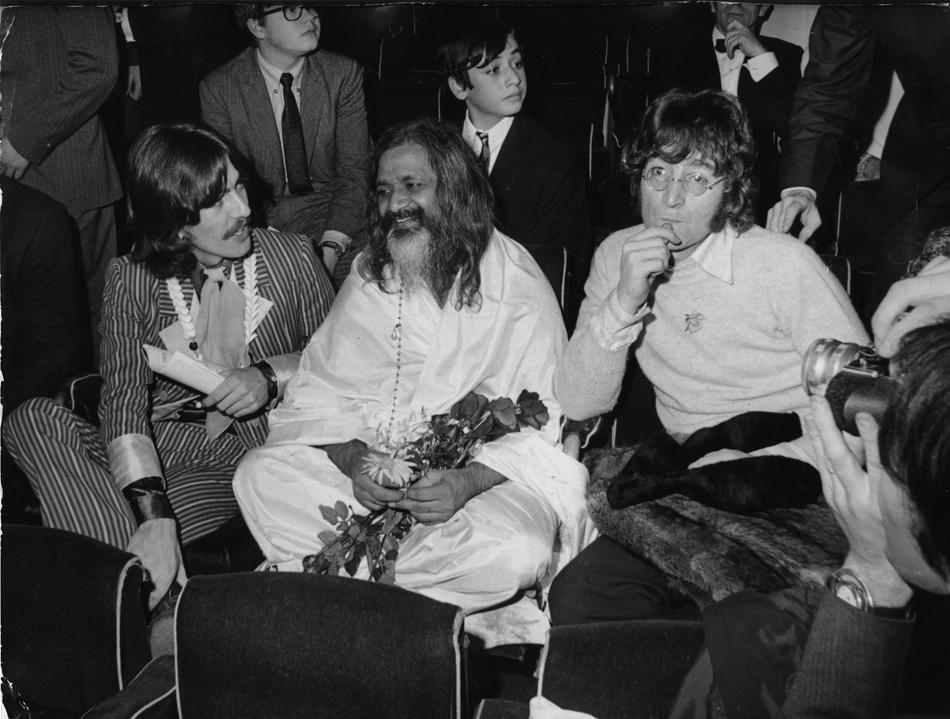
Maharishi Mahesh Yogi, who once tried to levitate Mia Farrow’s skirt, is interviewed by Howard Stern in 1985. Howard, who practices TM, was, sadly, very respectful, at least in this part of the interview.
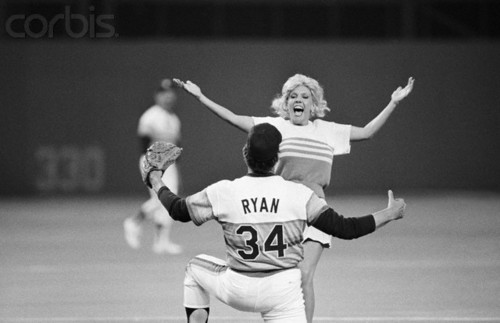
Morganna Roberts was a bosomy 13-year-old girl in 1960 when she first stepped onto a stage at a strip club, in an era when America was tormented by desire and morality, wanting all manner of urges satisfied and needing to punish the one who provided the satisfaction. Not content to just be ogled and cursed as the star of the burlesque circuit, the teen dreamed of a bigger spotlight–and found it. In the years before women were encouraged to take the field and participate in pro sports, she and her Dolly Parton-ish figure stormed the gates. Morganna, dubbed “the Kissing Bandit,” gained notoriety beginning in 1969 for running onto the playing field at pro games and attempting to plant one on the biggest male athletes of the day, from Pete Rose to Fred Lynn to Nolan Ryan. She was a groupie who only kissed, a streaker even when she kept her clothes on, and someone who was not very popular with women in a time when Billie Jean King was battling the sexist pigs on the court. Only in retrospect can she be appreciated as a feminist icon.
A short film by Adam Kurland about Morganna’s life as a public jiggler, “Always Leave Them Wanting More,” can be viewed here. (Thanks Hairpin.)
So-called spiritual guru Maharishi Mahesh Yogi, who was very good at keeping his legs crossed except when Mia Farrow was around, visits Merv Griffin for the first time in 1975. Merv is the one on your left.
Richard Linklater made Slacker, one of my favorite films, and spoke highly of George W. Bush, one of my least-favorite politicians. And until this very moment I forgot that I interviewed him years ago and he was a really forthright and honest subject. Linklater just did an Ask Me Anything on Reddit. A few exchanges follow.
________________________
Question:
In Slacker, it seems that you highlighted the “recent” rise of American Libertarianism and juxtaposed it with true anarchism (the Ron Paul ad and the old man being robbed). What side to you fall on, or were you trying to highlight the pros and cons of each philosophy?
Richard Linklater:
Glad you picked up on the nod to Ron Paul in Slacker. I’m with the Libertarian ideology on the freedom front… but I’m kind of a safety net guy, too — don’t like ideologies when they result in cruelty. There is a way in our world, given all of our resources, to have both.
________________________
Question:
What do you think about the “childization” of movies these days? It seems that Hollywood marketing has successfully turned us all into children. Do you think we are as dumb as the movies we watch, or are we playing dumb in order to enjoy what is commercially available to us?
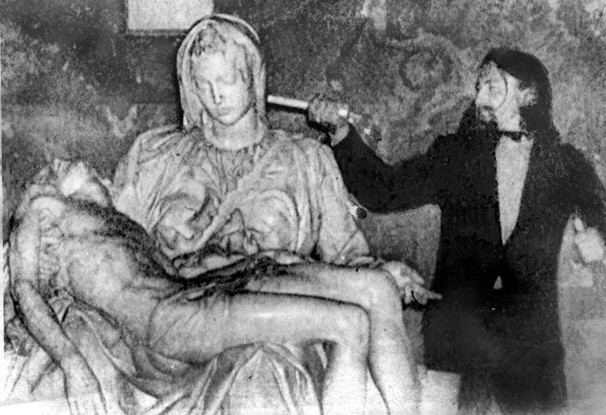
For whatever reason, the Vatican is commemorating the 41st anniversary of the attack on Michelangelo’s Pieta sculpture, which was vandalized by hammer-wielding madman Laszlo Toth, who believed he was Christ. From Reuters:
The statue is so lifelike that a viewer can almost feel the curls of the dead Christ’s hair and the softness of the Madonna’s lips.
The veins in Christ’s muscular arms seem to be still holding blood. The folds in the Madonna’s veil seem made of muslin rather than marble.
When art historian Giorgio Vasari saw the statue in 1550 he wrote in his book about the lives of artists.
“It is a miracle that a rock, which before was without form, can take on such perfection that even nature sometimes struggles to create in the flesh.”
After the attack, some art historians and restorers wanted the statue to remain as it was damaged as a sign of the violent times. Others said it should be restored but with clear marks delineating the damaged parts as a historical testament.
The Vatican instead decided on what is known as an “integral restoration,” one that would not leave any traces of the intervention visible to the naked eye.
“With any other statue, leaving the wounds (of the attack) visible, however painful, could have been tolerated,” said Antonio Paolucci, director of the Vatican Museums.
“But not with the Pieta, not this miracle of art,” he said.•
___________________________
Fuzzy footage of the attack, and some of the restoration.
This is the greatest TV footage ever not just because I’m an atheist but because I’m a big fan of awkwardness, when the truth pushes through a veneer of so-called civility, which is often nothing more than pandering.