Videos

You are currently browsing the archive for the Videos category.

Paul Schrader, Hollywood poet of the American underbelly, which often hides in plain sight, just did an Ask Me Anything at Reddit to promote his new film, The Canyons. A few exchanges follow.

___________________________

Question:

Any insights about John Hinckley and the Reagan assassination attempt? What was your reaction and those of other people involved with Taxi Driver?

Paul Schrader:

I was scouting locations for Cat People when the news came over the radio. I said to the driver, it’s one of those Taxi Driver kids. When I got back to the hotel, the FBI was waiting for me because Hinckley had mentioned the film. They wanted to know if he had tried to contact me. This is a very thorny moral question. My feeling is that if you censor art you will lose Crime and Punishment but you will still have Raskolnikov. But I also feel that there is a level of moral responsibility as well.

___________________________

Question:

Is there anything you’ve written that didn’t get produce for whatever reason that you were really bummed to see not be?

Also, did you ever do coke with Scorsese?

Paul Schrader:

Yes, I did one about the crime world in Quebec in the 70s. I did about Ayahuasca and the world of hallucinogens. Those are two that come immediatly to mind and there are more.

The answer to the second question is yes, Marty quit before I did. He had a very bad asthma experience in Rome and fortunately he was able to stop cold.

___________________________

Question:

Any chance of you writing for Marty again in the future?

Paul Schrader:

I did an HBO pilot for him but HBO passed. We have no other plans.

___________________________

Question:

The lead characters in Raging Bull and in Taxi Driver, played by Robert De Niro, were damaged individuals with serious problems dealing with women. In the case of Jake La Motta, he was a wife abuser, and Travis Bickle was essentially a stalker.

What was your approach to balance these flaws and still make the characters sympathetic to the audience?

Paul Schrader:

I think likability is an overrated quality in screen characters. What they need to be is interesting. If you put an interesting person in front of the viewer for 45 minutes and don’t give another perspective the viewer will begin to empathize with a character he or she previously though beneath empathy. That’s one of the ways art works.

___________________________

Question:

What is it like working with Bret Easton Ellis?

Paul Schrader:

It was a lot of fun with Bret. He was my partner as well as my collaborator. I don’t think we are necessarily on the same page but we are in the same book.

___________________________

Question:

I don’t really have a question, I just thought The Canyons was great, I really enjoyed it. All of the “issues” I’ve read about in various interviews really didn’t show on screen. (Example – not being able to film at the mall, issues with filming at dusk, etc.) So great job.

Paul Schrader:

Thank you. Many people confuse a troubled production with a troubled film, but in fact there is little interrelation. Many great films have had agonizing production problems and many harmonious/happy filmmaking experiences have resulted in stinkers.

••••••••••

A couple of pieces of a Schrader interview from 1982, at the time of Cat People:

Tags: , ,

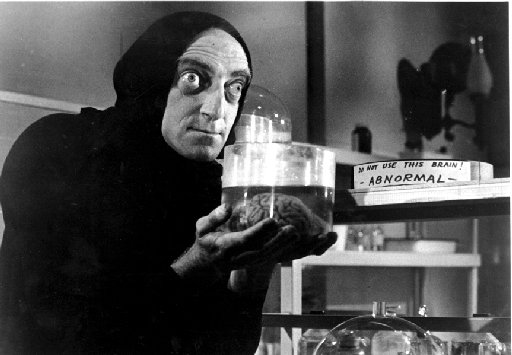
Two Mel Brooks clips, the first one a fairly rare 1975 British TV interview at the time of the release of Young Frankenstein, my favorite of the comic’s films and one of my top ten all-time screen comedies. 

The second is Brooks having dinner at his pal Carl Reiner’s house, as he has every night for decades, during one of the best episodes of Jerry Seinfeld’s Comedians in Cars Getting Coffee. By the way: I really like Seinfeld, but he would be better off shutting up on certain topics. When he’s not busy showing off his disposable income in his web series, he’s griping about being criticized for not booking any black or female comics during the show’s first season. Well, he should be criticized for that. Life’s a struggle for everyone, but when you’re in the groups that have easiest access to something prized, you should focus on making sure others have a way in also. At the very least, don’t complain if you’re called out on it. Acting put-upon when the truth is pointed out makes you seem petty and small.

Tags: ,

Elon Musk at the recent Teslive town-hall event, discussing Tesla Motors’ future.

Tags:

Members of the Homebrew Computer Club in the 1970s did all sorts of cool things with new computing power, including linking up the coffee makers and lighting in their houses so that they could be activated by timers. It didn’t become universal right away, but homes now are becoming smarter and more automated, and we’re just at the beginning. But, of course, all knowledge can be compromised. From Network World:

“If you added a home automation system to create your version of a ‘smart’ house, it could give you access from anywhere in the world to remotely control your lights, door locks, house temperature, electric appliances, water valves, alarm system, garage door, the ability to open and close your shades and blinds, or even to turn on music and crank up the volume. While that might seem pretty sweet, it also can be pretty vulnerable. If you use the Z-Wave wireless protocol for home automation then you might prepare to have your warm, fuzzy, happiness bubble burst; there will be several presentations about attacking the automated house at the upcoming Las Vegas hackers’ conferences Black Hat USA 2013 and Def Con 21.

Home automation devices are easy to spot with Shodan, a search engine for hackers, as pointed out by its creator John Matherly. And the home automation market forecast is predicted ‘to exceed $5.5 billion in 2016.’ Despite the technology having been available for over a decade, and many of these automation systems being extremely vulnerable, having a ‘smart house’ has become very trendy.

Exploiting houses with home automation may not be low-hanging fruit for malicious hackers, but with its increasing popularity and expanding product lines, we will see it gaining more attention from hackers who realize how insecure many of these systems actually are.”

. . . . . . . . . .

In 1967, Walter Cronkite looks the home of the future:

FromWhy We Keeping Playing the Lottery,” Adam Piore’s smart Nautilus piece on the psychological pull of paying the idiot tax:

“To grasp how unlikely it was for Gloria C. MacKenzie, an 84-year-old Florida widow, to have won the $590 million Powerball lottery in May, Robert Williams, a professor of health sciences at the University of Lethbridge in Alberta, offers this scenario: head down to your local convenience store, slap $2 on the counter, and fill out a six-numbered Powerball ticket. It will take you about 10 seconds. To get your chance of winning down to a coin toss, or 50 percent, you will need to spend 12 hours a day, every day, filling out tickets for the next 55 years. It’s going be expensive. You will have to plunk down your $2 at least 86 million times.

Williams, who studies lotteries, could have simply said the odds of winning the $590 million jackpot were 1 in 175 million. But that wouldn’t register. ‘People just aren’t able to grasp 1 in 175 million,’ Williams says. ‘It’s just beyond our experience—we have nothing in our evolutionary history that prepares us or primes us, no intellectual architecture, to try and grasp the remoteness of those odds.’ And so we continue to play. And play. People in 43 states bought a total of 232 million Powerball tickets for the lottery won by MacKenzie. In fact, the lottery in the United States is so exceedingly popular that it was one of the few consumer products where spending held steady and, in some states, increased, during the recent recession. That’s still the case. About 57 percent of Americans reported buying tickets in the last 12 months, according to a recent Gallup study. And for the 2012 fiscal year, U.S. lottery sales totaled about $78 billion, according to the North American Association of State and Provincial Lotteries.

It may seem easy to understand why we keep playing. As one trademarked lottery slogan goes, ‘Hey, you never know.’ Somebody has to win. But to really understand why hundreds of millions of people play a game they will never win, a game with serious social consequences, you have to suspend logic and consider it through an alternate set of rules—rules written by neuroscientists, social psychologists, and economists.” (Thanks Browser.)

••••••••••

New York porter wins $20k in first U.S. lottery:

Tags: , ,

A presentation of the hybrid bike and solar-powered car, the ELF.

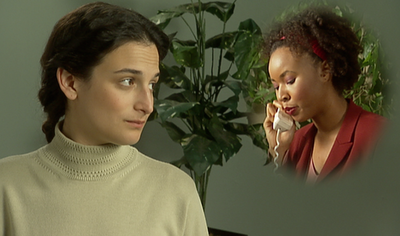
The first episode of Catherine, a disquieting, Lynchian 12-episode web series by Jenny Slate and her director husband, Dean Fleischer-Camp. Each episode, just three minutes, is a minimalist exercise in mundanity (save a single scene in the series). It’s like a nightmare you enjoy thinking about once you’ve awakened.

Tags: ,

Mesmerizing 17-minute DeLorean DMC-12 prospectus film that was shown to dealers and investors ahead of the automobile reaching the market in 1981.

Tags:

Even before the Internet, there were plenty of ridiculous rumors and urban legends that went viral. There is a cure for cancer, but the medical establishment won’t release it so that it can still keep profiting off of drugs and treatments. There are light bulbs that never burn out, but the light-bulb companies would be ruined if they were sold. Oh, and there is a car that can run on water, but Big Oil won’t allow its production. 

But there really is a car now that can run on water, though its tough to say how broadly its technology can be applied.

A 1975 documentary about Formula One racing, which has been known at various times as One by One, Quick and the Dead, and Champions Forever. An interesting period piece with a funked-up score, which focuses on Jackie Stewart, Peter Revson and their peers. Stacy Keach is the cool-as-can-be narrator, but racer François Cévert sums it up simply and best: “Steering is hard,” he admits.

Tags: , , ,

Amazing video from DARPA of new prosthetic limbs, which are brain-controlled and allow for a wide range of motion. (Thanks Singularity Hub.)

Before awakening from its dream of endless futurism and joining the reality of present-day global economic malaise, Abu Dhabi planned to outfit Masdar City with a fleet of driverless, electric pod cars to replace gas-guzzling taxis.

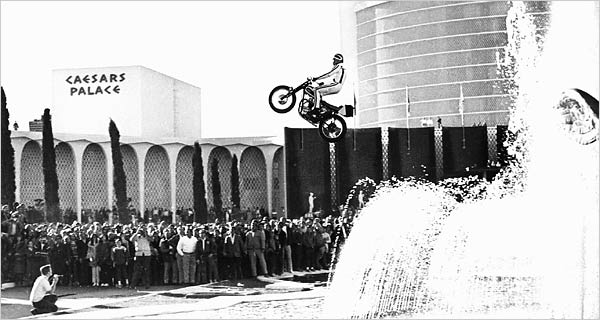
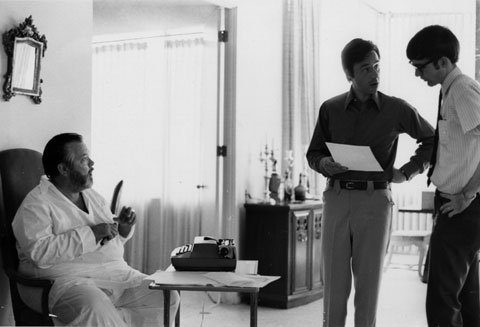
Instead of completing fascinating film projects, Orson Welles spent most of his final years shilling for money. Here he is in “Caesars Guide To Gaming with Orson Welles,” a 1978 casino paycheck that’s interesting in its own way.

Tags:

From the Maysles brothers’ 1963 film Orson Welles in Spain, a clip in which the great and star-crossed director presages the fraying of the traditional studio picture, with its formality. The work he’s discussing turned out to be his uncompleted 1970s movie The Other Side of the Wind.

Tags: , ,

Before New Wave was just another old wave, selling its own nostalgia, it was trying its best to give the past a slip. Once that mission was accomplished, there was really nowhere for its leaders to go. But sometimes a brief revolution that clears the deck, even if it doesn’t build a new deck, is better than nothing at all. Devo, guesting on Merv Griffin’s show in 1980.

Tags: ,

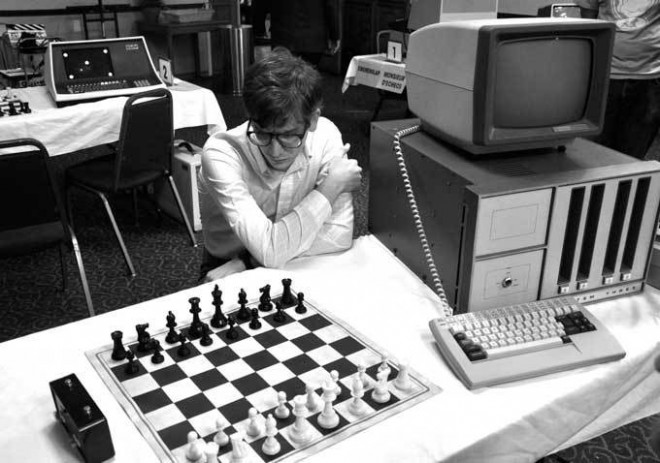
Here’s the trailer for Andrew Bujalski’s Computer Chess, which I blogged about last December. Looks amazing.

Bees have been experiencing Colony Collapse Disorder–and you’re not looking so hot yourself–but can pollination be outsourced to their silicone doppelgangers? From Inhabitat:

“Honey bee populations around the world are in decline due to causes ranging from ‘super mites‘ to Colony Collapse Disorder (CCD) and even cell phones – and if the insects disappear completely the planet’s ecosystems would be in peril. The issue has become so dire that now a team of Harvard and Northeastern University scientists are working on a swarm of miniature Robobee robots that could pollinate flowers and do the job of real bees if required.

Speaking to Scientific American, the team leaders said: “In 2009 the three of us began to seriously consider what it would take to create a robotic bee colony. We wondered if mechanical bees could replicate not just an individual’s behavior but the unique behavior that emerges out of interactions among thousands of bees. We have now created the first RoboBees—flying bee-size robots—and are working on methods to make thousands of them cooperate like a real hive.””

•••••••••••

“If you’re after getting the honey  / Then you don’t go killing all the bees”:

Wilhelm Reich, part-time cloudbuster and the likely inspiration for Woody Allen’s Orgasmatron, is the rich subject of a historical piece at Vice by Jason Louv. The opening:

“It was the greatest incidence of scientific persecution in American history.

In July of 1947, Dr. Wilhelm Reich—a brilliant but controversial psychoanalyst who had once been Freud’s most promising student, who had enraged the Nazis and the Stalinists as well as the psychoanalytic, medical, and scientific communities, who had survived two World Wars and fled to New York—was dying in a prison cell in Lewisberg, Pennsylvania, accused by the government of being a medical fraud engaged in a ‘sex racket.’

That ‘racket’ would one day be called the ‘sexual revolution.’ But it was still 1947 in America—an America not even ready for psychoanalysis, still a nascent science that Harper’s and the New Republic had categorized, right alongside Reich’s theories, as being no better than astrology. (Reich, Harper’s had decided, was the leader of a ‘new cult of sex and anarchy.’)

If the American public wasn’t ready for Dr. Freud, then how much less prepared would they be for Dr. Reich—a man who, at his Orgonon institute near Rangely, Maine, was researching the energetic force of the orgasm itself?

Reich had taken Freud’s theories far. Too far, according to the FDA. Starting with Freud’s connection of sexual repression to neurosis, Reich had theorized that it was the physical inability to surrender to orgasm that underlay neurosis, and eventually turned people to fascism and authoritarianism. Reich migrated from Freud’s simple talking cure to what he called character analysis, a therapy designed to help his patients overcome the physical and respiratory blocks that prevented them from experiencing pleasure. Finally—and most dangerously—he claimed that the orgasm was an expression of orgone, the joy-filled force of life itself. With phone-booth-size devices called ‘orgone accumulators’ he could harness this force to cure neurosis, disease, and even affect the weather and help crops grow.”

Tags: ,

We are going to get the blueprint for the Hyperloop. my greatest tech obsession, on August 12, according to Elon Musk’s Twitter account.

Elon Musk ‏@elonmusk6h

Will publish Hyperloop alpha design by Aug 12. Critical feedback for improvements would be much appreciated.

Tags:

Sky Deutschland has created “The Talking Window,” a technology which uses bone conduction to broadcast messages directly into weary train travelers’ heads when they lean them against the glass. These will be your new dreams.

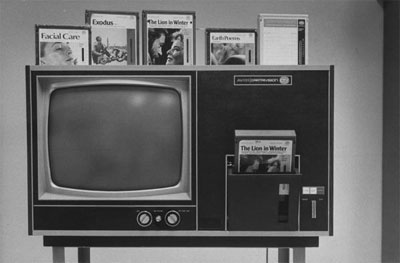
I know there were some early home-video recorders that failed to gain traction, but a 1970 Lillian Ross New Yorker piece (subscription required) profiles what appears to be the very first system, Cartrivision, which also offered the initial video-rental service, long before Netflix or even Blockbuster. An excerpt from her conversation with Cartrivison executive Samuel Gelfman, who realized way back then what a disruptive technology he was working with:

“What is Cartrivision?’ we asked.

“One of the greatest instruments of social change–the greatest, I would say, since the printing press,” Mr. Gelfman said. “Our set is a color-television set, but it’s also a cartridge-television. Whit this set, you can have your own cartridge library. You slip a cartridge in the slot, press the button, and watch up to two hours of your own choice of movie. A great football game. Anything you want. What’s more, we’ve built in an off-the-air recorder to pick up shows when you’re not at home. It doubles as a camera with a portable microphone. You can make your movies and have instant replay. We’ll sell you the set for between eight and nine hundred dollars. Our cartridges–blank ones–from nine-ninety-eight for a fifteen-minute tape to twenty-four ninety-eight for a two-hour tape. The movie cartridges we’ll rent. Three dollars for overnight. What’s important is for the first time we’re going to be able to provide what you want to see. You don’t have to worry about sponsors anymore.”•

 ______________________

Here’s a What’s My Line? episode in which the system is demonstrated by company spokesperson Art Rosenblatt in 1972, the year it came to the market and the one before it was pulled.

Tags: ,

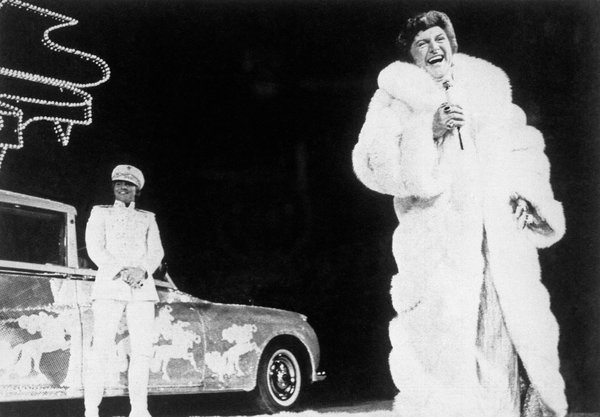
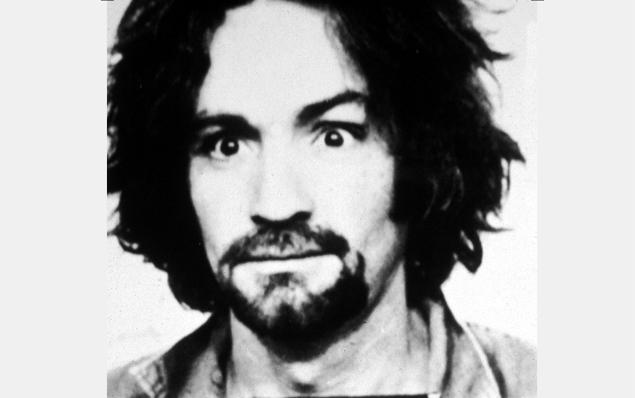
Did you have encounters (sexual and otherwise) with Liberace, Loretta Lynn, Ronald Reagan, Michael Jackson and Charles Manson? Of course not. But Scott Thorson, the source of Behind the Candelabra, says he has. He stopped by Howard Stern’s show recently to overshare about these people and so much more. Language absolutely NSFW, unless you work in an S&M dungeon.

Scott and I are just friends.

Scott and I are just friends.

Tags: , , , , , ,

Like the first President he served, former Secretary of State Henry Kissinger became quite a baseball junkie, especially in his post-Washington career. At the 15:40 mark of this episode of The Baseball of World of Joe Garagiola, we see Kissinger, who could only seem competent when standing alongside that block of wood Bowie Kuhn, being honored at Fenway Park before the second game of the sensational 1975 World Series. During the raucous run by the raffish New York Mets in the second half of 1980s, both Nixon and Kissinger became mainstays at Shea Stadium. Nixon was known to send congratulatory personal notes to the players, including Darryl Strawberry. It was criminals rooting for criminals.

Tags: , , , ,

From Sam Lipsyte’s Financial Times piece about our almost reflexive complicity with those entities that would spy on us–that are spying on us:

“A newspaper story on June 24 reported that Edward Snowden’s decision to flee Hong Kong, made over a dinner of pizza, fried chicken and Pepsi (how can you doubt his patriotism?), came after learning that, whatever the final outcome of his predicament, he might be spending a lot of time in a jail cell without a computer. This, apparently, was the deal-breaker. He could take life in a box but couldn’t imagine his life not plugged into one.

We can all probably relate, though I’ve been corresponding with a prisoner in America who has no access to computers but receives journals and magazines and books through the mail. He is doing a long stretch and is a voracious reader of contemporary fiction. I guess he’s got the time, but his handwritten letters are full of subtle insights about recent novels and short stories. It’s quite refreshing.

People on the outside involved with literary publishing talk mostly about advances, or the dearth of decent ones, or what qualities to look for in an agent. This guy wants to discuss a George Saunders short story. I certainly would not wish his situation on anyone, or, at least, not on most people. But it’s important to remember there are other technologies (such as Gutenberg’s) that can pull you through in a pinch.

Decades ago there was a clever Saturday Night Live short film called ‘Prose and Cons’ – ‘directed by Norman Mailer,’ the credits read – about a prison where every convict typed away at a novel as the warden boasted of the ‘sterling literary tradition’ of his institution. The film also featured an early appearance by Eddie Murphy’s street poet Tyrone Green (‘C-I-L-L my landlord’).

Somebody asked me recently if I ever fantasised about being in prison so I could be left alone to write. My one experience behind bars lasted only three days, and maybe it’s different in long-term facilities, but I can assure you the Manhattan Detention Centre, also known as The Tombs, is no writing colony. The noise alone would drive you crazy.”

*****

Tyrone Green + Terry “Big Sky” McDonell + Irving “Swifty” Lazar:

Tags: , ,

The Great Comedian once said this: “Gentleman, you can’t fight in here…this is the War Room,” the absurdity crystallizing everything within shouting distance. The modern equivalent might be this: “We know that you’re spying on us, because our spies told us.” 

In the wake of the NSA leaks by Edward Snowden, a man so outraged by surveillance that he relocated to Russia, few people in this country or any country have dealt with our new reality very honestly. Everyone is spying on everyone, from individuals to corporations to governments. It’s only going to grow more prevalent. And if everybody is guilty, nobody is guilty.

Within a week of French President François Hollande deriding the U.S. for spying, Le Monde printed an expose implicating France for similar behavior. From Steve Erlanger in the New York Times:

“PARIS — Days after President François Hollande sternly told the United States to stop spying on its allies, the newspaper Le Monde disclosed on Thursday that France has its own large program of data collection, which sweeps up nearly all the data transmissions, including telephone calls, e-mails and social media activity, that come in and out of France.

Le Monde reported that the General Directorate for External Security does the same kind of data collection as the American National Security Agency and the British GCHQ, but does so without clear legal authority.

The system is run with ‘complete discretion, at the margins of legality and outside all serious control,’ the newspaper said, describing it as ‘a-legal.’

Nonetheless, the French data is available to the various police and security agencies of France, the newspaper reported, and the data is stored for an indeterminate period. The main interest of the agency, the paper said, is to trace who is talking to whom, when and from where and for how long, rather than in listening in to random conversations. But the French also record data from large American networks like Google and Facebook, the newspaper said.”

Tags: , ,

« Older entries § Newer entries »