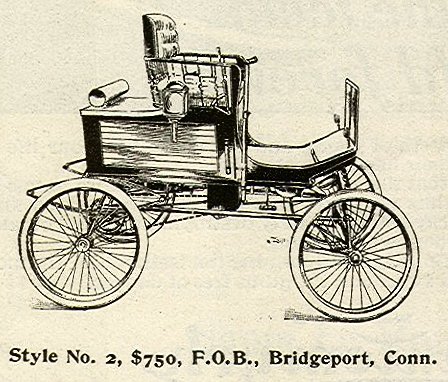
“The first horseless carriage to make its appearance in Riverhead arrived here yesterday by way of Quogue. It is the property of Richard Lawrence. Mr. and Mrs. Lawrence rode out from the city on the machine and say they had a delightful trip, covering the distance to Westhampton to excellent time, with no mishaps, the first day, and coming across the plains to their home the next morning. This latter section of the trip, covering twelve miles, was made in a trifle over an hour, which is excellent time considering the sandy road. The machine is a handsome road wagon, propelled by gasoline and is known as a locomobile. It attracted a large crowd at every place it stopped at in the village and several of the staid old farm horses went into fits at its approach.”
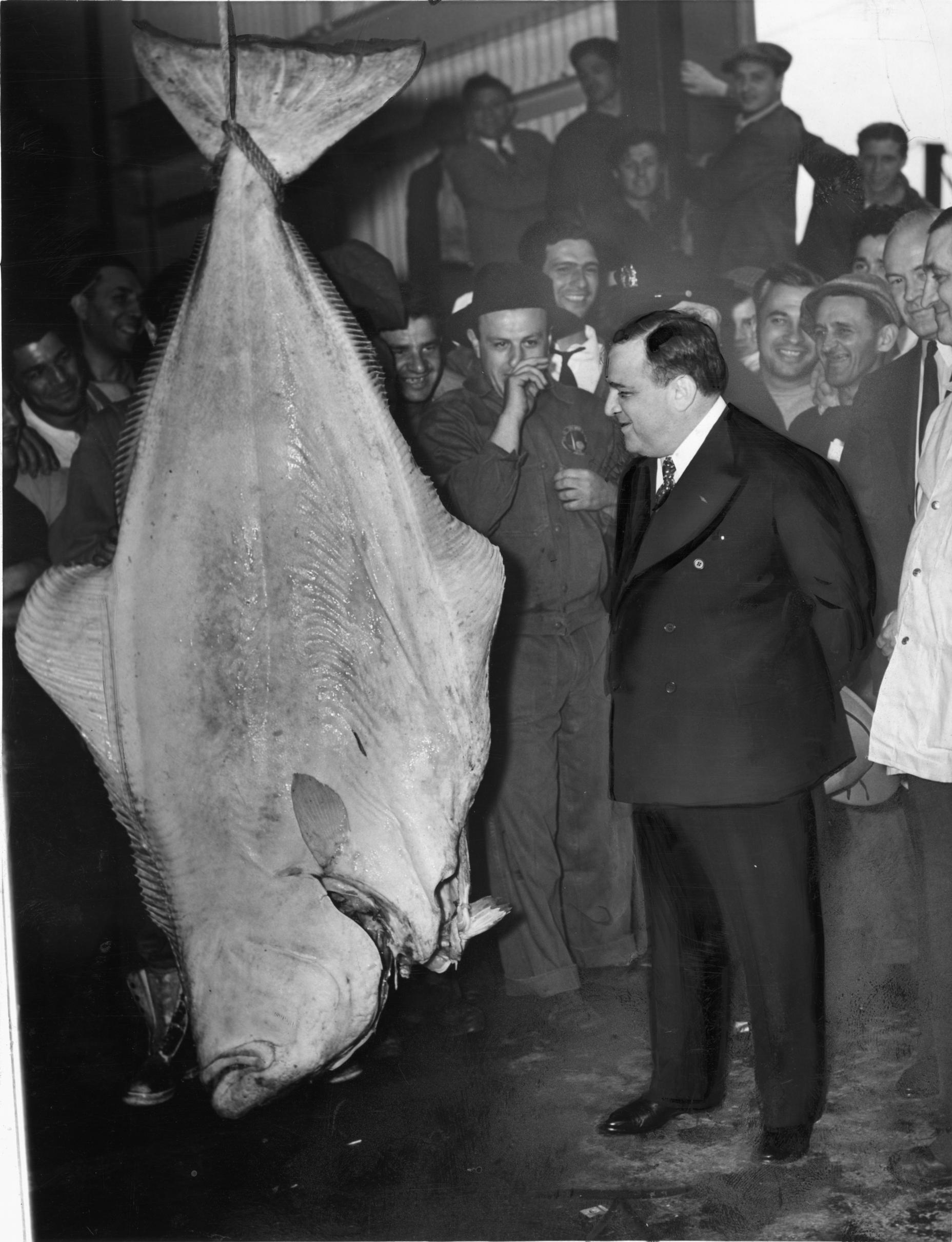
The "Little Flower," as the Mayor was known, with a big fish. (Image by C. M. Stieglitz.)
C.M Stieglitz of the long-defunct World Telegram took this classic 1939 photograph of New York’s Mayor Fiorello LaGuardia with a 300-pound halibut. LaGuardia, a commanding presence to say the least, was famous for everything from being one of Hitler’s earliest and most outspoken critics to reading comic strips to local children on the radio. He was also known to not be allergic to cameras. LaGuardia passed away from pancreatic cancer eight years after this photo was snapped. An exceprt from his New York Times obituary:
“A city of which he was as much a part as any of its public buildings awoke to find the little firebrand dead. Its people had laughed with him and at him, they had been entertained by his antics and they had been sobered by his warnings, and they found it difficult to believe that the voice he had raised in their behalf in the legislative halls of city and nation, on street corners and over the radio, was stilled forever.
Mayor O’Dwyer, his successor, expressed this feeling. Although Mr. La Guardia’s death was expected, the Mayor said, his passing brought with it ‘a shock of awful finality.’
‘In his death the people of the city, the State and nation have lost a great, patriotic American citizen,’ the Mayor said.”
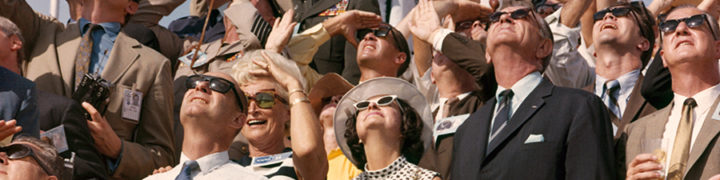
"Each year, between 7,000 and 8,000 college students and recent graduates work full-time, minimum-wage, menial internships at Disney World." (Image by NASA.)
From “Down and Out in the Magic Kingdom,” Ross Perlin’s fun inside look at the Disney World intern program, just published in Guernica:
“At Disney World, interns are everywhere. The bellboy carrying luggage up to your room, the monorail ‘pilot’ steering a train at forty miles per hour, the smiling young woman scanning tickets at the gate. They corral visitors into the line for Space Mountain, dust sugar over funnel cakes, sell mouse ears, sweep up candy wrappers. Mickey, Donald, Pluto and the gang may well be interns, boiling in their furry costumes in the Florida heat. Visiting the Magic Kingdom recently, I tried to count them, scanning for the names of colleges on the blue and white name tags that all ‘cast members’ wear. They came from public and private schools, community colleges and famous research universities, from across America. International interns, hailing from at least nineteen different countries, were also out in force. A sophomore from Shanghai greeted customers at the Emporium on Main Street, U.S.A. She was one of hundreds of Chinese interns, she told me, and she was looking forward to ‘earning her ears.’ Disney runs one of the world’s largest internship programs. Each year, between 7,000 and 8,000 college students and recent graduates work full-time, minimum-wage, menial internships at Disney World. Typical stints last four to five months, but the ‘advantage programs’ may last up to seven months.” (Thanks Longform.)
••••••••••
Mickey Mouse debuts in 1928:
The great Robert Smigel takes aim at the Mouse House:
This is 12.5 inches of beautiful, thick, and full bodied virgin hair. My hair is generally considered to be dirty blonde. Some may consider it brown with natural blonde highlights.
I grew my hair out for the purpose of selling it. This means that it is completely virgin. My hair has never been blow dried, straightened, died, or chemically treated in anyway. I have never used any hair products in my hair aside from the very occasional use of shampoo and conditioner. I am also not a smoker.
My hair is wavy/curly and i am willing to shave my entire head.
I get constant compliments from woman about how unique and wonderful my hair is. Often times they will tell me that my hair is both the color and texture they have tried so hard coax out of their own hair using different treatments with no success.
I feel that my asking price is more than fair however I will take other offers into consideration.
Open Culture dug up this cool, brief clip of Vladimir Nabokov perusing covers of various editions of Lolita. Has there ever been a better written novel than Lolita? Maybe Madame Bovary? I don’t know.
Several decades ago, Manhattan had a cachet the other boroughs didn’t enjoy, and bridge-and-tunnelers, as they were called, had one strike against them based on their home address. But during the 1970s, when class was a real and palpable thing in NYC, the outsiders from the outer boroughs began storming the city on Saturday nights and made it their own with the help of leisure suits and strobe lights. Nik Cohn captured the class consciousness of the city’s disco revolution in “Tribal Rites of a New Saturday Night,” an article in the June 7, 1976 issue of New York magazine, although he later acknowledged falsifying facts. At any rate, it became the basis of Saturday Night Fever, and that sensation made disco explode all over again. The opening of Cohn’s article:
“Within the closed circuits of rock & roll fashion, it is assumed that New York means Manhattan. The center is everything, all the rest irrelevant. If the other boroughs exist at all, it is merely as a camp joke—Bronx-Brooklyn-Queens, monstrous urban limbo, filled with everyone who is no one.
In reality, however, almost the reverse is true. While Manhattan remains firmly rooted in the sixties, still caught up in faction and fad and the dreary games of decadence, a whole new generation has been growing up around it, virtually unrecognized. Kids of sixteen to twenty, full of energy, urgency, hunger. All the things, in fact, that the Manhattan circuit, in its smugness, has lost.
They are not so chic, these kids. They don’t haunt press receptions or opening nights; they don’t pose as street punks in the style of Bruce Springsteen, or prate of rock & Rimbaud. Indeed, the cults of recent years seem to have passed them by entirely. They know nothing of flower power or meditation, pansexuality, or mind expansion. No waterbeds or Moroccan cushions, no hand-thrown pottery, for them. No hep jargon either, and no Pepsi revolutions. In many cases, they genuinely can’t remember who Bob Dylan was, let alone Ken Kesey or Timothy Leary. Haight Ashbury, Woodstock, Altamont—all of them draw a blank. Instead, this generation’s real roots lie further back, in the fifties, the golden age of Saturday nights.
The cause of this reversion is not hard to spot. The sixties, unlike previous decades, seemed full of teenage money. No recession, no sense of danger. The young could run free, indulge themselves in whatever treats they wished. But now there is shortage once more, just as there was in the fifties. Attrition, continual pressure. So the new generation takes few risks. It goes through high school, obedient; graduates, looks for a job, saves and plans. Endures. And once a week, on Saturday night, its one great moment of release, it explodes.” (Thanks to The Electric Typewriter.)
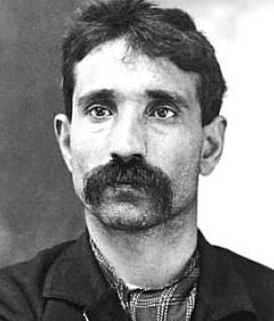
"An undersized Italian and a fairly prosperous junkman a few days ago went to New York to deposit $217 of his earnings in a Broadway bank."
Swindles in New York didn’t start with Bernie Madoff, as the following story from the bunco files of the July 21, 1890 Brooklyn Daily Eagle proves. An excerpt:
“Caromo De Vitto, of 43 Williams street, an undersized Italian and a fairly prosperous junkman, a few days ago went to New York to deposit $217 of his earnings in a Broadway bank. He fell into the hands of a bunco man and now mourns the loss of his money. It was in front of old St. Paul’s Church that the junkman was accosted by a suave Italian. This Italian said he was a German, that his name was Romaldo Marano and that he had been in the mines in Virginia. He was generous and confiding. The Brooklynite was asked to join him in a drink and the invitation was accepted. On the way down to a barroom on West street, the two men unbosomed themselves to each other, particularly as to their financial standing, De Vitto truthfully. The man who had been in the mines in Virginia said he had a lot of currency which he had brought up from Virginia. He did not know how to dispose of the stuff.
‘It’s all in this handkerchief,’ said Marano, as he pulled a soiled package from an inner pocket. De Vitto agreed to assist him in having the currency exchanged for more desirable money, but just then a pressing engagement at the Italian consul’s office would prevent him. They agreed to meet again, and an hour later, as De Vitto came out of the Chesebrough building, State street, the stranger with the soiled package was the first to greet him. The package was placed in De Vitto’s hands, and as a guarantee he tendered Marano the $217 he had intended to deposit.
"The package contained a small sack of Carolina tobacco."
‘I have not the slightest doubt as to your honesty and integrity,’ said the bunco man, as he sat down on the stoop of the Chesebrough building, while the junkman scurried off to an exchange office with the currency package in his hand.
A few minutes later De Vitto broke open the package in an exchange office in West street. The package contained a small sack of Carolina tobacco. The shock was great and De Vitto fainted. When he recovered he hurried over to the Cheseborough building, but the Virginian miner from Germany had disappeared.
The police of the Church street station were apprised of the swindling transaction and last night Detective Flynn arrested the bunco man. At the Tombs police court this morning Marano was held in $1,000 to answer at the court of general sessions.”
“Today Werner Herzog has chosen to be interviewed indoors. Perhaps it’s for the best. One of the more puzzling and improbable moments in the legendary 68-year-old German director’s career, and there have been many, came when he was doing a filmed interview for a BBC program called The Culture Show in 2006. He was standing a few miles from here on some barren scrubland in the Hollywood Hills, chosen so that the city of Los Angeles would be the backdrop falling away behind him, and he was explaining how nobody seems to care about his films in Germany when an unexpected noise interrupted him. Herzog flinched. Understandably so, because he had just been shot.
It has never been established who was doing the shooting—if it was more than just someone with an air rifle taking a random pop at a stranger for fun, it may have been because Herzog and the film crew were trespassing. Afterward, Herzog refused to call the police, fearing a SWAT-type overreaction, and he also declined, for the same reason, to seek medical help. Still, the pellet made its mark—under his mauve and pink windmill-motif boxer shorts, now blood-blotted, was a seeping entry wound near Herzog’s groin.
This shooting is an event he still chooses to play down—’It was kind of insignificant’—although I get the sense he also quite likes the opportunity to play it down. ‘It was just very silly,’ he insists. ‘I have been shot at, without being hit, much more seriously. What I experienced here was completely harmless.’ Barely worth noting. Though when I persist in challenging him to name one other person who has ever been shot in this way while doing a TV interview in America, he naturally has no answer. ‘The funny thing is, people sometimes believe I make things up, and nobody would believe it if it hadn’t been caught on tape. Nobody would have believed it.’
He is right. It seemed so unlikely, so preposterous, and yet somehow so perfectly Herzog. So much so, I tell him, that I think some people still suspect it was a great stunt he’d somehow arranged.
‘You may speculate as much as you want,’ says Herzog, a man whose own work frequently involves fascinating juxtapositions of fact and fantasy, and who is long accustomed to drawing such suspicions.”
I am a middle aged man who is overwhelmed by all of this technology. I am looking for someone to come to my home and assemble and connect my printer/fax/scanner to my new PC. As well, while you’re here, please help me download music to my IPOD. These are all Christmas presents, but I’ve been too daunted to tackle them and I really don’t have the head for it. I am offering $150 CASH on the barrel head, so if you want to make some fast cash, hit me up. Thanks.
Italian journalist Fernanda Pivanoconducted this interview with the Beat writer. He died three years after the segment was recorded. Cause of death was cirrhosis, unsurprisingly. Pivano passed away at age 92 in 2009.
Old Media gradually surrendered its omnipotence for a series of short-term financial gains, as technologies introduced from the 1960s forward slowly destroyed the accepted business model, and put people in control of the information. New Media isn’t accepting any such cheap payoff. We’ll get more for free, but, paradoxically, the price will be higher. Much to the good, the power to actively disseminate and question information is in the hands of the people as there is little or no barrier to publication. But there are costs. Social networks, search engines and smart phones want to analyze us, track us, crunch us and commodify us. Some people object to the intrusion greatly,even violently, and they will unfortunately be heard from. But the surprising thing is, most people in this age appear to actually want to be watched–or noticed, at least. Our ballooning authority seems to have inflated our egos, and those egos demand attention. Or maybe knowing more about the world is so scary that everyone wishes they had a brother, even if it’s Big Brother.
••••••••••
Home video recorders diminish the importance of appointment television:
Information and entertainment need to be portable:
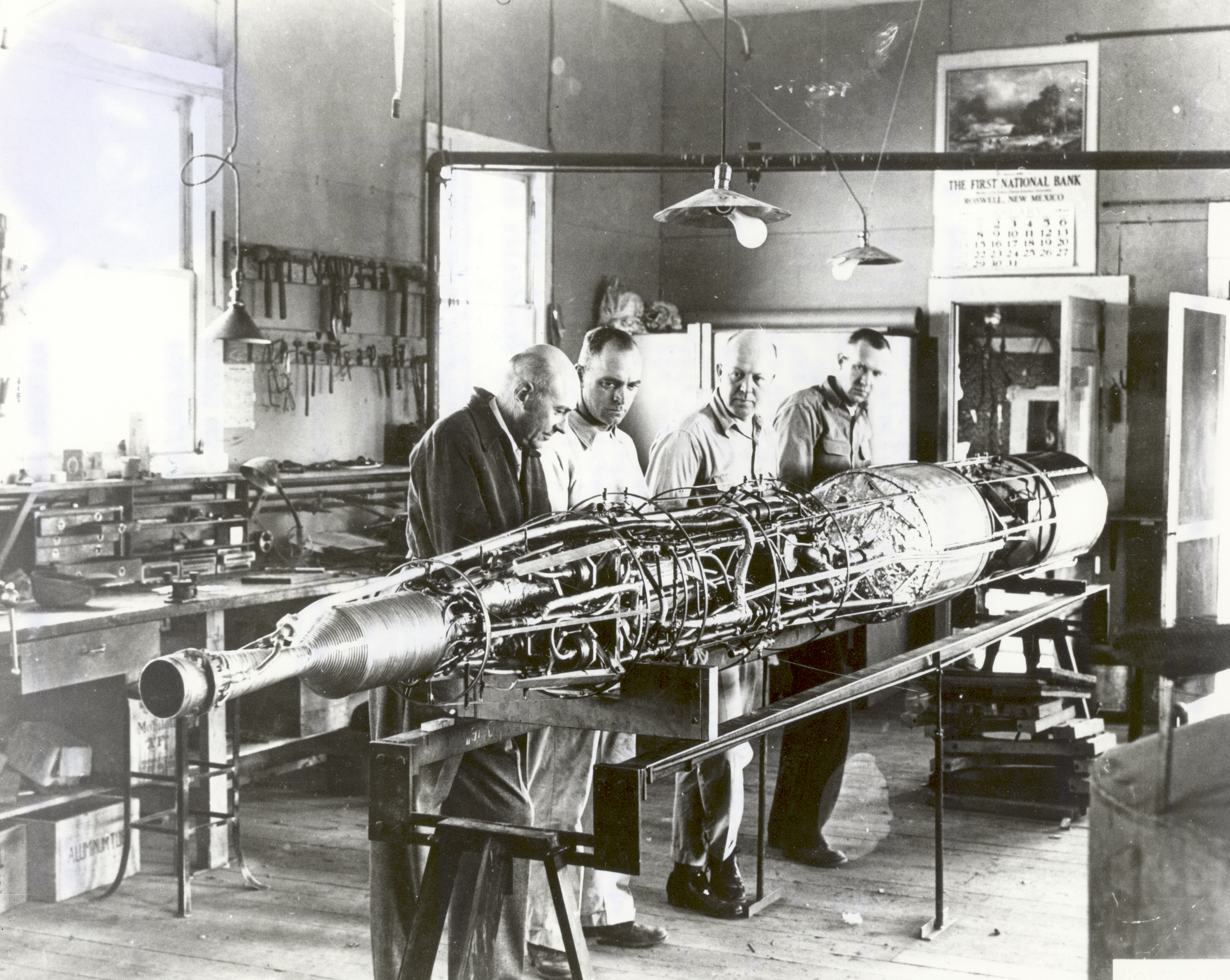
Goddard, far left, was a rocket man. (Image by National Geographic Society.)
Known as the “Father of American Rocketry,” Dr. Robert H. Goddard believed even before the 1920s that we could reach the stars, though some scoffed at him. In this classic 1940 photograph, Goddard and his team labor over a rocket with turbopumps in his workshop in Roswell, New Mexico. An excerpt from a Time article about the naysayers who took aim at Goddard’s far-flung ambitions:
“Robert Goddard was not a happy man when he read his copy of the New York Times on Jan. 13, 1920. For some time, he had feared he might be in for a pasting in the press, but when he picked up the paper that day, he was stunned.
Not long before, Goddard, a physics professor at Clark University in Worcester, Mass., had published an arid little paper on an outrageous topic, rocket travel. Unlike most of his colleagues, Goddard believed rocketry was a viable technology, and his paper, primly titled ‘A Method of Reaching Extreme Altitudes,’ was designed to prove it. For the lay reader, there wasn’t much in the writing to excite interest, but at the end, the buttoned-up professor unbuttoned a bit. If you used his technology to build a rocket big enough, he argued, and if you primed it with fuel that was powerful enough, you just might be able to reach the moon with it.
Goddard meant his moon musings to be innocent enough, but when the Times saw them, it pounced. As anyone knew, the paper explained with an editorial eye roll, space travel was impossible, since without atmosphere to push against, a rocket could not move so much as an inch. Professor Goddard, it was clear, lacked ‘the knowledge ladled out daily in high schools.'”
"We can meet at a eatery in Manhattan." (Image by Alisdair McDiarmid.)
free lunch
Would you like free lunch?
I would like to treat you. We can meet at a eatery in Manhattan.
I would like to talk to you about questions every person asks in life.
Questions such as:
Why am I going through so much difficulty in life? Why do I have so many problems and troubles? Why am I feeling this emptyness inside? Why am I feeling so lonely and depressed? Is there true love out there?
If you are asking these questions, I would like to help you.
Open Culture posted a bunch of Andy Warhol screen tests, including the Dennis Hopper one from 1965, which reminded me of “The Easy Rider Runs Wild in the Andes,” a great 1970 Life magazine article about Hopper that I came across on Google Books. At the time of the Life piece, Hopper had carte blanche to do whatever he wanted as a filmmaker thanks to the Easy Rider phenomenon. Such freedom poses dangers for a free spirit. Hopper went to Peru with a cast that included Samuel Fuller and Toni Basil, and embarked on a quixotic, confused project, eventually entitled The Last Movie, which pissed away all of his new capital. His career never completely recovered until his insane turn in David Lynch’s Blue Velvet.
From Brad Darrach’s Life article: “Peru has painfully learned to live with earthquakes, avalanches, tidal waves, jaguars and poisonous snakes. But Dennis Hopper was something else. When the director of Easy Rider arrived in Lima several months ago, a reporter from La Prensa asked his opinion of marijuana (illegal in Peru) and ‘homosexualism.’ Taking a long reflective pull on an odd-looking cigarette. Dennis said he thought everybody should ‘do his thing,’ and then allowed that he himself had lived with a lesbian and found it ‘groovy.’ No remotely comparable statement had ever appeared in a Peruvian newspaper. The clergy screamed, the ruling junta’s colonels howled. Within 24 hours the government denounced the article and issued a decree repealing freedom of the press.
Dennis Hopper was undisturbed. Furor trails him like a pet anaconda. At 34, he is known in Hollywood as a sullen renegade who talks revolution, settles arguments with karate, goes to bed with groups and has taken trips on everything you can swallow or shoot.
On the other hand, in the salons and galleries of Los Angeles and New York he is recognized as a talented poet, painter, sculptor, photographer and as a leading collector of pop-art. He is also, after eight years on the movie industry’s blacklist, the hottest director in Hollywood. Easy Rider, which cost only $370,000, is rapidly approaching a projected $50 million gross. In the process it has polarized a new film audience of under-30s, generated a new school of talented young directors such as Jack Nicholson, Peter Bogdanovich, Richard Rush and Melvin Van Peebles, and established the style of a New Hollywood in which producers wear love beads instead of diamond stickpins and blow grass when they used to chew Coronoas.”
"Mrs. R.W. Huston was the victim of a gasoline explosion yesterday and was literally roasted to death."
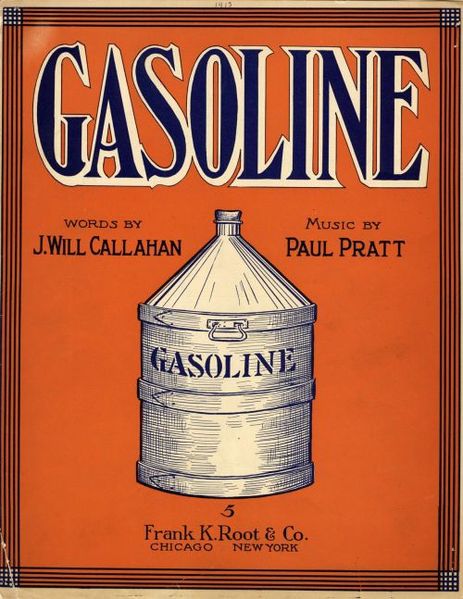
In the late nineteenth century, seemingly no one in the country knew how to behave while in close proximity to gasoline, as this quintet of stories printed in the Brooklyn Daily Eagle demonstrate.
••••••••••
“The Stove Polish Was Fatal” (November 13, 1901): “Rome, New York--Mrs. Anna Ferguson was fatally burned at the California House, four miles west of this city to-night. She mixed gasoline with stove polish and then started to polish a hot stove. In an instant she was enveloped in flames.”
••••••••••
“Careless Use Of Gasoline” (September 20, 1890) “Bloomington, Illinois–Conductor Lowrie and Brakemen Brockmiller, of the Chicago and Alton, at Venice yesterday were endeavoring to rid their caboose of vermin by using gasoline. The gasoline caught fire from a cigar in the mouth of one of the men, an explosion followed and Lowrie was fatally burned and Brockmiller very badly injured, being burned about the head and the hands.”
••••••••••
“Fatal Explosion Of Gasoline” (June 4, 1892): “Eldon, Iowa–Mrs. R.W. Huston was the victim of a gasoline explosion yesterday and was literally roasted to death. A servant was carrying an open vessel of gasoline when it became ignited from a stove. Mrs. Huston, the servant and two children were frightfully burned. The former lived three hours, suffering untold agonies. The other victims are still alive, but in a most pitiable condition.”
••••••••••
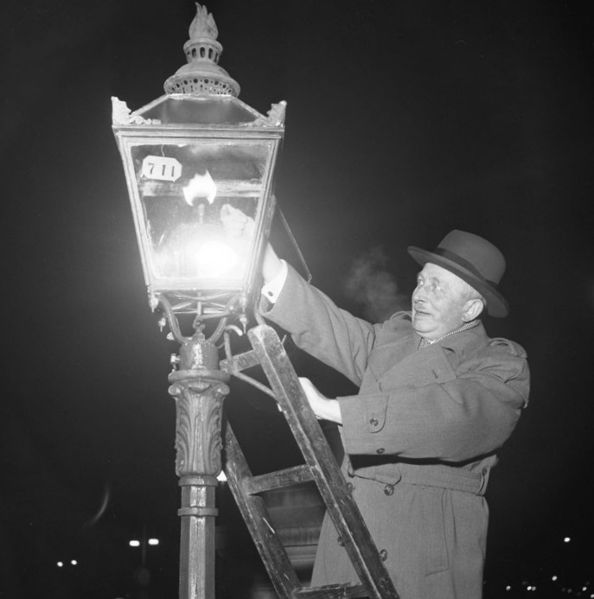
"The town is lighted at night with gasoline."
“Peculiar Explosion Of Gasoline” (October 4, 1890) “Cheviot, Ohio–“A peculiar accident occurred here last night. The town is lighted at night with gasoline. Edward Connor, one of the lighters, had just started on his trip on a light cart drawn by one horse. At the first lamp one of the cans became lighted. The whole lot exploded. Horse and man caught the burning fluid. The man, badly burned, was thrown from the wagon, while the horse on fire ran through the streets screaming in its awful agony until it dropped dead.”
••••••••••
“Fell Into A Vat Of Gasoline” (August 15, 1889): “William McBride, aged 22 years, of 146 Kent avenue, fell into a vat of gasoline yesterday afternoon while at the dye works of Greene street, Seventeenth Ward. The body was removed to his home by permission of Coroner Lindsay, who will hold an inquest.”
George Carlin, our best stand-up ever, cutting through this era’s idiotic jargon. I wish he was still with us, dissecting the world as it simultaneously gets smarter and dumber, closer together and further apart.
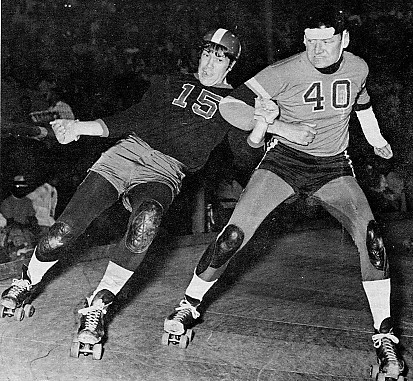
From a fun 1974 People article about the wedded life of roller derby royalty, “Dynamite” Mike Gammon and Judi McGuire, who married in their mid-teens and separated a few years after this piece was published:
Mike Gammon and his wife Judi McGuire are leading practitioners of one of the world’s most demeaning professions. They are stars of the New York Chiefs of the roller derby which is closer to third-rung Minsky or carny than organized sport. Their six-game-a-week 51-week season is an escape-less loop of one-night stands, in smoggy arenas, with nothing in between but smelly buses, crummy motels and junk food. The circuit is a demanding test of their family’s ability to stay intact. They get to see their 12-year-old daughter Sharilee only about once every six weeks. And the Gammons put up with all these indignities to perform before lunatic crowds, bellowing the foulest of four-letter abuse, pelting them with old sneakers and plastic cups full of beer, and generally carrying on in a manner that makes ice-hockey rinks seem, by comparison, like Wimbledon.
For nearly 16 years now, Mike, 31, Judi, 33, and their marriage have toughed out their little hell on roller skates with seemingly minimal damage. They look clean-cut enough to play a TV situation comedy. Physically they are not noticeably marked, because those skirmishes that bring out the animal in the audience are often artfully faked. (“The winning and losing team is predetermined before the match, but there can be a lot of jammings and other free-lance rough stuff along the way,” says one player.) Why do the Gammons put up with it all? “If you want a paycheck, you skate,” Mike explains. “We don’t like it much, but when you’re hungry, you’re hungry.” And because he dropped out of school after the eighth grade—it is one of the few ways to pull in $45,000. That is between them, though, and includes supplements for extra work: Mike is one of the roustabouts who install the track pre-game, and Judi stitches up the clawed and tattered uniforms during the endless bus trips.
Judi sometimes regrets that having started in the derby in their teens, “we had almost no time to grow up.” But she concludes stoically, “It’s been a good life, because we’ve been together nearly 24 hours a day, and that’s made us stronger.”•
__________________________________
“This is roller derby…they call it America’s fastest growing sport…that it is…15 million people watch it every week on television.”
From “David Hockney’s iPhone Passion,” a 2009 New York Review of Books article about an older artist becoming obsessed with new technology, by the brilliant non-fiction writer Lawrence Weschler:
“Hockney first became interested in iPhones about a year ago (he grabbed the one I happened to be using right out of my hands). He acquired one of his own and began using it as a high-powered reference tool, searching out paintings on the Web and cropping appropriate details as part of the occasional polemics or appreciations with which he is wont to shower his friends.
But soon he discovered one of those newfangled iPhone applications, entitled Brushes, which allows the user digitally to smear, or draw, or fingerpaint (it’s not yet entirely clear what the proper verb should be for this novel activity), to create highly sophisticated full-color images directly on the device’s screen, and then to archive or send them out by e-mail. Essentially, the Brushes application gives the user a full color-wheel spectrum, from which he can choose a specific color. He can then modify that color’s hue along a range of darker to lighter, and go on to fill in the entire backdrop of the screen in that color, or else fashion subsequent brushstrokes, variously narrower or thicker, and more or less transparent, according to need, by dragging his finger across the screen, progressively layering the emerging image with as many such daubings as he desires.
Over the past six months, Hockney has fashioned literally hundreds, probably over a thousand, such images, often sending out four or five a day to a group of about a dozen friends, and not really caring what happens to them after that. (He assumes the friends pass them along through the digital ether.) These are, mind you, not second-generation digital copies of images that exist in some other medium: their digital expression constitutes the sole (albeit multiple) original of the image.”
"This is a ligament methodology." (Image by Lawrencedwolf.)
Past – Life Regression – $150 (New York)
“We Live in the light of reflected action, the things that happen to us in the past are still happening to us everyday.”
What is a Past Life Regression?
It’s a technique used to take a person back through time using hypnosis, far back in time that the memories of previous lifetimes are rediscovered and explored. Past life regression is an exciting journey into your own past lives, unlocking memories in your mind. Other lives that was yours in another time. This relaxing, gentle method will allow you to tap into your subconscious mind and journey to previous lives you lived. With modern technology many historic and interesting facts from a regression can be confirmed, dates, names and places traced.
PLR – (past-life regression) – is based on the theory of reincarnation. It is a belief that a soul survives death to be re-born again into a new body with renewed opportunity to learn life’s lessons. You can come back as a man or women, peasant, king or many even someone well known, although regression as a famous person is rare.
“Karma” – a term often used in PLR work and describes the Law of Cause and Effect. The purpose of karma is not a system of punishment, but instead a learning opportunity to gain wisdom of nature’s law. “Free – Will” – the ability to choose own path of existence. “De-Ja vu” – the feeling that you have had an experience or visited a location before. Does a past life influence your present, every day lives?
Who you are now possibly influenced by who you were before, your very character. Sometimes we bring the effects of a traumatic experience into our present life from a previous one, resulting in irrational fears, phobias or behaviours. Under regression these issues can be dealt with giving you a greater understanding so that they can no longer affect your present life. A “root cause” or “core issue” is often found in a past-life memory. These issues can be brought to this lifetime using strong age regression and past-life regression methods. You can regress to the beginning of the event, pain or emotional attachment and then regress farther back to a past-life cause.
What does it feel like to be regressed?
You are gently led backwards to a time when you were a child, using methodical techniques similar to that of meditation. You won’t fall asleep and always remain in control and fully aware of what is happening to you. It is a perfectly safe and natural state of trance similar to daydreaming. You will be able to experience your past lives in your minds eye as if you were actually there.
What are the benefits of Past Life?
Many people come for a session just out of curiosity, to find who they were, who they were with, a love one and what their life was like. It’s quite usual for people to have normal day to day lives in the past, but those past lives usually have some meaning in their current life. Past Life Regression can help people move on in this life by understanding what happened in their past lives. For instance, someone who has problems with a certain relationship in this life may have had the same issues with the same person in a past life, likewise the cell memory of an illness from a previous life can be brought into a present life. The nature of the regression is for the client to reveal for themselves why they have certain problems or issues in this life. This understanding empowers them to make choices or changes in their present life.
A session usually last from 1 hour to 2 tops. Its recommended that you’ve done hypnosis before – if not, then our first session out of 2 would be to condition you for a past-life regression. It’s a terrific therapeutic tool as well as sheer entertainment purposes. Meaning, some people just curious to view a previous life.
This is not intended for parlor entertainment. This is a ligament methodology.