My room mate says there is a car that can go over 400 mph and faster. That is crazy because the New York State speed limit is at most 60mph. My roomy says this super car can within most trauma from collisons. Is such a car real? If so. I want one. The girlks I could get with this….
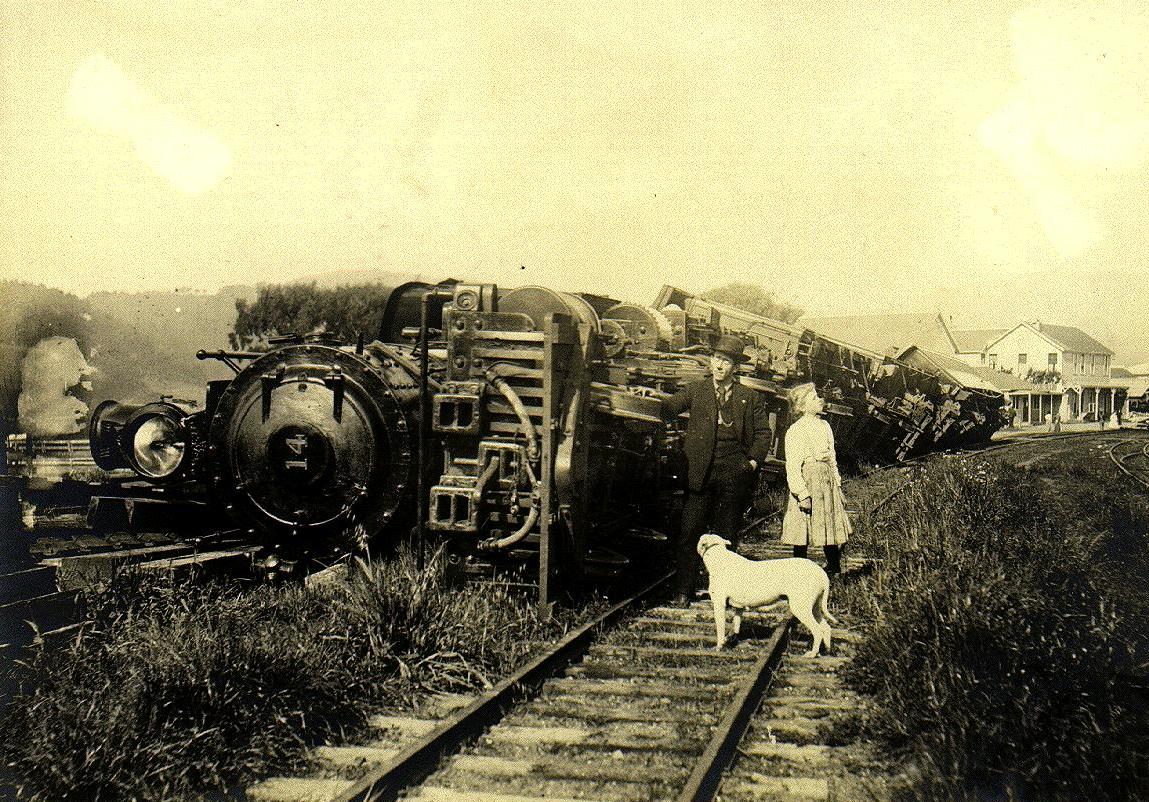
This amazing classic photograph, taken in 1906 by G.K. Gilbert, shows the Point Reyes Station in Marin County, in the wake of the San Francisco earthquake. (Click on the photo to see a much larger version.) Because of the girl in the skirt staring into the heavens and the presence of the dog, it gives off a Wizard of Oz vibe. An excerpt from a 2008San Francisco Chronicle articleabout the death of Irma Mae Weule, likely the final survivor of the 1906 quake:
“Mrs. Weule had vivid memories of growing up in the horse-and-buggy era and clearly recalled the 1906 earthquake, which she experienced as a child. She was one of 11 earthquake survivors who attended a centennial commemoration in 2006 and was interviewed on national television.
She was living at the time of the earthquake with her parents in a portion of the Bayview district called Butchertown, an area so far out that the family kept a cow in the backyard.
Her father, Louis Nonnenmann, ran a wholesale meatpacking business. The family home was large enough to have a social hall in the basement, and Mrs. Weule remembered that her father took in whole families of earthquake refugees.”
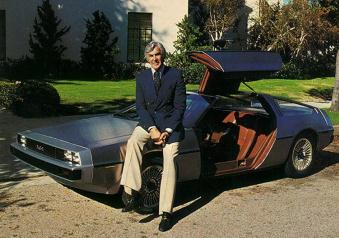
"John Zachary DeLorean certainly doesn't smile much. He can't. Not just yet, anyway."
In 1979, John Z. DeLorean was poised for greatness or disaster, having left behind the big automakers to create his own car from scratch, a gigantic gambit that required huge talent and hubris. Esquire writer William Flanagan profiled DeLorean that year, capturing the gambler in mid-deal, still bluffing, soon to be folding. The opening:
“For a man who looks like Tyrone Power, is married to the stunning young model in the Virginia Slims and Clairol ads, and earns six figures a year, John Zachary DeLorean certainly doesn’t smile much. He can’t. Not just yet, anyway. The reason is simple: The most important project in his life has yet to be accomplished. DeLorean wants to make a monkey out of General Motors. He is on the verge of doing it, but he has a way to go.
There will be no rest for DeLorean until he finishes doing what no one else in the history of modern business has dared attempt–to design, build, and sell his very own automobile from scratch, an automobile the world’s largest car company wouldn’t, couldn’t, and probably shouldn’t build.
By mid-1980, either DeLorean will be smiling at last or he’ll be a shattered man. At stake are thousands of jobs for unemployed Catholics in Belfast; the wisdom and reputation of the British government, which, amid howls of protest, has bet about $106 million on the flamboyant engineer; and about another $40 million posted by several hundred U.S. car dealers and other investors, ranging from Merrill Lynch stockbrokers to Johnny Carson.
But most important, John DeLorean’s pride is at stake. If his DMC-12 sports cars roll off the assembly line–and if they sell–he will have been avenged. He will have shown the bastards that they were wrong, goddammit, that General Motors was wrong about him and what you can do with an auto company. He will have shown that you can make a virtually rustproof car with a stainless steel skin and underbody, with air bags, with a reinforced plastic frame–a car that won’t kill you in a sixty-mile-an-hour, head-on crash, a car that can last twenty-five years or more. And he will have shown that you can sell that car, even at about $14,000 a copy. And if the platoons of pinstriped, cordovan-shod executives of GM doubt it, they can go and stick their noses up its tail pipe.”
••••••••••
John DeLorean speaks at the DeLorean Car Show in Cleveland in 2000:
old men & young women (A PUBLIC SERVICE ANNOUNCEMENT)
Men:
I think you’re delusional.
Men well in their 50s who want to date 35 year old women. Crazy
I get that they want some young fleshpot, but for a LTR? Totally weird. What do they think will happen when young miss thing hits her midlife crisis and wants to dump your wrinkled ass? Where are you then? Half your assets gone and NO DATE.
You’ll have to have a nice tub of butter to hang onto miss cutiepie then.
Don’t overlook women of a certain age…. I hated sex with my husband, but now I’ve it going on, now that I’m not listening to the constant wining.
Professor Leonard Kleinrock, in 1969. (Image by UCLA.)
The first host-to-host message sent over the nascent Internet occurred in 1969 at UCLA, which has belatedly created a shrine to the place where it all started. An excerpt from a story on the topic by Southern California Public Radio:
“In a small computer lab in a forgotten building at UCLA, Professor Leonard Kleinrock and a group of graduate students sent the very first message over what would become the Internet, back in 1969. Since that milestone, the room was in continuous use as a classroom, and its significance to history was all but forgotten. But now the room has been transformed into a re-creation of the ARPA lab, complete with the original equipment from the ’60s and period furnishings to match.
The Interface Message Processor, or IMP as engineers fondly call it, stands in the same spot in 3420 Boelter Hall today as it did in 1969. It functioned much like a modem, sending messages from the host computer, an SDS Sigma 7, through the network to an IMP in a remote location, which relayed it to another host computer.
During the ’60s, UCLA was chosen as the first node of what was known as ARPANET, a precursor to the Internet funded by the Defense Department’s Advanced Research Project Agency (DARPA). UCLA set up the very first network connection between their IMP and the IMP at Stanford Research Institute in northern California.
On October 29, 1969, Kleinrock and his team undertook a simple task to test the network – sending a login request from their host computer to the host computer at SRI.”
••••••••••
Leonard Kleinrock recalls the birth of the Internet:
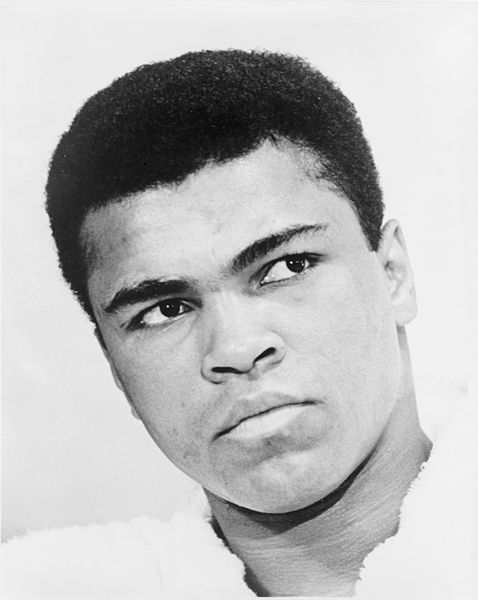
From a 1969 Life piece about the interlocutor Oriana Fallaci, who recalls introducing a young Muhammad Ali to her aggressive interviewing style:
“Question:
Has anyone actually threatened to break your nose off for something you wrote?
Oriana Fallaci:
Something like it happened with Cassius Clay. I had seen him a couple of times, and I went back to his house in Miami to finish the interview. He was eating a melon. I said, Good Morning, Mr. Clay. He keeps on eating the melon and suddenly belches very loud. I think he is just being impolite and I sit down with my tape recorder. And then oooaaagh. He belches again. A big one. Well, I said, let’s go on anyway. And just at that moment, buurp, buurp, whoops, whoops. I turned to him and shouted, I am not going to stay with an animal like you. And I was undoing my recorder, when he took the microphone and threw it against the wall. My microphone! I saw it flying past my head and I took my fists and bam, bam. Went against him. He stood there. So enormous. So tall. And he watched me in a way an elephant watches a mosquito. Black Muslims suddenly came out of all the doors into the room. Evil. Evil. They began to chant. You came for evil. It was like a nightmare. I backed out to my cab, trying to keep my dignity, but really afraid, and went straight to the airport. After the interview was published, Cassius Clay said he was going to break my nose if he ever saw me again. I said, we’ll see, if he breaks my nose, he is going to jail and we will have beautiful news in the papers. I saw him later in New York. I passed with my nose in the air, and he went by without looking at me.”
"The gallant ventriloquist thereupon assaulted the remonstrating husband."
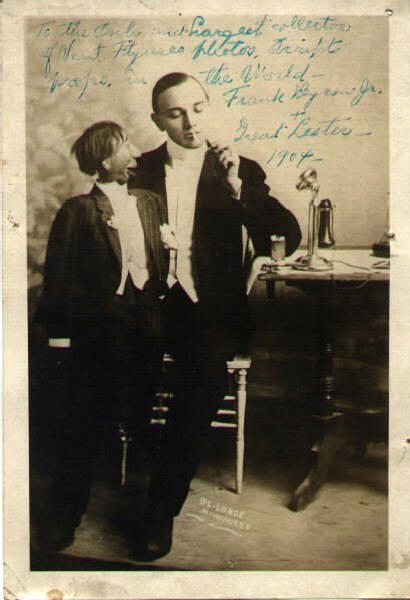
There was perhaps no bigger reprobate in 1880s New York than the ventriloquist, as the following reports published in the Brooklyn Daily Eagle demonstrate.
••••••••••
“A Gallant Ventriloquist” (July 20, 1886): “Charles Young, a ventriloquist, who earns a living by exhibiting his acquirement at the West End, Coney Island, was arraigned before Justice Newtown there yesterday afternoon, on complaint of John Dunn, a cottager on the Island, who accused him of assault. Dunn told the Justice that Young had been out walking with his wife and when they returned home Dunn told Young that he should not be so free with another man’s wife. The gallant ventriloquist thereupon assaulted the remonstrating husband, who had him arrested. Young denied the charge and said he had a thousand young ladies to go out with, without taking another man’s wife. He was placed in $200 bonds to answer.”
••••••••••
"A large crowd of people were attracted to the cemetery and they all concluded it was a ghost." (Image by Sukanto Debnath.)
“It Was Not a Ghost” (September 23, 1887): “Frederick Schmidt, of Middle Village, is an accomplished ventriloquist. On Tuesday night, about midnight, he secreted himself in the Lutheran Cemetery, on the outskirts of the village, and began to shriek ‘Murder! Murder! Oh, spare my life!’ at the top of a lofty falsetto voice. Justice Louis P. Knickmann and a large crowd of people were attracted to the cemetery and they all concluded it was a ghost. The justice chased the voice, but could not locate the specter and his hair stood on end along with the hair on the head of everybody present. Finally the voice seemed to hover over the crowd and then the justice and the crowd broke for Middle Village on a dead run. The justice cleared a fence six feet high surrounding the cemetery and was not aware of the fact until reminded of it two hours afterward by one who had observed the feat with astonishment. The justice is a large man. Mr. Schmidt has been smiling ever since.”
••••••••••
“Harry Kennedy Assaulted” (August 18, 1886): “Harry Kennedy, the ventriloquist and saloon keeper, met a few friends in a saloon at the Willink entrance to Prospect Park last night. He became involved in a dispute with a stranger and they clinched. Kennedy was thrown on his back, and the stranger kicked him about the face and body. His friends could not interfere, as they were under the influence of liquor. The strange man escaped from the room, and as no one knows him he will probably never be captured. Kennedy was taken in a carriage to his Coney Island saloon and is confined to his bed. His face is cut in several places and his body is covered in bruises.”
"Dalio appeared to compare Bridgewater to a pack of hyenas feeding on a young wildebeest."(Image by JerryFriedman.)
From John Cassidy’s New Yorker article about the odd inner workings of Bridgewater Associates, the world’s largest hedge fund, and its kingpin Ray Dalio:
“Dalio’s philosophy has created a workplace that some call creepy. Last year, Dealbreaker, a Wall Street Web site, picked up a copy of the Principles and made fun of a section in which Dalio appeared to compare Bridgewater to a pack of hyenas feeding on a young wildebeest. In March, AR, a magazine that covers hedge funds, quoted a former colleague of Dalio’s saying, ‘Bridgewater is a cult. It’s isolated, it has a charismatic leader and it has its own dogma.’ The authors of the article noted that Dalio’s ’emphasis on tearing down an individual’s ego hints at the so-called struggle groups of Maoism,’ while his search for “human perfection devoid of emotion resembles the fantasy world in Ayn Rand’s The Fountainhead.’
Dalio doesn’t pretend that Bridgewater is a typical workplace, but he is sensitive to criticism. The recent media attention irked him, because, in his view, it misrepresented and trivialized Bridgewater’s culture, which he insists is central to the firm’s success. ‘It is why we made money for our clients during the financial crisis when most others went over the cliff,’ he wrote to me in an e-mail. ‘Our greatest power is that we know that we don’t know and we are open to being wrong and learning.'”
Dead Letter Office, most likely in Washington D.C., 1922.
Above is a classic 1922 photograph of a dead letter office, a way-station where misaddressed missives went to get back on the right track. An excerpt from an1878 New York Times article in which the staff of a Manhattan dead letter office was profiled:
“The deparment is in charge of Mr. John H. Hallett, a white-haired, white-bearded, bright-eyed old gentleman, 65 and upward, but still as lively and business-like as a man of 30. He has seen just half a century of service in the Post Office, and he is a perfect encylopedia of New-York history. What he does not know about misdirected, badly written, mutilated, and unmailable letters, it would be useless for anybody to try to find out. Assisting Mr. Hallett in straightening the address of badly directed letters are two experienced clerks, whose intuition into things is little less than marvelous. They handled last month 11,800 imperfectly or wrongly directed letters, and sent to their destination all except 217. They have handled an average of 500 letters a day for the last two months, and the blunderers are increasing at a steady rate.”
The opening of Tom Junod’s excellent 1994 GQ article, “The Abortionist,” a profile of Dr. John Bayard Britton, who was murdered several months after this piece was published:
“The abortionist makes house calls. The abortionist’s patient, Mr. Beazley, is dying, and the abortionist has made a habit of visiting his house after work, to steer him to his end. Mr. Beazley is an old man, dying in his bed. He is beyond speech, beyond seeing and hearing. His lips are blue, and his gray tongue hangs out of his mouth. His wife and daughters stroke his arm, his leg. A drip bag, suspended over his bed, feeds him. The abortionist adjusts the rate of the drip. There is nothing else he can do. He cannot save Mr. Beazley. He cannot do anything but deaden his pain and console his family, and for this the Beazleys love him. ‘Oh, Doc, I can’t tell you how much we brag on you,’ Mrs. Beazley says to him in her weary smoker’s voice, and every few minutes a little blonde girl in an orange skirt -Mr. Beazley’s granddaughter-hands him, with a curtsy, a fresh drawing of the sun. The abortionist puts the drawings in his pocket and bows. The abortionist has a weakness for children. Some years ago, he delivered babies. The abortionist is a family doctor, and he understands that what he is doing -drawing out Mr. Beazley’s death- is simply a gesture for the family’s sake: an exercise that enables the Beazleys to believe they have done all they can, and to get a head start on their grief. The abortionist would rather let Mr. Beazley go. He is not, as he says, ‘sentimental,’ and he is ready to withhold the medicines that allow Mr. Beazley his scant purchase on existence. As a physician, he has decided that Mr. Beazley is already gone, and it is this-his willingness to make decisions, to answer questions of life and death-that permits Dr. John Bayard Britton to believe that one day, should his enemies come to kill him, he will find the courage to kill them first.”
"It was a tightly contested match against a local dentist, whose practice was suspended temporarily because of 'abject filthy conditions'"
WHY DID MY PARTNER TURN AGAINST ME? (OSCAR’S PATIO CAFE)
I often play golf with a younger, left handed, single digit player for whom I have great admiration. Yesterday, I was playing my heart out for my partner who was struggling a little bit in the early going. It was a tightly contested match against a local dentist, whose practice was suspended temporarily because of ” abject filthy conditions” and a psychotically competetitive masseuseur who pretends to be a “physical therapist”. On the eighth hole, a par three, i hit my tee shot into the hedges. Chopped out into the sand. then bladed a wedge to the other side of the green where the ball rested against the collar. My partner was lying one just off the green. Even though he knew I was disgusted and a little out of breath (suffering from a chest cold), he expected me to run across the green and putt so he could see the line. I was incredulous since his putt was not that difficult. I walked to my ball but before I could hit, he flubbled a chip or putt leaving it woefully short. Long story short, he three putt. the other team got up and down for par and we lost the hole. My partner was furious with me because I “rushed” him. Later in the match, he tried to get me to hit the wrong ball (we have a judge/member who has perfected this trick) and also bullied me on a tee box on 15 and made me bury my drive in fairway bunker. I think he was showing off for the young caddy who was stroking him for 18 holes. I don’t think he craves cock, but he has a friend (initials: OJ) who does. what should I do?
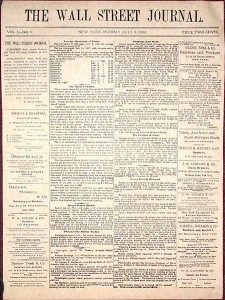
The Wall Street Journal, a newspaper with some amazing reporters, todayruns a “defense” of its parent company that would make Fox & Friends hosts cringe. The one News Corp. paper that you’d hope would come out of this ever-growing scandal unscathed is now stained by it. The tone-deaf opening:
“When News Corp. and CEO Rupert Murdoch secured enough shares to buy Dow Jones & Co. four years ago, these columns welcomed our new owner and promised to stand by the same standards and principles we always had. That promise is worth repeating now that politicians and our competitors are using the phone-hacking years ago at a British corner of News Corp. to assail the Journal, and perhaps injure press freedom in general.
***
At least three British investigations into phone-hacking and payments to police and others by the now-shuttered News of the World tabloid are underway, with 10 arrests so far. News Corp. and its executives have apologized profusely and are cooperating with authorities. Phone-hacking is illegal, and it is up to British authorities to enforce their laws. If Scotland Yard failed to do so adequately when the hacking was first uncovered several years ago, then that is more troubling than the hacking itself.”
In a1993 Wired interviewconducted by Gary Wolf, Steve Jobs, who was then doing his walkabout at NeXT, spoke cautiously about the World Wide Web. He thought it would be great for commerce but maybe not landscape-altering in essential ways. He was right in that all the connectivity and information hasn’t stopped wars or thinned the ranks of ignorant politicians.
One interesting thing that Jobs said was that the Web wouldn’t have the same awesome immediate impact that radio and TV had, that it would creep up on people. I think that’s true. Because the Web is controlled to a good extent by users, its wow factor is revealed incrementally, as people continue to tinker with it and grow it out. Ultimately, it will have much greater consequence for change than earlier technologies that made a bigger initial splash but were hampered by central control. An excerpt from the Q&A:
“What’s the biggest surprise this technology will deliver?
Steve Jobs: The problem is I’m older now, I’m 40 years old, and this stuff doesn’t change the world. It really doesn’t.
That’s going to break people’s hearts.
Steve Jobs: I’m sorry, it’s true. Having children really changes your view on these things. We’re born, we live for a brief instant, and we die. It’s been happening for a long time. Technology is not changing it much – if at all.
These technologies can make life easier, can let us touch people we might not otherwise. You may have a child with a birth defect and be able to get in touch with other parents and support groups, get medical information, the latest experimental drugs. These things can profoundly influence life. I’m not downplaying that. But it’s a disservice to constantly put things in this radical new light – that it’s going to change everything. Things don’t have to change the world to be important.
The Web is going to be very important. Is it going to be a life-changing event for millions of people? No. I mean, maybe. But it’s not an assured Yes at this point. And it’ll probably creep up on people.
It’s certainly not going to be like the first time somebody saw a television. It’s certainly not going to be as profound as when someone in Nebraska first heard a radio broadcast. It’s not going to be that profound.
Then how will the Web impact our society?
Steve Jobs: We live in an information economy, but I don’t believe we live in an information society. People are thinking less than they used to. It’s primarily because of television. People are reading less and they’re certainly thinking less. So, I don’t see most people using the Web to get more information. We’re already in information overload. No matter how much information the Web can dish out, most people get far more information than they can assimilate anyway.”
••••••••••
The William Morris Agency gets NeXT computers in 1990:
Italian novelistPaolo Giordanowent to Disneyland all by his lonesome andfiled a reportfor the Wall Street Journal. An excerpt:
“I take no rides in Disneyland, not even one, but I go into the reassuring auditorium where they show the return of ‘Captain EO’ in amazing 3-D and the temperature change is severe. Mothers extract sweaters from their bags, but the children have no intention of wearing them. They are thinking how funny they look with those big 3-D glasses on their faces, even though 3-D is no innovation for them; it’s nothing special, like this place Disneyland is nothing special. It looks a little old and there’s much more future in the Nintendo DSs, iPods, PlayStation Portables they’re carrying in their pockets.
Only small children still marvel—the Asian girl sitting at my left side, for example, she’s terrified by the dark and the wild assault of people trying to get the best seats and by Captain EO himself who—I’m discovering now—is Michael Jackson, close to his original color and surrounded by a group of tiny farting monsters. He has a mission to accomplish that later results in him dancing amid androids and repeating ‘We are here to change the world,’ which more or less is what he’d said throughout his career. When the seats start bouncing to the beat of the bass drum, I think that one of the ways Michael Jackson changed the world was to build a place similar to this one, a colorful trap for children where he decided to live, and the reason why he did it appears to me at once to be clear, tender, dreadful and incomprehensible.”
I don’t know why, but I would rather read newspapers and magazines online but still prefer to read old-fashioned, non-virtual books. Maybe it has to do with the length of time we spend with an article as opposed to a longer work. I think it’s something I’ll get over soon, though I probably won’t have a choice. But I’m all in favor of digitization of printed materials of value (and even of dubious value) and the democratization of scholarship that it allows. James Gleick speaks to this issue anew Op-Ed piecein the New York Times. An excerpt:
“Where some see enrichment, others see impoverishment. Tristram Hunt, an English historian and member of Parliament, complained in The Observer this month that ‘techno-enthusiasm’ threatens to cheapen scholarship. ‘When everything is downloadable, the mystery of history can be lost,’ he wrote. ‘It is only with MS in hand that the real meaning of the text becomes apparent: its rhythms and cadences, the relationship of image to word, the passion of the argument or cold logic of the case.’
I’m not buying this. I think it’s sentimentalism, and even fetishization. It’s related to the fancy that what one loves about books is the grain of paper and the scent of glue.
Some of the qualms about digital research reflect a feeling that anything obtained too easily loses its value. What we work for, we better appreciate. If an amateur can be beamed to the top of Mount Everest, will the view be as magnificent as for someone who has accomplished the climb? Maybe not, because magnificence is subjective. But it’s the same view.”