Books

You are currently browsing the archive for the Books category.

Ed Helms will play him in the movie.

Ed Helms will play Donaghy in the inevitable movie.

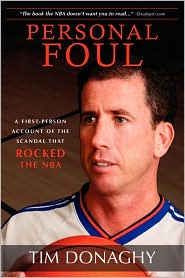
NBA official Tim Donaghy bet on basketball, so he automatically must  join the Chicago Black Sox and Pete Rose as a pariah forever banned by his sport. That’s the way it is for all pro athletes and officials who are caught gambling on their games. There’s a zero-tolerance policy, right? No, not always.

Prior to the 1963 season, two of the NFL’s better players, Detroit defensive tackle Alex Karras and Green Bay running back Paul Hornung, were caught gambling multiple times on football games. Karras also was proven to have business ties to underworld figures. Pete Rozelle suspended each player for the ’63 season and reinstated them in 1964. No one would have questioned him if he had given both lifetime bans, but he chose not to. Hornung was eventually elected to the Pro Football Hall of Fame and Karras regained All-Pro status in 1965 and became a successful NFL commentator and actor (most notably in Blazing Saddles and Victor/Victoria). How would their lives have turned out differently if they had been banned for life? Difficult to say. That doesn’t mean Rozelle made a right or wrong decision–he just made a different one. And that doesn’t mean that the gamblers deserve any leniency; they don’t.

Donaghy has gone on record saying that he believes Michael Jordan bet on basketball games and that was the real reason he left the NBA in the 1990s to try baseball. Would David Stern really have covered up that type of scandal to protect the NBA? It’s a harsh implication. There’s no proof he did and no reason to treat Donaghy’s word as gospel. But it’s easy to see that even something as seemingly black-and-white as athletes and officials gambling on their sport has some gray area.

Tags: , , , , , ,

los angeles

"I'd like to rest my heavy head tonight/ On a bed of California stars."

For those of us suffering through frigid climates, I came up with the warm-weather excerpt. I found this passage from Charles Bukowski’s novel, Hollywood, in an anthology called Los Angeles Stories: Great Writers on the City. It concerns the efforts of his doppelgänger (Chinaski) to buy a house after years of drifting, drinking, brawling and writing.

“Finally after a few weeks of house hunting, we found the one. After the down payment the monthly payments came to $789.81. There was a huge hedge in front on the street and the yard was also in front so the house sat way back on the lot. It looked like a good place to hide. There was even a stairway, an upstairs with a bedroom, bathroom and what was to become typing room. And there was an old desk left in there, a huge ugly old thing. Now, after decades, I was a writer with a desk. Yes, I felt the fear, the fear of becoming like them. Worse, I had an assignment to write a screenplay. Was I doomed and damned, was I about to be sucked dry? I didn’t feel it would be that way. But does anybody, ever?” Read the rest of this entry »

Tags: ,

Evan R. Goldstein has a really interesting article in The Chronicle of Higher Education about computer-science genius, conservative polemicist, Jewish scholar, Yale professor, artist and Unabomber target David Gelernter. In one passage, Gelernter addresses his odd-duck assortment of ideas and interests:

“‘I’m a misfit,’ he said. ‘Most people fit in a groove and focus on one thing, but I cut across the grain of different areas.’ In conversation, the eclecticism of Gelernter’s mind is immediately apparent. An opinionated raconteur, he seamlessly transitions from literary criticism (‘Deconstructionists destroy texts’), to trends in the art world (‘Modern museums are devoted to diversity as opposed to greatness’), gender roles (‘Women mainly work because of male greed’), contemporary politics (‘Anti-Semitism in Europe is so intense that, I think, Hitler would have an easier time today then he did in 1933’), and earthier topics (‘I am obsessed with sex and sexuality as much as anyone I have ever met’).” Read the rest of this entry »

Tags: , , ,

Hard Times An Oral History of the Great Depression by Studs TerkelThis excerpt from Hard Times, the late Studs Terkel’s oral history of the Great Depression remembers the last time the U.S. economy was actually worse than it is now. The following passage comes from an interview Terkel conducted with Hiram “Chub” Sherman, a Federal Theatre stage actor making his home in New York City at the beginning of the ’30s.

“It was rock bottom living in New York then. It really was. Cats were left on the streets. There were no signs about restricted parking. (Laughs.) If somebody had a jalopy–a few friends you know would have some old car–it would sit there for months on end neither molested nor disturbed. It would just fall apart from old age. You didn’t count your possessions in terms of money in the bank. You counted on the fact that you had a row of empty milk bottles. Because those were cash. They could be turned in for a nickel deposit, and that would get you on the subway. Two bottles: one could get you uptown, one could get you back.” Read the rest of this entry »

Tags: , ,

latetoloveI recently came across It’s Never Too Late to Love, a 1956 Royal Pyramid paperback that cost 35 cents when it first rolled off the presses. This time warp of a book, was published originally in 1953 in the wake of Alfred Kinsey’s two landmark volumes on sexual behavior. It’s written by Anna K. Daniels (“one of the most famous women gynecologists in America”) and has long been out of print. It was something of a clarion call to the reconsideration  of traditional societal and sexual roles that was to come a decade later, even though it seems quaint at best today. An excerpt from the chapter “The Art of Love”:

“The greatest threat to the happiness of long married people is that intercourse will become weary, stale, flat and unprofitable due to a lack of variety. The common position, in which the woman lies on her back and the man on top of her, which many people regard as the only one sanctioned by law, custom and religion, frequently becomes dull and monotonous. Moreover, there is always the danger that the woman’s body will sink too deeply into the bed, due to sagging mattress or springs, and thus lessen the pleasure for both…”

Tags: ,

Newer entries »