Books

You are currently browsing the archive for the Books category.

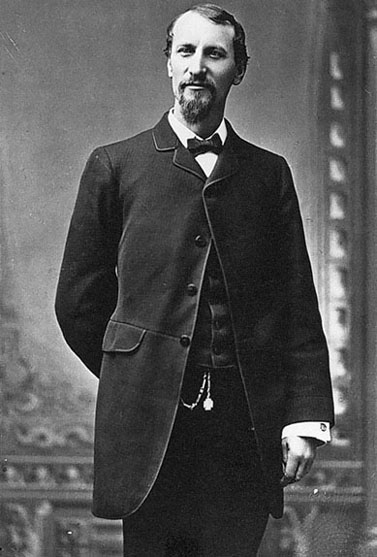
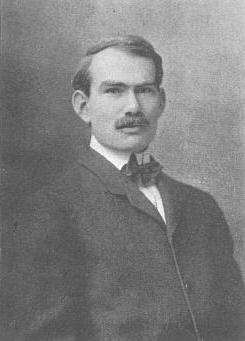
Inventor Lee de Forest: I was a tremendous prick, but terribly important.

Lee de Forest was one of the most important inventors in modern times, but don’t feel bad if you haven’t heard of him. The man is as forgotten as his invention, the Audion, is ubiquitous. The vexing inventor’s 1906 discovery made audio amplification possible, giving new life to the flagging radio industry and making possible any number of media. Gizmodo has posted an excerpt from Nicholas Carr’s new book, The Shallows, which provides insight into de Forest.  An excerpt:

“Even when judged by the high standards set by America’s mad-genius inventors, de Forest was an oddball. Nasty, ill-favored, and generally despised–in high school he was voted ‘homeliest boy’ in his class–he was propelled by an enormous ego and an equally outsized inferiority complex. When he wasn’t marrying or divorcing a wife, alienating a colleague, or leading a business to ruin, he was usually in court defending himself against charges of fraud or patent infringement–or pressing his own suit against one of his many enemies.

De Forest grew up in Alabama, the son of a schoolmaster. After earning a doctorate in engineering from Yale in 1896, he spent a decade fiddling with the latest radio and telegraph technology, desperately seeking the breakthrough that would make his name and fortune. In 1906, his moment arrived. Without quite knowing what he was doing, he took a standard two-pole vacuum tube, which sent an electric current from one wire (the filament) to a second (the plate), and he added a third wire to it, turning the diode into a triode. He found that when he sent a small electric charge into the third wire–the grid–it boosted the strength of the current running between the filament and the plate. The device, he explained in a patent application, could be adapted ‘for amplifying feeble electric currents.’

De Forest’s seemingly modest invention turned out to be a world changer. Because it could be used to amplify an electrical signal, it could also be used to amplify audio transmissions sent and received as radio waves. Up to then, radios had been of limited use because their signals faded so quickly. With the Audion to boost the signals, long-distance wireless transmissions became possible, setting the stage for radio broadcasting. The Audion became, as well, a critical component of the new telephone system, enabling people on opposite sides of the country, or the world, to hear each other talk.

De Forest couldn’t have known it at the time, but he had inaugurated the age of electronics.”

Tags: ,

“You think the Kardashians lack genius?” (Image by Martin Schneider.)

Robert Birnbaum of the Morning News has a fun, freewheeling interview with New Yorker editor David Remnick. The Q&A is pegged to Remnick’s new book about Obama, but the two cover a number of topics, both serious and silly, in an off-the-cuff manner. A few excerpts follow.

___________________

Robert Birnbaum:

What is going to happen with newspapers and such?

David Remnick:

I’m not a fortune teller. I know it would be interesting if I sat here and told you without a trace of uncertainty that in 10 years all magazines are going to be projected on screens on the side of the Empire State Building and the Prudential Building. Or alternately, they would be projected on the inside of your sunglasses in the summertime. I don’t know. Here’s what my job is, and I share that with other editors, too: We are in this moment of technological uncertainty and transition. The goal for me is to make sure we find a way, willy-nilly, to be healthy so that we can do the thing itself. The thing itself is what I care about most. Given a choice between the survival of the long-form narrative journalism, criticism, cartooning—all the things that we do—and print itself, there is no contest. No contest. I, at the age of 51, may still think, for me, the best technology for reading the New Yorker at this moment is the print version. But that’s just me. If your son, decides otherwise, that he wants to read it on an iPad, kenahorah [so be it].

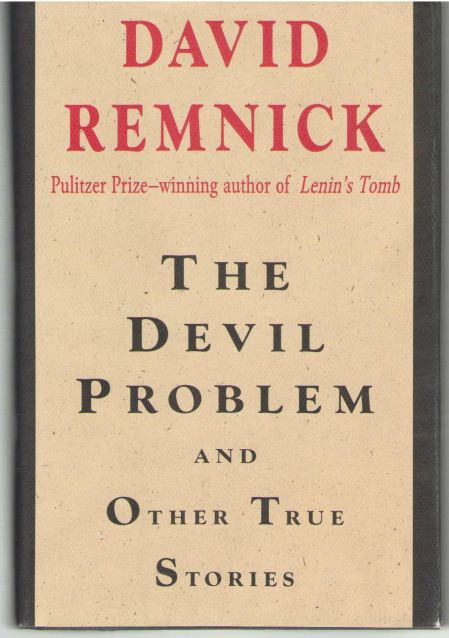
Remnick’s “The Devil Problem and Other True Stories” is one of my favorite non-fiction collections.

Robert Birnbaum:

I have to say I am befuddled by what flits across my TV screen—who are these Kondrashian [sic] people?

David Remnick

You think they lack genius?

Robert Birnbaum

Uh.

David Remnick

(laughs)

Robert Birnbaum

Someone must have genius associated with them.

David Remnick

Something I have never found interesting at all—two unbelievably popular things on television. One is reality television—it never interested me at all. And the other is this neo-talent-show stuff, like American Idol. The reason I don’t like American Idol is that a lot of the talent seems to be a replication of the singing style of Mariah Carey and Whitney Huston. I don’t need it.

___________________

David Remnick

David Owen is a fantastic golf writer.

Robert Birnbaum

I find golf to be the least interesting of pastimes.

David Remnick

To me it looks like a nervous breakdown with a stick.

Tags: ,

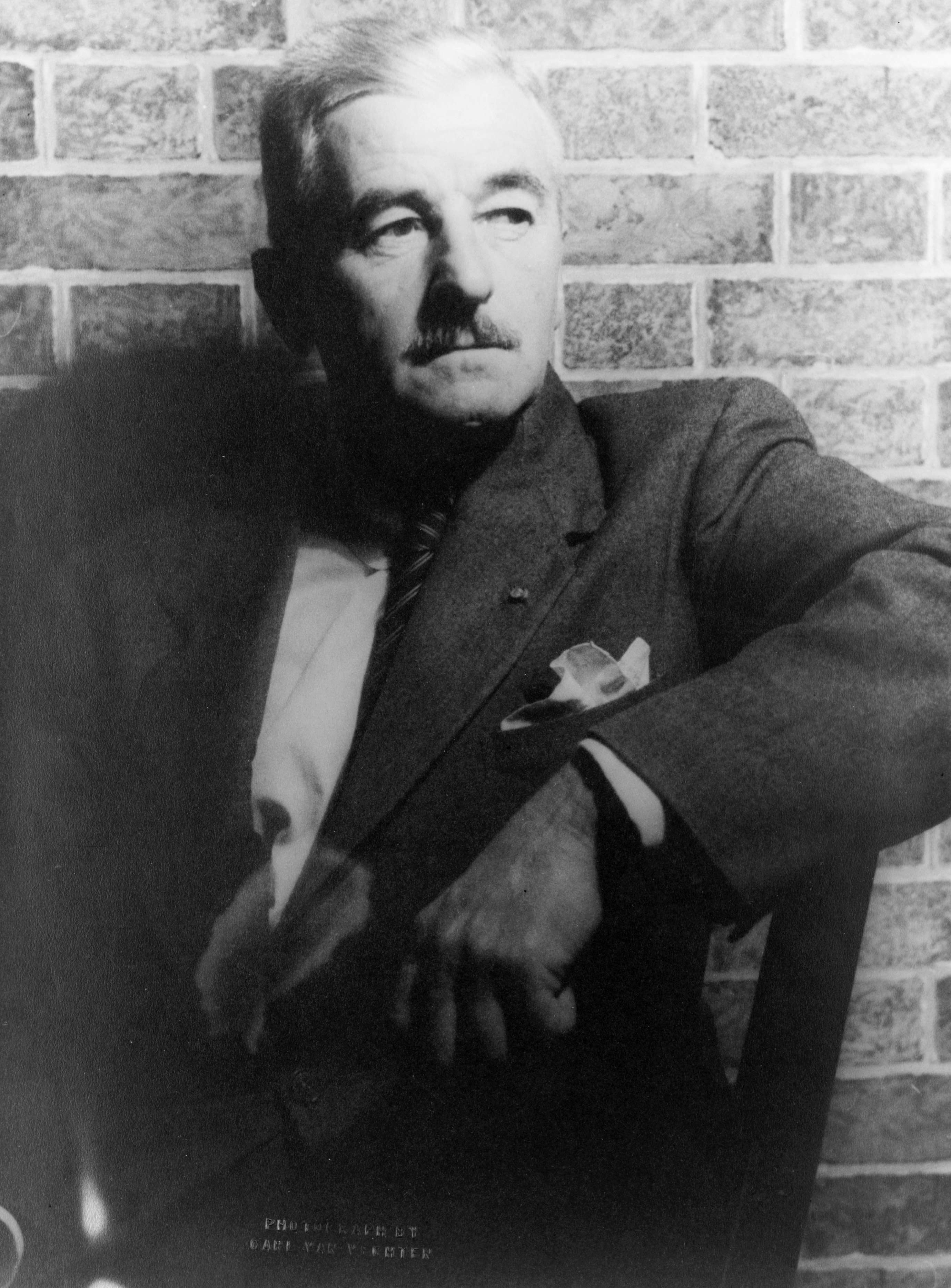
William Faulkner: "There is enough social life in the evening." (Image by Carl van Vechten.)

William Faulkner was better with a pen than a microphone. When he sat down for an interview with the Paris Review in 1956, Faulkner warned his interlocutor that he wasn’t partial to Q&As. “The reason I don’t like interviews,” he said, “is that I seem to react violently to personal questions.” But Faulkner did open up about what he thought was the finest job he ever had. An excerpt:

Paris Review: Then what is the best environment for a writer?

William Faulkner: Art is not concerned with environment either; it doesn’t care where it is. If you mean me, the best job that was ever offered to me was to become a landlord in a brothel. In my opinion, it’s the perfect milieu for a writer to work in. It gives him a perfect economic freedom; he’s free of fear and hunger; he has a roof over his head and nothing whatever to do except keep a few simple accounts and to go once very month and pay off the local police. The place is quiet during the morning, which is the best time of the day to work. There is enough social life in the evening, if he wishes to participate, to keep him from being bored; it gives him a certain standing in society; he has nothing to do because the madam keeps the books; all the inmates of the house are females and would defer to him and call him ‘sir.’ All the bootleggers in the neighborhood would call him ‘sir.’ And he could call the police by their first names.”

Tags:

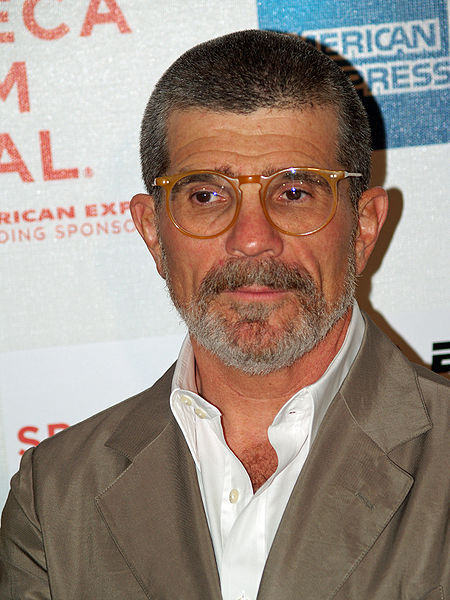
David Mamet: Put me up on the Cadillac board! (Image by David Shankbone.)

In 2009, Will Hubbard and Alex Carnevale of This Recording compiled a list called “The 100 Greatest Writers of All Time.” I’m not saying I agree with everything one-hundred percent, but it’s probably the best literary list I’ve ever come across. From number one hundred to the top spot, the duo rank the best writers in the history of the world, including poets, playwrights, essayists, short story writers and novelists. There are, of course, the household names (Congratulations, William Shakespeare!), but there are a lot of provocative inclusions as well. You owe it to yourself to read the whole thing, but here are a few examples of the entries:

88. David Mamet
The quintessentially Jewish-American dramatist, his conquests of poetry and fiction were minor. But he exploded the idea of the American play, creating an exciting new vernacular that brought crowds, excitement and controversy to the stage. Famous for shutting down an all-female production of his masterpiece Glengarry Glen Ross, Mamet is an able theoretician, and maybe the most important Chicago Jew of all time. Recommended reading: American Buffalo, The Duck Variations, Boston Marriage.

49. Charles Olson
America’s Bard, the voice of New England. Incredibly tall, incredibly wacked. He is the father of much of the American verse that directly followed, but he would never know just how lasting his work would be. He is our poet of the future, a deep thinker who lacked empathy for everyone but himself. Self-involvement can became a kind of genius at this depth, or so we hope. Recommended reading: “The Post Office”, The Maximus Poems, “The K”.

20. Laurence Sterne
The finest experimentalist ever. Smash novels, insights of incomparable erudition, hilarious, so ahead of their time that they seem more modern than most things published today. Tristram Shandy has lasted longer than its detractors. Many of its jokes have still yet to be parsed from a text thick with meaning, with comedy and profound statements of humanity in a time where it was not so easy to recognize what exactly that meant. Recommended reading: A Sentimental Journey, Tristram Shandy.

Tags: , ,

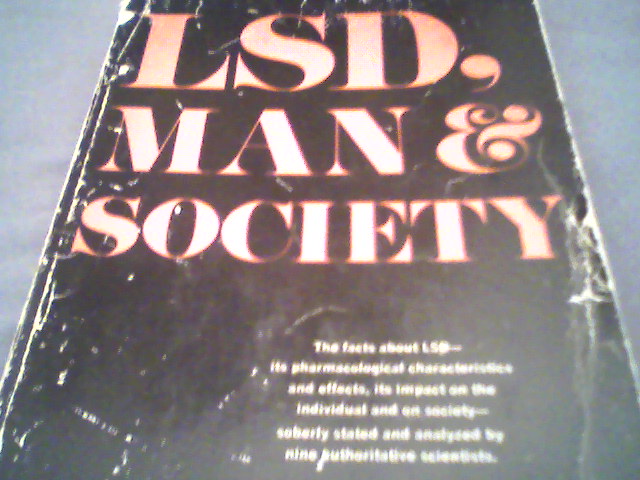
Early this morning I gleaned a dog-eared copy of LSD, Man & Society (along with a volume of Tristan Tzara’s Seven Dada Manifestos and Lampisteries) a block from my apartment in a box of old books some neighbor discarded. It was published by Wesleyan University during the heady early days of trippy drug’s popular ascendancy, with essays culled from a symposium on LSD that had been held at the school. The book examines the potential legitimate medicinal uses of LSD and attempts to dispel popular myths about the drug.

I’ve heard of the consciousness-expanding properties of LSD, of course, but I wasn’t aware there was apparently a charlatan (Timothy Leary, of course) who falsely claimed that it was a potent sex drug. An excerpt about that angle from the book:

“Perhaps the most reprehensible and misleading statement regarding LSD is the claim that it is a potent aphrodisiac (Timothy Leary, 1966). This claim is made by the avowed proselytizers, and more than any other single statement is effective in recruiting new converts to the LSD cult. LSD proponents insist that sexual relations under the influence of LSD are a spectacular, unmatched experience. They, of course, neglect to mention that the overwhelming majority of those taking LSD have no interest in sex, preferring their solipsistic trance, and that others who have taken LSD and attempted intercourse have found it impossible to consummate. Furthermore, the person responsible for the statement, when specifically challeneged on this point in a public debate in the fall of 1966, said that the statement was misinterpreted and that he in fact meant that LSD induces love in its most ethereal sense, but has no beneficial effect on casual or promiscuous physical sexual behavior.”

Virginia Tighe told the truth as far as she knew it, but it really wasn’t far enough.

The Colorado housewife caused a sensation in the U.S. in 1950s when, under hypnosis, she described with a perfect brogue the details of her earlier life as “Bridey Murphy,” a 19th-century Irish woman. Tighe (who was only identified by the pseudonym “Ruth Simmons” at the time) had never visited Ireland and seemingly had no way to know the quotidian detail of life in Cork and Belfast in the previous century.

When her hypnotist Morey Bernstein subsequently released a book about her story, The Search for Bridey Murphy, it quickly became a bestseller and a reincarnation craze swept the nation. Pretty soon the name “Bridey Murphy” was as famous as Dwight Eisenhower or Mickey Mantle, even if she never existed, at least not as Tighe’s earlier self.

Official records were later checked and the story began to fall apart. It eventually came to light that when Tighe was a small girl, a neighbor lady named Bridey Murphy Corkell had told her stories about her childhood in Ireland. Over the years, these tales of another land had become repressed memories for Tighe. So she was relaying the past alright, just not her own. But for a while, it was mania.

In the March 19, 1956 issue, Life offered its take with “Bridey Murphy Puts the Nation in a Hypnotizzy.” An excerpt:

Last week a considerable part of the U.S. lay under an Irish spell and the spell was becoming deeper and wilder as fast as the written word, awed gossip and the televised image could spread it. The genie responsible was a red-haired Irishwoman named Bridey (short for Bridget) Murphy, who may or may not have lived in early 19th-century Belfast and Cork, and who made her presence known, in eerily factual detail, during a series of hypnotic sessions held some time ago in Pueblo, Colorado. Bridey spoke through the hypnotized person of an attractive young Pueblo matron whose pseudonym is “Ruth Simmons.” While deep in a trance she told how she had grown up in early 19th-century Ireland, married, died and then even watched her own funeral.

The hypnotist was Morey Bernstein, a 36-year-old Pueblo businessman of impeccable reputation and honesty, who had taken up hypnotism as a hobby. He summoned up Bridey by a familiar technique known as hypnotic regression, whereby the hypnotist leads his subject back to adolescence or early childhood. Going one step further, Bernstein attempted to take his subject back before birth, and the next thing he knew he was listening to Bridey Murphy’s rambling discourse.•

Tags: , ,

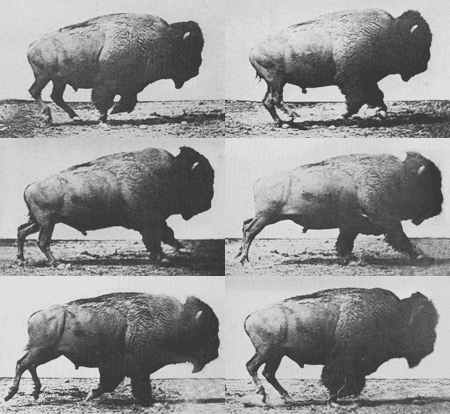
An excerpt from Railroads in the Days of Steam, which recalls how railroad development was perilous for buffalo herds:

“When the first railroads crossed the Mississippi River, the Great Plains were covered from Texas to Canada with vast herds of bison, or American buffalo. 

In the late 1860s and early 1870s, it seemed that everyone who followed the Union Pacific, the Kansas Pacific, and the Santa Fe railroads into the Prairie country wanted the buffalo killed off. Soldiers said they could not tame the hostile Prairie Indians as long as they could depend on the buffalo herds for food. Cattlemen wanted to run longhorns on the big natural pasture occupied by the buffalo.

Professional buffalo hunters were at work on the Plains in the years just after the Civil War providing meat for railroad construction camps and selling a few buffalo robes. But the slaughter of the buffalo did not begin in earnest until 1871, when word came of a market for buffalo hides in England.

A good hunter could shoot one hundred or more buffalo in the morning, then he would call his skinning crew to come up with the wagons. Hides were staked out on the prairie to dry. A well-cured hide was worth from $2.75 to $4, and many hunters earned more than $100 a day.

Passengers on the early trains could see large herds of buffalo, deer and antelope grazing calmly beside the tracks. They would open the car windows and shoot at the herds as the train sped along.”

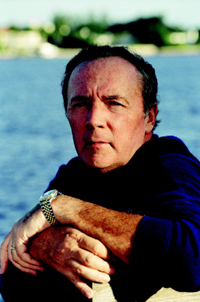
James Patterson: The writer of choice for some of today's best-read convicts. (Photo by Sue Solie-Patterson.)

The Browser pointed me toward an interesting article posted on the New York Public Library website, which is written by Jamie Niehof, an intern with the Correctional Services Program. The piece, “Controlled Chaos: A Day Working the Rikers Island Book Cart,” gives a behind-the-scenes look at contemporary book and periodical borrowing at NYC’s main jail complex. Based on this article, author James Patterson should be very pleased with himself. An excerpt:

“Getting books back from the prisoners and letting them pick out new ones is a bit of controlled chaos. We stood outside the iron door to the house with our cart and had two prisoners come out at one time, check off their returned book, and pick out a new one. Each prisoner is allowed one book and one magazine.

The most popular books are by far James Patterson’s novels, so popular in fact that we have to lock them up after book service because they tend to disappear. I wonder if James Patterson has any idea. National Geographic is the magazine of choice, and there is an entire box of them to choose from, some as far back as the early 80’s. Urban magazines and books were in high demand, with almost no supply.”

Tags:

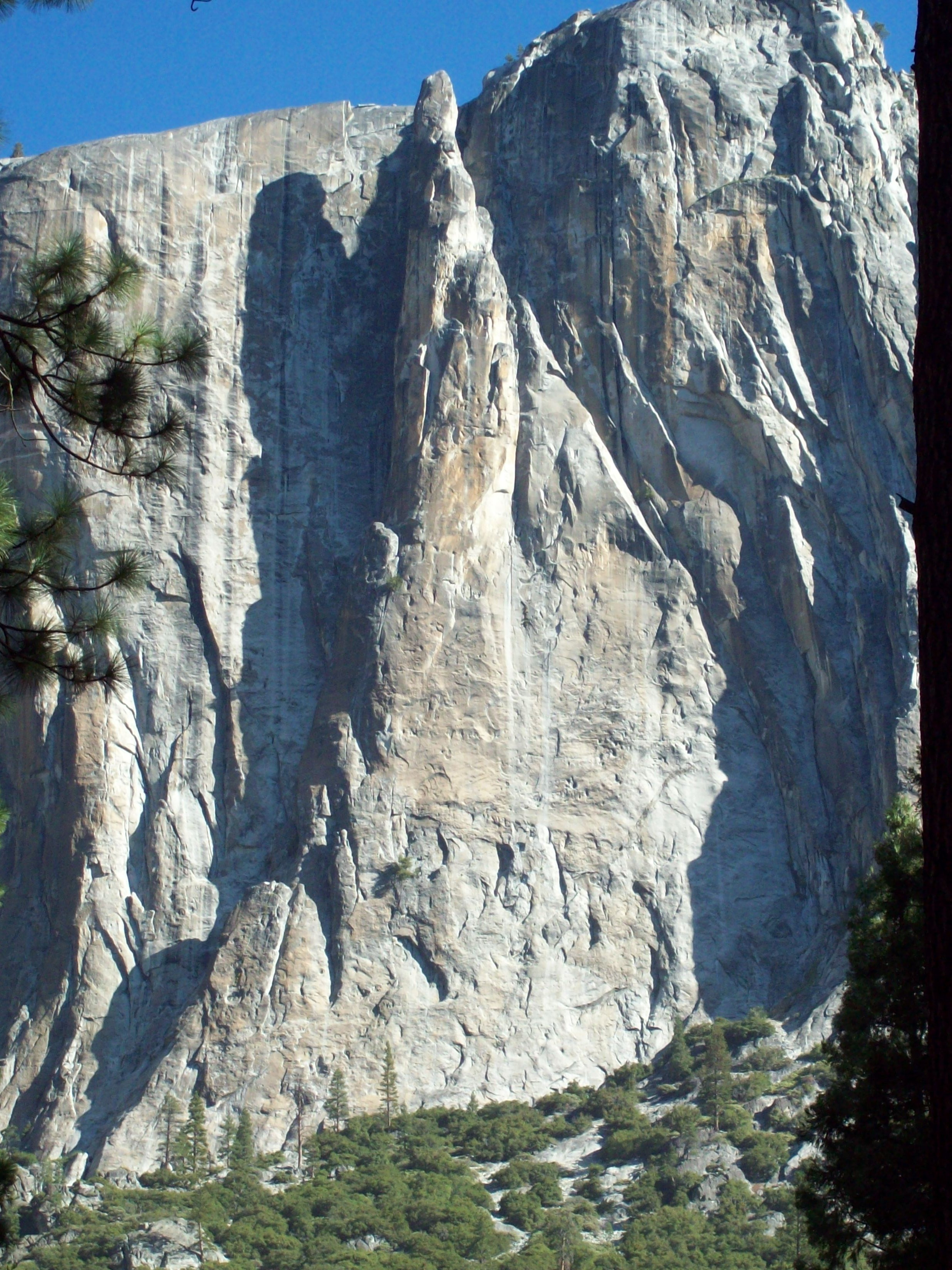
Filthy hippies touched some of these rocks. (Image by Meros Felsenmaus.)

Novelist Edward Abbey (The Monkey Wrench Gang) was a radical eco activist and onetime park ranger. He wasn’t exactly known for subtlety when it came to protecting nature, deriding both mainstream culture and counterculture; he possessed the rare ability to anger both conservatives and left-leaning environmentalists. Abbey was not in a sanguine mood about behavior in Yosemite National Park when he wrote this philippic for the September 3, 1971 issue of Life. An excerpt from “The Park That Caught Urban Blight“:

“For 14 years, I was a seasonal park ranger. But I quit because I found myself forced more and more into the role of a petty policeman. This year, I went to Yosemite Valley, the most troublesome of all Park Service areas, to see the park rangers in their new role as Park Fuzz, to see Smokey the Bear as Smokey the Pig.

In the foothills of the Sierras, up through the old mining towns of Coulterville and Chinese Camp, the flowers were blooming–silvery supine, California poppy, paintbrush and penstemon–and the traffic was light. When I saw a sign ‘Water Ahead,’ I anticipated a drink of pure Sierra Nevada spring water, fresh from the rocks. I found the spring, but another sign beside it read ‘Water Contaminated; Unfit to Drink.’

Later, several miles beyond the park entrance I stopped at a turnout of the classic view of Yosemite Valley below. There was El Capitan, Half Dome, Sentinel Dome, Bridalveil Fall, and a blue haze above the valley floor. Wood smoke? Exhaust fumes? In nearby Cascade Creek I found my first Budweiser can in the clear snow water.

Down in the valley teen-age gypsies with sleeping bags, backpacks and ragged heads slouched along the road, thumbs out. Damn lazy city kids, I thought–let them walk. Good for them, and I spurred my widespread Pontiac right on by. Hitchhiking is illegal in national parks. Hitchhikers are poor, dirty, immoral. I was one; I should know. They steal your credit card, they leave a weird smell lingering in the back seat, they contribute nothing to the national economy.”

Tags:

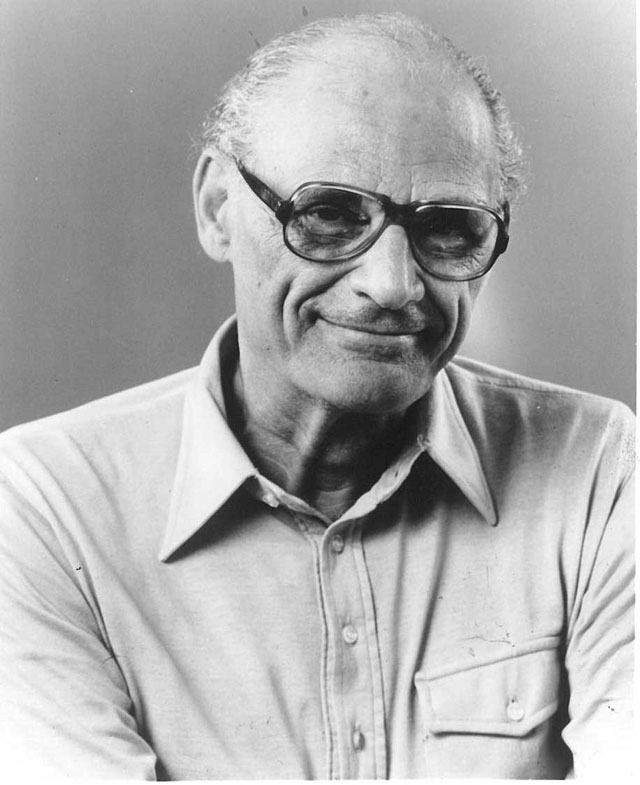
Miller grew up well-to-do in NYC, the son of a wealthy Polish-Jewish immigrants.

From Elia Kazan’s famed 1949 production of Death of a Salesman until the end of his life in 2005, Arthur Miller was a towering figure in American letters. In a 1966 interview in the Paris Review, he looked back on the humble origins of his career as a playwright. An excerpt:

Interviewer: Would you tell us a little about the beginning of your writing career?

Arthur Miller: The first play I wrote was in Michigan in 1935. It was written on a spring vacation in six days. I was so young that I dared to do such things, begin it and finish it in a week. I’d seen about two plays in my life, so I didn’t know how long an act was supposed to be, but across the hall there was a fellow who did the costumes for the University theater, and he said, “Well, it’s roughly forty minutes.” I had written an enormous amount of material and I got an alarm clock. It was all a lark to me, and not to be taken too seriously…that’s what I told myself. As it turned out the acts were longer than that, but the sense of the timing was in me even from the beginning, and the play had a form right from the start.

Being a playwright was always the maximum idea. I’d always felt that the theater was the most exciting and the most demanding form one could master. When I began to write, one assumed inevitably that one was in the mainstream that began with Aeschylus and went through about 2500 years of playwriting. There are so few masterpieces in the theater, as opposed to the other arts, that one can pretty much encompass them all by the age of nineteen.”

Tags: ,

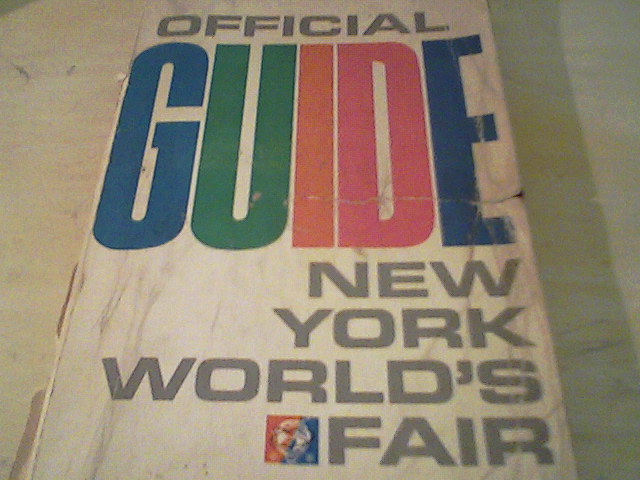
The guide cost an even dollar in 1964.

When I briefly got my tough but tender hands on a copy of the Official Guidebook of the 1939 World’s Fair, I managed to also have a peek at the 1964 Guide. Like the 1939 World’s Fair, the later version took place in Flushing Queens, the neighborhood where both I and the 12-story-high Unisphere were born.

The 1964 World’s Fair had “Peace Through Understanding” as its theme and featured many exhibits that revolved around technology and space travel, unsurprising during the space-race decade. But it also presented Michelangelo’s Pieta, was responsible for popularizing the Belgian waffle in America and unveiled Disney’s animatronic “It’s A Small World” ride.

In addition to info about the prehistoric creatures on display in “Sinclair Dinoland” and the rockets in “Space Park,” the guide has an entry about a curious Cold War-esque subterranean structure prototype called “Underground World Home,” one of which still exists today. An excerpt:

“Something really different in housing is displayed here: a three-bedroom house, completely below ground level. It is presented as the forerunner of dwellings that the builder says have marked advantages for today’s living. Guides explain during the 20-minute tour why underground homes can provide more control over air, climate and noise than conventional houses–as well as protection from such hazards as fire and radiation fallout. The house occupies most of the area inside a rectangular concrete shell, the top of which is two and a half feet underground; a wide staircase brings visitors down to the front door. Windows of the house face scenic murals placed on walls of the shell.”

Tags:

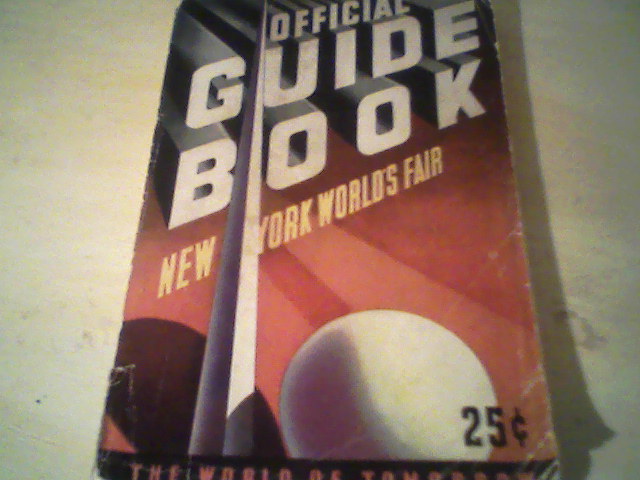
The Guidebook cost just a quarter back then.

I linked to some fun home movies of the 1939 New York World’s Fair a while back, and now I got my coarse yet practiced hands on a copy of that event’s official guidebook.

The book (which is the shape and thickness of an old-school TV Guide) is pretty straightforward, touting the highlights that drew 4.4 million visitors, with info on exhibits about technology, medicine, science and government in addition to amusements.

One oddity from the “Amusement Area” that jumped off the page is called “Little Miracle Town.” An excerpt:

“Morris Gest’s Little Miracle Town, occupying 36,000 square feet was brought over from Europe by a specially chartered ship. A miniature community, complete in every detail even to the diminutive organ in the church, its one hundred and twenty-five midget inhabitants have their own tiny restaurant, their city hall, their own theatre, art gallery and railroad station.

Other features include a midget circus, motion picture studio, garage, radio station, ballroom, guard barracks, Punch and Judy show and toy and doll factory. Never in the history of any exposition has there been a Midget Village as spectacular as this one. Morris Gest, famous producer of Chauve Souris and other successful shows, toured all Europe to secure the greatest ‘little people’ for Little Miracle Town.”

Tags:

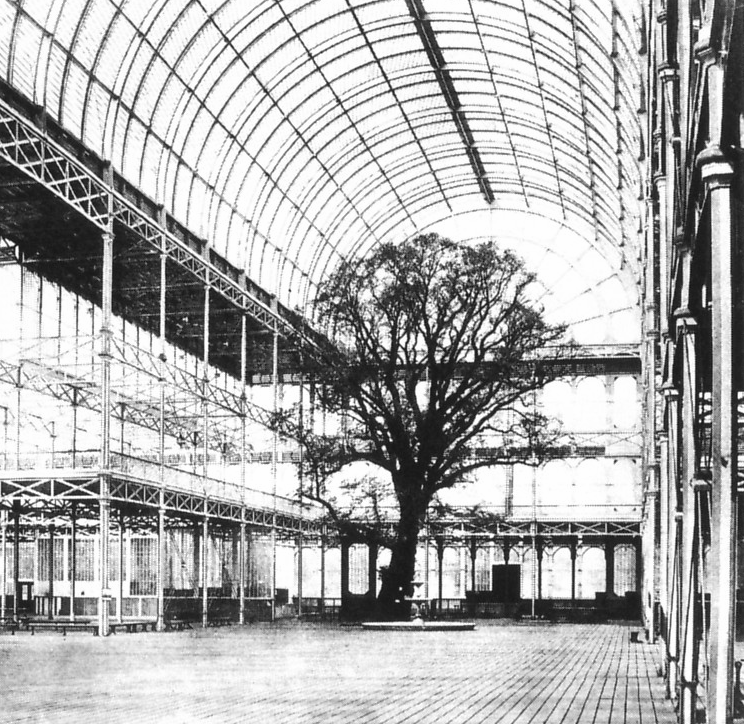
The Crystal Palace was built in under six months.

Engineer Henry Petroski, always a provocative thinker and writer, did some of his best work in the 1985 collection known as To Engineer Is Human: The Role of Failure in Successful Design. Petroski examined a wide array of design disasters and explained how engineering is more of an educated guess than an exact science. And to add context, he singled out some daring engineering feats that succeeded despite their high degree of difficulty.

One such example is the 750,000-square-foot cast iron, wood and glass Crystal Palace in Hyde Park that Joseph Paxton built quickly in the mid-nineteenth century. The edifice was used to house the Great Exhibition, the first World’s Fair. Paxton was a gardener who used innovations in the Crystal Palace that had worked in his greenhouse designs. There were plenty of naysayers who didn’t think it would work, but the building outlived them all. An excerpt:

“One of the most ambitious and innovative structures of the Victorian era was not a bridge or a tower but the vast building constructed to house the Great Exhibition of London in 1851. The story of the Crystal Palace is a fascinating one that bears repeating, for it shows that no matter how innovative an engineering structure might be and no matter how many opponents it may have, the proof is in the putting up and in the testing of it….

Although the true skyscraper did not come into its own until the twentieth century, the Crystal Palace prefigured it in many important ways. The way the light, modular construction ingeniously stiffened against the wind is the essence of modern tall buildings. And the innovative means by which the walls of the Crystal Palace hung like curtains from discrete fastenings, rather than functioning as integral load-bearing parts of the structure, is the principle behind the so-called curtain wall of many modern facades.”

Tags: ,

Moe Berg: Rocking the unibrow.

Morris “Moe” Berg wasn’t a particularly distinguished major league catcher, but he was one thing that Yogi Berra, Elston Howard and Josh Gibson never were–a spy for the U.S. government. A graduate of Princeton and Columbia Law School who spoke numerous languages and had a profound intellectual curiosity, Berg was a spy for the Offices of Strategic Services during WWII. He was also the player that the king of the oddballs Casey Stengel once labeled as “the strangest man in baseball.”

Nicholas Davidoff wrote a really good book about the brainy athlete’s shadowy work called The Catcher Was A Spy: The Mysterious Life of Moe Berg in 1994. Davidoff notes on the back cover of the book that Berg is the only former major leaguer to have his baseball card on display at CIA headquarters. An excerpt from the chapter entitled “You Never Knew He Was Around”:

“Moe Berg had always been a loner, and as he receded to the fringes of professional baseball, his eccentricities became more pronounced. Nobody had really ever known much about him. Now he became obviously unusual, and it began to occur to some people to wonder….

An eager conversationalist, even garrulous at times, Berg could be very funny. Yet for the flow of talk, he kept himself to himself. He was as gray as the front page, and he behaved like a newspaper, too; all the latest facts, but no reflections. ‘We knew a lot about [ballplayers’] private lives,’ says Shirley Povich, ‘but he was mysterious. You never saw him hanging around the hotel lobby like other ballplayers. They just accepted Moe for what he was–a man apart.’ The game ended and Berg showered, dressed and disappeared. ”

Other Recent Sports Posts:

Tags: , , , , ,

The episode where Groucho Marx annoyed the hell out of Truman Capote was very special.

The Dick Cavett Show that ran evenings on ABC from 1969-1975 is my favorite TV program ever, even though I didn’t see a single episode until decades after it went off the air.

Cavett was an unusually honest and curious interlocutor who always had a fascinating mix of people on his panel (Lillian Gish, Satchel Paige and Salvador Dali shared the stage one night). And this was an era when notable personalities were willing to talk about a lot more than the latest product they were pushing. You owe it to yourself to watch or re-watch the shows that are on DVD. (Just don’t start with the Jimi Hendrix disc–it’s a butchered group of interviews that doesn’t contain the full programs.)

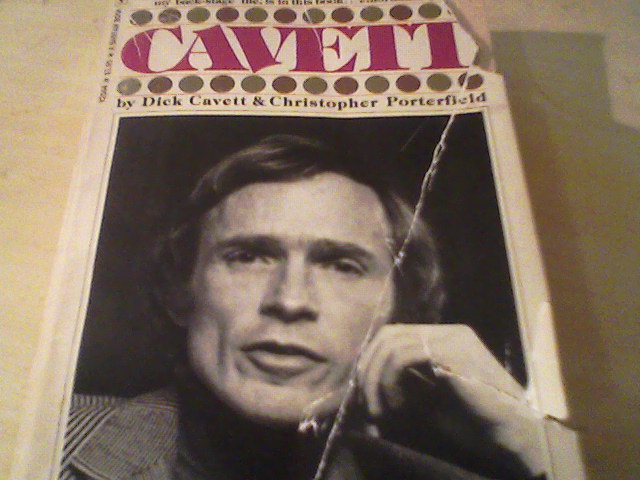
In Cavett’s self-titled 1974 memoirs (a book-long interview with his friend Christopher Porterfield), the host recalls the 1970 show when Georgia Governor Lester Maddox stormed off the stageAn excerpt about the incident:

“People ask me about the time Lester Maddox, the former governor of Georgia walked off my show because I refused to apologize for what he saw as an insult to his constituency.

Was he right to walk off? Yes. But not because I failed to apologize. He was right because it was theatrical and well timed, and got him more attention than he had since the old pick-handle-brandishing days of the Pickrick Restaurant. I heard that he papered the wall of his office with the congratulatory wires he got. Maddox is as smart as a whip–or should I say knout?–and knows how to exploit the media as well as or better than Jerry Rubin or Abbie Hoffman ever did. As I said on the next night’s show, he also knows the value of television time, walking off as he did a scanty eighty-eight minutes into the show.

Truman Capote, who was also on the panel that night, says that, of all the TV he has done, to this day people refer to that night wherever he goes.”

Tags: , ,

There's finally a way to resemble Gregg Jefferies, circa 1990.

I gleaned these spectacular, completely ridiculous items last spring a block from where I live. How could my neighbors tire of such gems? It’s hard to fathom.

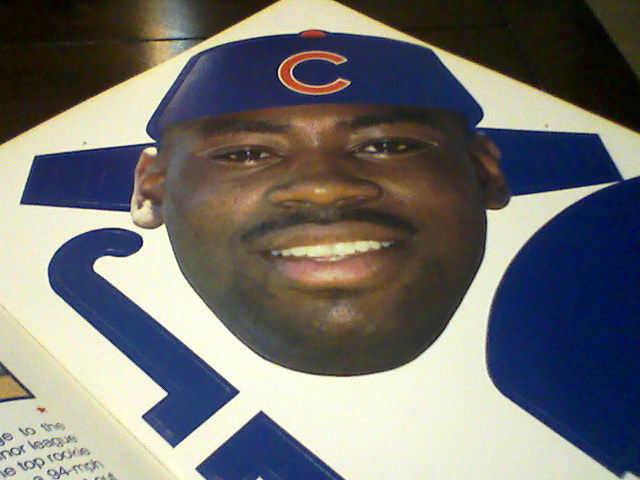
In 1990, Gallery Books put out four volumes of paper masks that looked like famous baseball players. Each of the quartet of books represents a different theme: Big Hitters, Gold Glovers, Power Pitchers and Hot Rookies. I gleaned the latter two editions.

The paper masks in Power Pitchers are of Nolan Ryan, Doc Gooden, Roger Clemens and Orel Hersheiser. Hot Rookies include: Gregg Jefferies, Ken Griffey Jr., Jim Abbott and Jerome Walton. Griffey is the only one still playing.

Sure, you're handsome, but now you can be Jerome Walton handsome.

The masks are very odd; you have to punch out the eyes and nose to put them on. It doesn’t seem that they were aimed at Halloween costume shoppers but rather just at strange nine-year-olds who wanted to resemble Chicago Cub Jerome Walton. You know Gallery Books doubted the intelligence of their customers since they included the helpful warning: “Do not wear masks while playing baseball.”

See other Gleanings.

Tags: , , , , , , ,

Malcolm's book is ranked at #97 on the Modern Library's "100 Best Nonfiction Works of the 20th Century."

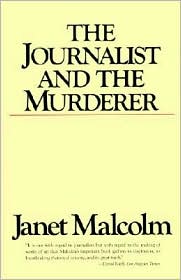
In 1989, Janet Malcolm packed a mighty punch with a single sentence: “Every journalist who is not too stupid or not too full of himself knows what he does is morally indefensible.” That was the first line in her famous (and infamous) much-debated book, The Journalist and the Murderer, which began as a New Yorker article.

In the essay, Malcolm examined the relationship of scribe Joe McGinniss and killer Jeffrey MacDonald, an Army officer and physician who murdered his pregnant wife and two daughters. McGinniss befriended the murderer and pretended to be sympathetic to him, though he thought MacDonald was guilty and was just collecting information for his eventual bestseller, Fatal Vision. Malcolm had other issues with McGinniss, but the central question was and is: Are journalists unethical for betraying their subjects’ faith in the pursuit of truth, even if those subjects are horrifyingly immoral?

Malcolm’s ideas on the subject are very broad and she may have been exorcising her own demons (she can be a mean take-down artist), but the central question is worth investigating. Here’s an excerpt of the rest of the paragraph that immediately follows her infamous first sentence:

“He is a kind of confidence man, preying on people’s vanity, ignorance or loneliness, gaining their trust and betraying them without remorse. Like the credulous widow who wakes up one day to find the charming young man and all her savings gone, so the consenting subject of a piece of nonfiction learns–when the article or book appears–his hard lesson. Journalists justify their treachery in various ways according to their temperaments. The more pompous talk about freedom of speech and ‘the public’s right to know’; the least talented talk about Art; the seemliest murmur about earning a living.”

Tags: , ,

"His waitresses lived in company housing and kept curfew."

The Wall Street Journal’s Jonathan Eig has published a smart book review of Stephen Fried’s Appetite for America. The book examines how Fred Harvey’s chain of lunchrooms–America’s first national chain of any kind–which grew up around railroads in the Old West beginning in the 1870s, helped to tame that still-wild region of America. Harvey served surprisingly good food, offered a warm environment and imported an all-female waitstaff (“Harvey Girls“) to attract single men looking for brides.

For a formerly poor New York immigrant pot scrubber to have accomplished so much, Harvey had to run a tight ship. An excerpt from the review about his strict business practices:

“He ran his railroad-restaurant business, operating along the Atchison, Topeka & Santa Fe lines, like a military operation. His waitresses lived in company housing and kept curfew. On and off the job, they were expected to follow rules: ‘Have a Sincere Interest in People’ was the first on a list that Mr. Fried reprints. Another reminded employees that ‘Tact is an Asset and HONESTY is still a Virtue.’ Harvey’s decrees didn’t necessarily apply to Harvey: A newspaper in 1881 reported that when he fired the manager of a train-station restaurant in Deming, N.M., Harvey threw the man out the front door onto the train platform ‘and the dining room equipment followed after him in quick order.'”

Tags: , ,

The stuff Franklin invented–in addition to helping invent our country–is just wild. His most famous work with electricity and bifocals are obviously great. But you know when you go into a grocery store and you use that grabby thing to get stuff down from a tall shelf? That was Franklin. He called it the “Long Arm.” An excerpt about the gizmo from the “Description of an Instrument for Taking Down Books from Tall Shelves” section of The Autobiography of Ben Franklin:

longhand22“Old men find it inconvenient to mount a ladder or steps for that purpose, their heads sometimes being subject to giddiness, and their activities, with the steadiness of their joints, being abated by age; besides the trouble of removing the steps every time  a book is wanted from a different part of their library.

For the remedy, I have lately made the following simple machine, which I call Long Arm.

The Arm is a stick of pine, an inch square and eight feet long, the Thumb and Finger, are two pieces of ash lath, an inch and half wide, and a quarter of an inch thick…To use this instrument, put one hand into the loop, and draw the sinew straight down the side of the arm; then enter the end of the finger between the book and the book you would take down…All new tools require some practice before we can become expert in the use of them. This requires very little.”

Tags:

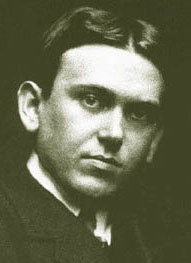
I wrote about everything from the Scopes Monkey Trial to George Washington's weariness of the American people.

Mordant, contrarian, irrepressible, satirical wits like H.L. Mencken are always a source of strength in our country. In addition to being a distinctive prose stylist, the “Sage of Baltimore” was to his time what Stewart, Colbert and Maher are to theirs. His acute readings of American politics, race, class and gender in the first half of the twentieth century are still potent. I highly recommend Vintage Mencken if you’ve never read it.

In the 1948 piece I’m excerpting, Mencken distilled a conflict in which a mixed-race group of tennis players were arrested for attempting to have a match on a Baltimore public court. Mencken’s record as a progressive on civil rights and women’s rights is commendable, though his track record with Jewish people was less distinguished. He often decried the Jewish race, but he also did chastise FDR for not providing refuge for Jewish people after Hitler’s rise to power. Even great thinkers are a mixed-bag, I guess. An excerpt from the Baltimore Evening Sun piece:

“When, on July 11 last, a gang of so-called progressives, white and black, went to Druid Hill Park to stage an inter-racial tennis combat, and were collared and jugged by the cops, it became instantly impossible for anyone to discuss the matter in a newspaper, save, of course, to report impartially the proceedings in court….

But there remains an underlying question, and it deserves to be considered seriously and without any reference whatever to the cases lately at bar. It is this: Has the Park Board any right in law to forbid white and black citizens, if they are so inclined, to join in harmless games together on public playgrounds? Again: Is such a prohibition, even supposing that it is lawful, supported by anything to be found in common sense and common decency?

I do not undertake to answer the first question, for I am too ignorant of law, but my answer to the second is a loud and unequivocal No. A free citizen in a free state, it seems to me, has an inalienable right to play with whomsoever he will, so long as he does not disturb the general peace. If any other citizen, offended by the spectacle, makes a pother, then that other citizen, and not the man exercising his inalienable right, should be put down by the police.”

Tags:

Donald Barthelme: "Grace Paley is a wonderful writer and troublemaker. We are fortunate to have her in our country."

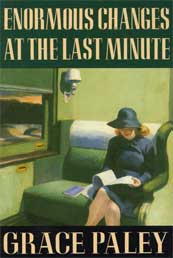
I love the Bronx-born short-story writer Grace Paley, especially her 1974 collection Enormous Changes at the Last Minute. The book contains only 17 stories, but there’s so much humor, pathos and wisdom packed into those pages. (Although I actually recommend you instead buy The Collected Stories, since you can get all 45 of her published short works for just pennies more.)

A political activist as well as a writer, Paley’s work in Enormous Changes was informed by the tumult of New York in the ’60s and early ’70s. She was the perfect writer for that time and place.

Here’s an excerpt from a 1985 David Remnick article about Paley (when she was 62) from the Washington Post:

“‘I’ve been here for almost forever,’ she says. Take ‘here’ to mean New York, and that is true. Paley’s background is richer than just the block. Her parents, Isaac Goodside and Manya Ridnyik, left Russian around 1905 and settled in New York, first on the Lower East Side and then in the Bronx. When they were young in Russia they had been Social Democrats opposed to the czar. Goodside had been exiled to Siberia and Ridnyik to Germany.

In New York, Goodside helped teach himself English by reading Dickens. He became a doctor. Paley’s mother took care of the house–Paley herself often escapes to sweeping and washing when her stories won’t come unstuck.

‘When I was little I used to love to listen to my parents’ stories, all the talk that went on,’ she says. ‘I loved to listen and soon I loved to talk and tell.'”

Tags: , , ,

The oral history Working is one of the best books by the late, great writer, historian and radio host Studs Terkel. I can’t recommend this book enough. There’a also a graphic adaptation that Harvey Pekar worked on, though I haven’t seen a copy.

An excerpt from “Dolores Dante, Waitress”:

People imagine a waitress couldn’t think or have any kind of aspiration other than to serve food. When somebody says to me, ‘You’re great, how come you’re just a waitress?’

Just a waitress. I’d say, ‘Why, don’t you think you deserve to be served by me?’ It’s implying that he’s not worthy, not that I’m not worthy. It makes me irate. I don’t feel lowly at all. I myself feel sure. I don’t want to change the job. I love it.

Some don’t care. When the plate is down you can hear the sound. I try not to have that sound. I want my hands to be right when I serve. I pick up a glass, I want it to be just right. I get to be almost Oriental in the serving. I like it to look nice all the way. To be a waitress, it’s an art.

I feel like a ballerina, too. I have to go between those tables, between those chairs. Maybe that’s the reason I always stayed slim. It is a certain way I can go through a chair no one else can do. I do it with an air. If I drop a fork, there is a certain way I pick it up. I know they can see how delicately I do it. I’m on stage. I tell everyone I’m a waitress and I’m proud.•

Tags: ,

One of Studs Terkel’s oral histories wrapped around a central theme, Working presents people discussing in their own words their jobs and careers. It’s Terkel’s usual mix of astute social commentary and literature, marked by his inimitable knack for getting people to open up in profound ways. Some professions covered include: farm worker, bus driver, jockey, cop, film critic and prostitute. An excerpt from “Terry Mason, Airline Stewardess”:

“When people ask what you’re doing and you say stewardess,you’re really proud, you think it’s great. It’s like a stepping stone. The first two months I started flying I had already been to London, Paris and Rome. And me from Broken Bow, Nebraska. But after you start working it’s not as glamorous as you thought it was going to be.

They like girls that have a nice personality and that are pleasant to look at. If a woman has a problem with blemishes, they take her off. Until the appearance counselor thinks she’s ready to go back on. One day this girl showed up, she had a very slight black eye. They took her off. Little things like that.

We had to go to stew school for five weeks. We’d go through a whole week of make-up and poise. I didn’t like this. They make you feel like you’ve never been out in public. They showed you how to smoke a cigarette, when to smoke a cigarette, how to look at a man’s eyes. Our teacher, she had this idea we had to be sexy. One day in class she was showing us how to accept a light for a cigarette from a man and never blow it out. When he lights it, just look in his eyes. It was really funny, all the girls laughed.”

Read also:

Tags: ,

The same arrogance the made Mailer a great writer also made him sometimes do dumb things. (Image from MDC Archives.)

I think the first time in my childhood that I heard the name “Norman Mailer” was in connection with one of the worst things he ever did. Mailer agitated for the release of convict/writer Jack Henry Abbott, who had spent much of his life in prison. Mailer envisioned Abbott as an American Genet.

It was, of course, a stupendously stupid thing to do. Within six weeks of his 1981 release, Abbott murdered 22-year-old New York waiter/aspiring actor Richard Adan. Whether he was springing cons, running for mayor or seething at Gore Vidal, Mailer often acted out of incredible hubris. But he was a magnificent writer, especially when he was in full-on non-fiction mode.

Some of his best work is collected in Miami and the Siege of Chicago, his street-level examinations of the 1968 Republican and Democrat national conventions, in all their depressing and tumultuous infamy. An excerpt from The Siege of Chicago, which concerns a protest march that was halted with utter brutality:

“There, damned by police on three sides, and cut off from the wagons of the Poor People’s March, there, right beneath the windows of the Hilton that looked down on Grant Park and Michigan Avenue, the stationary march was abruptly attacked. The police attacked with tear gas, with Mace, and with clubs, they attacked like a chainsaw cutting into wood, the teeth of the saw the edge of their clubs, they attacked like a scythe through grass, lines of twenty or thirty policemen striking out in an arc, their clubs beating, demonstrators fleeing. Seen from overhead, from the nineteenth floor, it was like a wind blowing dust, or the edge of waves riding foam on the shore.”

Tags: , , ,

I thought we were gonna rule the planet. Was Charlton Heston just fucking with me? (Photo by Kabir Bakie.)

The New Scientist has an interesting post about the superlative Australian author and explorer Paul Rafaele. The site reviews his new book, Among the Great Apes: On the Trail of Our Closest Relatives, which predicts the disappearance of the magnificent creatures in the next few decades, due to the compromised nature of their habitats. They also interview the globe-trotting writer about his new work. An excerpt from the Q&A:

New Scientist: Some of the places you travelled to are notorious trouble spots, yet you still went. Why?

Paul Rafaele: Looking at captive apes doesn’t tell you much about them. In the wild, each subspecies of ape has its own culture and behaviour. It’s the great apes’ bad luck that their habitats are in some of the most violent, corrupt places on earth. But if you are going to report a war you have to go and see for yourself, and if you are going to report on great apes you have to do the same.

New Scientist: Can the great apes be saved?

Paul Rafaele: The only way to guarantee there will be some left in the wild in 50 years is to have pockets of heavily defended habitat with anti-poaching patrols at least as well armed as the poachers. The impetus and the funding must come from western governments and they must ensure that it goes where it is needed.”

Tags:

« Older entries § Newer entries »