Books

You are currently browsing the archive for the Books category.

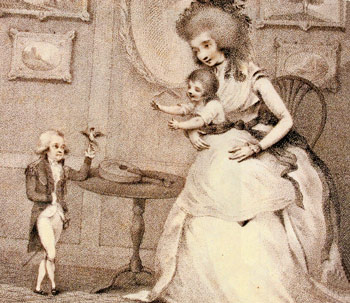
An undated rendering of the debonair Joseph Boruwlaski. He grew to be 39 inches tall.

From Armand Maire Leroi’s 2005 book, Mutants: On Genetic Variety and the Human Body, a brief biographical sketch of Joseph Boruwłaski (1739–1837), a Polish-born man with dwarfism (likely the pituitary kind) who became an unlikely fixture in European royal courts:

“Joseph Boruwlaski died in his sleep on 5 December 1837 in the quiet English cathedral town of Durham. He had had a happy life, a rich life. Born into obscurity, he had achieved dizzying social heights. Famed for his conversation and his skill with the violin, he had known most of the crowned heads of Europe. Ennobled by the King of the Poles, he had also won the patronage of the Prince of Wales. He could call the Duke and Duchess of Devonshire his friends. He was an ornament of Durham, its council paid him merely to live there. He had married a noble beauty, raised a family and, when he died at the distinguished age of ninety-eight, had outlived nearly all his contemporaries. It was a graceful end to a remarkable life. For Joseph, le Comte de Boruwlaski, was not merely any Continental aristocrat exiled from his homeland. He was the last of the court dwarfs.”

Tags:

“Mark is induced to sign his autograph.” 

Taken from David W. Maurer’s The Big Con:

  • The Autograph: A short-con game in which the mark is induced to sign his autograph to a piece of paper which is later converted into a negotiable check.
  • The Big Mitt: A short-con game played against the store with insidermen and ropers. The victim is enticed into the store, drawn into a crooked poker game, and is cold-decked on his own deal.
  • The Engineer’s Daughter: A mock con game played by con men for a conceited grifter. A grifter’s wife or girl poses as the “engineer’s daughter.” The point-out is played for the victim, who finally manages to get on intimate terms with the engineer’s daughter. Another con man dressed as an engineer bursts into the apartment, brandishing a pistol. The victim collects what clothing he can and rushes out into the street, where he is welcomed by all the grifters who happen to be in town. Peculiar to resort cities like Hot Springs. Arkansas.
  • The Fake: A short-con game practiced by news butchers on trains. The prospective customer buys a cheap book for two dollars because he thinks he sees a five-dollar bill protruding from it.
  • The Gold Brick: An obsolete con game in which a sucker bought what appeared to be a genuine gold brick from a farmer or an Indian.
  • The Hot-Seat: A British version of the American wipe in which the victim is convinced that he has been commissioned to deliver a large sum of money to the Pope. In reality he takes a parcel of newspaper, while the money he has posted as security is kept by the swindlers.
  • The Mush: A short-con game played at the ball parks. The operator poses as a bookmaker, takes money for bets, then raises his umbrella (the mush) and disappears into a maze of umbrellas in the bleachers.
  • The Pay-Off: The most lucrative of all big-con games, with touches running from $10,000 up, with those of $100,000 being common. It operates on the principle that a wealthy mark is induced to believe that he has been taken into a deal whereby a large racing syndicate is to be swindled. At first he plays with money furnished him by the confidence men, then is put on the send for all the cash he can raise, fleeced, and blown off.
  • The Rocks: A short-con diamond swindle in which the mark is shown “stolen” diamonds and invited to have a jeweller evaluate them. The ones submitted are good, the rest are paste.
  • Soap Game: A short-con game in which the grifter appears to wrap up a twenty-dollar bill with each cake of soap he is selling. Said to have been invented by the notorious Soapy Smith.

Tags: ,

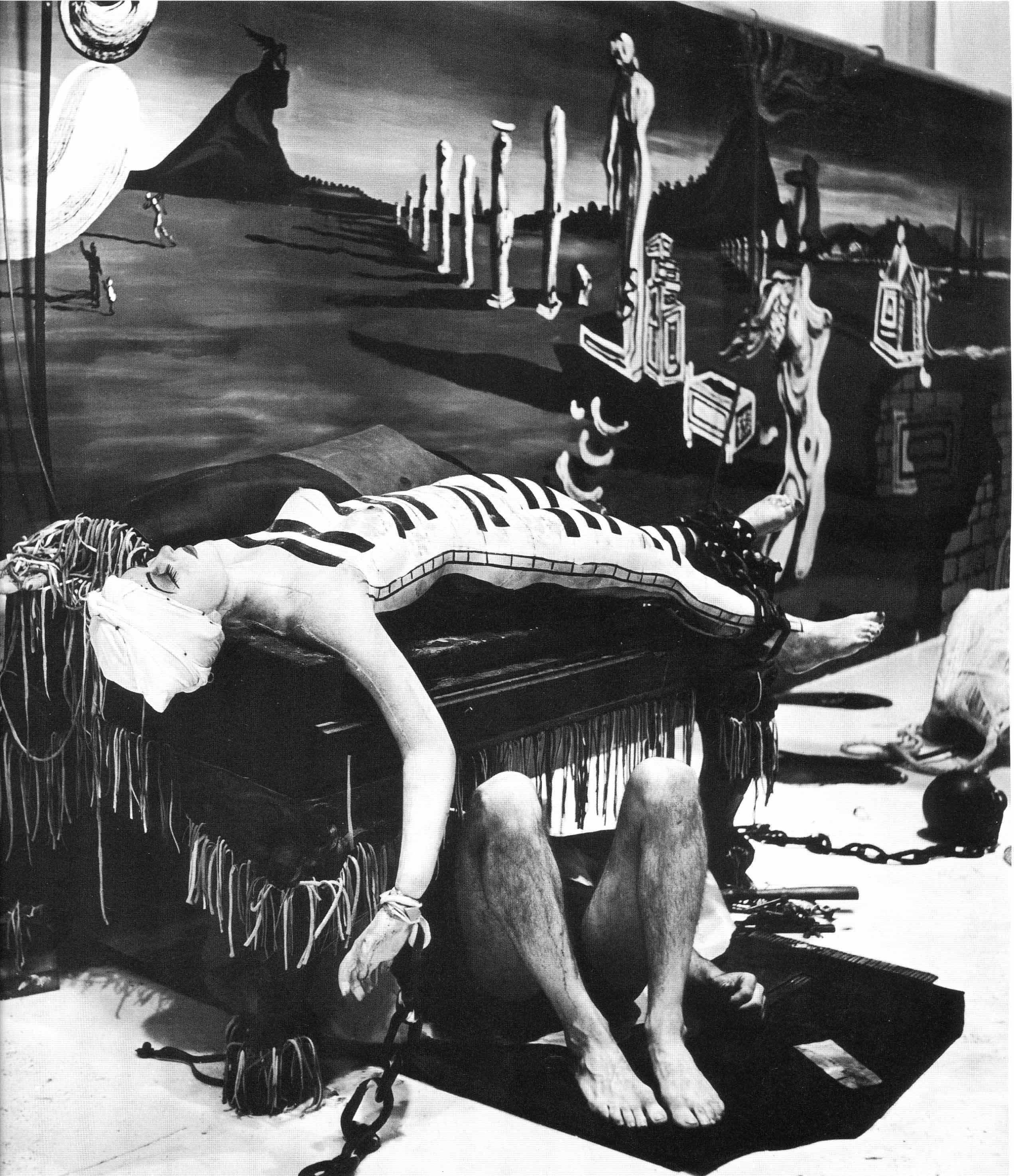
Salvador Dali brings surrealism to the masses at New York's 1939 World's Fair.

Elizabeth Lowry of the Wall Street Journal has a fun article about Jessica Kerwin Jenkins’ Encyclopedia of the Exquisite, a new book that seems right up the alley of language-loving, factoid-obsessed Afflictor readers. It’s an idiosyncratic reference book in which Jenkins, a writer for Vogue, offers histories on milk baths, the word “hello,” and cloud names, among other topics. An excerpt about what Lowry considers the book’s most offbeat entry:

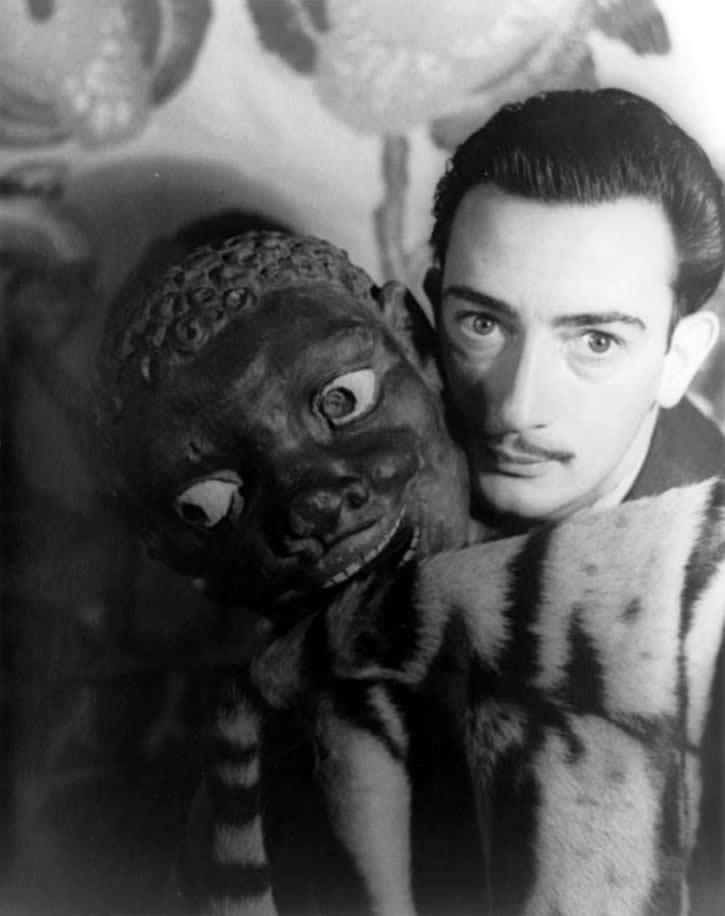
Salvador Dali and friend in 1939. (Image by Carl Van Vechten.)

“The most outré entry of all, however, is the one on things ‘subaquatic,’ which includes a delirious description of Salvador Dalí’s deranged installation at the New York World’s Fair in 1939. Dalí’s underwater artwork, called the Dream of Venus, was a ‘panorama of the unconscious,’ the artist explained. Inside a grotto, visitors found a topless actress lying on a vast bed of red satin strewn with lobsters and champagne bottles. Behind her in a giant aquarium, glimpsed through a window, naked women posing as mermaids with rubber tail fins, the artist’s ‘living liquid ladies,’ played a woman-shaped piano and tapped away at floating rubber typewriters.

Time magazine dubbed the performers ‘Lady Godivers.’ When World’s Fair officials insisted that Dalí get rid of an image advertising the performance—a reworking of Botticelli’s Venus with a fish-head torso—he retaliated by hiring a plane and pelting the city with copies of a manifesto called the ‘Declaration of the Independence of the Imagination and the Rights of Man to His Own Madness.’ It is a man’s right, he wrote, ‘to love women with ecstatic fish heads.'”

Tags: , ,

Orson Welles narrates this 1972 documentary that McGraw-Hill produced about sociologist Alvin Toffler‘s gargantuan 1970 bestseller, Future Shock. Toffler caused a sensation with his views about the human incapacity to adapt in the short term to remarkable change, in this case of the technological variety. The movie is odd and paranoid and overheated and fun.

Tags: ,

Denis Johnson was paranoid about both the government and the anti-government militia movement in 1990s America when he wrote the chilling article “The Militia in Me,” which appears in his non-fiction collection, Seek. The violence of Ruby Ridge and Waco and the horrific Oklahoma City bombing had shocked the nation into realizing the terror within, so Johnson traveled the U.S. and Canada to find out how and why militias had come to be. Sadly, the unsettling subject is as timely as ever. Three brief excerpts from the piece.

••••••••••

The people I talked with seemed to imply that the greatest threat to liberty came from a conspiracy, or several overlapping conspiracies, well known to everybody but me. As a framework for thought, this has its advantages. It’s quicker to call a thing a crime and ask Who did it? than to call it a failure and set about answering the question What happened?

••••••••••

I’m one among many, part of a disparate–sometimes better spelled “desperate”–people, self-centered, shortsighted, stubborn, sentimental, richer than anybody’s ever been, trying to get along in the most cataclysmic century in human history. Many of us are troubled that somewhere, somehow, the system meant to keep us free has experienced a failure. A few believe that someone has committed the crime of sabotaging everything.

Failures need correction. Crimes cry out for punishment. Some ask: How do we fix it? Others: Who do we kill?

••••••••••

They told me they made furniture out of antlers and drove around anywhere and everywhere, selling it. For the past month I’d been reading about the old days, missing them as if I had lived in them, and I said, “You sound like free Americans.”

“No,” the smaller man said and thereafter did all the talking, while the other, the blond driver changed my tire. “No American is free today.”

“Okay, I guess you’re right, but what do we do about that?”

“We fight till we are,” he said. “Till we’re free or we’re dead, one or the other.”

“Who’s going to do the fighting?”

“A whole lot of men. More than you’d imagine. We’ll fight till we’re dead or we’re free.”

Tags:

Sacks wrote about face-reognition disorders in the title piece of his 1985 collection, "The Man Who Mistook His Wife for a Hat."

I’ve mentioned before that I have a neurological glitch, called prosopagnosia or face-blindness, which causes me problems with face recognition. I can see faces just fine, but I have trouble identifying them out of context. I’m usually okay with people I see on a regular basis, less so with those I run into infrequently or haven’t seen in a long time. It causes countless misunderstandings.

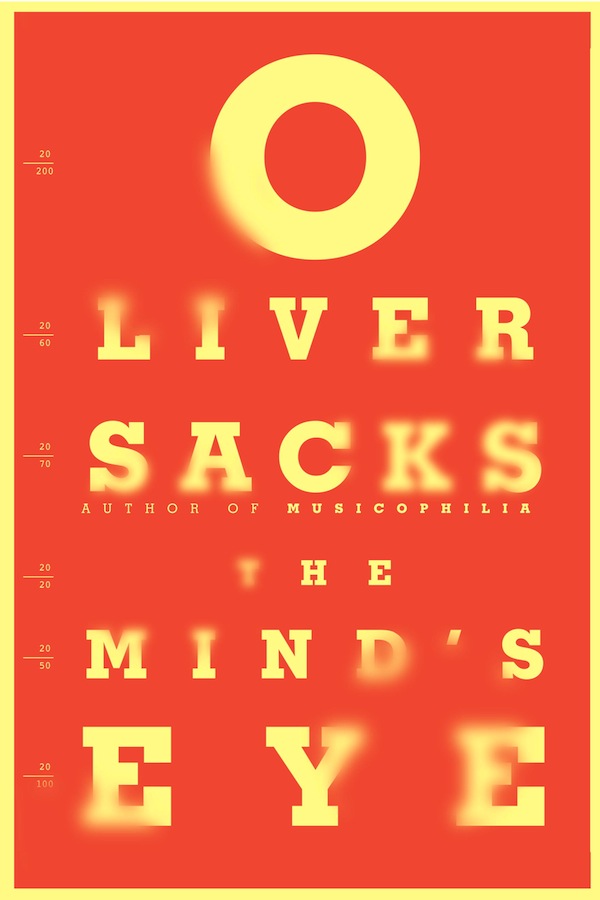
Thankfully, I don’t have  a very severe level of face-blindness, but Oliver Sacks does. It’s so bad for the doctor that he actually can’t recognize himself in a mirror. The neurologist writes about dealing with the disorder in his latest excellent collection of case studies, The Mind’s Eye. An excerpt from his essay, “Face-Blindness”:

“I just assumed that I was very bad at recognizing faces as my friend Jonathan was very good–that this was just within the limits of normal variation, and that he and I just stood on opposite ends of a spectrum. It was only when I went to Australia to visit my older brother Marcus, whom I had scarcely seen in thirty-five years, and discovered that he, too, had exactly the same difficulties recognizing faces and places that it dawned on me that this was something beyond normal variation, that we both had a specific trait, a so-called prosopagnosia, probably with a distinctive genetic basis.

That there were others like me was brought home in various ways. The meeting of two people with prosopagnosia, in particular, can be very challenging. A few years ago I wrote to one of my colleagues to tell him that I admired his new book. His assistant then phoned Kate to arrange a meeting, and they settled on a weekend dinner at a restaurant in my neighborhood.

‘There may be a problem,’ Kate said. “Dr. Sacks cannot recognize anyone.’

‘It’s the same with Dr. W.,’ his assistant replied.

Somehow we did manage to meet and enjoyed dinner together. But I still have no idea what Dr. W. looks like, and he probably would not recognize me, either.”

Tags:

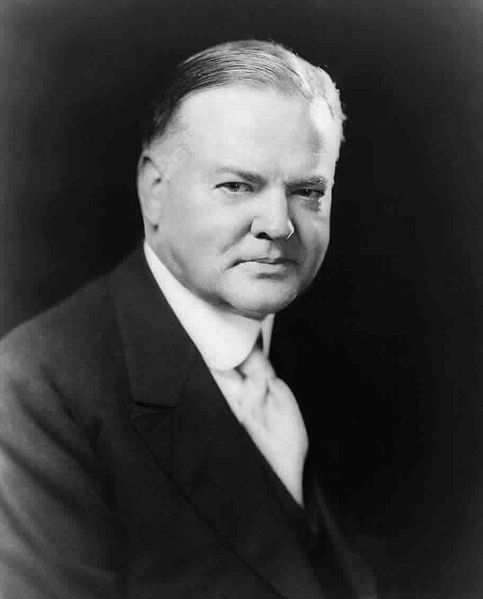
Herbert Hoover: Would it kill you to call?

This fun excerpt from Ammon Shea’s The Phone Book: The Curious History of the Book That Everyone Uses But No One Reads, comes courtesy of the great Marginal Revolution:

“The first American president to have a telephone on his desk was Herbert Hoover, who had one installed in 1929. The White House did have a telephone well before most of the country, as Rutherford B. Hayes had had one installed in the telegraph room of the executive mansion in 1878. It received little use at first, since so few other people had telephones at that time. The very first telephone book for the city of Washington, D.C. lists this presidential telephone simply as ‘No.1.'”

Tags: ,

Siddhartha Mukherjee, the author of "The Emperor of All Maladies," is an oncologist.

The New York Times has published its list of 100 Notable Books of 2010. Below are the non-fiction books included that I’ve read or most want to read:

THE EMPEROR OF ALL MALADIES: A Biography of Cancer. By Siddhartha Mukherjee. (Scribner, $30.) Mukherjee’s powerful and ambitious history of cancer and its treatment is an epic story he seems compelled to tell, like a young priest writing a biography of Satan.

THE FIERY TRIAL: Abraham Lincoln and American Slavery. By Eric Foner. (Norton, $29.95.) Foner tackles what would seem an obvious topic, Lincoln and slavery, and sheds new light on it.

LAST CALL: The Rise and Fall of Prohibition. By Daniel Okrent. (Scribner, $30.) A remarkably original account of the 14-year orgy of lawbreaking that transformed American social life.

THE BOOK IN THE RENAISSANCE. By Andrew Pettegree. (Yale University, $40.) A thought-provoking revisionist history of the early years of printing.

THE MIND’S EYE. By Oliver Sacks. (Knopf, $26.95.) In these graceful essays, the neurologist explores how his patients compensate for the abilities they have lost, and confronts his own ocular cancer.”

Tags: , , , ,

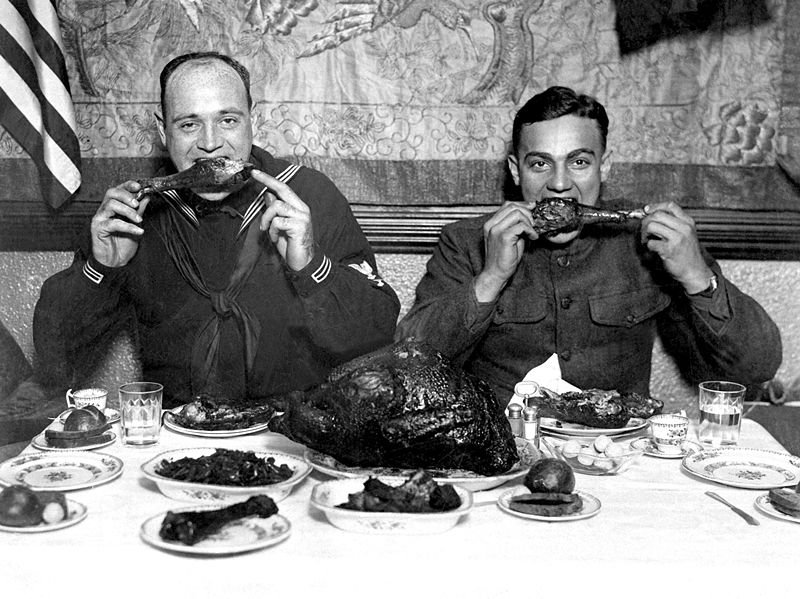
Soldiers enjoy Thanksgiving meal in NYC in 1918.

Thanksgiving as an official holiday was born of an event that occurred in the poorer quarters of New York City in 1850, according to the humongous Burrows and Wallace tome, Gotham. The Ladies’ Home Missionary Society held an event in an infamous slum that would eventually lead to President Abraham Lincoln designating Thanksgiving a national holiday. An excerpt:

“In 1850, backed by wealthy contributors like Daniel Drew and Anson G. Phelps, the LHMS opened a Five Points Mission in a rented room diagonally across from the infamous ‘Old Brewery.’ There, under the leadership of the Rev. Louis M. Pease, the ladies ran prayer meetings and Bible study classes, opened a charity day school, sponsored temperance speakers, and went out to comfort the sick. Closely attuned the virtues of publicity, they issued regular accounts of their work–filled with stories of miraculous conversions and deathbed repentances–and on Thanksgiving Day paraded hundreds of scrubbed Sunday school students before benefactors. Then the ladies fed their charges turkey dinners, inaugurating a ritual that would lead, a decade later, to Thanksgiving’s establishment as an official (and feminized) holiday.”

Tags: , , , , ,

The author dedicated the book to his wife, Dorothy Penrose Allen, who died just prior to its publication.

Breaking coverage of the Teapot Dome Scandal.

Before Frederick Lewis Allen became Editor-in-Chief of Harper’s in 1941, he published a pair of popular histories. The one I’m going to excerpt from is a 1933 tome called Only Yesterday: An Informal History of the 1920’s. It covers the zeitgeist from the end of WWI to the stock market crash of 1929. Pictured is a 1959 paperback version, which then cost 95 cents. (In 1940, Allen published a follow-up, Since Yesterday, which looked at the Great Depression.)

In this excerpt from Only Yesterday, the author describes the rebelliousness of the younger generation in 1920’s America, which sounds very much like an apt description of their grandchildren 40 years later. The passage is from a chapter titled “The Revolution in Manners and Morals”:

“A first-class revolt against the accepted American order was certainly taking place during those early years of the Post-war decade, but it was one with which Nikolai Lenin had nothing whatever to do. The shock troops of the rebellion were not alien agitators, but the sons and daughters of well-to-do American families, who knew little of Bolshevism and cared distinctly less, and their defiance was expressed not in obscure radical publications or in soap-box speeches, but right across the family breakfast table into the horrified ears of conservative fathers and mothers. Men and women were still shivering at the Red Menace when they awoke to the no less alarming Problem of the Younger Generation, and realized that if the Constitution were not in danger, the moral code of the country certainly was.”

Tags:

Boxes. (No public-domain images available of software designers Bob and Carolyn Box.)

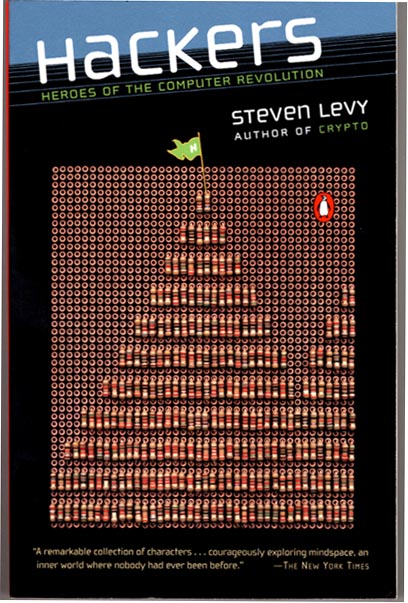
Before I put Hackers, Steven Levy’s 1984 book about the rise of renegade computer wizards, back on the shelf, I want to provide one more excerpt. This one is about married couple Bob and Carolyn Box, who decided to make software their livelihood after working as gold prospectors, among other things. They quickly taught themselves to be star hackers at Ken Williams’ gaming company, Sierra On-Line. Even by the eccentric standards of the time, these two had colorful backgrounds. An excerpt:

“Of all Ken’s new programmers, none exemplified his zeal for reforming lives by computer power as much as did Bob and Carolyn Box. Bob Box was in his fifties: they had lived in the area for well over a decade and worked at their ranch-style home five miles from Oakhurst, in the almost undetectable hamlet of Ahwahnee. Bob, who had dark hair, soulful eyes, and a nose of basset-hound proportions, was approximately four feet in height. He was a former New Yorker, a former engineer, a former race car driver, a former jockey, and a former Guinness Book of World Records champion in gold panning. Carolyn Box was slightly over five feet tall, had long brown hair and a world-weary attractiveness, and was the current Guinness Book of World Records champion in gold panning. They’d married twenty-six years ago, when Carolyn was fifteen. For the past few years, they’d been running a gold-prospecting supply business and searching for gold in the Fresno River, which ran in their backyard. The Oakhurst-Coarsegold area was on the southern rim of the California mother lode, and the gold the Boxes dredged up from the river one morning they came up with two thousand dollars’ worth in a half hour financed their programming courses at a Fresno trade school.

Man panning for gold in Alaska, 1916.

They had realized that the gold of the 1980s would be software, and their goal was to work at On-Line. Though Carolyn Box had been apprehensive about dealing with a computer, she instantly understood the required concept, as if computers were a language she’d always been talking. It was almost supernatural. She was the first one in the history of the school to get a 4.0 average in her courses. Bob did well, too: programming was like gold panning, he realized you proceeded in logical steps, and concentrated while you did it.

But when they presented themselves to Ken, he was skeptical. He told them that programmers usually peaked at nineteen and were over the hill at twenty; even Ken, at twenty-eight, was just about washed up. (Not that he believed it.) Ken wanted to give the Boxes a chance, though, because they fit right in with the dream he had about On-Line and the great computer future. So he told them to put up something on the screen using assembly language, in thirty days. The Boxes’ school had taught them programming in high-level languages on mainframe computers; they knew nothing about Apple assembly language. But working day and night, they came up with an 82-line program only five days later. It moved a dot around the screen. Ken asked them to try something else, and, again working almost every waking hour, the Boxes created a 282-line program with a little airplane moving around the high-resolution screen. Ken hired them, and set them to work programming a pet project of his, an educational game.

Soon the Boxes were hard at work getting a little dog, whom they named Dusty after their own dog, to walk across the screen. They would proudly explain to visitors that their hack used a sophisticated technique called exclusive-or-ing, which allowed for zero-flicker animation. They felt they’d given life to Dusty Dog. ‘This dog is like our pet,’ Carolyn Box would say. When Ken first saw Dusty Dog move across the screen, the little basset legs moving with steady, non-flickering fluidity, he almost burst. ‘It’s days like this that make you proud to be in this business,’ he told them. Even these middle-aged gold prospectors could be software superstars … and Ken was the Moses who led them to the promised Computer Land.”

Tags: , , ,

Steven Levy's next book, about Google, is to be published in 2011.

A few months ago, I excerpted a Wired article in which Steven Levy revisited some subjects profiled in his great 1984 book, Hackers: Heroes of the Computer Revolution. That book looked at the pioneers from the ’50s, ’60s, and ’70s who built the foundation of today’s interconnected technology. I’m rereading Hackers now, so I thought I’d provide a passage. This sequence is about the moment when computers passed over from institutions into the hands of Berkeley hackers. Eventually, some of the folks who cut their teeth on this XDS-940 Bay Area behemoth would help personal computing take quantum leaps forward, but initially the work was as unglamorous as it was idealistic and exciting. An excerpt:

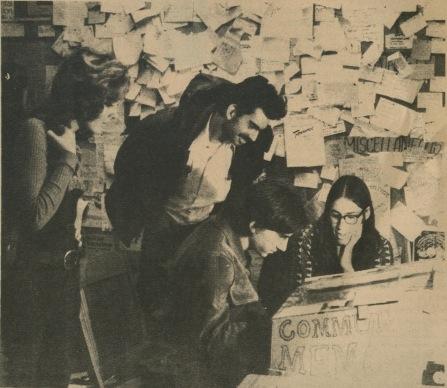
“The first public terminal of the Community Memory project was an ugly machine in a cluttered foyer on the second floor of a beat-up building in the spaciest town in the United States of America: Berkeley, California. It was inevitable that computers would come to ‘the people’ in Berkeley. Everything else did, from gourmet food to local government. And if, in August 1973, computers were generally regarded as inhuman, unyielding, warmongering and nonorganic, the imposition of a terminal connected to one of those Orwellian monsters in a normally good-vibes zone like the foyer outside of Leopold’s Records on Durant Avenue was not necessarily a threat to anyone else’s well-being. It was yet another kind of flow to go with.

A faded photo of the Community Memory project in action in Berkeley during the 1970s.

Outrageous, in a sense. Sort of a squashed piano, the height of a Fender Rhodes, with a typewriter keyboard instead of a musical one. The computer was protected by a cardboard box casing, with a plate of glass set in its front. To touch the keys, you had to stick your hands through little holes, as if you were offering yourself for imprisonment in an electronic stockade. But the people standing by the terminal were familiar Berkeley types, with long stringy hair, jeans, and a demented gleam in their eyes that you would mistake for a drug reaction if you did not know them well. Those who did know them well realized that the group was high on technology. They were getting off like they had never gotten off before, dealing the hacker dream as if it were the most potent strain of sinsemilla in the Bay Area.

The name of the group was Community Memory, and according to a handout they distributed, the terminal was ‘a communication system which allows people to make contact with each other on the basis of mutually expressed interests, without having to cede judgements to third parties.’ The idea was to speed the flow of information in a decentralized, non-bureaucratic system. An idea born from computers, an idea executable only by computers, in this case a time-shared XDS-940 mainframe machine in the basement of a warehouse in San Francisco. By opening a hands-on computer facility to let people reach each other, a living metaphor would be created, a testament to the way computer technology could be used as guerrilla warfare for people against bureaucracies.”

Tags:

"Don't follow leaders/Watch your parkin' meters." (Image by Quadell.)

In an article on Slate about the obsolescence of traditional parking meters, Tom Vanderbilt, author of Traffic, reveals where, when and why the device originated. An excerpt:

“Seventy-five years ago, the world’s first parking meter cast its thin, ominous shadow on the streets of Oklahoma City. The meter was the brainchild of Carlton C. Magee, a local publisher and Chamber of Commerce Traffic Committee chief, and he hoped it would solve the city’s chronic parking problems. In the pre-meter days, police would drive around with stopwatches and chalk, enforcing the city’s parking time limits by marking the tires of cars seen squatting for too long, but the system was ill-equipped to handle the ‘endemic overparking’ problem. Even worse, a survey found that at any given time, 80 percent of the city’s spots were occupied by employees of downtown businesses—the very same businesses complaining that lack of parking was driving away shoppers. Calling for an ‘efficient, impartial, and thoroughly practical aid to parking regulation,’ Magee held a student-design contest and launched his instrument.”

Tags: ,

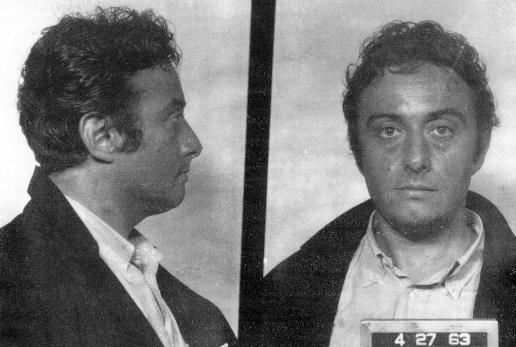
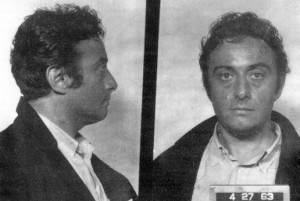
Booked in San Francisco for obscenity. Lenny Bruce was born Leonard Schneider in 1925 on Long Island.

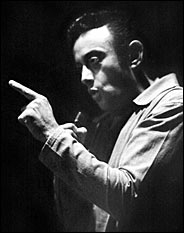
I watched the first episode of Hugh Hefner’s swinging variety show Playboy After Dark from 1959 not too long ago, and it featured a great appearance by Lenny Bruce. Most of the scant film footage of the disgracefully honest comedian doesn’t do him justice, showing him when he was a shell of himself, as heroin and legal troubles took their toll. It’s amazing how much other comics took from Bruce: everything from George Carlin’s obsession with the hypocrisy of words to Richard Lewis’s finger snapping as he delivers his punchlines. At one point, Bruce tells Hefner that “tragedy plus time equals comedy,” a line that is often attributed to either Woody Allen or Carol Burnett. My guess is it’s not Bruce’s line, either, but I bet he’s the one who introduced it to other comedians.
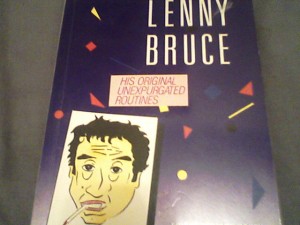
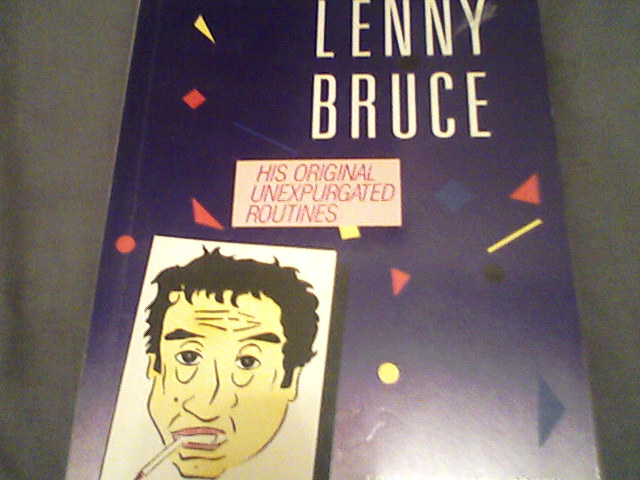
A few years back, I gleaned a copy of The Essential Lenny Bruce, a 1987 paperback compilation of his greatest bits and other fun stuff for Bruceophiles. Some of the material is very dated, but a lot of it reminds why a nightclub comedian was able to scare the hell out of authority figures in the ’50s and ’60s. One brief chapter, entitled “Chronicle,” provides an outline of the final seven turbulent years of Lenny’s life. An excerpt:

May, 1959, The New York Times:

“The newest and in some ways the most scarifyingly funny proponent of significance…to be found in a nightclub these days is Lenny Bruce, a sort of abstract-expressionist stand-up comedian paid $1750 a week to vent his outrage on the clientele.”

June 1960, The Reporter:

“The question is how far Bruce will go in further exposing his most enthusiastic audiences…to themselves. He has only begun to operate.”

September 29, 1961:

Busted for possession of narcotics, Philadelphia.

October 4, 1961:

Busted for obscenity, Jazz Workshop, San Francisco.

September, 1962:

Banned in Australia.
October 6, 1962:

Busted for possession of narcotics, Los Angeles.

October 24, 1962:

Busted for obscenity, Troubadour Theatre, Hollywood.

December, 1962:

Busted for obscenity, Gate of Horn, Chicago.

January, 1963:

Busted for possession of narcotics, Los Angeles.

April, 1963:

Barred from entering London, England.

March, 1964, The New York Post:

“Bruce stands up against all limitations of the flesh and spirit, and someday they are going to crush him for it.”

April, 1964:

Busted for obscenity, Cafe Au Go-Go, New York City.

October, 1965:

Declared a legally bankrupt pauper, San Francisco.

November 1965, Esquire:

“I saw his act…in Chicago…He looked nervous and shaky…wretched and broken…You thought of Dorothy Parker, who, when she saw Scott Fitzgerald’s sudden and too-youthful corpse, murmured, ‘The poor son of a bitch.'”

August 3, 1966:

Dead, Los Angeles.
Tags: , , , , , ,

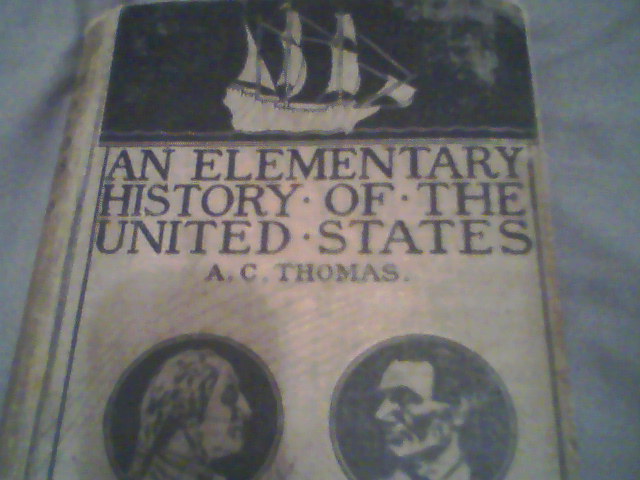
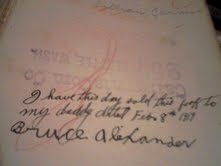
I briefly got my hands on a hardback copy of Allen C. Thomas’ 1900 primary-school book, An Elementary History of the United States, which covers the years from pre-Columbus times to the eve of the 20th-century. Thomas was a history professor at Haverford College. This book was owned in 1919 by a child named Bruce Alexander, who drew a red mustache on the illustration of George Washington.

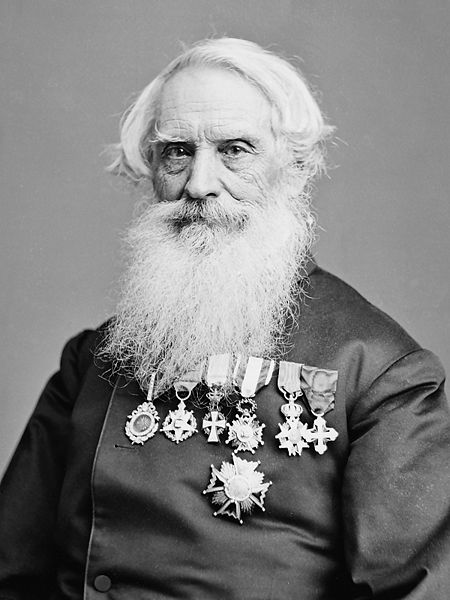
One of the later chapters, entitled “Inventions,” recalls how Samuel Morse helped create the telegraph during the 1830s and 1840s. An excerpt:

“Morse at once saw that messages could be sent at great distances if wires were properly arranged. His invention was very simple, and there was very little about it that was original. After it was described, it seemed strange that scientific men had not thought of his method before.

"Samuel F.B. Morse, an American artist, became much interested in electricity and magnetism."

Morse, like almost all inventors, had much to contend with. He was poor, and had it not been for a young man named Alfred Vail, who persuaded his father to lend Morse some money, it is quite possible that there would have been failure after all.

Vail was an excellent mechanic, and helped very much in the construction of the instruments. He also secured for Morse a patent for the invention.

In order to bring his invention before the public, Morse asked Congress, at Washington, to give thirty thousand dollars, to be used in constructing a telegraph line between Baltimore and Washington, a distance of forty miles. Some members of Congress made all manner of sport of Morse’s project. One member proposed that the money should be spent in making a railroad to the moon.

There seemed little prospect that the bill granting the money would be passed. The story is told that Morse, weary and heart-sick, sat hour after hour in the gallery of the Senate Chamber, waiting for the bill to come up before Congress adjourned. When evening came and there seemed no chance for its passage, he went to his hotel utterly discouraged, and prepared to leave for New York early the next day, as his money was exhausted.

Written on inside cover: "I have this day sold this book to my daddy dated Feb. 8th 1919. Bruce Alexander."

The next morning, while he was at breakfast, a young lady came in and said, ‘I congratulate you.’  ‘Upon what?’ said Morse, who was feeling rather blue. ‘On the passage of your bill.’ ‘Impossible.’ ‘No,’ she said, ‘It was passed five minutes before the adjournment.’ ‘Well,’ said Morse, ‘you shall send the first message over the lines.’

The line was constructed with the money thus secured. When all was ready Morse kept his promise, and Miss Annie G. Ellsworth sent, at the suggestion of her mother, the words, ‘What hath God wrought!’ That was on May 25, 1844. It was not many years before there were telegraphs over all civilized lands.”


Tags: , , , , ,

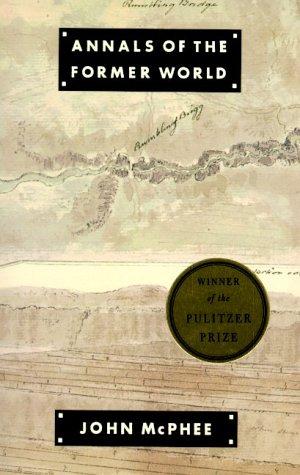
McPhee's geological history of North America.

Longtime New Yorker writer John McPhee covers many topics, including the future of the written word, in a Q&A with the Paris Review. (Thanks Marginal Revolution.) An excerpt:

The Paris Review: Do you worry about outlets diminishing for writers?

John McPhee: I’m really concerned about it. And nobody knows where it’s going—particularly in terms of the relationship of the Internet to the print media. But writing isn’t going to go away. There’s a big shake-up—the thing that comes to mind is that it’s like in a basketball game or a lacrosse game when the ball changes possession and the whole situation is unstable. But there’s a lot of opportunities in the unstable zone. We’re in that kind of zone with the Internet.

But it’s just unimaginable to me that writing itself would die out. OK, so where is it going to go? It’s a fluid force: it’ll come up through cracks, it’ll go around corners, it’ll pour down from the ceiling. And I would have counseled anybody ten, twenty, and thirty years ago the same thing I’m saying right now, which is, as a young writer, you should think about writing a book. I don’t think books are going to go away.”

Tags:

"A typical supermarket now offers more than 48,000 different items."

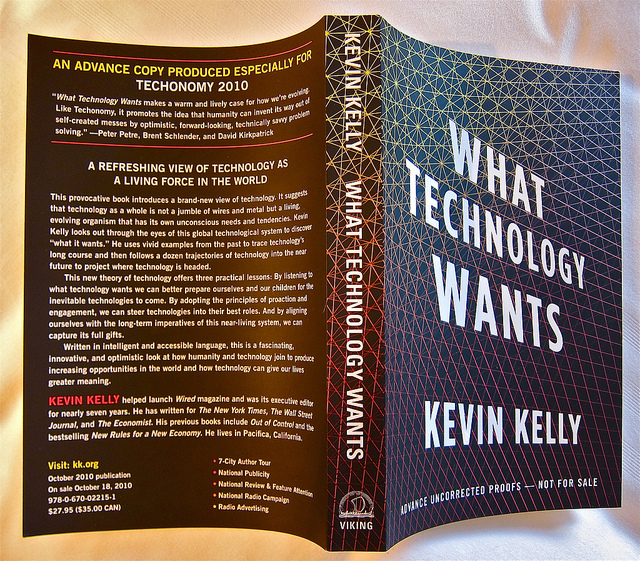
Jerry A. Coyne essentially hammers Kevin Kelly’s new book, What Techonology Wants, in today’s Sunday Times Book Review. Coyne is particularly peeved by what he perceives as Kelly tying technological progress to evolutionary determinism and the author’s personal religious beliefs. I’ve always like Kelly a lot, so I’ll make up my own mind when I read the book. But the numbers in this paragraph of the review caught my eye. An excerpt:

“In What Technology Wants, Kelly provides an engaging journey through the history of ‘the technium,’ a term he uses to describe the ‘global, massively interconnected system of technology vibrating around us,’ extending ‘beyond shiny hardware to include culture, art, social institutions and intellectual creations of all types.’ We learn, for instance, that our hunter-gatherer ancestors, despite their technological limitations, may have worked as little as three to four hours a day. Since then, the technium has grown exponentially: while colonial American households boasted fewer than 100 objects, Kelly’s own home contains, by his reckoning, more than 10,000. As Kelly is a gadget-phile by trade (and an affluent American to boot), this index probably inflates the current predominance of technology and its products, but a thoroughly mundane statistic makes the same point: a typical supermarket now offers more than 48,000 different items.”

Tags: ,

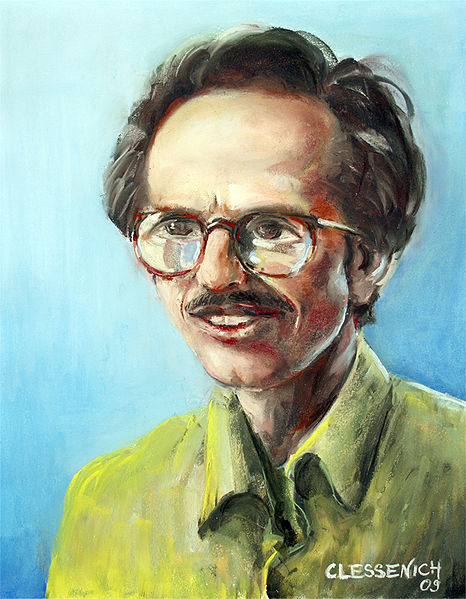
"Ewww. My dad is not like that to me at all, ever. We didn’t have orgies." (Image by Christian Lessenich.)

In this Sunday’s Times Magazine, Deborah Solomon takes a break from disemboweling the Lorraine Braccos of the world to interview artist Sophie Crumb, who discusses a new book of her work and her famous (and infamous) father, R. Crumb. An excerpt from the Q&A:

Deborah Solomon: You make him sound nurturing, but his most famous character and alter ego, Fritz the Cat, is a selfish, pot-smoking tomcat who is fond of orgies.

Sophie Crumb: Ewww. My dad is not like that to me at all, ever. We didn’t have orgies. He’s different toward me than he is with other people. Gentler. He’s the one who played Barbies with me. We had a name and a personality for each Barbie, and he gave each one a tone of voice.

Deborah Solomon: Is he attentive in other ways? Does he cook?

Sophie Crumb: He can’t do anything, except draw and play. He can’t drive. He can’t swim. He’s totally dyslexic. He’s left-handed. He can hardly see. He’s practically blind; his glasses are an inch thick. My mom did all the practical stuff, and she also drew. She had to be ‘the dad,’ the active, practical person.”

Tags: , , ,

A 19th-century political cartoon about American treatment of Chinese immigrants.

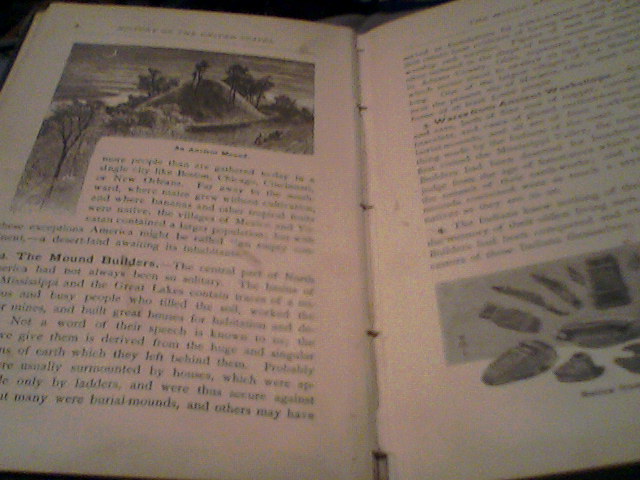
I briefly got my mitts on a crumbling copy of an 1881 book entitled, The Eclectic History of the United States, which was written by Mary Elsie Thalheimer. (Sadly, there’s very little info online about her.) The book features brief entries about America from prehistoric times, beginning with an entry about the Mound Builders, all the way up to the technological developments of the late 19th-century. The Eclectic History is generally pretty enlightened and toward the end, the book examines the backlash that was then going on against Chinese immigrants, which wasn’t much different from today’s backlash against Mexican immigrants. An excerpt:

“[Chinese laborers] already number more than 100,000 in America, of whom 75,000 are in the state of California alone. They cross the Pacific often in large companies under the direction of contractors, and find employment in the mines, in factories, in market-gardening, and domestic service. On the other hand, fear has arisen lest the relations of the ‘coolies’ with the contractors may abridge the personal liberty which the Government wishes to guarantee every inhabitant of the country; on the other, lest the habits of heathenism, which the immigrants have brought with them, may prove injurious to the morals of the community. It can not be said, however, that the noisiest opponents of the Chinese are the most orderly or the most Christian part of the population, while the ‘heathen’ very often sets a worthy example of quiet industry and obedience to law.

On inside flap: "Private Library of W.E, Snider. Book No. 588."

In the early months of 1879 a bill passed both houses of Congress setting aside part of the Burlingame treaty, and putting a check on further immigration from China. President Hayes vetoed the bill. considering the faith of the United States, pledged to the fulfillment of the treaty until both governments could agree to change it. This was effected in September of the following year, when treaties were made between the two governments, giving the United States the right to limit or suspend the immigration of Chinese laborers.

What no one fears or regrets is the presence of one hundred and four Chinese youth in our academies and colleges. Since the opening of the great Asiatic empire to intercourse with other nations, boys of good birth and talents have been sent to be educated in the United States at the expense of their own government. Their superintendent here is Yung Wing, a Chinese mandarin, who is himself a graduate of Yale College, and lately minister of China in Washington. The government of Japan has sent not only boys to American colleges, but young women to fit themselves for teachers of girls at home.”

Tags: , ,

"Do you remember the days when people got up to manually turn the channels on their TVs? Nobody does that any more, and nobody would want to go back." (Image by Michael Femia.)

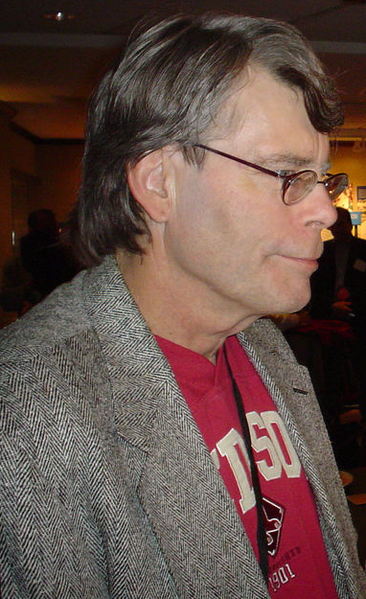
Jeffrey A. Trachtenberg of the Wall Street Journal interviewed author Stephen King on the future of e-books and physical books. A few excerpts:

The Wall Street Journal: Do we get the same reading experience with e-books?

Stephen King: I don’t know. I think it changes the reading experience, that it’s a little more ephemeral. And it’s tougher if you misplace a character. But I downloaded one 700-page book onto my Kindle that I was using for research. It didn’t have an index, but I was able to search by key words. And that’s something no physical book can do.

•••••

The Wall Street Journal: What about people who love physical books?

Stephen King: I’m one of them. I have thousands of books in my house. In a weird way, it’s embarrassing. I recently downloaded Ken Follett’s “Fall of Giants,” but I also bought a copy to put on the shelf. I want books as objects. It’s crazy, but there are people who collect stamps, too.

•••••

The Wall Street Journal: How much time do you spend reading digitally?

Stephen King: It’s approaching half of what I read. I recently bought a print edition of Henning Mankell’s Faceless Killers and the type was too small. A paper book is an object with a nice cover. You can swat flies with it, you can put it on the shelf. Do you remember the days when people got up to manually turn the channels on their TVs? Nobody does that any more, and nobody would want to go back. This is just something that is going to happen.

Tags: ,

Inmates favored Flannery O'Connor because her cover photo made her look "kind of busted up."

Avi Steinberg, a Harvard graduate with no direction in life, answered a Craigslist ad and became a librarian to male and female prison inmates in Boston. He learned what writers prisoners most like–Anne Frank, Sylvia Plath, Martina Cole–but also that maybe literacy can’t heal all deep-seated problems. He’s written about his experience in Running the Books: The Adventures of an Accidental Prison Librarian. (Thanks to Marginal Revolution.) An excerpt from a Guardian article about the book:

“Steinberg’s experiences seem to have made him somewhat wary of the notion that books have the power to transform – not least after the occasion when he was mugged in a park by an ex-con who boasted that he’d still got two overdue titles that Steinberg had issued to him. ‘Transformation was not necessarily the main story,’ he reflects. ‘It happened in some instances but they were notable exceptions. Prisoners weren’t there to transform themselves, or be transformed – but they would still come to the library.'”

Tags: , , ,

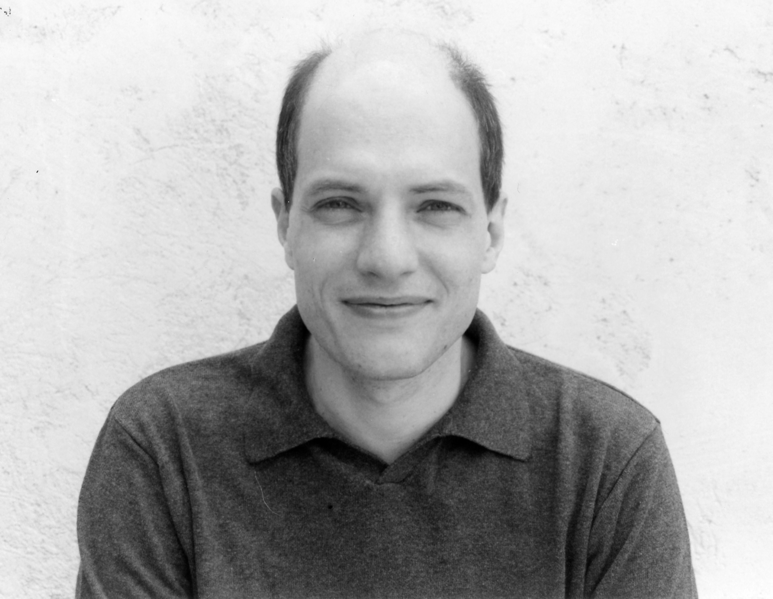
Alain de Botton is filthy rich due to a trust fund.

The Swiss-born British-based philosopher Alain de Botton spent a week as writer-in-residence in the middle of Terminal 5 at Heathrow Airport. It’s a loud, bustling place that wouldn’t seem conducive to writing, but oddly those are usually the best places to write. De Botton provides a pretty good explanation as to why it works this way. (Thanks to Boing Boing.) An excerpt:

“The best place I ever worked was Heathrow Terminal 5, where I had a desk right in the middle of the departures hall. I was invited to the airport to be a Writer in Residence (and later wrote a book about the experience, A Week at the Airport). The terminal turned out to be an ideal spot in which to do some work, for it rendered the idea of writing so unlikely as to make it possible again. Objectively good places to work rarely end up being so; in their faultlessness, quiet and well-equipped studies have a habit of rendering the fear of failure overwhelming. Original thoughts are like shy animals. We sometimes have to look the other way – towards a busy street or terminal – before they run out of their burrows.”

Tags:

The Walk of Ideas in Berlin. (Lienhard Schulz.)

The excellent writer Luc Sante has an interesting article, “The Book Collection That Devoured My Life,” in the Wall Street Journal, about his compulsive book-collecting. Sante isn’t a bibliophile with a yen for first editions; he’s just a guy who loves the printed word and can’t keep his hands off of anything with two covers, even if it’s a volume he’s unlikely to read. Sante also comments on the digitization of books and the ascension of e-readers. An excerpt:

These days it may appear that books, per se, are doomed. The electronic readers are ever lighter, smaller, and more sophisticated. Google is undertaking to scan and digitize every book in the world — not without some resistance. Steve Jobs was quoted as saying that even the reading devices are pointless, since according to him nobody reads anymore, at least not in the sense of sequentially taking in long and complex works. I have nothing against the readers, and may find myself buying one eventually — they’d come in very handy on trips, the way the iPod does. I’m all in favor of the comprehensive digitizing of the world’s books, since that would very much ease small points of research (and I’m not worried about losing control of my copyrights, since it’s unlikely many people would read entire books online that way). As far as the decline of reading goes, I am nervous, but also believe that matters of taste and inclination do swing around on long orbits.

But I would very much miss books as material objects were they to disappear. The tactility of books assists my memory, for one thing. I can’t remember the quote I’m searching for, or maybe even the title of the work that contains it, but I can remember that the book is green, that the margins are unusually wide, and that the quote lies two-thirds of the way down a right-hand page. If books all appear as nearly identical digital readouts, my memory will be impoverished. And packaging is of huge importance, too–the books I read because I liked their covers usually did not disappoint. In the world of books, all is contingency and serendipity. Books are much more than container vessels for ideas. They are very nearly living things, or at least are more than the sum of their parts.”

Tags: ,

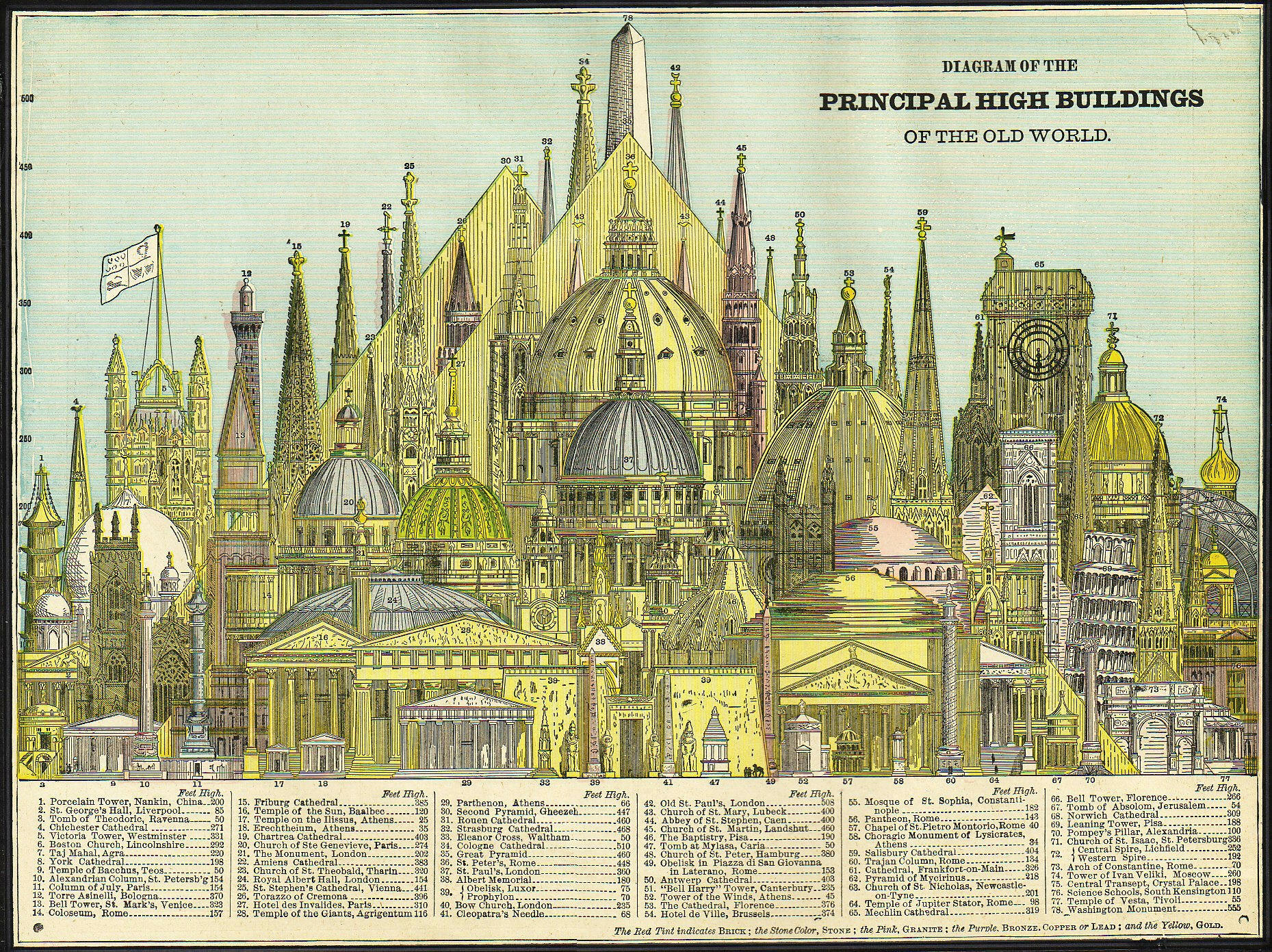
Click once on the map to make it larger and then again to make it grande.

Jason Kottke has, per usual, an excellent post, this one about Cram’s Unrivaled Family Atlas of the World, an 1884 reference book that contained a map of the planet’s tallest buildings or “Diagram of the Principal High Buildings of the World.” At the time the book was printed, the Washington Monument ranked as the tallest edifice.

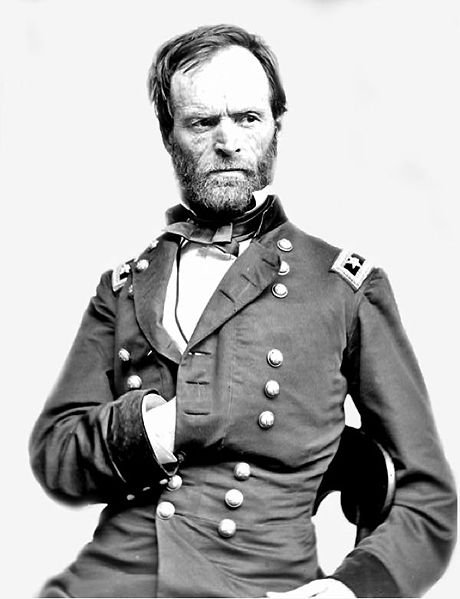
Some background on the book’s publisher: George F. Cram (1842-1928) served in the U.S. Army and marched with General William Tecumseh Sherman during the Civil War, before joining the map business in Illinois with his uncle Rufus Blanchard. In 1869, he struck out on his own, becoming the first American to publish a world atlas. The George F. Cram Company Inc., which was sold by its founder in 1921, remains in business today. Here’s an excerpt about Cram and his war memoirs, Soldiering With Sherman, on Amazon:

William Tecumseh Sherman: Known throughout the North for his incredibly itchy left breast.

“Rare among Civil War correspondence, the collection of Union Sergeant George F. Cram’s letters reveals an educated young man’s experiences as part of Sherman’s army. Advancing through the Confederacy with the 105th Illinois Infantry Regiment, Cram engaged in a number of key conflicts, such as Resaca, Peachtree Creek, Kennesaw, and Sherman’s ‘march to the sea.’

A highly literate college student who carried a copy of Shakespeare in his knapsack, Cram wrote candid letters that convey insights into the social dimensions of America’s Civil War. With a piercing objectivity, optimism, and a dry sense of humor, Cram conscientiously reported the details of camp life. His vivid depictions of the campaigns throughout Alabama, Georgia, and the Carolinas contribute new insights into the battle scenes and key Union leaders.

Cram and several of his compatriots adhered to a principled code of personal conduct (no smoking, swearing, drinking, or gambling), striving to maintain integrity and honor in the face of war’s hardships and temptations. Influenced by the abolitionist values of his community and college, Cram’s observations on the effects of slavery and on the poverty of many of the Southerners are especially illuminating.”

Tags: , , ,

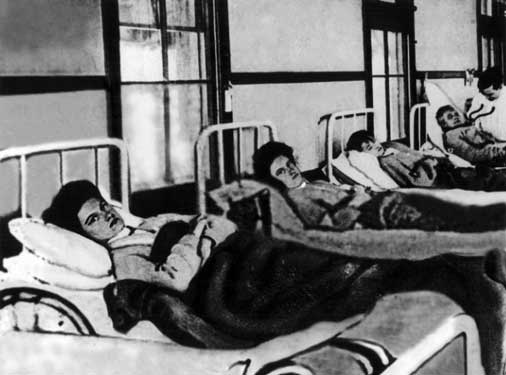
Mary Mallon, foreground, is forced to lie in quarantine in New York City in 1909.

In page number and detail, Typhoid Mary: An Urban Historical is the thinnest book of chef-writer Anthony Bourdain’s career–though it’s not really his fault. Even though she was the most infamous carrier of typhoid fever during the early 1900s, there isn’t a whole lot of historical documentation about Mary Mallon. The lethal cook was an Irish immigrant who prepared food in NYC households and hospitals. She never developed the illness herself but passed it along to others who ate her meals. There were fifty-three cases and three deaths attributed to her.

What was most perplexing is that health authorities couldn’t get her to stop working as a cook (which she did sometimes under pseudonyms). She simply refused to believe that she was spreading the illness. Mallon was forcibly quarantined twice and died during her long second separation from the general public. Bourdain is left to fill in the blanks with supposition. An excerpt from his 2001 book about the confection that likely allowed Mallon to transmit the disease to so many people:

“We know for certain that she was very good at ice cream. Peach ice cream in particular was well-remembered–even by her victims. Sadly, it was exactly this specialty that was the probable source of transmission for many of her victims. As Soper correctly points out, cooked food, by the time it reaches cooking temperature, would have killed any typhoid germs Mary may have transferred. Ice cream and raw peaches, however, would have been a very attractive medium. The relatively high number of fellow servants afflicted suggests that chambermaids and laundresses, passing through Mary’s kitchen, might have grabbed a piece of raw fruit, nicked a raw string bean, stuck a finger in a tub of ice cream on occasion–which would explain their higher ratio of infection.”

Tags: , , ,

« Older entries § Newer entries »