Books

You are currently browsing the archive for the Books category.

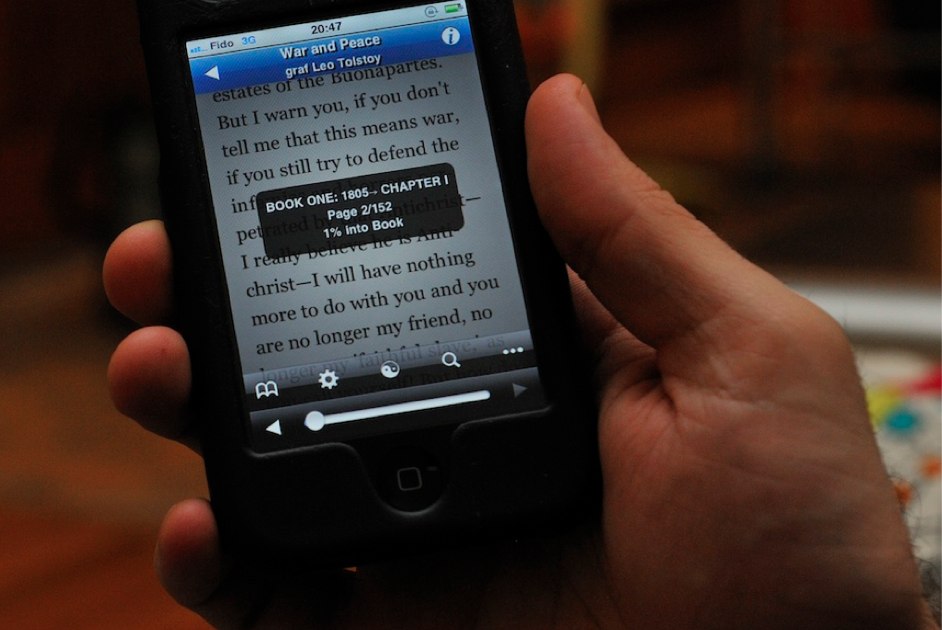
The sales of e-books have flattened this year in the U.S., and even declined worldwide, surprisingly. An excerpt from Nicholas Carr’s list of six reasons why this might be so:

“1. We may be discovering that e-books are well suited to some types of books (like genre fiction)  but not well suited to other types (like nonfiction and literary fiction) and are well suited to certain reading situations (plane trips) but less well suited to others (lying on the couch at home). The e-book may turn out to be more a complement to the printed book, as audiobooks have long been, rather than an outright substitute.

2. The early adopters, who tend also to be the enthusiastic adopters, have already made their move to e-books. Further converts will be harder to come by, particularly given the fact that 59 percent of American book readers say they have ‘no interest’ in e-books, according to the Bowker report.

3. The advantages of printed books have been underrated, while the advantages of e-books have been overrated.”

Tags:

New York City has always been a gold rush but one that usually created something beautiful or exciting in the pursuit. I’m not sure that’s true anymore. When people reflexively refer to it as the “greatest city in the world,” I wince. It’s still interesting, sure, but Manhattan is now primarily the playground of the wealthy and tourists. And the things New York did that made it special, the media and such, have been diminished, dispersed and democratized by technology. You’re still special to me, New York, but we’re growing apart.

Maybe too many of the really creative people I know have dispatched to the West Coast and other points or perhaps these are the dark thoughts one has when hastily crossing the street in Soho on a Tuesday night to avoid a horde of middle-school girls in Daisy Dukes who frantically await a Kardashian poster-signing.

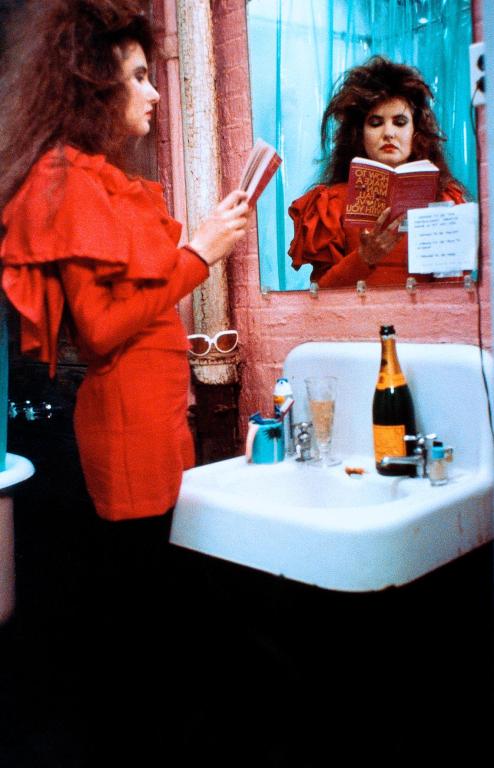
The opening of Dinah Prince’s 1986 New York magazine cover story on Tama Janowitz, written at a time when New York decided that money could buy it happiness but when literature still had a place in the discussion:

“On the day before her party at the Milkbar, Tama Janowitz was in a panic. Lisa E. who had organized the affair to celebrate Janowitz’s new book of short stories, Slaves of New York, called to say she had just bought a new dress. It was long and blue and had big sexy cutouts beneath each breast.

‘I was like, ‘She’s got a new dress?!‘ Janowitz recalls. I really wanted one.’

After Janowitz hung up, the 29-year-old author tried to tell herself she would be perfectly presentable. She could wear her black velvet miniskirt and the sequined top an ex-boyfriend had got her from fashion designer Stephen Sprouse in exchange for a painting. 

‘It was cute; I mean, it would have been fine,’ she says.

Janowitz’s newest beau, a Texas oilman named Brady Oman, was in town for the party. When he heard about Lisa E.’s dress, he took Janowitz shopping in the East Village and SoHo.

‘We ran all over looking for dresses,’ Janowitz says. ‘He took me into IF, and, I mean, they were really pretty. But $1,500 for some froufrou thing?’

Two hours before the party, Janowitz called Paige Powell, an advertising associate at Interview.

‘Paige, I have nothing to wear!’ she said.

Powell met the writer and her new boyfriend at Texarkana with an armload of dresses. In the ladies’ room, Janowitz modeled a scarlet dress with one bare shoulder and a tutu that billowed from her hip.

She walked out in the dress, and it met with the approval of everyone in the restaurant,’ Powell says.

After finishing her steak, Janowitz headed to the party.

‘Oh God, I tried to be nervous and thought, Well, I’ll just pretend it’s a party for somebody else,’ she says. She descended the red neon-bathed staircase into the Milkbar and instantly became the center of attention. She was photographed by Newsweek, Details, and NY Talk. Patrick McMullan, a downtown paparazzo, posed her beside comedian Howie Mandel.

‘I was like, I didn’t know who the person was,’ she says. ‘Some geek who obviously didn’t know who I was and didn’t care to know who I was. But there he was, getting his picture taken with me. I said to him, ‘Howie, I’m waiting for my left breast to fall out of my dress.’ He was totally uninterested.’

Back in her tiny Horatio Street studio apartment by 2 A.M., Janowitz and Oman folded out the couch and went to bed. A few hours later, the shower curtain collapsed in the bathroom. This set off a series of ear-piercing howls from her Yorkshire terriers, Lulu and Beep-beep. Finally, after everyone got back to sleep, the phone rang at 6 A.M.

‘Some guy called looking for his boyfriend,’ she says, ‘thinking I had run off with his boyfriend.’

Such is the stuff of Tama Janowitz’s life.”
Tags: , , , , , , ,

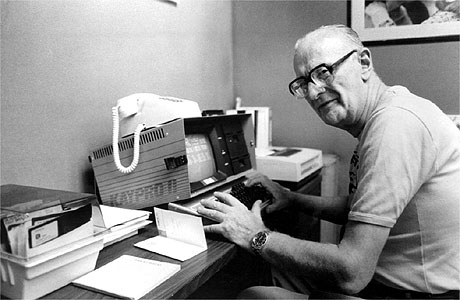
In 1995, just as the Internet began entering the public consciousness with a fury, Tod Mesirow interviewed Arthur C. Clarke. Part of that discussion has now been posted at the Los Angeles Review of Books. An excerpt about 2001: A Space Odyssey:

Tod Mesirow:

The idea of an intelligent computer, an artificial intelligence like HAL, do you think we’ll achieve that?

Arthur C. Clarke

Oh, I don’t think there’s any question of that. I think that the people that say we will never develop computer intelligence — they merely prove that some biological systems don’t have much intelligence.

Tod Mesirow:

What was it like to create the scene when HAL is dying in 2001?

Arthur C. Clarke:

Well, Danny Curry deserves most of the credit for that, and by the way, when I switch off my computer you hear HAL say, “My mind is going.” It happens every time I switch it off. [laughs]

Tod Mesirow:

Was 2001 an interesting experience? You’re planning what would happen if —

Arthur C. Clarke:

Well, it was, you know, a fascinating experience, for many reasons. I was moonlighting at Time Life where I was doing a book called Man and Space. This was in 1964 when the Apollo Program, you know, had been announced. But, no one really believed we would go to the moon and, still sort of had a skepticism. And also, Stanley and I had to outguess what would happen, I believe — this may not be true, maybe Stanley’s publicity department — he’s supposed to have gone to Lloyd’s, taken an insurance against Martians being discovered before the film was released. [laughs] Well, I don’t think — I don’t know how Lloyd’s would have carried the odds on that one. [laughs] So, anyway, we were writing the film, before we had any close-ups of the moon’s surface. We had to guess what it might be like, and there are all sorts of problems. I — we — I think we did pretty well. One or two mistakes. For instance, we show the moon as more rugged then in fact it turned out to be. It turned out to be sort of smooth and sort of sandblasted.”

Tags: , ,

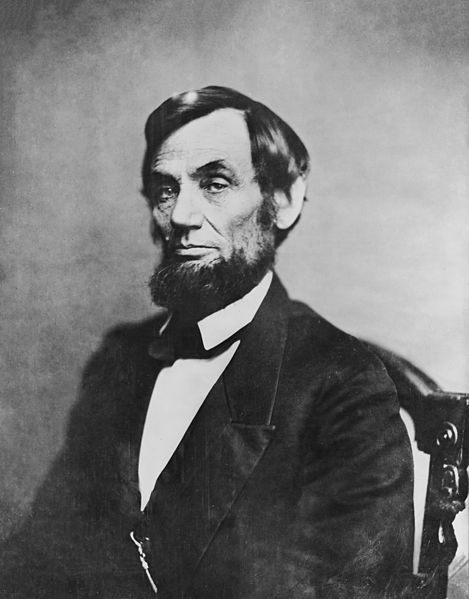
Lincoln.

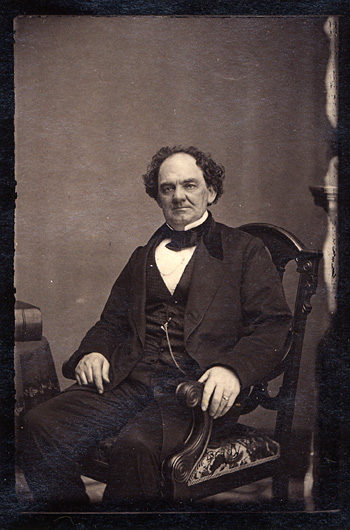
Barnum.

Barnum.

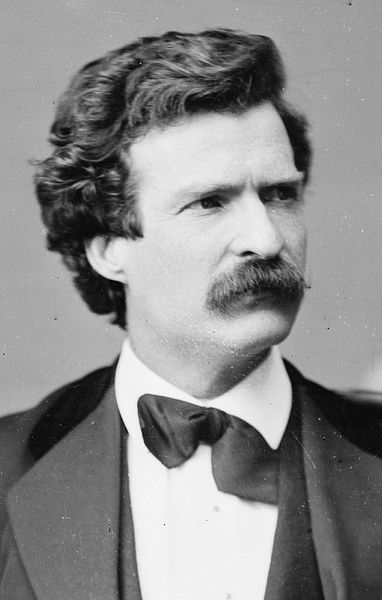
Twain.

Twain.

The opening of Caleb Crain’s New York Times Book Review piece about Mathew Brady, Robert Wilson’s portrait of the Civil War-era’s chief portraitist:

“Death was early American photography’s killer app. Since the first pictures required long exposures, it was convenient to have a subject that held still. There was a psychological angle as well. A 19th-­century photographer reported that when he visited a town in upstate New York, all the residents welcomed him except the blacksmith, who at first reviled him as a swindler. But then the blacksmith’s son drowned — and the blacksmith came begging for an image of the boy.

The tale is retold by Robert Wilson, the editor of The American Scholar, in Mathew Brady, his patient and painstaking new biography of the portraitist and Civil War photographer. Brady wasn’t one to overlook a sales tool. ‘You cannot tell how soon it may be too late,’ he warned in an 1856 ad that ran in The New York Daily Tribune, advising readers to come sit for a portrait while they still could. When the Civil War began in 1861, thousands of new soldiers and their families became acutely aware that it might soon be too late. They were willing to pay a dollar apiece for tintypes, and Wilson reports that at Brady’s Washington studio, ‘the wait was sometimes hours long.’

Brady’s other great marketing device was celebrity. His business strategy consisted of photographing politicians, generals and actors for free and displaying their likenesses in a gallery to attract paying customers. His own celebrity was self-made. He was born into an Irish immigrant’s family near Lake George in upstate New York around 1823, and seems to have first entered the photography business in the 1840s as a manufacturer of the leather cases that held the early photographs known as daguerreotypes — fine-grained ­images developed on copper plates that have an almost holographic quality.”

Tags: , ,

At Amazon, David Blum, the editor of Kindle Singles, has a very smart (and completely free) interview with President Obama about the state of the economy. The President touches on the sweeping changes that automation has brought to the job market, though he doesn’t go nearly far enough in acknowledging the seismic shifts that are occurring. Globalization may have been just as disruptive thus far, but it’s automation that will ultimately have a deeper and more-lasting impact. And I don’t know that community college courses will remedy that. An excerpt:

President Obama:

Where I think we have fallen is in staying focused on the benefits of an economy where growth is broad based and everybody has opportunity. We have increasingly resigned ourselves to a ‘winner-take-all’ economy–again, driven a lot by technology and globalization, where folks at the very top are doing very well and the broad middle class of people, people trying to get into the middle class, are having a tougher and tougher time. You will see that in every profession. You see that in journalism. It used to be that there were local newspapers everywhere. If you wanted to be a journalist, you could really make a good living working for your hometown paper. Now you have a few newspapers that make a profit because they’re national brands, and journalists are having to scramble to piece together a living, in some cases as freelancers and without the same benefits that they had in a regular job for a paper. What’s true in journalism is true in manufacturing and is true in retail. What we have to recognize is that those old times aren’t coming back. We’re not going to suddenly eliminate globalization. We’re not going to eliminate technology. If people are going to book their vacation over the Internet, they’re not going to go down to a local travel agent. If that’s the case, then where are the new opportunities? Where are the new industries? With just a few modest, but really important, changes to government policy, we could be doing an awful lot better than we’re doing right now. American living standards would still be higher than folks a generation ago. People might have different jobs, so instead of a guy who had just graduated from college walking over to the local plant, like his dad did, and getting a good middle class job doing blue collar manufacturing work, now he might have to go to a community college and get more specialized training because he’s working as a computer technician. The opportunities are available. We just haven’t done a good job of making sure they’re accessible to all people.”

Tags: ,

Reza Aslan, the Muslim author of  Zealot: The Life and Times of Jesus of Nazarethwas welcomed warmly by Lauren Green at Fox News over the weekend. I’ll go the cynical route and guess that he knew what he was walking into and that it would be priceless promotion for his book. If so, good on him. Well played, sir. Aslan just did an Ask Me Anything at Reddit. A few exchanged follow.

____________________________

Question:

What do you think about the new direction the Pope is taking the Vatican in?

Reza Aslan:

I think this Pope is the best thing that has happened to Catholicism since Vatican II. Then again I’m biased as a proud product of a Jesuit education.

____________________________

Question:

Why did some cultures embrace monotheism, while others looked to polytheism?

Reza Aslan:

Monotheism is actually a very recent phenomenon. In the hundred thousand year history of human religious experience, monotheism is perhaps three thousand years old. That’s because the idea of a single god being responsible for both good and bad, light and dark, is something that the ancient mind had a very difficult time accepting. And no wonder! The only way that monotheism finally “stuck” is thru the concept of angels and demons. In other words, it was only when all the other “gods” were demoted into spiritual beings responsible for different aspects of the human condition that people were able to accept the idea one GOD in charge of all the lower spiritual beings.

____________________________

Question:

Serious question, if aliens visit earth, what happens to religion?

Reza Aslan:

We would simply absorb their reality into our religious traditions they we have done with every major scientific breakthrough (the earth revolves around the sun!).

____________________________

Question:

If you had to do it all over again, would you have used a pseudonym so that the focus would be more on the content of the book than on who is qualified to write it? Did you expect the media to react this way? Or did it take you by surprise?

Reza Aslan:

Yes. I would have written the book under the pseudonym: JK Rowling.

Tags: ,

From “Inside the Immortality Business,” Josh Dean’s excellent Buzzfeed report about cryonics, a passage about the first-ever “cryonaut”:

“At one end of Alcor’s conference room is a picture window of the kind you see in police interrogation rooms. It’s typically covered with a metal screen, but Mike Perry, the company’s Patient Care Director, pushed a cartoonishly large red button and it raised to reveal the cold storage room, which if you’ve been on a brewery tour, basically looks like that. On the far wall is a row of towering silver canisters containing four patients each (claustrophobia is not a concern of the cryopreserved) — plus another eight or 10 frozen heads, which are stored in crock-pot-sized cans and stacked in the canister’s center channel. Each capsule, Perry explained, is cooled to 320 degrees below zero Fahrenheit using liquid nitrogen and requires no electricity. Canisters operate on the same basic principle as a thermos bottle; they are double-walled with a vacuum-sealed space between the two walls and are known as dewars, for the concept’s Scottish inventor, James Dewar. The chamber itself is filled with liquid nitrogen and is replenished weekly from a huge storage container, though in truth, Perry noted, that’s overkill. A test canister once went eight months before all of the nitrogen finally boiled off, so there’s little reason to worry about your frozen loved ones thawing should the nightwatchman fall asleep on the job.

Perry, who is gaunt, wispy-haired, and hunchbacked (a condition he hopes will be fixed when he’s revived down the road), drew my attention to another unit, horizontal and obviously much older, on the floor just on the far side of the glass. This container once held Dr. James Bedford who, in 1967, became the world’s first-ever cryonaut, as the fervent press at the time dubbed him. Perry said that security reasons prevented him from identifying precisely which of the new capsules now contained Bedford, or for that matter the baseball legend Ted Williams, who is the most famous ex-person publicly known to be in Alcor’s care. (Walt Disney, contrary to urban legend, was never frozen. Neither was Timothy Leary, who was once an Alcor member, but later canceled.)

Cryonics as a concept has existed in science-fiction for more than a century, but it traces its real-world origins to the 1964 publication of The Prospect of Immortality. That book, written by a physics and math professor from Atlantic City named Robert Ettinger, opened with a bold proclamation: ‘Most of us now living have a chance for personal, physical immortality.’ Ettinger went on to lay out, in a very specific and carefully constructed scientific argument, why humans should immediately begin to consider this plausible alternative. He wrote: ‘The fact: At very low temperatures it is possible, right now, to preserve dead people with essentially no deterioration, indefinitely.’ Ettinger called this ‘suspended death’ and the overall movement he hoped would grow up to support it ‘the freezer program,’ an ominous phrase that didn’t stick for obvious reasons. (In a later book, he called it being ‘preserved indefinitely in not-very-dead condition,’ which is so hilariously stiff as to sound bureaucratic.)”

Tags: , , ,

In a New York Review of Books essay, Martin Scorsese sums up the new literacy:

“Now we take reading and writing for granted but the same kinds of questions are coming up around moving images: Are they harming us? Are they causing us to abandon written language?

We’re face to face with images all the time in a way that we never have been before. And that’s why I believe we need to stress visual literacy in our schools. Young people need to understand that not all images are there to be consumed like fast food and then forgotten—we need to educate them to understand the difference between moving images that engage their humanity and their intelligence, and moving images that are just selling them something.

As Steve Apkon, the film producer and founder of the Jacob Burns Film Center in Pleasantville, New York, points out in his new book The Age of the Image, the distinction between verbal and visual literacy needs to be done away with, along with the tired old arguments about the word and the image and which is more important. They’re both important. They’re both fundamental. Both take us back to the core of who we are.

When you look at ancient writing, words and images are almost indistinguishable. In fact, words are images, they’re symbols. Written Chinese and Japanese still seem like pictographic languages. And at a certain point—exactly when is ‘unfathomable’—words and images diverged, like two rivers, or two different paths to understanding.

In the end, there really is only literacy.”


Tags: ,

I love books so much, but when was the last time I stepped inside of a library? I can’t even remember. From a piece by Paul Sawers at the Next Web in which Internet pioneer Vint Cerf thinks about the future of libraries:

“As with the newspaper industry, Google has had an immeasurable impact on how people access information. Indeed, most petty arguments are settled in seconds now thanks to smartphones and search engines.

When asked what he saw as the ‘future’ of libraries, he expressed deep concern about the way information will be stored and passed through generations. Books, if looked after, can be passed down through many generations – but the rate at which technology is evolving leads to some concerns about so-called bit-rot.

‘You have no idea how eager I am to ensure that the notion of library does not disappear – it’s too important. But the thing is, it’s going to have to curate an extremely broad range of materials, and increasingly digital content,’ says Cerf.

‘I am really worried right now, about the possibility of saving ‘bits’ but losing their meaning and ending up with bit-rot,’ he continues. ‘This means, you have  a bag of bits that you saved for a thousand years, but you don’t know what they mean, because the software that was needed to interpret them is no longer available, or it’s no longer executable, or you just don’t have a platform that will run it. This is a serious, serious problem and we have to solve that.'”

Tags: ,

From a New York Times article by David Streitfeld, a reminder that paperback books, now endangered by digital books, were once themselves considered a disruptive technology:

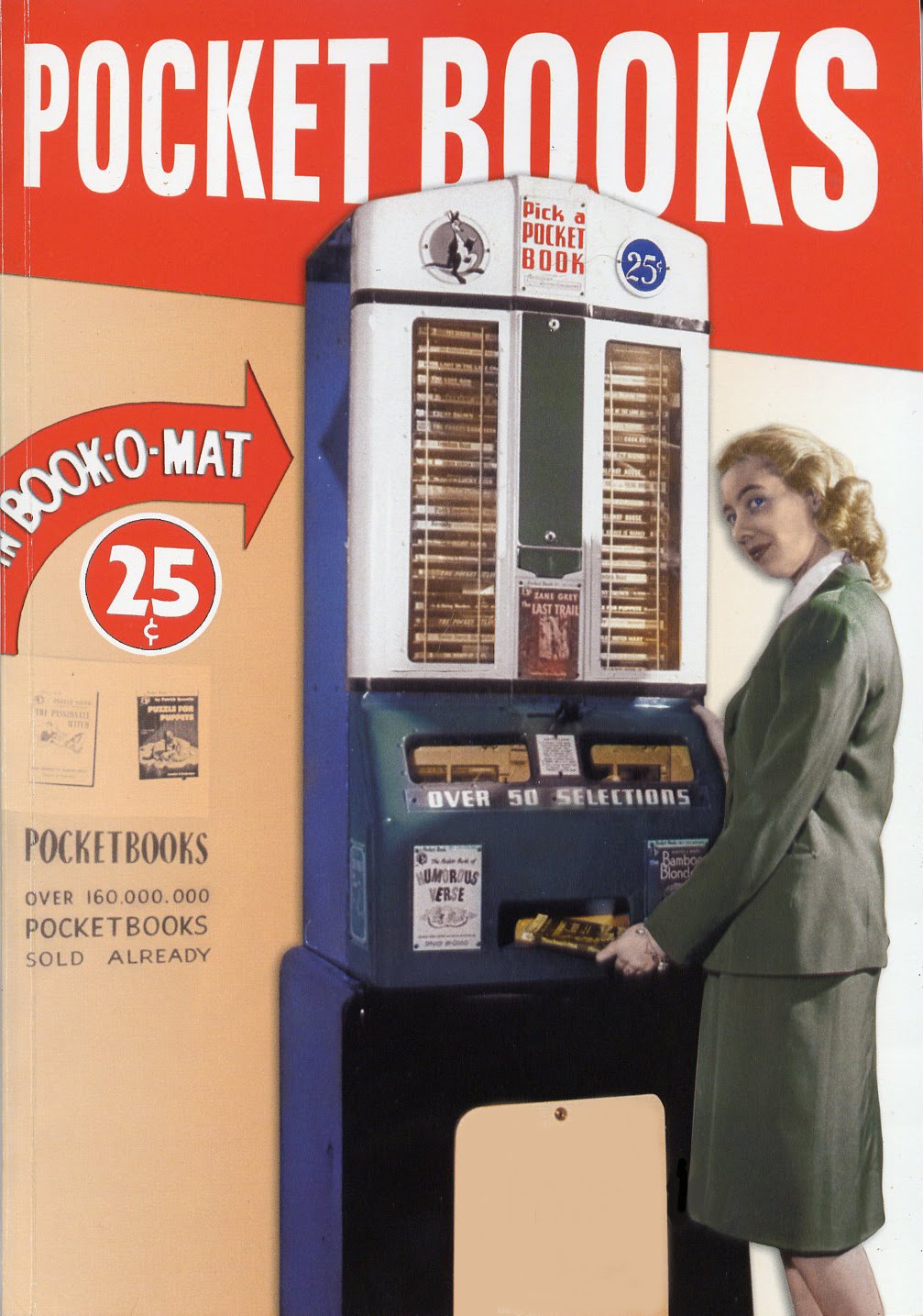
“Penguin and Random House were innovators who made paperbacks into a disruptive force in the 1940s and ’50s. They were the Amazons of their era, making the traditional book business deeply uneasy. No less an authority than George Orwell thought paperbacks were of so much better value than hardbacks that they spelled the ruination of publishing and bookselling. ‘The cheaper books become,’ he wrote, ‘the less money is spent on books.’ Orwell was wrong, but the same arguments are being made against Amazon and e-books today. Amazon executives are not much for public debate, but they argue that all this disruption will ultimately give more money to more authors and make more books more widely available to more people at cheaper prices, and who could argue with any of that? This was not a prospect that many on Wednesday were putting much faith in.”

Tags: ,

You know that when I write that I’m less than sanguine about the chances of Barnes & Noble or any brick-and-mortar bookstore chain that I’m talking what I think is happening and not what I wish were happening, right? There are great advantages to e-readers, but I would love to see physical stores thrive. I just don’t see how that occurs. But not everybody is as dour as I am. From Julie Bosman in the New York Times:

“John Tinker, an analyst for the Maxim Group, said the retail stores were still an attractive property, something that had been obscured by missteps from the digital division. Mr. Lynch, who came to Barnes & Noble with a background in technology and e-commerce rather than book-selling, spent most of his time focused on the digital side of the company. Mr. Riggio has expressed support of the Nook business to employees, but has always devoted his energies to old-fashioned retail book-selling.

“The huge losses and the huge noise on the Nook side are masking a very interesting business on the retail side,’ Mr. Tinker said. ‘If there’s one thing that Riggio is good at, it’s running stores.'”

Tags:

Remember earlier this year when I posted about Barnes & Noble announcing it would cut only a small percentage of its stores over the next decade, as if the chain were capable of controlling the sweep of history? Things continue to get stickier. From Matthew Yglesias at Slate:

“Obviously Michael Huseby isn’t going to save Barnes & Noble. Because Barnes & Noble is a very successful chain of bookstores, except the number of people who want to buy physical books is plummeting. A digital bookstore can stock a much larger inventory with almost no warehousing costs, and can deliver the book of your choice to you within seconds. What’s more, a Kindle Paperwhite or a iPad Mini is lighter than a book and yet can contain many books, greatly facilitating travel. Even better, you can highlight passages of your digital books and annotate them and then have all your annotations available to you on all your digital devices. The only real value of physical books at this point is a kind of nostalgia-soaked experience, and people want to experience that at a friendly independently owned bookstore not an impersonal chain.”

Tags: ,

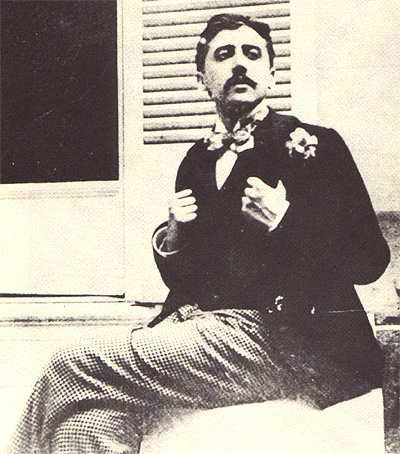
Marcel Proust, who was a subject of photography after dying, was taken with telephony during life. The opening of Clara Byrne’s Forbes piece about the novelist’s relationship with this disruptive technology:

“‘The telephone, a supernatural instrument before whose miracles we used to stand amazed, and which we now employ without giving it a thought, to summon our tailor or order an ice cream,’ wrote Marcel Proust in his much discussed but less read novel In Search of Lost Time. So what can a dead French novelist tell us about new technology? As it turns out, the answer is quite a lot.

Proust was a keen observer and user of new technologies from the telephone to the motorcar and plane, all of which came into common usage over the lifetime of his epic novel. The author even subscribed to a service which allowed members to listen to plays and concerts over the phone, a sort of 19th century Netflix but he is at his sharpest on the social impact of that new communication technology known as the telephone.”

Tags: ,

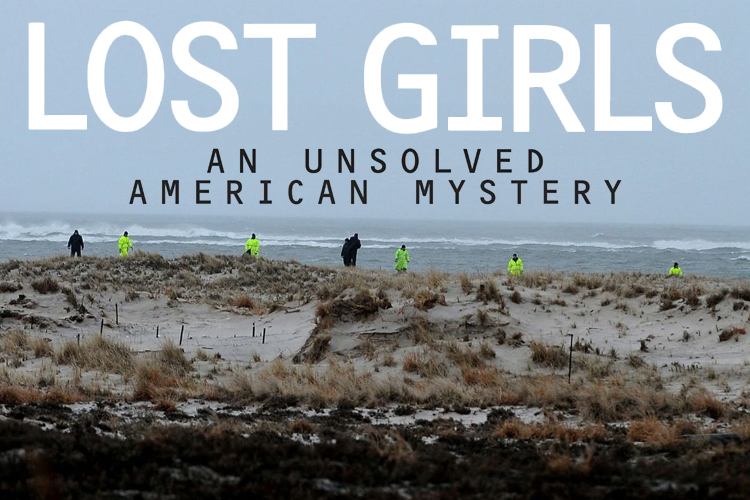
If Robert Kolker’s book, Lost Girls: An Unsolved American Mystery, to be published this month, is anywhere near as good as his piece on the same topic in the New York Times, he’ll have turned out something pretty special. An excerpt from the NYT article:

“In 2010, Maureen Brainard-Barnes’s body was one of four uncovered close by one another in the sand dunes of Gilgo Beach, Long Island, wrapped in burlap. Three years later, the Long Island serial killer case remains unsolved, even as six more sets of remains have been discovered nearby along Ocean Parkway and farther east. The first four bodies were identified as women in their 20s — just like another woman, Shannan Gilbert, who had disappeared three miles from where the four bodies in burlap were found. These five women clearly had much in common. Maureen Brainard-Barnes, Melissa Barthelemy, Shannan Gilbert, Megan Waterman and Amber Lynn Costello all grew up in struggling towns a long distance from Long Island. And they all were escorts who discovered an easy entree into prostitution online.

It had seemed enough, at first, for some to say that the victims were all prostitutes, practically interchangeable — lost souls who were gone, in a sense, long before they actually disappeared. That is a story our culture tells about people like them, a conventional way of thinking about how young girls fall into a life of prostitution: unstable family lives, addiction, neglect.

But in the two years I’ve spent learning about the lives of all five women, I have found that they all defied expectations. They were not human-trafficking victims in the classic sense. They stayed close to their families. They all came to New York to take advantage of a growing black market — an underground economy that offered them life-changing money, and with a remarkably low barrier to entry. The real temptation wasn’t drugs or alcohol, but the promise of social mobility.

The Web has been the great disrupter of any number of industries, transforming the way people shop for everything, and commercial sex has been no exception.”

Tags: , , , , ,

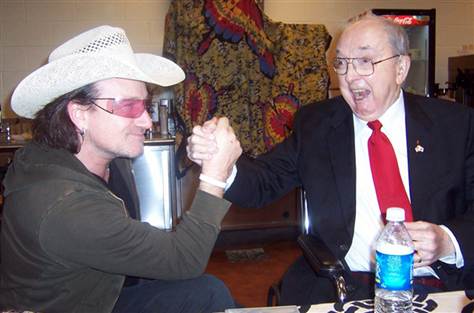
You have to rationalize a lot if you’re going to be Bono. You have to make allowances. You can’t nitpick. You need to embrace scoundrels as well as the sainted. You actually have to convince yourself that the scoundrels have a saint within them. You must believe in large corporations–even own a stake in some–that don’t treat the downtrodden particularly well, the very downtrodden you say you stand with. It’s a tangled web you weave. You look at it as playing the inside game to try to improve the world, making small sacrifices to benefit the big picture.

But Harry Browne, in The Frontman, his excoriation of U2’s lead singer, looks at it differently. From Terry Eagleton in the Guardian:

One result of his campaigning has been a kind of starvation chic. In this impressively well-researched polemic, Browne recounts how Ali Hewson, Bono’s wife, praised the work of her company’s Paris-based clothes designer for being influenced by dusty African landscapes. She admired ‘the way some of the clothes look like they’ve been worn before and sort of restitched … to incorporate the continent, in a sense.’ Hewson’s Messianic husband, or ‘the little twat with the big heart.’ as Viz magazine once dubbed him, has been trying to incorporate Africa into his image for a good few decades now. Like Geldof, he inherited the social conscience of the 1960s without its political radicalism, which is why he has proved so convenient a front man for the neo-liberals.

In fact, as Browne points out, he has cosied up to racists such as Jesse Helms, whitewashed architects of the Iraqi adventure such as Tony Blair and Paul Wolfowitz, and discovered a soulmate in the shock-doctrine economist Jeffrey Sachs. He has also brownnosed the Queen, sucked up to the Israelis, grovelled at the feet of corporate bullies and allied himself with rightwing anti-condom US evangelicals in Africa. The man who seems to flash a peace sign every four seconds apparently has no problem with the sponsorship of the arms corporation BAE. His consistent mistake has been to regard these powers as essentially benign, and to see no fundamental conflict of interests between their own priorities and the needs of the poor. They just need to be sweet-talked by a charmingly bestubbled Celt. Though he has undoubtedly done some good in the world, as this book readily acknowledges, a fair bit of it has been as much pro-Bono as pro bono republico.

If Bono really knew the history of his own people, he would be aware that the Great Irish Famine of the 1840s was not the result of a food shortage. Famines rarely are. There were plenty of crops in the country, but they had to be exported to pay the landlords’ rents. There was also enough food in Britain at the time to feed Ireland several times over. What turned a crisis into a catastrophe was the free market doctrine for which the U2 front man is so ardent an apologist. Widespread hunger is the result of predatory social systems, a fact that Bono’s depoliticising language of humanitarianism serves to conceal.

Browne’s case is simple but devastating.” (Thanks Browser.)

Tags: , , ,

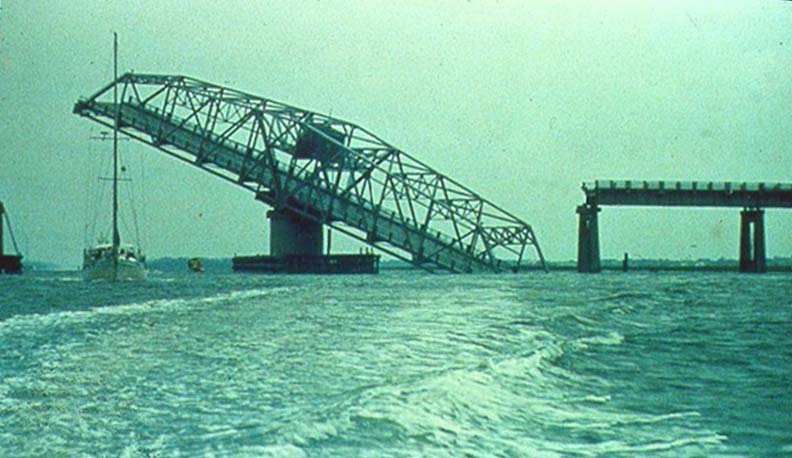
I’ve posted before about Henry Petroski’s first book, To Engineer Is Human, which I love. It’s the one that made crystal for a non-engineer like myself that building bridges and buildings is not only a matter of science but also of best guesses. All these years after that 1985 volume–and with many books in between–Petroski has published a sequel of sorts, To Forgive Design, which examines, among other things, how the lessons of the past are no match for climate change of today and tomorrow. FromCollapse and Crash,” by Bill McKibben, in the New York Review of Books:

“But what if, in fact, the old war stories are becoming obsolete? The engineer, like the insurance agent, is hampered by the fact that his skill depends on the earth behaving in the future as it has in the past. As Petroski writes,

Since it is future failure that is at issue, the only sure way to test our hypotheses about its nature and magnitude is to look backward at failures that have occurred historically. Indeed, we predict that the probability of occurrence for a certain event, such as a hundred-year storm, is such and such a percentage, because all other things being equal, that has been the actual experience contained in the historical meteorological record.

That record, however, is now shattered. In the course of Petroski’s lifetime, and all of ours, we’ve left behind the Holocene, the ten-thousand-year period of benign climatic stability that marked the rise of human civilization. We’ve raised the global temperature about a degree so far, but a better way of thinking about it is: we’ve amped up the amount of energy trapped in our narrow envelope of atmosphere, and hence every process that feeds off that energy is now accelerating. For instance, this piece of simple physics: warm air holds more water vapor than cold. Already we’ve increased moisture in the atmosphere by about 4 percent on average, thus increasing the danger both of drought, because heat is evaporating more surface water, and of flood, because evaporated water must eventually come down as rain. And those loaded dice are doing great damage. The federal government spent more money last year repairing the damage from extreme weather than it did on education.”

Tags: ,

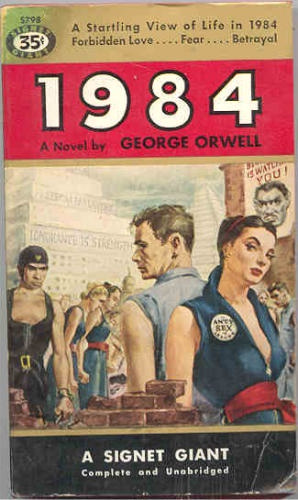
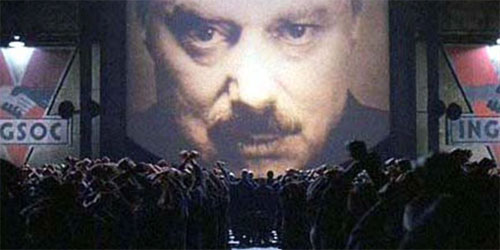
A lot of Americans seemed to not be aware until the Snowden leak case that the government is spying on us–and that we’re spying on the government. The realization caused the Amazon sales rank of George Orwell’s 1984 to surge. Of course, Amazon was collecting information about you with each order and if you purchased the Kindle version of the book about spying overlords, you were potentially setting up a trail of info that could incriminate you. The opening of Nick Harkaway’s article on the topic at Future Book:

I’m quoted in the Guardian’s piece on Joyland and filesharing today, and on the basis that if you’re here at all it’s because you’re prepared to let me flesh out some ideas, that’s what I’m going to do. In the words of George Cyril Wellbeloved: ‘I expect you’re wondering what I think about all this.’

‘All this,’ incidentally, is a new system which apparently alters the text of ebooks in order to trace whose copy has been copied without consent.

In the first place, I think the notion of a book which is reconfigured to provide a chain of evidence in a civil proceeding against the reader is repellant. I think that is in the most perfectly Teutonic sense an un-book. Books should not spy on you. I’m fascinated by Kobo’s remarkable ability to track readers’ progress through an ebook, and the commercial side of me really wants that information. But the civil liberties thinker in me hates that the facility exists and loathes the fact that people aren’t entirely clear on how much they’re telling the system about themselves. It really unsettles me. This is far worse: the deliberate creation of an engine of observation inside the text of the book. It stinks

Tags: ,

hemingway@realhemingway

Isn’t it pretty to think so? #sadendings


•••••

An excerpt from a New Yorker blog post, in which author Thomas Beller, who is not Madison Smart Bell, considers the intersection of Twitter and literature:

Though Twitter is not exactly a new writing technology, it is a technology that is affecting a lot of writers. It used to be a radical cri de coeur to claim, ‘We live in public.’ Like many mantras of the cyber-nineties, this turns out to be mostly true, but misses an even larger truth: more and more, we think in public. For writers, this is an especially strange development.

•••

I sometimes wonder how the great writers of the past would handle the Twitter predicament. Would they ignore it or engage and go down the rabbit hole? Who are the really unlikely tweeters from literary history? Would Henry James, whose baroque sentences could never have been slimmed down into a hundred and forty characters, have disdained Twitter?

Most great writers could, if they wanted to, be very good at Twitter, because it is a medium of words and also of form. Its built-in limitation corresponds to the sense of rhythm and proportion that writers apply to each line. But some writers achieve their effect through an accumulation, or make sense via sentences that are, by themselves, on the far edge of making sense. (Robert Musil comes to mind.) Not everyone is primed to be a modern-day Heraclitus, like Alain de Botton, who starts each day, it seems, by cranking up his inner fortune-cookie machine and producing a string of tweets that are, to varying degrees, sour, funny, fatalistic, and bitingly true. It’s a comedian’s form. The primal tweet may be, ‘Take my wife, please!’

Gertrude Stein, with her gnomish, arty, aphoristic tendencies, would seem to be ideal. ‘There is no there there’ may be one of the great proto-tweets.

Joyce Carol Oates, whom I don’t think of as famously concise but who has become a prolific and often ingenious tweeter, recently tweeted a question: ‘If an action is not recorded on a smart phone, does it, did it, exist?’

Oates’s question touches on a set of major problems for writers on Twitter: Does a piece of writing that is never seen by anyone other than its author even exist? Does a thought need to be shared to exist? What happens to the stray thought that drifts into view, is pondered, and then drifts away? Perhaps you jot it down in a note before it vanishes, so that you can mull it over in the future. It’s like a seed that, when you return to it, may have grown into something visible. Or perhaps you put it in a tweet, making the note public. But does the fact that it is public diminish the chances that it will grow into something sturdy and lasting? Does articulating a thought in public freeze it in place somehow, making it not part of a thought process but rather a tiny little finished sculpture? Is tweeting the same as publishing?”

Tags:

Ralph Graves, the final editor of the weekly Life magazine which ceased publishing in 1972, just passed away. If he only had a several-year run at the top, Graves picked the right time, a raucous era for jaw-dropping news. He presided over everything from the highs of Norman Mailer’s mammoth multi-part moon landing article to the lows of nearly publishing excerpts from Clifford Irving’s Howard Hughes hoax book. From his New York Times obituary:

But by the late 1960s general-interest magazines, squeezed by television on the one hand and specialty publications on the other, were an endangered species. Life’s circulation was 8.5 million when Mr. Graves took over; a year and a half later it was 5.5 million, despite a strong run of journalism.

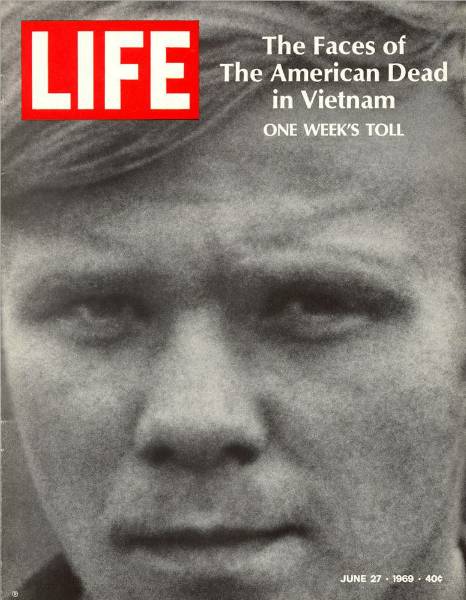
Within weeks of becoming managing editor, Mr. Graves supervised a controversial issue whose cover article, under the headline ‘The Faces of the American Dead in Vietnam: One Week’s Toll,’ showed photographs of more than 200 American soldiers killed in the Vietnam War from May 28 through June 3.

The article was especially startling appearing in Life, which had a history of supporting the war, and it drew a passionate reaction, both from those who found that it exploited the country’s grief and from those who found it courageous and moving. As a journalistic device, it has since been used by many publications, including the New York Times.

That same year, 1969, Life covered Woodstock, the moon landing (with a more than 20,000-word article by Norman Mailer) and the unlikely success of the Mets. The next year, Life published unauthorized reminiscences by the former Soviet premier Nikita S. Khrushchev that the Soviet government newspaper said were fraudulent. Experts on Khrushchev consulted by the magazine declared the manuscript legitimate.

In 1971, Mr. Graves and Life were victims of a genuine fraud after Clifford Irving, a relatively unknown writer, with the aid of a researcher, created a phony memoir of the reclusive industrialist Howard Hughes and sold it to McGraw-Hill. Life bought serial rights and was set to publish three 10,000-word installments when the hoax came to light. In 1972, Life published an account by Mr. Graves of the whole embarrassing affair.

‘I was an active participant in everything that happened,’ he wrote in a 2010 memoir, The LIFE I Led. ‘I spent substantial time with Clifford Irving himself, some of it at crucial moments.'”

Tags:

I’m sure that feeding books into computers instead of reading them can tell us something about literature–and ourselves–but there are limits to quantitative methods when it comes to poetry. The opening of “Big Data Meets the Bard,” an article about “distant reading” by John Sunyer in the Financial Times:

“Here’s some advice for bibliophiles with teetering piles of books and not enough hours in the day: don’t read them. Instead, feed the books into a computer program and make graphs, maps and charts: it is the best way to get to grips with the vastness of literature. That, at least, is the recommendation of Franco Moretti, a 63-year-old professor of English at Stanford University and unofficial leader of a band of academics bringing a science-fiction thrill to the science of fiction.

For centuries, the basic task of literary scholarship has been close reading of texts. But for digitally savvy academics such as Moretti, literary study doesn’t always require scholars actually to read books. This new approach to literature depends on computers to crunch ‘big data,’ or stores of massive amounts of information, to produce new insights.

Who, for example, would have guessed that, according to a 2011 Harvard study of four per cent (that is, five million) of all the books printed in English, less than half the number of words used are included in dictionaries, the rest being ‘lexical dark matter’? Or that, as a recent study using the same database carried out by the universities of Bristol, Sheffield and Durham reveals, ‘American English has become decidedly more ‘emotional’ than British English in the last half-century’?

Not everyone is convinced by this approach.”

Tags: ,

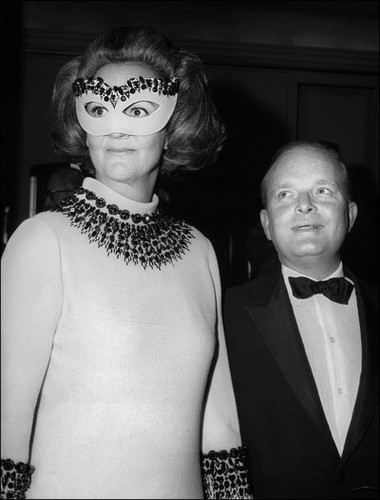
Part of an 1969 interview David Frost conducted with Truman Capote, who was already four years into a long decline, having published his masterpiece, In Cold Blood, in 1965, after a long struggle, with cycles of celebrity, scandal, addiction and rehab awaiting him. When I was a small child, I was taking a bus trip with my parents from the Port Authority, and we saw Capote seated on the benches, wearing a big straw hat, wasted out of his mind. He was trying to get a homeless woman to talk to him. She had no interest.

Tags: ,

Two of the more perplexing entities in existence, Vice magazine and Sen. Rand Paul, met for a brief interview. The reporter, Grace Wyler, did a good job. An excerpt:

Vice:

What do you think about the Obama administration’s decision to support the FBI’s push to make it easier to spy on the Internet?

Sen. Rand Paul:

My reaction is mostly disappointment. The one area where I liked President Obama was that I thought he would defend civil liberties. It turns out that he might care less for civil liberties than George Bush, and I think that’s disappointing.

It must be truly disappointing for those who truly are progressive on the left who believe in civil liberties, and it’s disappointing to those of us on the right who didn’t support him but thought, ‘Gosh, well, at least maybe he’ll support civil liberties.’

Vice:

It all seems kind of dystopian. Speaking of which, I hear you want to teach a class on the dystopian novel?

Sen. Rand Paul:

I’ve talked about it, but unfortunately I keep developing other projects that get in the way. I would like to do it someday. I think dystopian novels are a discussion of politics, and sort of what happens if you let a government accumulate too much power.

As I said in my filibuster, this presidential, or king, complex that both Republicans and Democrats get where they think, ‘Well, the power is not so bad, because I’m a good person and I won’t abuse that power.’ President Obama has said that with indefinite detention, he’s said ‘Oh, well I don’t intend to use that power.’ That’s not good enough, it’s like when Madison said: ‘If government were comprised of angels, we wouldn’t have to worry about how much power to give the government.’

The government is not comprised of angels. No one can be trusted. I think it was either Madison or Jefferson who said to always worry about any power you give to your government, because there should always be a certain level of distrust for anyone who seeks power. “

Tags: ,

I was recently gifted with a copy of the latest issue of the excellent Fashion Projects, which is edited by the beautiful (and pregnant) Francesca Granata. The presumed father of the child, Jay Ruttenberg, editor of the Lowbrow Reader Reader and a favorite of hoboes everywhere, is a contributor.

This issue focuses exclusively on fashion criticism and has interviews with Guy Trebay, Suzy Menkes, Judith Thurman and others. You can sample and purchase it hereAn excerpt from Granata’s conversation with New Yorker writer Thurman:

Fashion Projects: 

I was wondering how you came to your current post writing about fashion at the New Yorker?

Judith Thurman: 

It was sort of happenstance. I followed fashion, but not professionally. I had worked at The New Yorker before I left to write the biography of Colette. David Remnick, who had just taken up the editorship of the magazine in 1999 said, ‘Why don’t you come back and work for us? I know you can write about books and art, but what else can you do? Is there something else you really want to do?’ To which I replied ‘Actually I would love to write about fashion. I think I would always be an outsider; I am not going to write about it as an insider, like my great friend Holly Brubach a wonderful fashion critic who covered the collections. I said I don’t want to do that and you don’t want me to do it.’  He said, ‘You are right.’ So that’s how I started.

Fashion Projects:

So you started writing about fashion, somewhat recently, in the last decade or so. What drew you to the subject?

Judith Thurman:

I see it as an important element of culture and itself a culture. That really interests me. It is a form of expression, a kind of language dealing with identities. And the aesthetic of it also drew me to it. I love clothes and couture and its history is very interesting to me. For instance, I have always gone to museums and studied the clothing in the paintings. However, I don’t particularly like the fashion world and I try not to write about the business side of it.

Fashion Projects:

So you see yourself more as a cultural critic writing about fashion as opposed to a more traditional fashion critic covering the collections?

Judith Thurman:

Yes, although I have written about the collections. I used to go once a year to do one collection, whether it was menswear or couture or Paris or New York. I kind of stopped doing that. They were very hard pieces to write, since I wasn’t actually critiquing the clothes, I was trying to find some sort of zeitgeist that was coming out of the collections.”•

Jay Ruttenberg: Stole wardrobe from scarecrow.

Jay Ruttenberg: Dresses like scarecrow.

I find that insulting.

Edgar Allan Crow: “I resent that comparison.”

Tags: , ,

Julian Assange makes a raft of good points in his New York Times Op-Ed piece about the globalizing effect of the Googleplex and its arrogant brand of technocracy. But because he’s the kind of exasperating person who sees the world only in extremes, Assange goes too far in painting the company as unmitigated autocratic evil. If you think we’re going to become the United States of Google, let’s recall that Microsoft was not too long similarly feared, and even without government intervention, it would have collapsed beneath its own weight because that’s usually what corporate behemoths do. And Google is nowhere near the tool of American governmental policy that Bell Labs was. You remember Bell Labs, right? It used to be a thing. An excerpt from Assange’s article, which is inspired by the book, The New Digital Age:

“The writing is on the wall, but the authors cannot see it. They borrow from William Dobson the idea that the media, in an autocracy, ‘allows for an opposition press as long as regime opponents understand where the unspoken limits are.’ But these trends are beginning to emerge in the United States. No one doubts the chilling effects of the investigations into The Associated Press and Fox’s James Rosen. But there has been little analysis of Google’s role in complying with the Rosen subpoena. I have personal experience of these trends.

The Department of Justice admitted in March that it was in its third year of a continuing criminal investigation of WikiLeaks. Court testimony states that its targets include ‘the founders, owners, or managers of WikiLeaks.’ One alleged source, Bradley Manning, faces a 12-week trial beginning tomorrow, with 24 prosecution witnesses expected to testify in secret.

This book is a balefully seminal work in which neither author has the language to see, much less to express, the titanic centralizing evil they are constructing. ‘What Lockheed Martin was to the 20th century,’ they tell us, ‘technology and cybersecurity companies will be to the 21st.’ Without even understanding how, they have updated and seamlessly implemented George Orwell’s prophecy. If you want a vision of the future, imagine Washington-backed Google Glasses strapped onto vacant human faces — forever. Zealots of the cult of consumer technology will find little to inspire them here, not that they ever seem to need it. But this is essential reading for anyone caught up in the struggle for the future, in view of one simple imperative: Know your enemy.

Tags:

David Cornwell, a.k.a. John le Carré, appears in 1964 on To Tell the Truth, newly a white-hot writer thanks to The Spy Who Came in From the Cold. Begins at the 8:30 mark.

Tags: ,

« Older entries § Newer entries »